Paragraph Writing for Class 3 with Hints and Examples
Turn short hints into a clear Class 3 paragraph with a five-step method, six worked examples, practical correction tips, and a free printable worksheet.
Free printable worksheet
Free Class 3 paragraph-writing worksheet
The printable below asks the child to turn five rainy-day hints into a five-part plan and then write a complete paragraph. Let the child attempt the plan before showing the worked example above.
- Free PDF download
- Ready to print
Free to print and use at home or in class. How to use this worksheet
A Class 3 paragraph is a group of sentences about one main idea. When hints are provided, the child uses each hint as an idea, turns it into a complete sentence, and arranges the sentences in a sensible order. A useful practice target is five to seven sentences: a topic sentence, three to five detail sentences, and an ending sentence.
How to write a paragraph from hints in five steps
Use the same five steps until the child can follow them without help.
- Find the one main idea. If the topic is “A Rainy Day,” every sentence should tell the reader something about that rainy day.
- Put the hints in an order. Time order often works well: what the child saw first, what happened next, and how the experience ended.
- Say each sentence aloud. A hint such as “dark clouds” can become “Dark clouds covered the sky.” Speaking first helps a child hear whether the sentence is complete.
- Add an opening and an ending. The topic sentence names the main idea. The ending sentence gives a final thought or feeling.
- Read and check. Look for capital letters, full stops, repeated words, missing details, and any sentence that wanders away from the topic.
The NCERT learning outcomes for the elementary stage include drafting, revising, and writing short paragraphs from verbal, print, and visual clues. The IES elementary writing practice guide also recommends explicitly teaching planning, drafting, revising, and editing strategies. In practice, this means the hint list should help the child plan, not replace the child's thinking.
Worked example: A Rainy Day
Topic: A Rainy Day
Hints: dark clouds, cool wind, bright umbrella, puddles, hot snack
| Paragraph part | Plan |
|---|---|
| Topic sentence | Rain changed an ordinary afternoon into something exciting. |
| Detail 1 | Dark clouds covered the sky and a cool wind began to blow. |
| Detail 2 | I carried my bright umbrella and watched raindrops splash into puddles. |
| Detail 3 | After the rain, I came home and ate a hot snack. |
| Ending sentence | The rainy afternoon felt fresh, cosy, and memorable. |
Sample paragraph
Rain changed an ordinary afternoon into something exciting. Dark clouds covered the sky, and a cool wind began to blow. I opened my bright umbrella before stepping outside. Raindrops bounced into the puddles along the road. After the rain, I came home and ate a hot snack. The rainy afternoon felt fresh, cosy, and memorable.
Notice what the answer does: it uses every hint, but it does not simply join the hint words with commas. Each hint becomes a complete thought. The first and last sentences hold the paragraph together.
Six paragraph-writing topics for Class 3 with hints and answers
The sample answers below are models. A child's own wording can be different and still be correct.
1. My School Bag
Hints: blue bag, three pockets, books, lunch box, keeps things organised
Sample answer: My blue school bag helps me carry everything I need. It has three pockets of different sizes. I keep my books and notebooks in the largest pocket. My lunch box fits safely in the front pocket. The smaller pocket holds pencils and an eraser. My school bag keeps my things neat and organised.
2. A Visit to the Park
Hints: early morning, green grass, swings, birds, fresh air
Sample answer: I visited the park early on Sunday morning. The grass looked green and fresh after watering. I played on the swings and walked along the path. Birds chirped in the trees above me. The cool air made the morning pleasant. I returned home feeling active and cheerful.
3. My Favourite Festival
Hints: festival name, decorations, special food, family, happy feeling
Sample answer: Diwali is my favourite festival. We decorate our home with lamps and colourful rangoli. My family prepares special food and shares sweets with our neighbours. In the evening, we spend time together and enjoy the bright decorations. I like the warmth and happiness that the festival brings.
4. The Mango Tree
Hints: tall tree, broad leaves, cool shade, raw and ripe mangoes, birds
Sample answer: A tall mango tree grows near my home. Its broad green leaves make a patch of cool shade. Small raw mangoes appear before the fruit becomes ripe and sweet. Birds often rest on its branches. The tree gives us fruit, shade, and a lively place to watch nature.
5. Helping at Home
Hints: tidy room, set the table, water plants, work together, proud
Sample answer: I help with a few jobs at home every day. I tidy my room and put my books back on the shelf. Before dinner, I set the table. I also water the plants when the soil feels dry. These small jobs are easier when everyone works together. I feel proud when I take care of my home.
6. Why Trees Are Important
Hints: clean air, shade, fruit, homes for animals, protect nature
Sample answer: Trees are important to people, animals, and the Earth. They help keep the air clean and give us shade on hot days. Some trees provide fruit and useful wood. Birds, insects, and other animals make their homes in trees. Planting and protecting trees helps nature stay healthy.
For a different writing skill that begins with an image rather than word clues, use this Class 3 picture composition practice. If the child is ready to explain a belief, move next to opinion paragraphs with reasons.
Free Class 3 paragraph-writing worksheet
The printable below asks the child to turn five rainy-day hints into a five-part plan and then write a complete paragraph. Let the child attempt the plan before showing the worked example above.
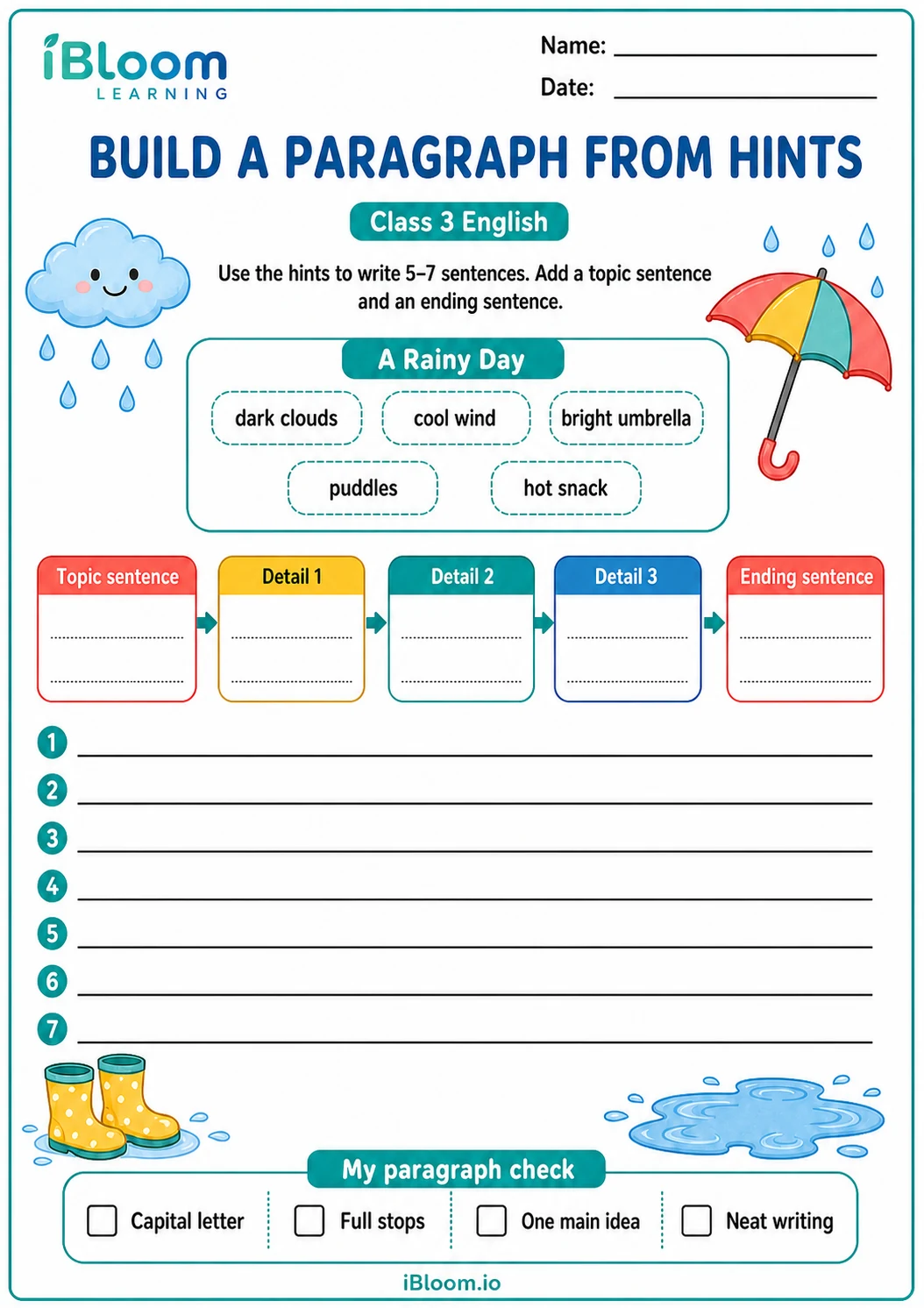
Download the free Class 3 paragraph worksheet PDF
You can also browse Class 3 paragraph practice worksheets or explore English worksheets by grade and skill.
How to use hints without encouraging copying
Hints should reduce the effort of finding ideas while leaving the sentence-making to the child.
Parents: Read the topic and ask the child to explain each hint orally. If a hint is “puddles,” ask, “What did the puddles look like?” or “What happened near the puddles?” Do not supply a polished sentence unless the child cannot begin. Offer a sentence starter instead: “Raindrops...”
Teachers: Model one hint on the board, think aloud while changing it into a sentence, and let the class try the remaining hints. Ask learners to compare two possible topic sentences. A model is most useful when students can see the decisions behind it.
The IES Grades 2–4 writing toolkit describes planning as generating and organising ideas before and during drafting. That is the right job for hints. They are a temporary scaffold that can become shorter as the learner gains confidence.
Common mistakes and exact fixes
| What appears in the paragraph | What to teach next |
|---|---|
| “Dark clouds. Cool wind.” | Turn each fragment into a complete sentence: “Dark clouds covered the sky.” |
| Every sentence begins with “I” | Combine observation and action: “Puddles formed beside the road, so I walked carefully.” |
| A sentence is unrelated to the topic | Ask, “Does this help the reader understand the rainy day?” Remove it if the answer is no. |
| The hints appear in a confusing order | Number the hints before writing and use time words only where they help. |
| The child copies the sample answer | Change the topic or one hint, then ask for a new sentence in the child's own words. |
| The paragraph has no ending | Ask for one final feeling, lesson, or summary sentence. |
| Capitals and full stops are missing | Edit after the ideas are written. Do not interrupt every sentence during the first draft. |
Once the ideas are clear, the Grade 3 paragraph revision checklist can guide a second reading.
A ten-minute paragraph routine
- Two minutes: Read the topic and discuss the hints.
- Two minutes: Put the hints in order and say one possible opening.
- Four minutes: Write the paragraph without stopping to correct every word.
- Two minutes: Read it aloud and check the opening, details, ending, capitals, and full stops.
Stop after one paragraph. Short, repeated practice is more useful than asking a child to copy several answers in one sitting.
Frequently Asked Questions
How many sentences should a Class 3 paragraph have?
Five to seven sentences is a practical target for guided practice, not a fixed rule. The paragraph needs enough sentences to introduce one idea, explain it with relevant details, and finish clearly.
What are good paragraph topics for Class 3?
Familiar topics work best at first: a rainy day, a school bag, a park visit, a festival, a helpful habit, a favourite food, or the importance of trees. The child should already know enough about the topic to supply details.
What is the difference between a hint and a sentence?
A hint is a word or short phrase that suggests an idea. A sentence expresses a complete thought. For example, the hint “cool wind” can become “A cool wind blew before the rain began.”
Should a child copy the sample paragraph?
Use the sample to study structure, then change the topic or hints. Copying may practise handwriting, but it does not show that the child can plan and express an original paragraph.
How can I help when the child cannot start?
Ask the child to say the first sentence instead of writing it. Offer two openings and let the child choose one, or provide a starter such as “My favourite...” Gradually remove the starter as beginning becomes easier.
Is picture composition the same as paragraph writing with hints?
They overlap, but the starting point differs. Picture composition begins with observing a scene and choosing details from it. Paragraph writing with hints begins with supplied words or phrases that the learner must organise and expand.