Addition Word Problems for 1st Grade
Common Core addition word problems for 1st grade with object models, ten-frames, examples, worksheets, and answer checks.

Overview
Parents and teachers searching for addition word problems for 1st grade usually want a practical page that gives examples, a short routine, and a next step for child practice. This guide keeps the task concrete: model one item, let the child try one item, and ask for one explanation before moving on.
Use iBloom practice with this guide: lesson support and worksheet practice).


Key Takeaways
- Addition Word Problems for 1st Grade works best when children practise a small set and explain one answer.
- The adult should model the first item, then reduce help quickly.
- A good session can be five to ten minutes when the task is focused.
- Children should point to the clue, object, sound, number, word, or safety rule that proves the answer.
- The best next step is one direct iBloom lesson or worksheet, not a long list of tabs.

What This Skill Means
Addition Word Problems for 1st Grade supports first grade learners moving from counting objects to writing addition equations. The important part is not only finishing a worksheet or reading a guide. The important part is helping the child notice what matters and say why the answer makes sense.
For grade 1 addition, children need clear language. Adults can say: first look, then think, then answer, then explain. This routine works for home review, classroom small groups, tutoring, homeschool, and short after-school practice.
A strong page should include a model, a child turn, a correction step, and a next activity. If the child guesses, return to the model. If the child is confident, ask the child to create a similar example.

Examples to Try
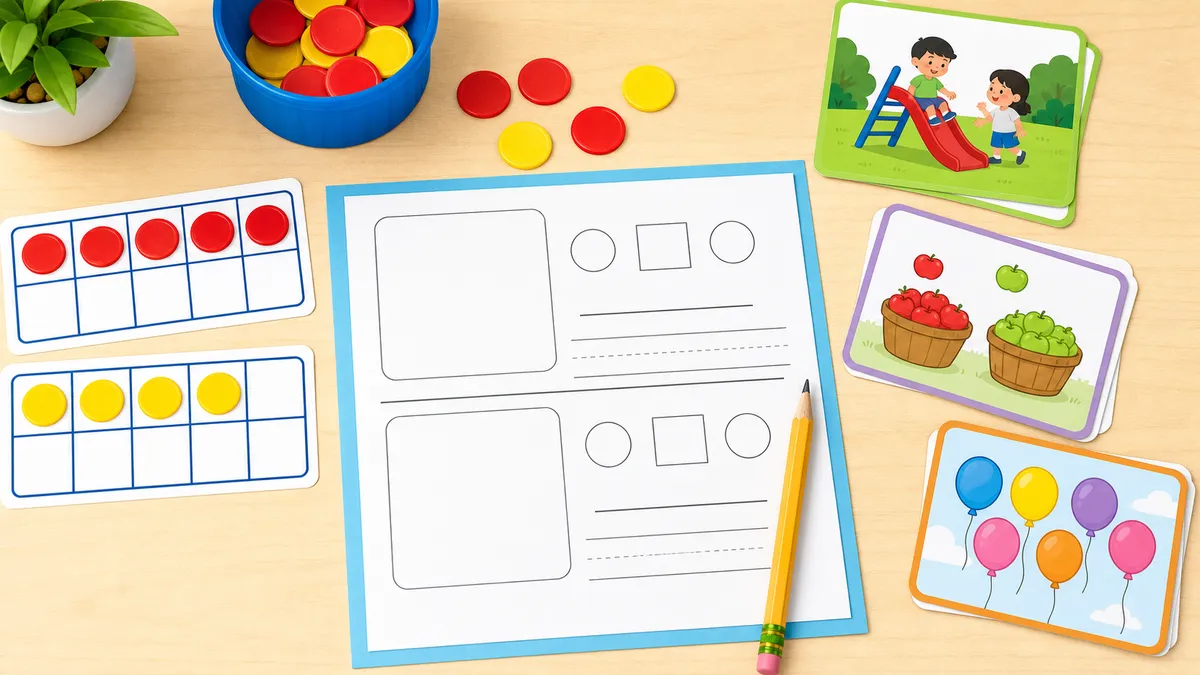
- Mia has 4 cubes and gets 3 more cubes. Children build both groups before writing 4 + 3 = 7.
- A ten-frame helps children see five plus two without counting every object again.
- Words like altogether and in all should match a joining action.
Turn each example into a short routine. Read or show the prompt. Ask the child what they notice. Let the child answer. Then ask, "How do you know?" That final question turns the page from completion into learning.

Parent Routine
Start with one calm practice block. Open the iBloom page, read the direction aloud, and complete the first item together. Do not correct every tiny mistake immediately. First ask the child to point to the part that helped.
Use this five-step routine:
- Name the skill in simple words.
- Complete one example together.
- Let the child try one example independently.
- Ask for one spoken explanation.
- End with one correction or one challenge question.
Parents can also use everyday objects. Counters, pencils, books, letter cards, picture cards, a timer, or a short story can make the skill easier to see. The goal is not a perfect packet. The goal is one accurate answer the child can explain.
Teacher Routine
Teachers can use this guide as a warm-up, small-group reteach, station activity, homework support page, or exit check. Keep the first task visible and short. Children learn faster when they know exactly what kind of answer they are trying to give.
A classroom flow can look like this:
- Model one item on the board or projector.
- Ask students to identify the clue, number, sound, or rule.
- Let students complete one item with a partner.
- Collect one explanation from the group.
- Send students to the related iBloom worksheet or lesson for independent practice.
For children who need support, reduce the number of items. For children who finish quickly, ask them to write a similar question and trade with a partner.

Common Mistakes
Children often rush because the page looks familiar. Slow the task down by asking one proof question. In reading, the proof may be a sentence clue. In math, it may be an object model, ten-frame, place-value trade, or equation. In spelling, it may be a sound pattern. In AI safety, it may be a privacy or originality rule.
Watch for these mistakes:
- Guessing from the picture without reading the prompt.
- Copying an answer without explaining it.
- Counting too fast and skipping an object.
- Choosing an operation before understanding the story.
- Using a tool or hint without checking whether the child still understands.
When a mistake appears, ask the child to redo only one part. A short correction is better than repeating the whole page while tired.
Regional Search Fit
For US search intent, this guide uses Kindergarten, 1st grade, 2nd grade, 3rd grade, Common Core, word problems, regrouping, free printable worksheets, classroom centers, homeschool, intervention, and answer-check language. It can support families and teachers in California, Texas, Florida, New York, Illinois, Pennsylvania, Ohio, Georgia, North Carolina, Michigan, Los Angeles, Houston, Chicago, Phoenix, Philadelphia, Dallas, Austin, Seattle, Boston, Denver, Atlanta, and Miami.
Location and curriculum words are included because parents search with those words. They should support the page, not distract from the learning task.
Related Blogs
Helpful External References
Keep Practicing With iBloom
Choose one related iBloom practice page. Ask the child to complete one item and explain it in a full sentence. If the child can explain the answer, continue. If not, return to the model and try a smaller example.
Frequently Asked Questions
Who should use this guide?
Use it for first grade learners moving from counting objects to writing addition equations. It is useful for parents, teachers, tutors, homeschool families, and children who need a focused practice routine.
How long should one session take?
Five to ten minutes is enough for most children. Short accurate practice is better than a long rushed worksheet session.
Should I print the worksheet or use it online?
Use whichever format helps the child focus. Printable practice is helpful for handwriting and circling. Interactive practice is helpful for quick review and repeated attempts.
What should I do if the child guesses?
Ask the child to point to the clue, object, number, sound, word, or rule that proves the answer. If the child cannot point to proof, model one example again.
What is the next best step?
Open one direct iBloom lesson or worksheet from Related iBloom Practice. Ask for one answer and one explanation before starting a larger set.