Context Clues Worksheets Grade 5 Practice
Context clues worksheets for Grade 5 help children use nearby words, sentence logic, and passage details to infer unfamiliar vocabulary.

Context clues worksheets for Grade 5 help children use nearby words, sentence logic, and passage details to infer unfamiliar vocabulary.
Start With the Matching Practice
Use this guide with a direct worksheet or lesson so the child moves from explanation into reading practice.
Table of Contents
Worksheet And Lesson Previews
Determine word meanings in historical texts Worksheets for Fifth Grade Preview
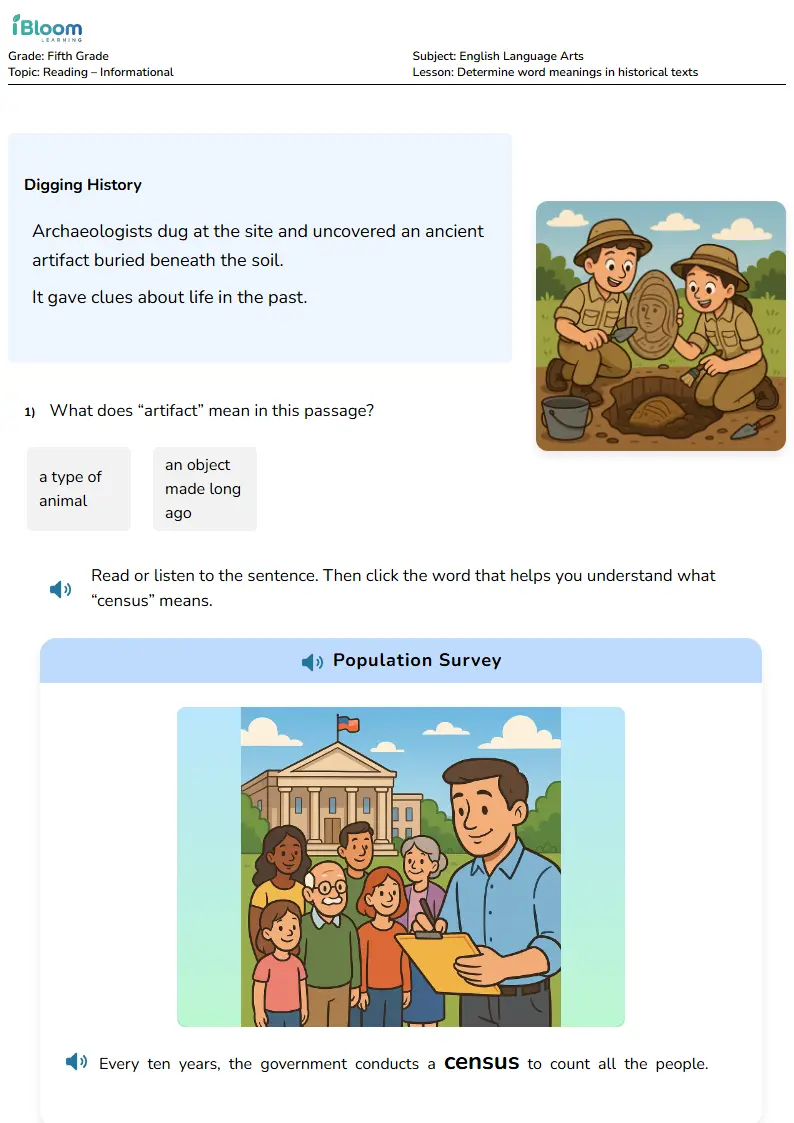
Use this preview to see the kind of practice children will open before you start the routine.
Scientific Vocabulary Meaning Worksheet Preview
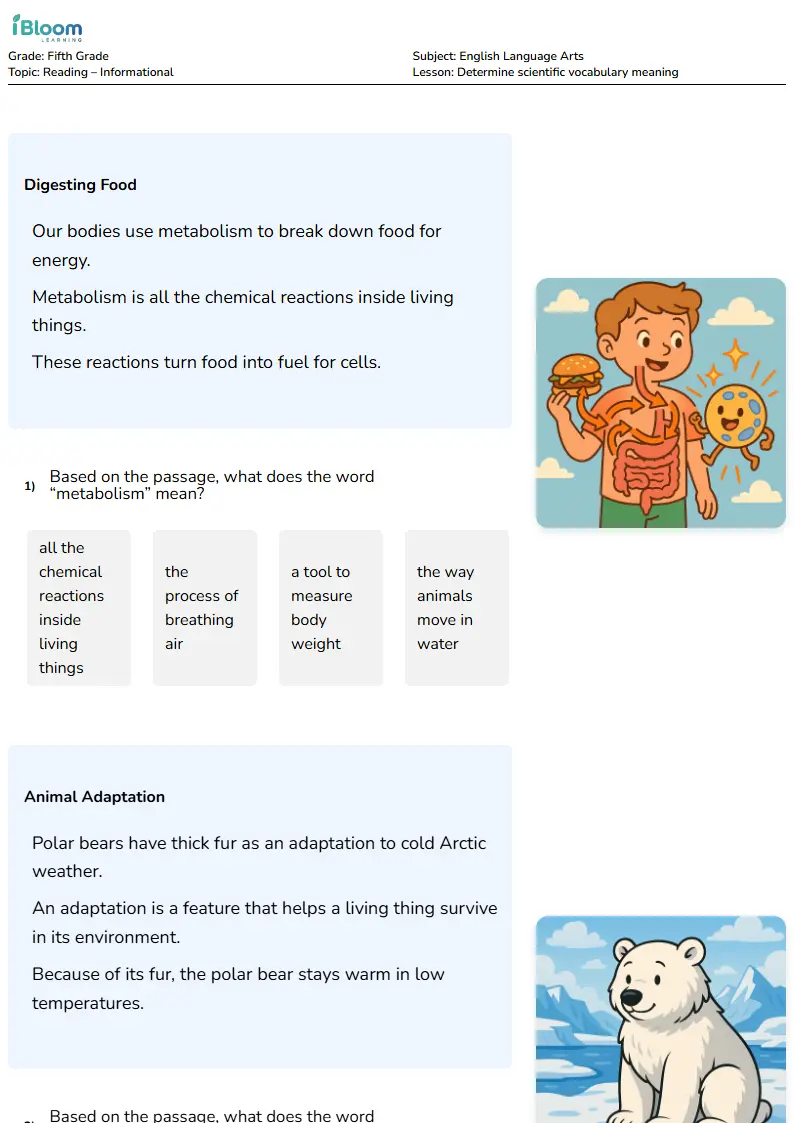
Use this preview to see the kind of practice children will open before you start the routine.
Context Clues Word Meaning Worksheet Preview
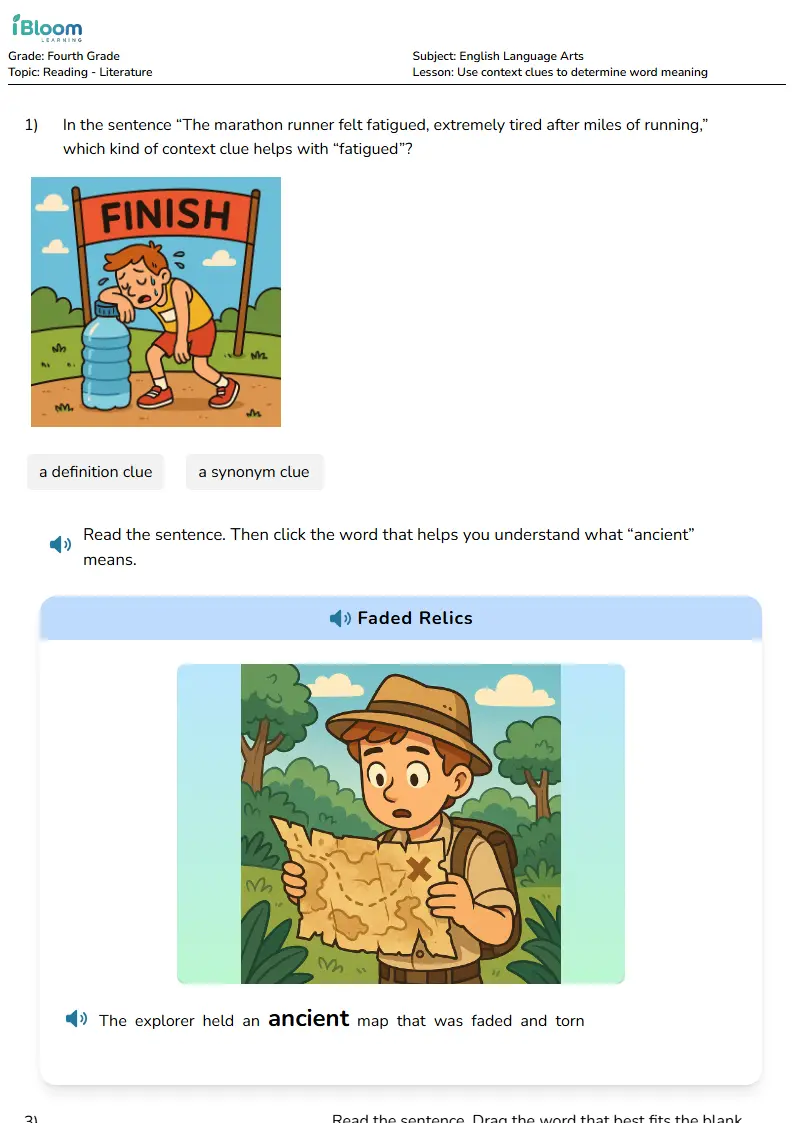
Use this preview to see the kind of practice children will open before you start the routine.
Key Takeaways
- context clues worksheets grade 5 should teach children to find evidence in the sentence or passage, not guess from one word.
- Strong practice includes definition clues, example clues, contrast clues, synonym clues, word-part clues, and rereading.
- Parents can ask one simple question: "Which words helped you know?"
- Teachers can use one passage for warm-up, small group, vocabulary center, and exit ticket work.
- The best next step is a matching iBloom worksheet or lesson where children practise the skill directly.
Why Context Clues Matter
upper-elementary readers need stronger evidence habits: definition clues, contrast clues, example clues, and subject-specific vocabulary clues. Context clues build vocabulary, reading comprehension, and independent problem solving. The child learns to pause at an unfamiliar word, reread the sentence, test a possible meaning, and explain the evidence.
The Reading Rockets vocabulary guide and Reading Rockets comprehension resources both support explicit vocabulary and comprehension instruction. The IES foundational reading practice guide is also useful adult background for planning evidence-based reading support.
Use this article with Context Clues for Kids, Context Clues Examples for Kids, and Context Clues Worksheets for Grade 3 when adults need a broader path. Then return to the exact worksheet or lesson above so the child can practise.
Step-by-Step Routine
- Read the full sentence or paragraph.
- Underline the unfamiliar word.
- Look before and after the word for clues.
- Decide whether the clue defines, explains, contrasts, or gives an example.
- Try a meaning in the sentence.
- Ask the child to explain which words helped.
This routine is short enough for home and classroom use. It works for a Grade 5 passage, a Class 4 vocabulary worksheet, a first-grade story, or a second-grade reading group because the thinking step stays the same.
Examples Children Can Try
- The desert was arid, with no rain for months. Which words explain arid?
- Mia was reluctant to speak, but after practice she finally raised her hand. What clue shows reluctant?
- The animal was nocturnal; it slept during the day and hunted at night. Which part gives the meaning?
- The room was chaotic, unlike the calm library. Which word gives a contrast clue?
- Choose one word from a reading passage and write a sentence clue for a classmate.
Parent Practice Plan
Parents can use context clues during ordinary reading. Stop at one unfamiliar word, reread the sentence, and ask, "What words around it help?" Do not turn every page into a quiz. One thoughtful word is enough.
In India, families may connect this routine to CBSE, ICSE, state-board, Class 1 through Class 5, Delhi, Mumbai, Bengaluru, Chennai, Hyderabad, Pune, Kolkata, Ahmedabad, Jaipur, Kerala, Tamil Nadu, Karnataka, Maharashtra, Telangana, Gujarat, Rajasthan, and West Bengal. In the US, families may connect it to Grade 1 through Grade 5 reading, vocabulary homework, homeschool, intervention, California, Texas, Florida, New York, Illinois, Pennsylvania, Ohio, Georgia, North Carolina, Michigan, Los Angeles, Houston, Chicago, Dallas, Seattle, Boston, Denver, Atlanta, and Miami. In the UAE, families may use it across Dubai, Abu Dhabi, Sharjah, Ajman, Al Ain, Ras Al Khaimah, Fujairah, Umm Al Quwain, British, American, IB, and Indian curriculum schools.
Teacher Practice Plan
Teachers can use context clues in short, repeatable routines:
- Warm-up: one sentence with one unfamiliar word.
- Small group: children underline clue words and explain the clue type.
- Vocabulary center: match clue cards to possible meanings.
- Exit ticket: write one sentence explaining which clue helped.
For children who need support, offer two possible meanings and ask which one fits the sentence. For children ready for more, ask them to write a new sentence with a clue for a partner.
India, US, and UAE Notes
Some schools say vocabulary in context, word meaning, unfamiliar words, inference, reading comprehension, or language skill. The label changes, but the task stays clear: read around the word, find evidence, test meaning, and explain.
Multilingual children may explain the sentence in a home language first if needed, then repeat the key English words: clue, meaning, sentence, paragraph, contrast, example, definition, synonym, antonym, prefix, suffix, and evidence.
Common Mistakes
- The child guesses from the first letter instead of reading the sentence.
- The child chooses a meaning that sounds familiar but does not fit the passage.
- The child finds a clue word but cannot explain how it helps.
- The adult gives the meaning too quickly.
- The worksheet is completed once and never revisited.
When this happens, return to one sentence and ask, "Which exact words helped?" One explained answer is stronger than a full page finished silently.
Keep Practicing on iBloom
Use this guide with a direct worksheet or lesson so the child moves from explanation into reading practice.
Frequently Asked Questions
What are context clues?
Context clues are words, phrases, sentences, or passage details that help a reader figure out the meaning of an unfamiliar word.
How long should children practise?
Five to fifteen minutes is enough. Choose one word, find the clue, test a meaning, and explain the evidence.
Should children use a dictionary first?
Use the sentence first when the goal is context clues. A dictionary can confirm the meaning after the child has tried using evidence.
What should parents ask?
Ask, "Which words helped you know?" This keeps the focus on evidence instead of guessing.
Which iBloom page should we use next?
Start with the worksheet linked at the top, then use the paired lesson or a related context clues blog when the child needs more examples.