Counting Objects Worksheets for Preschool and Kindergarten
Plan counting objects worksheets for early learners with one-to-one counting, small sets, number words, and parent routines.
Free printable worksheet
Free counting objects worksheet for preschool and kindergarten
This two-page printable has 12 counting questions for preschool and kindergarten: eight groups of up to 6 pictures, then four groups of 7 to 10 pictures set out in rows of five, each with three numbers to choose from. Page 2 is the answer key.
- Free PDF download
- Answer key included
- Ready to print
Free to print and use at home or in class. How to use this worksheet
Counting Objects Worksheets for Preschool and Kindergarten are most helpful when children do more than finish a page. They should touch, count, compare, say the math words aloud, and explain what they notice. This guide is for parents, teachers, tutors, and children who want early math worksheets that build confidence across home practice, classroom centers, and short daily routines. It connects build one-to-one counting, stable order, cardinality, and careful object matching, with iBloom support from Counting Numbers up to 5 worksheet, Identifying Numbers from 1 to 10 lesson, Less Objects Worksheets for Kindergarten, After, Before, and Between Numbers 1 to 20, and Pre-Kindergarten Math hub.
Free counting objects worksheet for preschool and kindergarten
This two-page printable has 12 counting questions for preschool and kindergarten: eight groups of up to 6 pictures, then four groups of 7 to 10 pictures set out in rows of five, each with three numbers to choose from. Page 2 is the answer key.
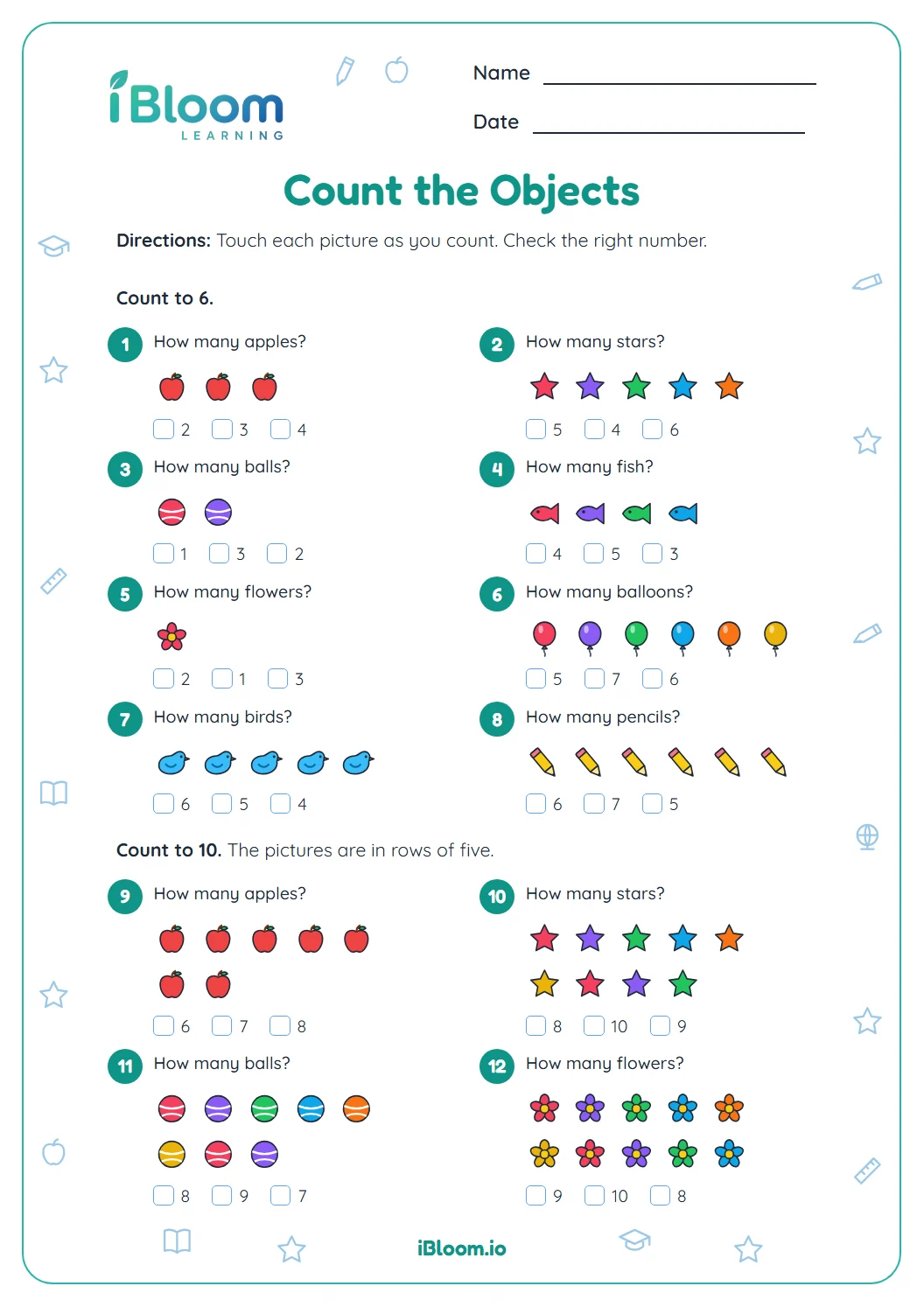
Download the free counting objects worksheet PDF
Answer key preview
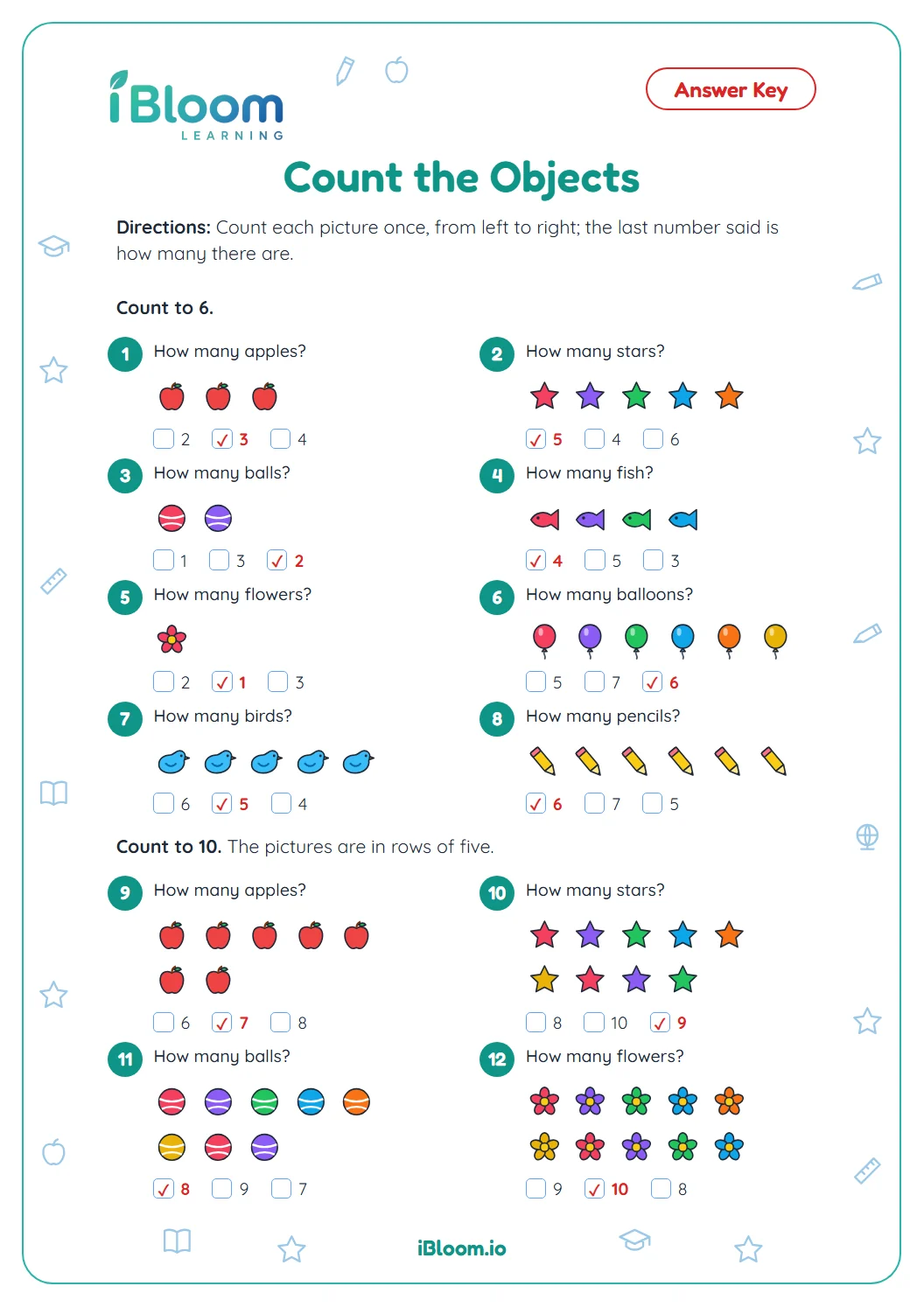
Let your child touch each picture as they say the number, then ask how many there are in all.
Start with the Matching Practice
Use this guide with a direct iBloom worksheet or lesson so children can move from reading the explanation into real practice.
Table of Contents
Worksheet And Lesson Previews
UKG Identifying Numbers 1 to 10 Lesson Preview
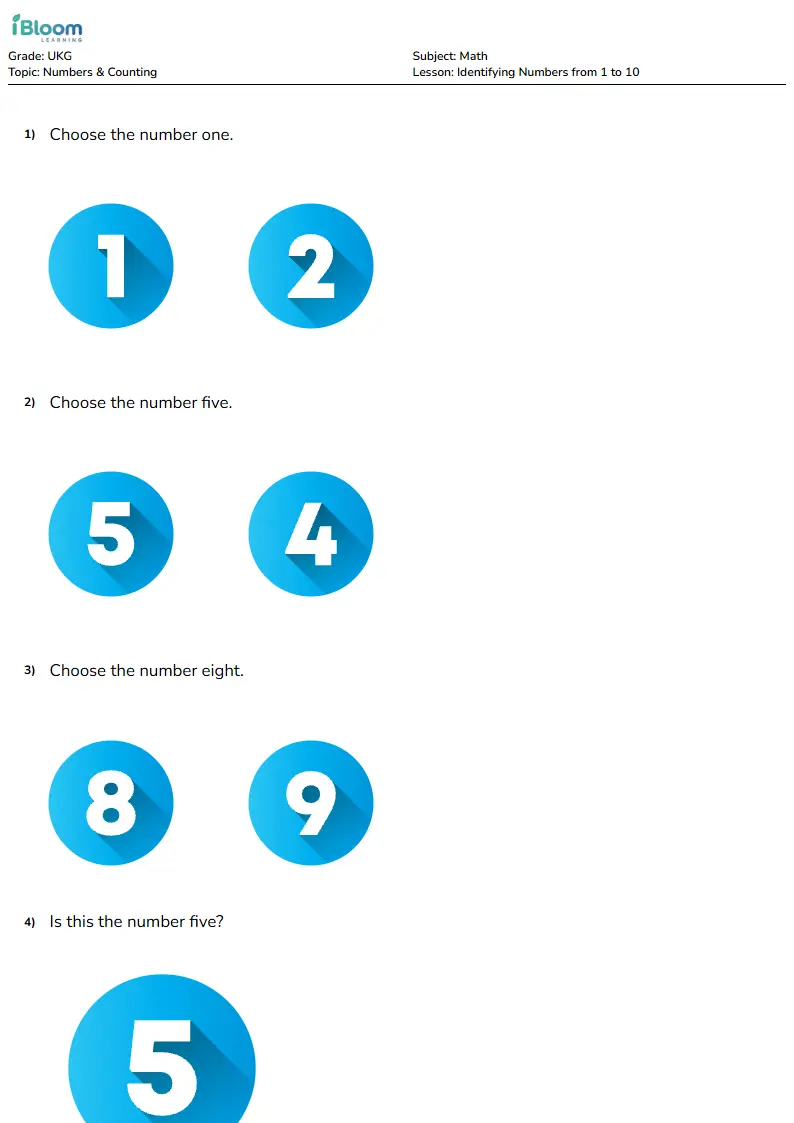
Use this preview to see the kind of practice children will open before you start the routine.
Key Takeaways
- Strong counting objects worksheets practice uses objects, pictures, number words, and explanation.
- Children need short, repeatable routines more than long worksheet packets.
- Parents can support early math with counting talk during snacks, toys, cleanup, and errands.
- Teachers can turn one worksheet into a center, small-group check, math talk prompt, or exit ticket.
- iBloom practice should connect the worksheet to related number, counting, comparison, and early math pages.
Why This Early Math Skill Matters
The What Works Clearinghouse practice guide for teaching math to young children recommends teaching number and operations through a developmental progression, building from what children already know, and integrating math throughout the day. That fits counting objects worksheets for preschool and kindergarten because children learn early math through repeated experiences: touching objects, matching amounts, comparing groups, hearing math words, and explaining answers.
The IES Teaching Math to Young Children Toolkit also emphasizes routines, games, classroom activities, and progress monitoring for preschool, prekindergarten, and kindergarten. Families can use the same idea at home without making practice complicated. A good worksheet routine sounds like this: touch each object once, count slowly, say the last number again, then match the quantity to a numeral. Then the adult asks, "How do you know?" That one question turns a worksheet from answer-getting into thinking.
Use Counting Numbers up to 5 worksheet as the closest iBloom practice page, then move to Identifying Numbers from 1 to 10 lesson when the child needs another concrete example. For broader support, connect this guide with Less Objects Worksheets for Kindergarten and After, Before, and Between Numbers 1 to 20.
A Simple Worksheet Routine
Start with a small set. Ask the child to look, touch, say, and explain. If the child rushes, slow the task down with a mat, counters, fingers, or a ten-frame. If the child hesitates, model one example and let the child repeat with a new item. The goal is not speed. The goal is accurate math language and confident reasoning.
- Name the skill in child-friendly words.
- Model one item with objects or fingers.
- Ask the child to do one item aloud.
- Ask the child how they know.
- Repeat with a small variation.
- Move to Pre-Kindergarten Math hub or Identifying Numbers from 1 to 10 lesson when the child is ready for another page.
Examples Children Can Try
For counting objects worksheets for preschool and kindergarten, one child might count five blocks, match the numeral 5, and say, "There are five because I touched each block once." Another child might compare two cups and say, "This cup is full and this one is empty." Another child might look at two groups and say, "This group has less because it has only three." These short explanations show whether the child understands the math, not just the answer.
Try a three-pass method. On the first pass, the child answers with objects. On the second pass, the child says the math sentence aloud. On the third pass, the child writes, circles, or chooses the answer. This is especially useful before children work independently on Counting Numbers up to 5 worksheet or Identifying Numbers from 1 to 10 lesson.
Parent Practice Plan
Parents can use counting objects worksheets for preschool and kindergarten in ten minutes. Start with a real object warm-up: snacks, blocks, spoons, bottle caps, toy cars, or crayons. Then complete three worksheet items. End with one everyday question such as, "Which plate has more?" or "Which cup is empty?" This gives the child a bridge between the worksheet and real life.
In India, the routine works for CBSE, ICSE, and state-board early math in Delhi, Mumbai, Bengaluru, Chennai, Hyderabad, Pune, Kolkata, Ahmedabad, Jaipur, Lucknow, Kerala, Tamil Nadu, Karnataka, Maharashtra, Telangana, Gujarat, Rajasthan, and West Bengal. In the United States, it fits kindergarten, preschool, homeschool, and intervention practice in California, Texas, Florida, New York, Illinois, Pennsylvania, Ohio, Georgia, North Carolina, Michigan, Los Angeles, Houston, Chicago, Phoenix, Philadelphia, Dallas, Austin, Seattle, Boston, Denver, Atlanta, and Miami. In the UAE, it supports Dubai, Abu Dhabi, Sharjah, Ajman, Ras Al Khaimah, Fujairah, Umm Al Quwain, and Al Ain families across British, American, IB, and Indian curriculum settings.
Teacher Practice Plan
Teachers can use counting objects worksheets for preschool and kindergarten as a five-minute mini-lesson, a math center, a small-group observation, or homework support. The strongest classroom routine is model, count, explain, switch examples, and check again. Ask children to use sentence frames such as "I counted..." "I know because..." "This group has more..." "This container is empty..." or "The number matches the objects."
For small groups, assign roles. One child builds the set, one child counts, one child chooses the numeral, and one child explains. Rotate roles every item. This keeps children active and gives the teacher quick information about who understands one-to-one counting, number words, comparison language, or capacity words.
Choosing The Right Worksheet
Choose a page with one main skill. If the child is learning number recognition, use small numbers and clear quantities before moving to larger sets. If the child is learning counting objects, avoid pages where the objects overlap or distract from one-to-one counting. If the child is learning full and empty, use real containers before abstract pictures.
NCTM's position on early childhood mathematics emphasizes meaningful, equitable math experiences rather than only rote counting and answer-getting. NAEYC examples of number games also show the value of playful counting, dot cards, fingers, and small-number composition. Those ideas pair naturally with iBloom pages because children can first play, then practise, then explain.
Common Mistakes
The first mistake is rushing to written answers before the child has handled or imagined the quantity. The second mistake is treating counting as a chant instead of a way to find how many. The third mistake is skipping math language; children need words such as more, fewer, full, empty, same, different, before, after, first, and last. The fourth mistake is correcting without asking the child to explain. A better prompt is, "Show me how you counted."
If the child struggles, reduce the set size. Use three objects instead of ten. Use two cups instead of a full worksheet row. Use fingers before written numerals. Then return to the page and let the child try again with confidence.
Regional Learning Notes
Early math expectations differ by school system, but young children need the same foundation everywhere: counting accurately, matching quantities, comparing groups, using math words, and explaining what they see. A child in Bengaluru might count lunchbox items, a child in Chicago might compare blocks at a center, and a child in Dubai might describe which bottle is full during a home routine. The skill stays the same.
Teachers in multilingual classrooms can let children discuss the idea orally first, then repeat the English math sentence. Parents can do the same at home. What matters is that the child connects the object, the word, the numeral, and the explanation.
How iBloom Fits
iBloom works well when the adult starts with one clear page, then links the child to a related next step. Begin with Counting Numbers up to 5 worksheet, use Identifying Numbers from 1 to 10 lesson for concrete counting, connect to Less Objects Worksheets for Kindergarten for a related article, and use Pre-Kindergarten Math hub when the child needs a broader math hub.
Frequently Asked Questions
What age are counting objects worksheets for preschool and kindergarten best for?
They work best for preschool, prekindergarten, UKG, LKG, kindergarten, and early Grade 1 learners when the adult chooses small, clear sets and asks the child to explain.
Should children count aloud or silently?
Count aloud first. Hearing the number words helps adults notice skipped numbers, double-counting, or uncertainty. Silent work can come later when the child is accurate.
How many questions should a child do in one session?
Three to eight thoughtful items are enough for many young children. A short session with explanation is better than a long page done quickly.
What should adults do when a child guesses?
Return to objects. Ask the child to touch each object once, match the numeral, or compare the two groups again. Then ask, "How do you know?"
How can teachers extend the worksheet?
Turn one item into a partner talk prompt, a counting mat, a ten-frame activity, a container comparison, or a quick drawing. Then send children back to iBloom for related practice.
Practice This Skill Next
After reading this guide, children can practise the same skill on iBloom. Start with Counting Numbers up to 5 worksheet or Identifying Numbers from 1 to 10 lesson, then ask the child to explain one answer before moving on.