Crossword Puzzles for Teachers
A classroom guide to crossword puzzles for teachers, with vocabulary routines, clue-writing strategies, grade-level ideas, assessment tips, and iBloom links.

- Why crossword puzzles work in classrooms
- What teachers should teach before the puzzle
- A 20-minute classroom crossword routine
- How to choose vocabulary words
- Clue-writing strategies for teachers
- Grade-by-grade crossword ideas
- Crosswords for English learners and mixed-ability groups
- How to connect crosswords with iBloom practice
- Assessment checklist
- Frequently Asked Questions
- Conclusion
Start with the Matching Practice
Use this guide with a direct iBloom worksheet or lesson so children can move from reading the explanation into real practice.
Why Crossword Puzzles Work in Classrooms
Crossword puzzles for teachers are useful because they make students retrieve words, read clues carefully, check spelling, and connect meaning with context. A student cannot finish a strong vocabulary crossword by memorizing a list for five minutes. The child has to ask: What does the clue mean? Which word fits the meaning? Which spelling fits the boxes? Does the crossing letter confirm or challenge my answer?
That makes crosswords especially valuable for vocabulary review. They create a low-pressure reason to revisit words after direct instruction. They can also help teachers notice which students know the definition, which students recognize the word but cannot spell it, and which students need the word used in a sentence.
This post is part of iBloom's crossword and vocabulary cluster. Start with this teacher guide when you want classroom routines. Use Crossword Puzzles for Vocabulary Practice when you need parent and teacher practice ideas. Use Crossword Puzzle Tips for Parents and Teachers for a broader overview. Then connect students to iBloom English worksheets, context clue lessons, and SpellBee for follow-up practice.
Research on vocabulary supports this approach. Reading Rockets explains that vocabulary grows through both direct instruction and indirect exposure to words in rich contexts. Its guide to teaching vocabulary is a useful reference for teachers designing word-learning routines. The What Works Clearinghouse practice guide on teaching academic content and literacy to English learners also emphasizes explicit academic-language work, which crosswords can support when teachers use them thoughtfully.
What Teachers Should Teach Before the Puzzle
Do not hand out a crossword before students understand the target words. A crossword is a practice tool, not the first explanation. The strongest routine has three steps before the puzzle begins.
1. Teach the words in context
Select vocabulary from a story, informational passage, science unit, social studies topic, spelling list, or writing mini-lesson. Students should see each word in a meaningful sentence before they meet it in the crossword.
For example, if the reading passage is about weather, the crossword might include words such as forecast, humid, temperature, thunder, climate, and shelter. If the class is reading a story, the crossword might include character-trait words such as curious, nervous, generous, stubborn, and relieved.
2. Discuss student-friendly meanings
Definitions should be clear and usable. Instead of giving only dictionary-style definitions, ask students to say the meaning in their own words. If the word is "relieved," a student-friendly explanation might be: "You feel relieved when a worry goes away."
3. Practice one example clue
Before students begin, solve one clue together. Show how to read the clue, predict the answer, check the number of boxes, and use crossing letters. This prevents the puzzle from turning into guessing.
A 20-Minute Classroom Crossword Routine
Teachers often avoid crossword puzzles because they imagine them as time fillers. The better version is a short, structured lesson.
| Time | Teacher action | Student action |
|---|---|---|
| 0-3 minutes | Preview 5 to 8 target words. | Say the word, meaning, and one example. |
| 3-5 minutes | Model one clue. | Explain why the answer fits. |
| 5-13 minutes | Circulate and ask questions. | Complete the puzzle independently or with a partner. |
| 13-17 minutes | Review tricky clues. | Correct answers and explain word meanings. |
| 17-20 minutes | Add a writing extension. | Use 2 target words in original sentences. |
This routine works because it keeps the crossword connected to instruction. The puzzle becomes one part of a cycle: teach, retrieve, discuss, write, and reuse.
Teacher prompts during the puzzle
Use questions that make students explain instead of guess:
- Which word from our list fits this meaning?
- What part of the clue helped you?
- Which crossing letter confirms your answer?
- Can you use the word in a sentence?
- Does the clue ask for a noun, verb, adjective, or adverb?
- What word part helps you understand the meaning?
How to Choose Vocabulary Words
The best classroom crossword words are useful, teachable, and connected to current learning. A crossword with random words may be fun, but it will not build a strong vocabulary pathway.
Choose words from the lesson
Use words students need for comprehension. Reading Rockets' vocabulary instructional guidelines recommends context, repeated use, and active student engagement. Crossword clues can reinforce those conditions when the words come from real reading and discussion.
Mix easier and harder words
A puzzle should include several quick wins and several stretch words. If every clue is hard, students shut down. If every clue is easy, the puzzle becomes busywork.
Include academic words
Crosswords are useful for academic verbs and adjectives: compare, contrast, explain, predict, summarize, describe, evidence, accurate, similar, different, and specific. These words appear across subjects, so students benefit from repeated practice.
Use spelling patterns
Teachers can also choose words by spelling pattern: long vowels, prefixes, suffixes, compound words, silent letters, or Greek and Latin roots. This connects crossword work to Spelling Bee Practice Schedule for Kids, Spelling Bee Words by Grade Level, and Spelling Bee Rules for Kids.
Clue-Writing Strategies for Teachers
A good clue teaches. It should not be so vague that students guess, and it should not be so obvious that they stop thinking.
Definition clue
Use when students are learning the basic meaning.
Example: A word that means "to tell what something is like." Answer: describe.
Sentence clue
Use when the word needs context.
Example: The student felt ___ when the missing notebook was found. Answer: relieved.
Category clue
Use when words are grouped by topic.
Example: A tool used to measure temperature. Answer: thermometer.
Opposite clue
Use for adjectives and verbs.
Example: The opposite of ancient. Answer: modern.
Word-part clue
Use for prefixes, suffixes, and roots.
Example: The prefix in "preview" means this. Answer: pre.
Student-created clue
After completing a teacher-made puzzle, students create one clue for a partner. This is a strong assessment because a child must understand the word well enough to describe it without giving it away.
Grade-by-Grade Crossword Ideas
Grade 1
Keep puzzles small. Use picture-supported clues, CVC words, sight words, feelings words, school words, and simple nouns. Students should read the word aloud after writing it.
Connect Grade 1 vocabulary crosswords with Building Sentences with Nouns and Verbs and Pictures Help Us Read.
Grade 2
Use spelling patterns, compound words, synonyms, antonyms, and story vocabulary. Ask students to explain how one crossing letter helped them confirm an answer.
Grade 3
Add context clues, prefixes, suffixes, and content-area words. Students can build crosswords from science, social studies, math, and reading vocabulary. Pair this with Use Context Clues to Determine Word Meaning.
Grade 4
Use figurative language, multiple-meaning words, academic vocabulary, and text-evidence words. Pair with Identify and Analyze Key Details and grade-level ELA review.
Grade 5
Use roots, affixes, precise academic verbs, genre terms, and subject-specific vocabulary. Students can write clue sets for classmates and defend why each clue is fair.
Crosswords for English Learners and Mixed-Ability Groups
Crossword puzzles can help English learners when teachers provide enough language support. They can also frustrate students if the clues depend on cultural references or obscure wordplay.
Use these supports:
- Pre-teach each target word with a picture, sentence, and student-friendly meaning.
- Let students discuss clues with a partner before writing.
- Include a word bank for early or mixed-ability groups.
- Avoid clue wording that is more difficult than the answer.
- Allow students to draw a clue or act out a word before solving.
- Review pronunciation after the puzzle so written vocabulary becomes oral vocabulary.
The What Works Clearinghouse guide for English learners supports explicit vocabulary and academic-language routines. Crosswords fit best after explicit teaching, when students need retrieval, partner talk, and repeated exposure.
How to Connect Crosswords with iBloom Practice
Crosswords are strongest when they point students into more practice. Use this internal map:
| Classroom need | iBloom next step |
|---|---|
| Vocabulary review | Crossword Puzzles for Vocabulary Practice |
| Parent and teacher tips | Crossword Puzzle Tips for Parents and Teachers |
| Spelling and word study | iBloom SpellBee |
| Word lists | Spelling Bee Words by Grade Level |
| Reading evidence | Identify and Analyze Key Details |
| Context clues | Use Context Clues to Determine Word Meaning |
| Early reading | Pictures Help Us Read |
| Broad ELA practice | iBloom English worksheets |
This internal linking matters for users and SEO. A teacher searching for crossword puzzle tips should not land on an isolated article. The teacher should find a path into vocabulary practice, spelling practice, reading comprehension, grade-level worksheets, and classroom-ready routines.
Assessment Checklist
Use this checklist after a crossword lesson.
| Skill | What to look for |
|---|---|
| Meaning | Student can explain the word in their own words. |
| Context | Student can use the word in a sentence. |
| Spelling | Student spells the word correctly in the grid and in writing. |
| Clue reading | Student can explain which part of the clue helped. |
| Transfer | Student can recognize the word in a new passage. |
| Collaboration | Student can discuss a clue respectfully with a partner. |
If students finish the puzzle but cannot explain the words, the activity was too shallow. Add oral review, sentence writing, and word sorting. If students understand the words but cannot spell them, add spelling practice through SpellBee or a short dictation routine. If students can spell and define the word but cannot use it in reading, add context-clue practice.
Frequently Asked Questions
Are crossword puzzles good for classroom vocabulary practice?
Yes, when they are connected to explicit teaching. Crossword puzzles help students retrieve meanings, check spelling, read clues, and discuss words. They should follow vocabulary instruction, not replace it.
What words should teachers put in a classroom crossword?
Use words from current reading, science, social studies, spelling, writing, or academic-language lessons. Include a mix of easy review words and harder target words.
Should teachers include a word bank?
For younger students, English learners, and mixed-ability groups, a word bank is useful. As students become more confident, remove the word bank or use a smaller one.
How long should a classroom crossword take?
A focused classroom crossword can take 15 to 20 minutes, including preview, solving, discussion, and a short writing extension. Longer puzzles should be split across centers or homework.
How do crosswords support reading comprehension?
Students must connect clues to word meaning. When the words come from a passage or topic, the puzzle reinforces vocabulary needed for comprehension.
What iBloom resources pair well with crossword puzzles?
Use Crossword Puzzles for Vocabulary Practice, iBloom English worksheets, SpellBee, and reading lessons such as context clues.
Conclusion
Crossword puzzles for teachers can be much more than a Friday worksheet. Used well, they become a compact vocabulary lesson: students retrieve word meanings, check spelling, read clues, talk with peers, and write with new words. The key is intentional design. Choose words from real instruction, model clue solving, review tricky answers, and connect the puzzle to reading, writing, and spelling practice.
For the next lesson, use this guide alongside Crossword Puzzles for Vocabulary Practice, Crossword Puzzle Tips for Parents and Teachers, Spelling Bee Practice Schedule for Kids, and iBloom SpellBee. That gives teachers a complete word-learning pathway: teach the word, solve the clue, spell the word, use it in a sentence, and find it again in reading.
Practice This Skill Next
After reading this guide, children can practise the same skill on iBloom. Start with context clue lessons or Building Sentences with Nouns and Verbs, then ask the child to explain one answer before moving on.
Worksheet And Lesson Previews
Building Sentences with Nouns and Verbs Lesson for Class 1 Preview
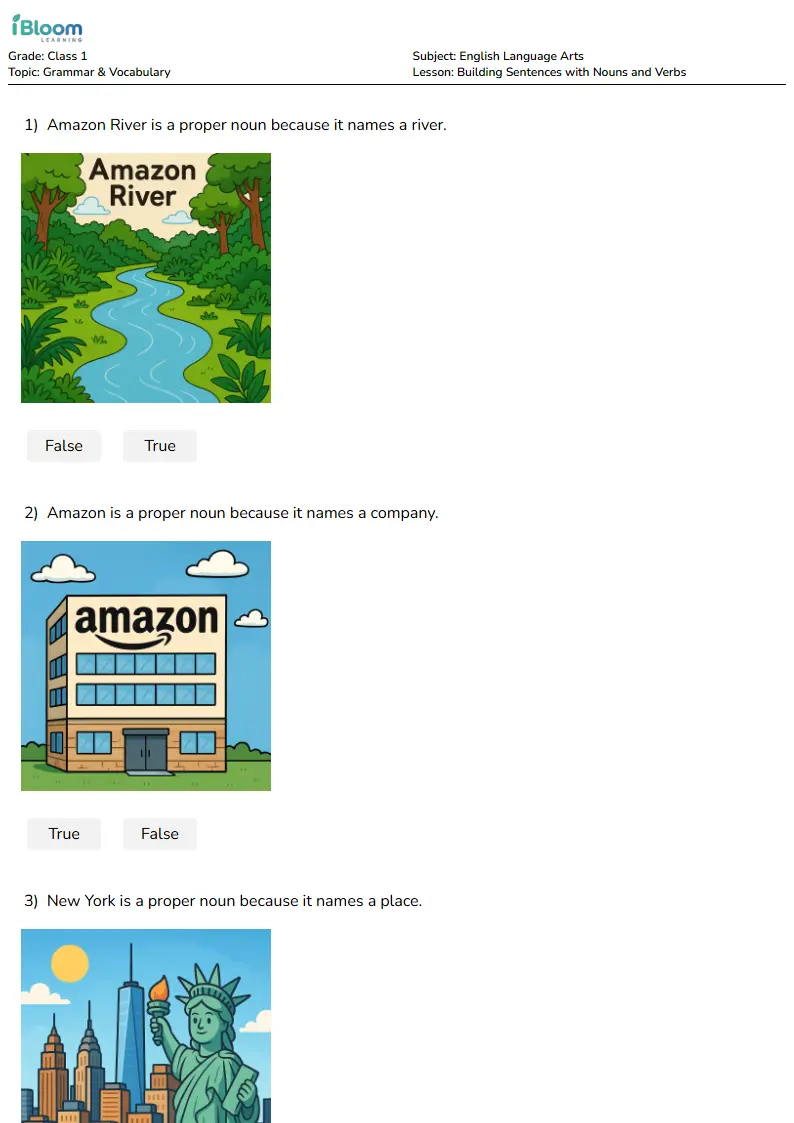
Use this preview to see the kind of practice children will open before you start the routine.
Pictures Help Us Read Worksheets for Class 1 Preview
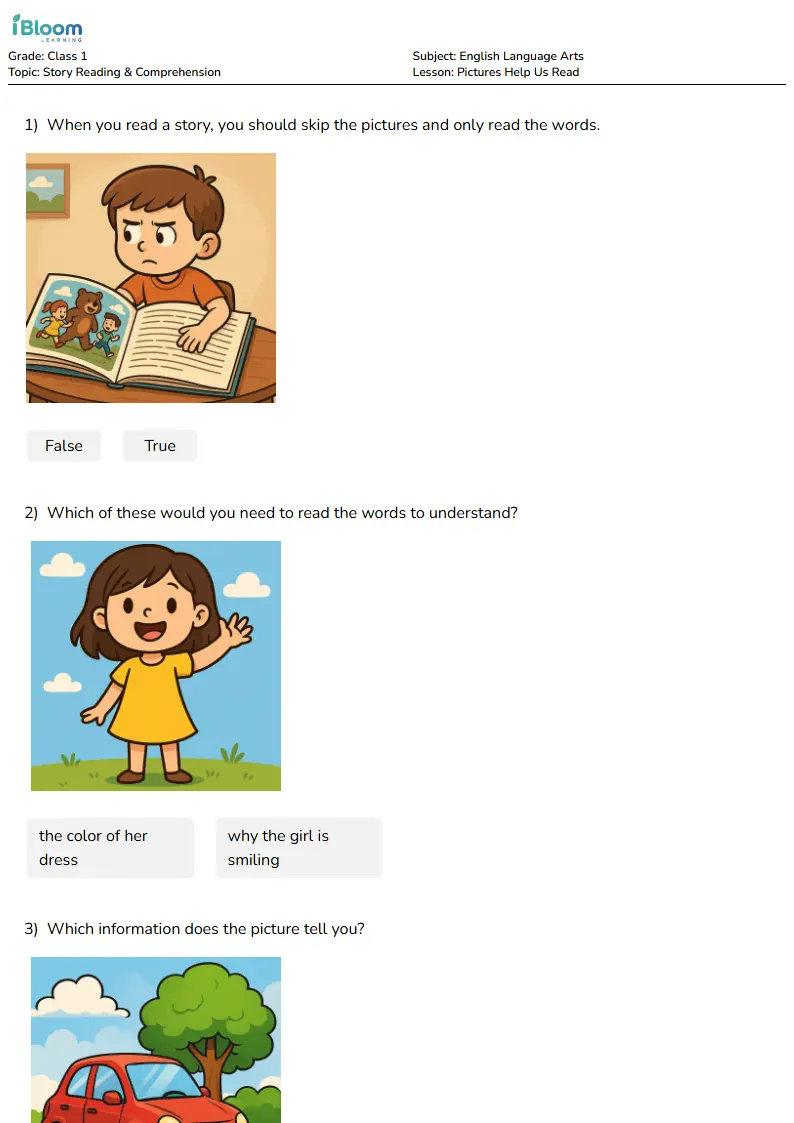
Use this preview to see the kind of practice children will open before you start the routine.
Identify and analyze key details Lesson for Fourth Grade Preview
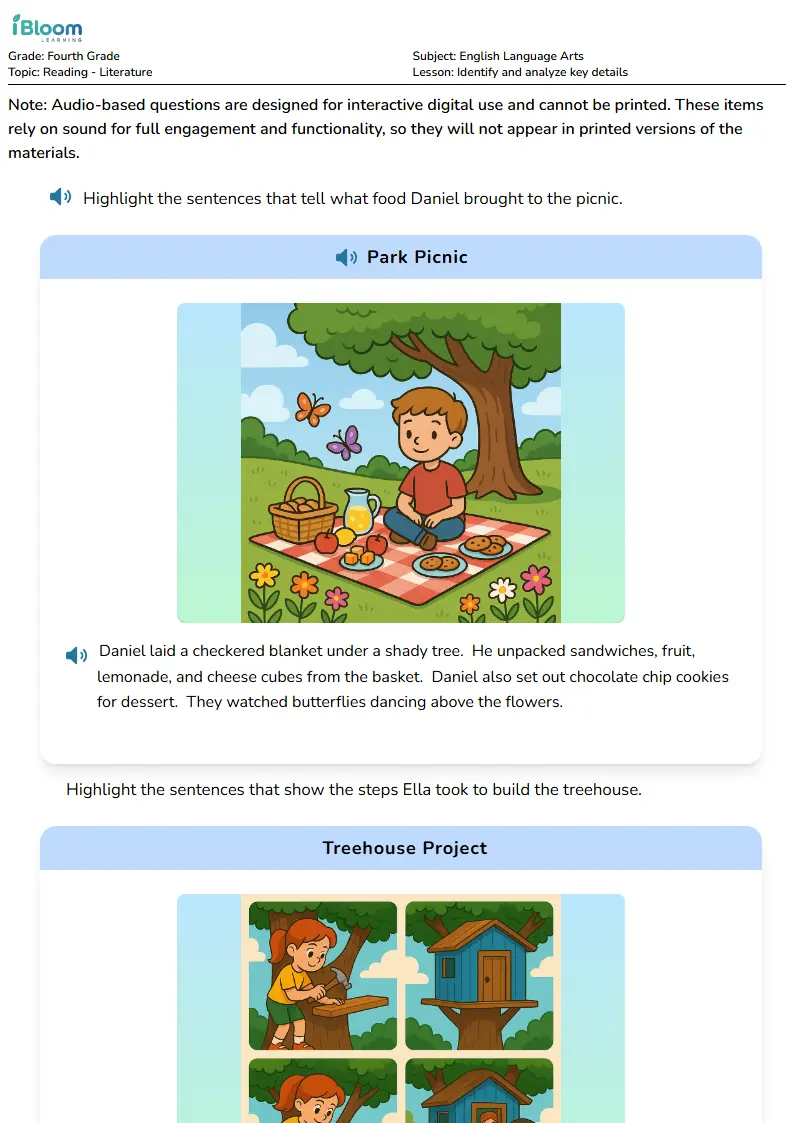
Use this preview to see the kind of practice children will open before you start the routine.