Crossword Puzzles for Vocabulary Practice
A practical teacher and parent guide to using crossword puzzles for vocabulary practice, spelling review, reading comprehension, and confident word learning.
Free printable worksheet
Free vocabulary crossword worksheet for Grade 3
This two-page printable has a 10-word vocabulary crossword with a word bank and student-friendly clues, then two sentences to write with the new words: 12 tasks in all. Page 2 is the filled-in answer key.
- Free PDF download
- Answer key included
- Ready to print
Free to print and use at home or in class. How to use this worksheet
Crossword puzzles are more than a quiet worksheet for early finishers. Used well, they help children connect word meanings, spelling patterns, context clues, and retrieval practice in one compact activity. A vocabulary crossword gives students a reason to read a clue carefully, recall a precise word, check the number of letters, and revise when the answer does not fit.
That mix is useful for teachers, homeschool families, tutoring centers, and parents who want word practice to feel less like memorization. It also fits the search intent already appearing around iBloom's crossword content: parents and teachers are finding iBloom through crossword puzzle tips, but they need a more classroom-focused guide that shows exactly how to use crosswords for vocabulary, spelling, and reading confidence.
This guide explains how to use crossword puzzles for vocabulary practice in Grades 1-5, with routines for classrooms, home practice, spelling review, reading centers, and enrichment. For a broader parent-teacher crossword guide, start with iBloom's crossword puzzle tips for parents and teachers. For children who need more reading practice, pair crossword work with iBloom's English worksheets and grade-level English Language Arts lessons.
Free vocabulary crossword worksheet for Grade 3
This two-page printable has a 10-word vocabulary crossword with a word bank and student-friendly clues, then two sentences to write with the new words: 12 tasks in all. Page 2 is the filled-in answer key.
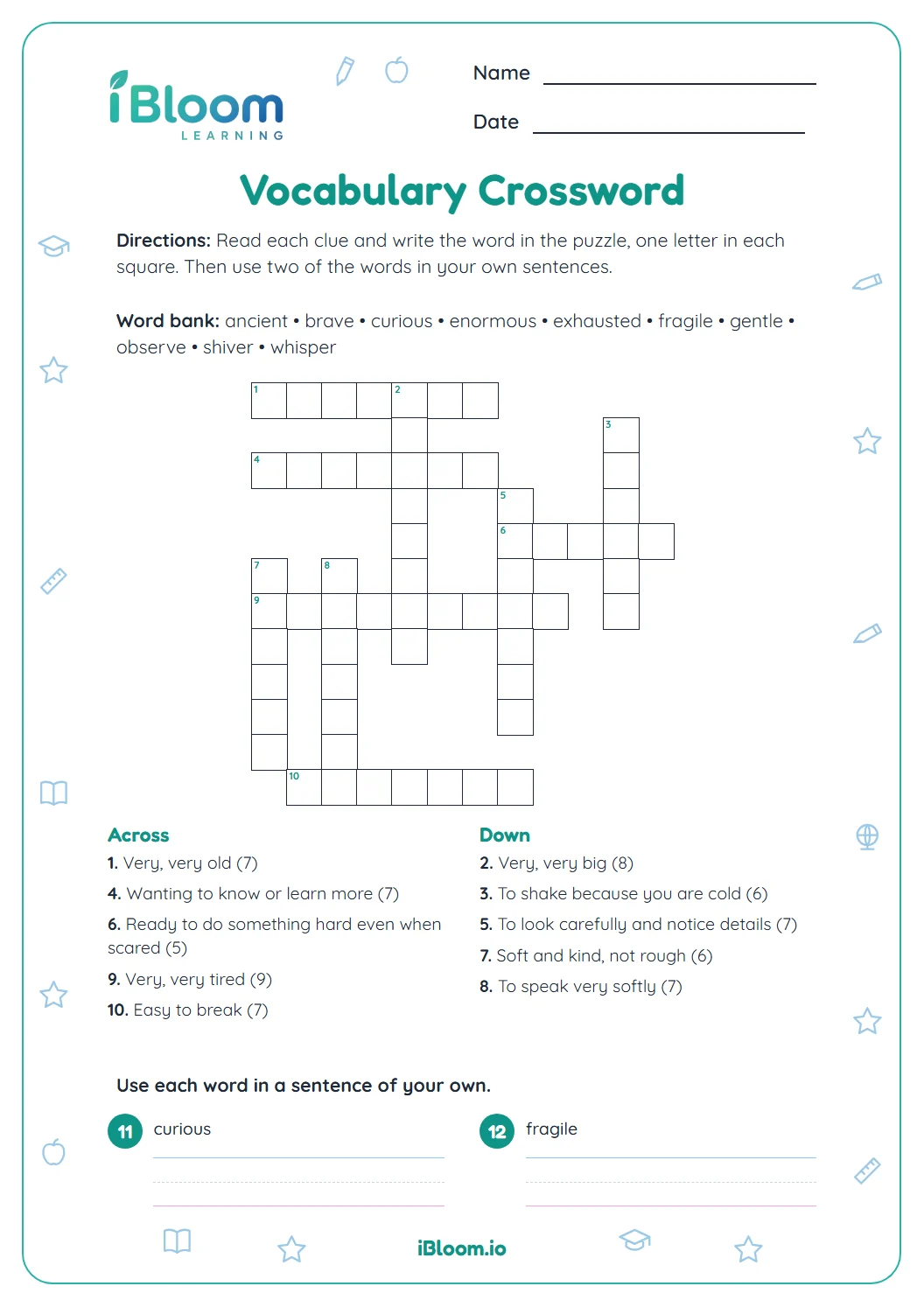
Download the free Grade 3 vocabulary crossword PDF
Answer key preview
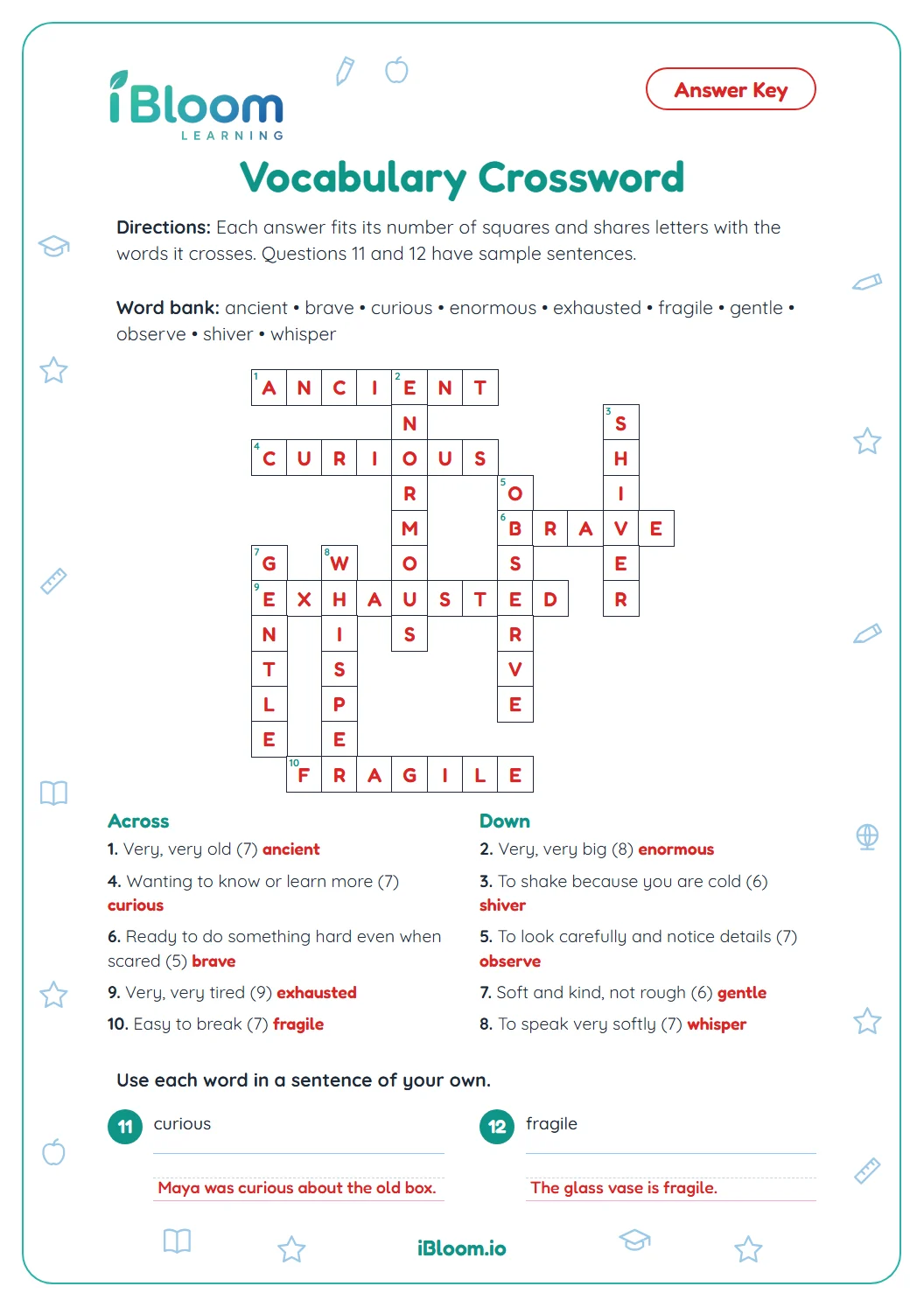
Solve the clues your child is sure of first, then use the crossing letters to work out the harder words.
Start with the Matching Practice
Use this guide with a direct iBloom worksheet or lesson so children can move from reading the explanation into real practice.
Why Crossword Puzzles Help Vocabulary Grow
Vocabulary learning improves when students meet a word more than once and use it in more than one way. A crossword puzzle can support that process because each answer is connected to a clue, a spelling pattern, and a crossing word. Students are not only asked, "Do you know this word?" They are also asked to test whether the word fits the clue and the puzzle structure.
That matters because many children recognize a word when they hear it but cannot spell it, define it, or use it in a sentence. Crossword puzzles bridge those skills. A student may know the word "observe," but the clue "to look carefully and notice details" asks the student to connect meaning with spelling. If the puzzle crosses with another word, the student gets feedback from the grid.
For teachers, the value is practical. A crossword puzzle can turn a weekly word list into a reading, spelling, and reasoning activity. For parents, it can become a screen-light game that still builds school vocabulary.
What Makes a Good Vocabulary Crossword?
A strong vocabulary crossword is not just a list of random words. It is built around a learning goal.
Good classroom crossword puzzles usually have:
- a focused word set
- clear student-friendly clues
- a mix of easier and harder words
- spelling patterns that match the week's lessons
- enough crossing letters to support problem solving
- a short follow-up task such as using words in sentences
Weak crossword puzzles often fail because the clues are too vague, the words are too unrelated, or the activity ends once the grid is filled. The learning comes from the thinking around the puzzle: reading the clue, choosing the word, checking spelling, explaining meaning, and using the word again.
Best Words to Use in Vocabulary Crosswords
Choose words that students need to know, not only words that are easy to fit into a grid. A good word list can come from:
- a reading passage
- a science or social studies unit
- a spelling list
- a phonics pattern
- a classroom read-aloud
- a grammar lesson
- commonly confused words
- academic vocabulary
For Grade 1 and Grade 2, use short words, sight words, phonics patterns, and simple nouns or verbs. For Grade 3, add prefixes, suffixes, compound words, and content vocabulary. For Grades 4 and 5, include figurative language, academic words, roots, synonyms, antonyms, and words from nonfiction reading.
A Simple Classroom Routine
Use this 20-minute routine when introducing vocabulary crosswords in class.
1. Preview the Word List
Spend three minutes reading the words aloud. Ask students to repeat tricky words and mark any word they have seen before. If the words come from a passage, remind students where they appeared.
2. Read the Clues Before Writing
Have students read every clue once before filling the grid. This helps them notice which clues are easy, which are uncertain, and which words may connect.
3. Fill Easy Words First
Students should begin with words they know. Easy answers create crossing letters that help with harder clues.
4. Use Context and Letter Clues
When students get stuck, ask:
- What does the clue mean?
- Which word from the list has that meaning?
- How many letters does the answer need?
- Which crossing letters are already filled?
- Does the spelling pattern make sense?
5. Discuss Three Tricky Words
After the puzzle, choose three words that caused mistakes. Ask students to explain the meaning, identify the hard spelling part, and use the word in a sentence.
Home Practice Routine for Parents
Parents can use crossword puzzles as a low-pressure vocabulary routine. The goal is not to finish quickly. The goal is to talk about words.
Try this:
- Pick 8-12 words from school or reading.
- Read the clues together before solving.
- Let your child solve the easy clues first.
- Ask your child to explain two answers.
- Review missed words without frustration.
- End by using three words in original sentences.
Families in New York, California, Texas, Florida, Illinois, Georgia, Washington, New Jersey, North Carolina, and Massachusetts can use this as weekly ELA support. Families in Delhi, Mumbai, Bengaluru, Chennai, Hyderabad, Pune, Kolkata, Ahmedabad, Kochi, Jaipur, and Lucknow can use the same routine for English vocabulary enrichment, CBSE/ICSE word practice, and school spelling support.
Grade-by-Grade Crossword Ideas
Grade 1
Use picture-supported clues and short answers. Keep grids small. A Grade 1 crossword might include words such as "sun," "hop," "fish," "book," and "play." Clues should be direct and concrete.
Good focus areas:
- short vowel words
- CVC words
- sight words
- color words
- family words
- school words
Grade 2
Grade 2 students can handle simple definitions and sentence clues. Add words from stories, folktales, science topics, and spelling patterns.
Good focus areas:
- long vowel words
- compound words
- contractions
- plural nouns
- story vocabulary
- question words
Grade 3
Grade 3 crosswords can include synonyms, antonyms, prefixes, suffixes, and content-area vocabulary. Students can also write clues for classmates.
Good focus areas:
- prefixes such as re-, un-, pre-, and mis-
- suffixes such as -ful, -less, -ness, and -ment
- homophones
- character trait words
- science vocabulary
- reading comprehension terms
Grade 4
Grade 4 students benefit from academic vocabulary and words linked to nonfiction reading. Crosswords can reinforce context clues and precise word choice.
Good focus areas:
- main idea and details vocabulary
- figurative language terms
- Greek and Latin roots
- transition words
- text structure words
- multisyllabic spelling patterns
Grade 5
Grade 5 students can use crosswords for review, enrichment, and test preparation. Include more abstract words and ask students to explain why each answer fits.
Good focus areas:
- advanced roots and affixes
- literary terms
- academic vocabulary
- science and history words
- commonly confused words
- vocabulary from novels and nonfiction
Crossword Activities for Vocabulary Centers
Crosswords work well in reading centers because they are compact and self-contained. Use them alongside reading passages, vocabulary cards, and writing prompts.
Here are five center ideas:
Word Meaning Center
Students solve a crossword from definition clues, then choose five words to use in original sentences.
Spelling Pattern Center
Students solve a crossword where every answer shares a spelling pattern, such as long a, silent letters, double consonants, or tion endings.
Context Clue Center
Each clue is a sentence with the target word missing. Students must use context to choose the word.
Student-Created Crossword Center
Students write clues for a word list and trade with a partner. This is powerful because writing clues requires deeper word knowledge.
Review Center
Use a crossword at the end of a unit to review vocabulary from a book, science chapter, or social studies topic.
How Crosswords Support Spelling
Crossword puzzles make spelling visible. If a student spells a word incorrectly, crossing letters may not fit. That immediate feedback is useful because it helps students notice errors without a teacher marking every word.
For spelling practice, choose words with related patterns. A puzzle might focus on:
- silent letters
ighwordsoughwords- double consonants
tionandsion- prefixes and suffixes
- irregular high-frequency words
After solving, ask students to circle the hard part of each word. This turns the crossword into a spelling analysis activity, not just a finished grid.
How Crosswords Support Reading Comprehension
Vocabulary and comprehension are closely connected. A student who understands more words can follow a passage more easily. Crosswords help because they make students slow down and think about meaning.
For comprehension support, build a crossword from a passage students have just read. Use clues that require recall and interpretation:
- "The character who solved the problem"
- "A word that means surprised"
- "The place where the story begins"
- "The reason the character changed"
- "A detail that supports the main idea"
This works especially well after short fiction, nonfiction articles, science readings, and classroom read-alouds.
Common Mistakes to Avoid
Making the Puzzle Too Hard
If every clue is difficult, students guess and lose confidence. Include easy entry points so they can build momentum.
Using Vague Clues
A clue like "good" could lead to many words. A better clue is "kind and willing to help others" for "helpful."
Skipping Discussion
The crossword is the start of vocabulary learning, not the end. Always add a short discussion, sentence task, or word sort.
Treating It Only as Busywork
Students learn more when they know the purpose. Tell them whether the puzzle is for spelling, vocabulary, comprehension, or review.
Quick Crossword Lesson Plan
Use this plan for a 30-minute ELA block.
| Time | Activity | Purpose |
|---|---|---|
| 5 minutes | Preview 10 vocabulary words | Build pronunciation and meaning |
| 10 minutes | Solve the crossword | Practice recall and spelling |
| 5 minutes | Check with a partner | Discuss meanings and corrections |
| 5 minutes | Write three sentences | Use words in context |
| 5 minutes | Review tricky words | Strengthen memory |
This plan can be used in elementary classrooms, tutoring sessions, homeschool co-ops, and after-school literacy programs.
How to Choose Clues That Teach
The best clues push students to think without becoming unfair.
Use a mix of clue types:
- Definition clue: "A word that means to look carefully"
- Sentence clue: "We will ___ the plant each day to see how it grows"
- Synonym clue: "Another word for quick"
- Antonym clue: "The opposite of empty"
- Category clue: "A type of weather"
- Example clue: "Apples, bananas, and grapes are examples"
For older students, add clues that require roots and affixes:
- "A prefix meaning again"
- "A suffix meaning full of"
- "A root meaning write"
Internal Linking Ideas for Teachers and Parents
Crossword vocabulary work fits well with other iBloom literacy resources. Use the crossword puzzle tips guide for general strategy, then connect vocabulary practice to English worksheets, Fourth Grade ELA lessons, and iBloom SpellBee for word practice.
If your child enjoys spelling competitions, combine crosswords with the spelling bee practice schedule and spelling bee words by grade level. Crossword puzzles can be a useful bridge between word-list study and real vocabulary use.
Frequently Asked Questions
Are crossword puzzles good for vocabulary practice?
Yes. Crossword puzzles can support vocabulary practice because students must connect clues, meanings, spelling, and letter patterns. They work best when followed by discussion or sentence writing.
What age can kids start doing vocabulary crosswords?
Many children can start with simple picture or word-bank crosswords in Grade 1. Older elementary students can use definition clues, context clues, synonyms, antonyms, and academic vocabulary.
How often should teachers use crossword puzzles?
One or two short crossword activities per week is enough for most classrooms. Use them for review, reading centers, spelling patterns, or end-of-unit vocabulary practice.
Should crossword puzzles include a word bank?
For younger students or new vocabulary, a word bank is helpful. For older students, remove the word bank after practice so students retrieve words from memory.
How do parents make crossword puzzles more useful at home?
Parents can ask children to explain answers, use words in sentences, and review missed words the next day. The conversation around the puzzle is where much of the learning happens.
Practice This Skill Next
After reading this guide, children can practise the same skill on iBloom. Start with Fourth Grade ELA lessons, then ask the child to explain one answer before moving on.