Equivalent Fractions Worksheets for Grade 3
Use equivalent fractions worksheets for Grade 3 with fraction bars, number lines, visual models, and simple explanations.
Free printable worksheet
Free equivalent fractions worksheet for Grade 3
This two-page printable has 15 equivalent fractions questions for Grade 3: six pairs of fraction bars to compare, six missing numbers such as 1/2 = ?/4, and three questions to choose an equivalent fraction, including one on a number line. Page 2 is the answer key.
- Free PDF download
- Answer key included
- Ready to print
Free to print and use at home or in class. How to use this worksheet
Equivalent Fractions Worksheets for Grade 3 help children move from memorizing fraction rules to understanding fraction size. This guide is for parents, teachers, tutors, and children who want worksheet practice that uses visual models, clear explanations, and short routines. It focuses on seeing why two different fraction names can show the same amount, with iBloom practice from Generating Equivalent Fractions with Visual Fraction Models lesson, Finding Equivalent Fractions Using Visual Models lesson, Fractions Grade 3, Fractions for Grade 2, and Free 2nd Grade Math Worksheets.
Free equivalent fractions worksheet for Grade 3
This two-page printable has 15 equivalent fractions questions for Grade 3: six pairs of fraction bars to compare, six missing numbers such as 1/2 = ?/4, and three questions to choose an equivalent fraction, including one on a number line. Page 2 is the answer key.
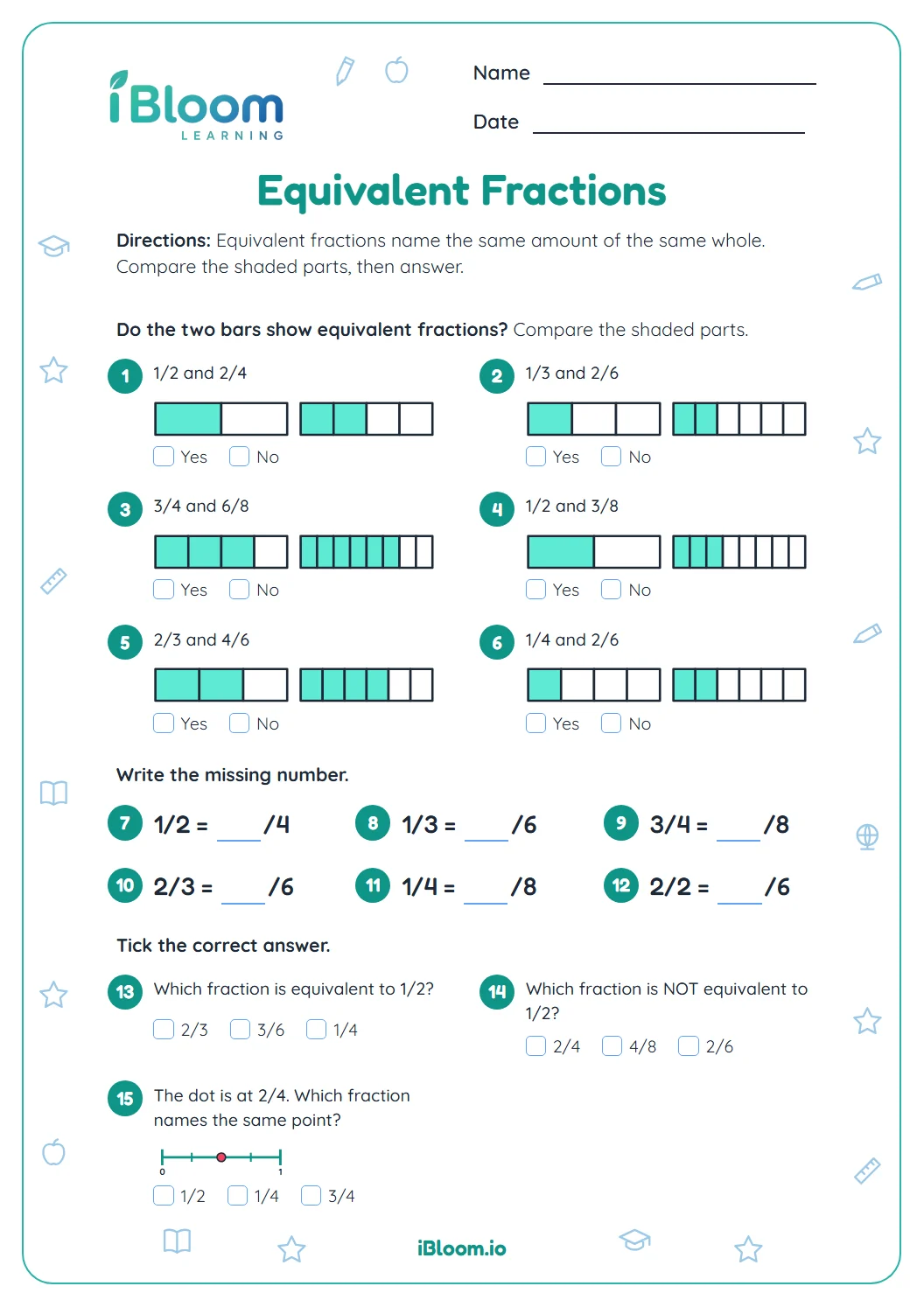
Download the free Grade 3 equivalent fractions worksheet PDF
Answer key preview
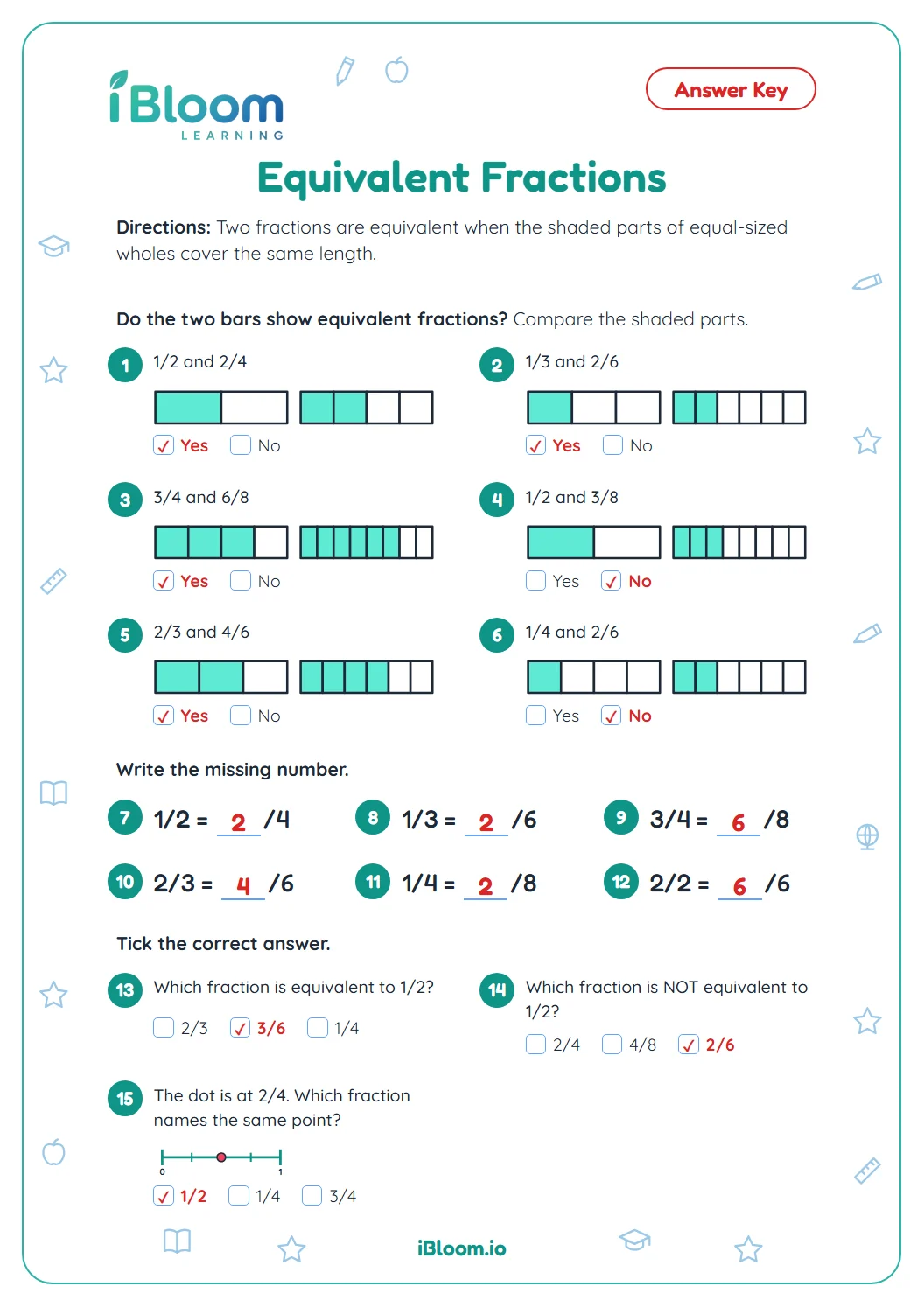
Fold a paper strip in half, then in half again, so your child can see that 1/2 and 2/4 cover the same length.
Start with the Matching Practice
Use this guide with a direct iBloom worksheet or lesson so children can move from reading the explanation into real practice.
Table of Contents
Key Takeaways
- Strong equivalent fractions worksheets grade 3 practice keeps the whole, the parts, and the explanation visible.
- Children should draw, shade, label, compare, and explain before moving to shortcuts.
- Parents can support fraction practice with paper strips, food portions, measuring cups, clocks, and number lines.
- Teachers can use one worksheet for modeling, partner talk, small-group checks, or an exit ticket.
- iBloom practice should connect a fraction article to exact lesson and worksheet pages, not only broad math hubs.
Why This Fraction Skill Matters
The What Works Clearinghouse practice guide on fractions recommends helping students understand fractions as numbers, use number lines, compare fractions, and build conceptual understanding before relying on procedures. That is why equivalent fractions worksheets for grade 3 should not be only answer boxes. Children need to see the same whole, equal parts, fraction labels, and the reason behind each comparison or location.
The Common Core Grade 3 fraction standards also place strong attention on unit fractions, fractions on a number line, equivalent fractions, and comparing fractions by reasoning about size. Teachers can plan with standards language, while children can use simpler language: "the whole is split into equal parts," "this fraction is at this point," and "these two fractions show the same amount." Adult planning sources such as https://ies.ed.gov/ncee/wwc/Docs/PracticeGuide/fractions_pg_093010.pdf, https://corestandards.org/Math/Content/3/NF/, and https://corestandards.org/Math/Content/4/NF/ give the background; iBloom gives children the practice surface.
A Simple Worksheet Routine
Use this routine: shade two models, line up equal wholes, name both fractions, then explain why the area or length is the same. Then ask, "How do you know?" A fast answer without a model may hide a misunderstanding. A slower answer with a drawing, label, and sentence usually shows stronger fraction sense.
- Name the whole before naming the fraction.
- Check that the parts are equal.
- Shade, mark, or build the fraction.
- Say the numerator and denominator meaning.
- Explain the answer in a because sentence.
- Move to Generating Equivalent Fractions with Visual Fraction Models lesson or Finding Equivalent Fractions Using Visual Models lesson for the next connected page.
Examples Children Can Try
A child working on equivalent fractions worksheets for grade 3 might say, "The denominator tells how many equal parts are in the whole, and the numerator tells how many parts I use." For number line work, the child can say, "I split the line from 0 to 1 into four equal spaces, so three fourths is at the third mark." For equivalence, the child can say, "One half and two fourths match because they cover the same amount of the same-sized whole." For comparing, the child can say, "Three sixths is less than four sixths because the denominator is the same and four parts is more."
Try a three-model check. Draw an area model, a number line, and a fraction strip. If the child can connect all three, the worksheet is doing more than checking answers. It is building a mental picture that will help in later fraction operations.
Parent Practice Plan
Parents can use equivalent fractions worksheets for grade 3 in short sessions. Begin with a paper strip or simple drawing. Ask the child to fold, shade, mark, or compare. Then complete three to five iBloom items. End by asking the child to explain one answer without looking at the choices.
In India, this supports CBSE, ICSE, and state-board fraction work in Delhi, Mumbai, Bengaluru, Chennai, Hyderabad, Pune, Kolkata, Ahmedabad, Jaipur, Lucknow, Kerala, Tamil Nadu, Karnataka, Maharashtra, Telangana, Gujarat, Rajasthan, and West Bengal. In the United States, it supports Grade 3 and Grade 4 fraction standards in California, Texas, Florida, New York, Illinois, Pennsylvania, Ohio, Georgia, North Carolina, Michigan, Los Angeles, Houston, Chicago, Phoenix, Philadelphia, Dallas, Austin, Seattle, Boston, Denver, Atlanta, and Miami. In the UAE, it supports Dubai, Abu Dhabi, Sharjah, Ajman, Ras Al Khaimah, Fujairah, Umm Al Quwain, and Al Ain families across British, American, IB, and Indian curriculum settings.
Teacher Practice Plan
Teachers can use equivalent fractions worksheets for grade 3 as a mini-lesson, math center, intervention task, or exit ticket. Model the first item with a visual, ask students to explain the whole, then let partners solve one similar item. The strongest sentence frames are "The whole is..." "The denominator shows..." "The numerator shows..." "The fractions are equivalent because..." and "This fraction is larger because..."
Small groups work well when roles are clear. One student draws the model, one labels the fraction, one explains, and one checks whether the whole stayed the same. Rotate roles every item so children practise both the math and the language.
Choosing The Right Worksheet
Choose a page that keeps the same-sized whole clear. Children often make fraction mistakes because two wholes are not equal, a number line interval is uneven, or a comparison is made without looking at the denominator. A good worksheet lets the child see equal parts, then asks for a short explanation.
If the child is new to the skill, use Generating Equivalent Fractions with Visual Fraction Models lesson first. If the child is ready for a connected challenge, use Finding Equivalent Fractions Using Visual Models lesson or Fractions Grade 3. For a broader Grade 3 guide, keep Fractions Grade 3 open while planning practice.
Common Mistakes
The first mistake is treating fractions like whole numbers and assuming a larger denominator always means a larger amount. The second mistake is forgetting that the whole must be the same size before fractions can be compared. The third mistake is counting tick marks on a number line instead of counting spaces. The fourth mistake is memorizing cross-multiplication before the child understands the size of the fractions.
Fix mistakes with a model. If a child says one eighth is bigger than one fourth because eight is bigger, draw two equal wholes and shade the parts. If a child misplaces three fourths on a number line, count equal spaces from 0 to 1. If a child calls two fractions equivalent too quickly, ask them to prove it with a model.
Regional Learning Notes
Fraction examples can come from food, measurement, time, sports, crafts, maps, and money, but the mathematical whole must stay clear. A pizza slice, a paper strip, a measuring cup, and a number line are only helpful when the child knows what counts as one whole. This matters across classrooms in India, the United States, and the UAE because fraction language can change by curriculum, but the reasoning remains the same.
Multilingual learners benefit from repeating the same math sentence several times. Let the child explain in home language first if needed, then practise the English fraction sentence. The visual model gives meaning before the words become automatic.
How iBloom Fits
iBloom works best when adults connect the article, the exact practice page, and a related next step. Start with Generating Equivalent Fractions with Visual Fraction Models lesson, move to Finding Equivalent Fractions Using Visual Models lesson, and use Fractions Grade 3 for a broader Grade 3 fraction guide. If the child needs a lower-grade foundation, use Fractions for Grade 2; if the child is ready for a different math connection, use Free 2nd Grade Math Worksheets.
Frequently Asked Questions
What age are equivalent fractions worksheets for grade 3 best for?
They are best for Grade 3 and Grade 4 learners who are ready to reason about equal parts, number lines, equivalent fractions, and fraction comparison. Older learners can also use them for review.
Should children use models every time?
Use models often at first. When children can explain the model and predict the answer, they can gradually move toward more symbolic work.
What is the most common fraction mistake?
Many children compare numerator and denominator digits as if they were whole numbers. Bring the child back to the whole, equal parts, and fraction size.
How many worksheet questions should a child do?
Five thoughtful items with explanations can be enough. Fraction practice should include drawing, labeling, comparing, and explaining.
What should the child do next?
Move to Generating Equivalent Fractions with Visual Fraction Models lesson, Finding Equivalent Fractions Using Visual Models lesson, or Fractions Grade 3 when the child is ready for another connected fraction task.
Practice This Skill Next
After reading this guide, children can practise the same skill on iBloom. Start with Generating Equivalent Fractions with Visual Fraction Models lesson or Finding Equivalent Fractions Using Visual Models lesson, then ask the child to explain one answer before moving on.