Fact and Opinion Worksheets
A parent and teacher guide to fact and opinion worksheets with examples, discussion prompts, and proof checks.
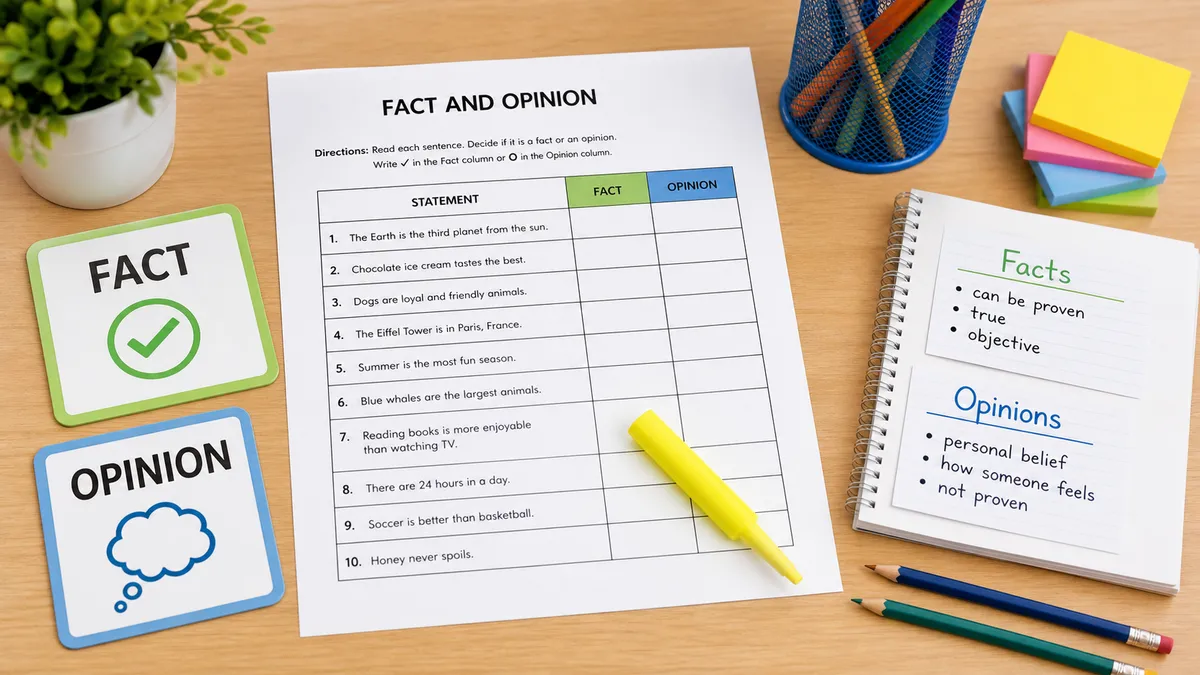
Fact and Opinion Worksheets help children slow down, read carefully, and explain answers with proof. This guide is for parents, teachers, tutors, and children who want reading and writing practice that builds real comprehension. Start with iBloom pages such as Writing a Strong Opinion worksheet, Starting My Opinion Writing lesson, and Distinguish Strong and Weak Reasons worksheet, then connect the skill to nearby guides like Main Idea Worksheets, Finding Facts Worksheets, and Text Evidence Worksheets.
Start with the Matching Practice
Use this guide with a direct iBloom worksheet or lesson so children can move from reading the explanation into real practice.
Table of Contents
Worksheet And Lesson Previews
Writing a Strong Opinion Worksheets for Class 2 Preview
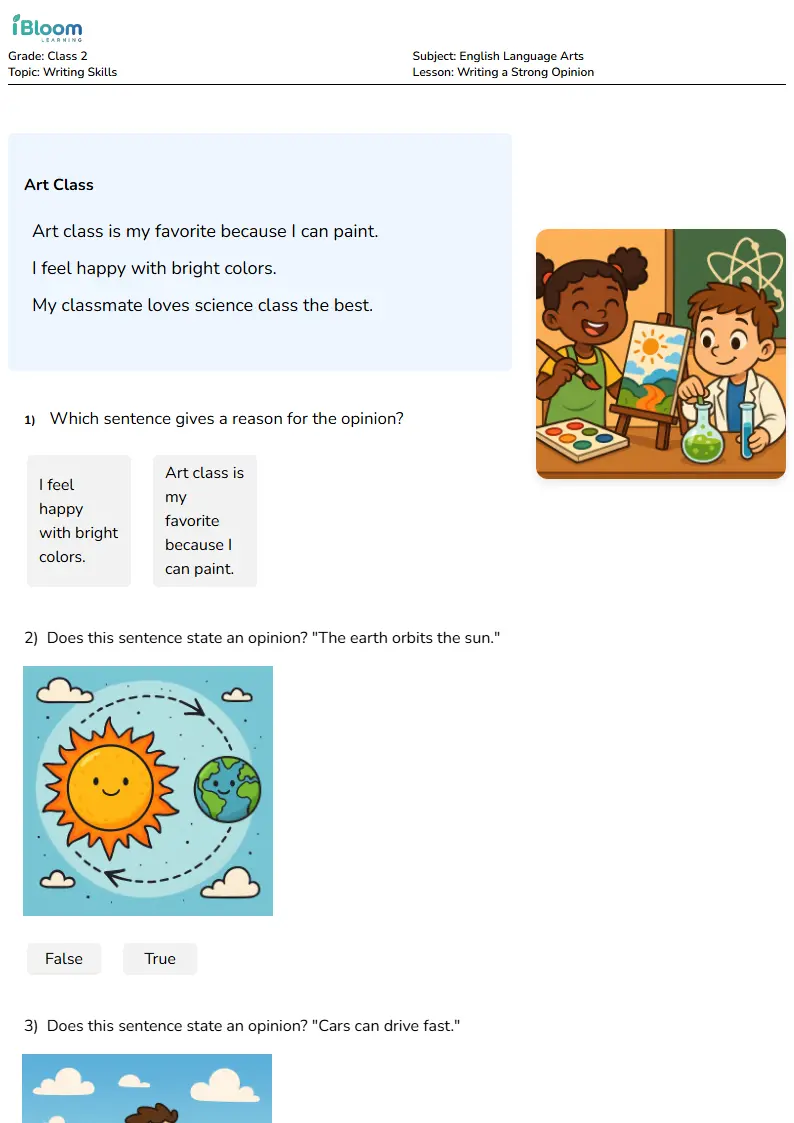
Use this preview to see the kind of practice children will open before you start the routine.
Starting My Opinion Writing Lesson for Class 2 Preview
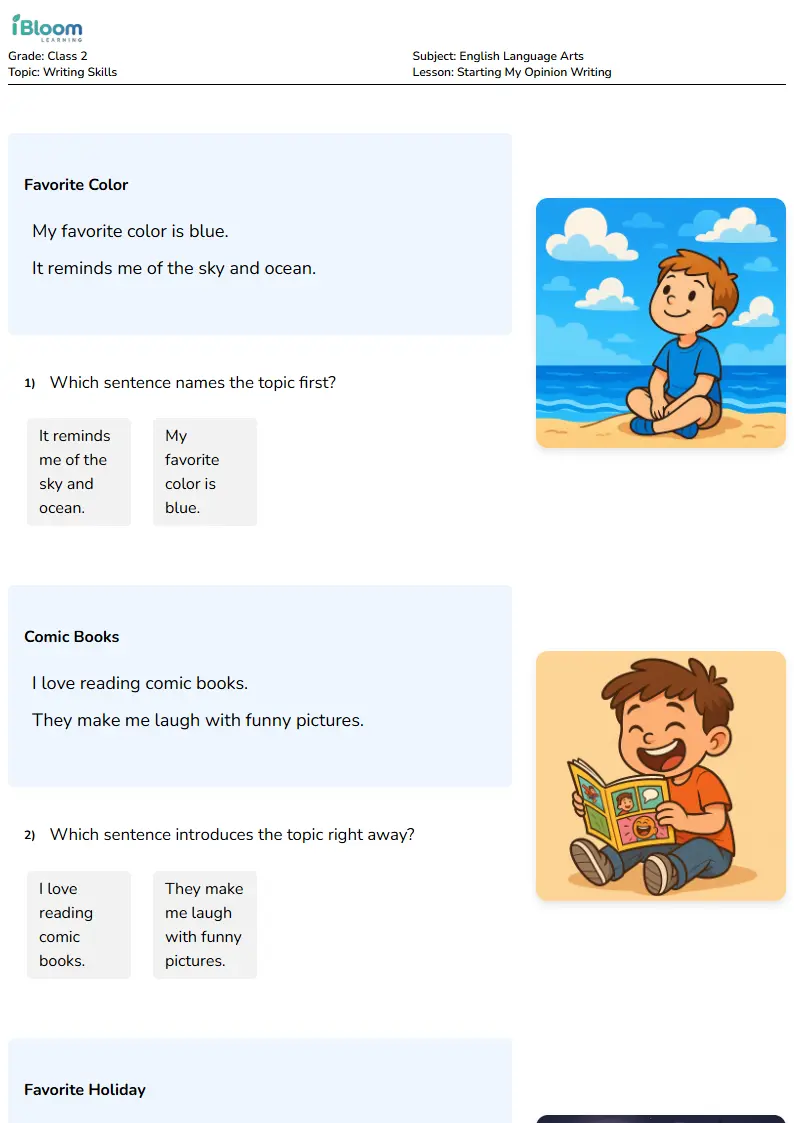
Use this preview to see the kind of practice children will open before you start the routine.
Key Takeaways
- Fact and Opinion Worksheets should ask children to read, locate proof, explain thinking, and write a short answer.
- The best routine is simple: read the question, return to the text, mark evidence, say the answer, then write.
- Parents can use short passages, picture books, school readers, and everyday nonfiction.
- Teachers can use one worksheet as a small-group task, center, exit ticket, or writing warm-up.
- Internal links should move children from exact practice to related facts, reasons, evidence, main idea, and response pages.
Why This Skill Matters
Children often answer quickly before checking the text. Fact and Opinion Worksheets build the habit of proving an answer. A child who can point to the sentence, picture, heading, or detail that supports an answer is learning to read with attention. That skill supports main idea, author's point, opinion writing, informative writing, and later argument writing.
The Reading Rockets comprehension resources emphasize strategies that help children actively make meaning from text. The Reading Rockets writing resources are useful for adults helping children turn ideas into sentences. The IES reading comprehension practice guide supports explicit comprehension instruction, discussion, and structured practice. On iBloom, those ideas become practical through short questions, text-based answers, and connected worksheets.
Across India, the United States, and the UAE, children meet this skill in different curriculum language. CBSE, ICSE, state-board, American, British, IB, and Indian-curriculum classrooms may call it facts, evidence, reasons, author's point, opinion, proof, or key details. The classroom name changes, but the child action stays the same: go back to the text and explain.
What Strong Worksheets Include
A strong fact and opinion worksheets page should include a short passage or picture, clear questions, and enough room for a child to mark proof. It should not be a guessing task. Children should have to look back, choose evidence, and explain why the answer works.
Useful formats include:
- Read a short passage and underline the sentence that proves the answer.
- Sort statements into fact, opinion, reason, or unsupported idea.
- Match an author's point to the supporting reason.
- Choose the best evidence for a written answer.
- Complete a sentence frame with because.
- Compare a strong reason with a weak reason.
- Write one answer and point to where the text supports it.
After children try Writing a Strong Opinion worksheet, move to Starting My Opinion Writing lesson or Distinguish Strong and Weak Reasons worksheet so they see the same thinking in another format.
A Step-by-Step Routine
1. Read the question first
Ask the child what the question wants. Is it asking for a fact, an opinion, a reason, an author's point, or proof from the text? Naming the task helps children avoid random guessing.
2. Return to the text
Children should point to the sentence, picture, title, heading, dialogue, or detail that helps. For young learners, this may be oral. For older learners, it can be underlining, highlighting, or writing a line number.
3. Say the answer aloud
Before writing, ask the child to say the full answer. A child might say, "I think the author wants us to recycle because the passage gives two reasons about saving materials." Oral rehearsal makes written answers clearer.
4. Write a short answer
Use a sentence frame only when useful: The fact is..., I know because..., The author's point is..., One reason is..., The text says.... Then remove the frame gradually so the child can write independently.
5. Check the proof
Ask, "Does your answer match the text?" This one question improves accuracy and helps children catch answers that sound good but are not supported.
Examples Children Can Try
- Mark 'The tree is tall' as a fact if the text gives a measurement.
- Mark 'The tree is beautiful' as an opinion because it tells a feeling or judgment.
- Ask, 'Can I prove this from the text or picture?'
- Rewrite one opinion with a reason that explains why.
For a stronger challenge, ask children to write one wrong answer and explain why it does not match the text. This helps them understand the difference between a guess and proof.
Parent Practice Plan
Parents can practice this skill in five to ten minutes. Use a school reader, picture book, science paragraph, recipe, short news item for children, or iBloom worksheet. Ask one question, then ask the child to point to the proof. In Delhi, Mumbai, Bengaluru, Chennai, Hyderabad, Pune, and Kolkata, this can fit beside English homework. In California, Texas, Florida, New York, Illinois, Georgia, and North Carolina, it can fit after reading logs or classroom packets. In Dubai, Abu Dhabi, Sharjah, Ajman, and Al Ain, it can support multilingual learners moving between home language talk and English reading answers.
If the child gives an answer without proof, do not start with correction. Ask, "Show me where you found that." If they cannot show it, reread together and choose a better answer.
Teacher Practice Plan
Teachers can use Fact and Opinion Worksheets in a compact routine:
- Model one question with the whole class.
- Ask partners to find proof in the text.
- Let children answer one item independently.
- Have students compare a strong answer and a weak answer.
- End with one sentence frame or one oral explanation.
For small groups, pair this page with Main Idea Worksheets or Text Evidence Worksheets. For writing connections, use Finding Facts Worksheets so children see how facts and reasons support a larger answer.
India, US, and UAE Learning Notes
In Indian classrooms, children may see this skill in comprehension questions, value-based questions, grammar-integrated English work, and EVS reading passages. In US classrooms, it often appears as text evidence, author's purpose, main idea, opinion writing, and constructed response. In UAE classrooms, children may meet it in British, American, IB, or Indian curriculum English lessons, often with multilingual support.
The same support works across all three regions: keep passages short, ask children to mark proof, encourage oral explanation, and connect reading to writing. Location examples should help children feel seen, but they should never replace the reading task.
Common Mistakes
- Guessing from memory: ask the child to point back to the text.
- Copying too much: ask for only the strongest sentence or detail.
- Confusing fact and opinion: ask whether the statement can be proved.
- Choosing a weak reason: ask whether the reason directly supports the point.
- Writing without a full sentence: use a frame once, then try again independently.
How iBloom Fits
iBloom works best when children move from exact skill practice into a connected reading path. Use Writing a Strong Opinion worksheet for the starting task, then connect to Main Idea Worksheets for evidence, Finding Facts Worksheets for a related reasoning skill, and Text Evidence Worksheets for written response practice. This supports both classroom comprehension and home review.
Frequently Asked Questions
What grade level are fact and opinion worksheets best for?
They can be used from kindergarten through upper elementary when the passage and answer length are adjusted. Younger children can answer orally; older children can write with evidence.
Should children highlight the text?
Highlighting helps only when it is focused. Ask children to mark the exact proof, not the whole paragraph.
How can parents help without giving the answer?
Ask questions: What does the question ask? Where is the proof? Does your answer match the text? These prompts help without replacing the child's thinking.
Can this skill support writing?
Yes. Finding facts, telling fact from opinion, and choosing supporting reasons all help children write stronger informative and opinion answers.
What should teachers check first?
Check whether the child can explain why the answer is supported. A neat answer without proof may still be weak.
Practice This Skill Next
After reading this guide, children can practise the same skill on iBloom. Start with Writing a Strong Opinion worksheet or Starting My Opinion Writing lesson, then ask the child to explain one answer before moving on.