Feelings and Emotions Worksheets for Kids
A practical guide to feelings and emotions worksheets for early language, story talk, and social-emotional vocabulary.
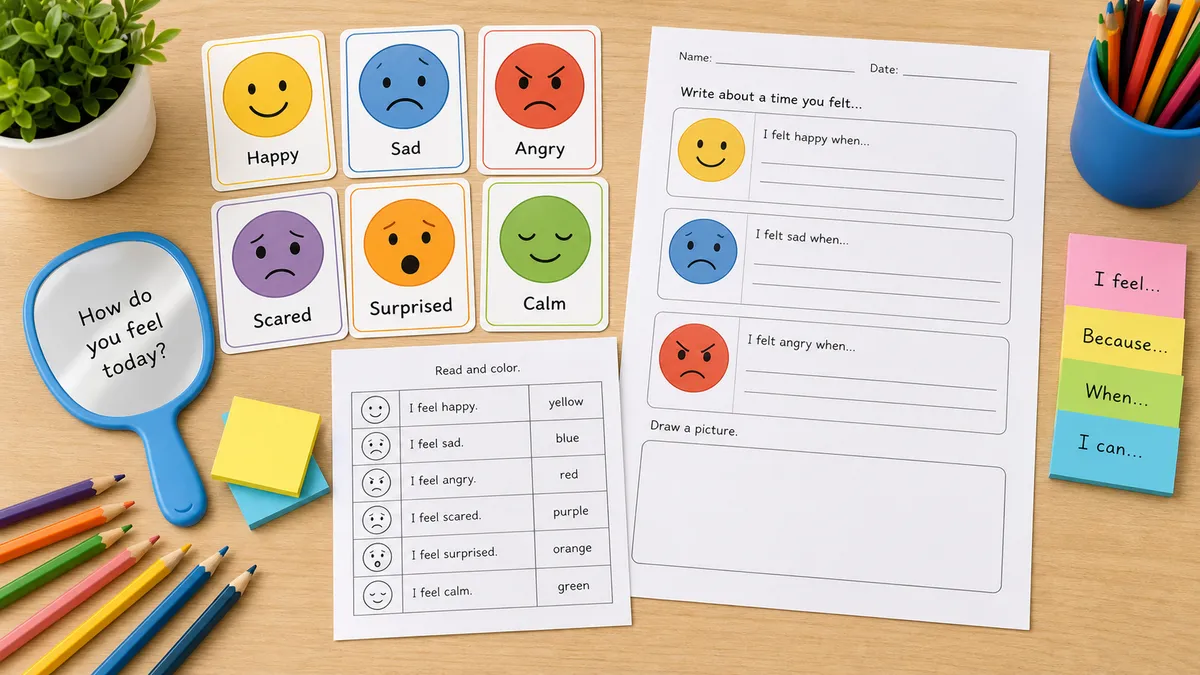
Feelings and Emotions Worksheets for Kids help young children turn everyday experiences into words. This guide is for parents, teachers, tutors, and children who want early language practice that supports speaking, listening, story understanding, and classroom confidence. Start with iBloom pages such as Identify feelings and emotions worksheet, Describe feelings with words worksheet, and Identify emotions in stories worksheet, then connect to related support from Child learning behaviour guide, Daily routine worksheets, and Conversation skills worksheets.
Start with the Matching Practice
Use this guide with a direct iBloom worksheet or lesson so children can move from reading the explanation into real practice.
Table of Contents
Key Takeaways
- Feelings and Emotions Worksheets for Kids should help children say useful words, not memorize isolated labels.
- The best routine uses pictures, oral sentences, role-play, drawing, and short written or matching tasks.
- Parents can connect practice to meals, play, cleanup, story time, and bedtime.
- Teachers can use one worksheet as a speaking circle, small-group prompt, language center, or story-response task.
- Internal links should move children between exact worksheets, related lessons, feelings, routines, conversation, and home-learning support.
Why Early Communication Practice Matters
Early language grows when children hear words, use words, and connect words to real situations. The Reading Rockets early literacy resources describe the importance of early language, books, sounds, and meaning-making. The CDC positive parenting tips are also useful for adults because they emphasize warm, age-appropriate support for children's development. When children can name a feeling, describe a routine, ask for help, or retell a small event, they are building the language base that supports reading comprehension and writing later.
In India, the United States, and the UAE, families may use different names for the same stage: preschool, pre-kindergarten, LKG, UKG, kindergarten, KG1, or KG2. A child in Delhi, Mumbai, Bengaluru, Chennai, Hyderabad, Pune, New York, Houston, Chicago, Dallas, Los Angeles, Dubai, Abu Dhabi, Sharjah, Ajman, or Al Ain still needs the same basic practice: look at a picture, say a word, connect it to life, and use it in a sentence.
What Strong Worksheets Include
A strong feelings and emotions worksheets page should include clear pictures, familiar settings, and prompts that invite children to speak. For young learners, worksheet practice should not be silent for the whole time. Children need to point, say, listen, act out, and explain.
Useful worksheet formats include:
- Picture matching with feeling, routine, or conversation words.
- Role-play cards for asking, answering, helping, sharing, and waiting.
- Sequence cards that show what happens first, next, and last.
- Sentence frames such as I feel..., I need..., I want..., First I..., and Can you help me?
- Story pictures that ask what a character does, says, needs, or feels.
- Drawing prompts that let children connect the worksheet to their own home or classroom.
After trying Identify feelings and emotions worksheet, children can move to Describe feelings with words worksheet or Identify emotions in stories worksheet so they practise the same language in more than one context.
A Step-by-Step Practice Routine
1. Name the picture
Ask the child what they see. If the child gives one word, expand it gently: "Yes, happy. The child is happy." This gives a model without making the child feel corrected.
2. Connect the picture to life
Ask when the child has seen or felt something similar. For daily routines, ask what happens at home. For conversations, ask what the child could say to a friend or teacher. For feelings, ask what might help the character.
3. Use a sentence frame
Frames help children organise language. Try "I feel ___ when ___," "First I ___, then I ___," or "Can I ___ please?" Remove the frame slowly once the child can speak more independently.
4. Act it out or draw it
Role-play makes language practical. A child can act out asking for help, telling a routine, or naming a feeling. Drawing also helps quiet children show ideas before speaking.
5. End with one clear sentence
Ask for one complete sentence. This keeps practice short and successful. A strong sentence is more valuable than a rushed page.
Examples Children Can Try
- Point to a face card and say, 'I feel happy because...'
- Read a story page and ask, 'How does the character feel?'
- Match worried, excited, sad, calm, and proud to simple picture clues.
- Draw one feeling and tell when that feeling happens at home or school.
For a challenge, ask children to make a new prompt for an adult. A child might say, "Ask me what I do after lunch," or "Tell me what this face feels." Creating a prompt shows ownership of the language.
Parent Practice Plan
Parents can use Feelings and Emotions Worksheets for Kids for five to ten minutes. In Indian homes, this can fit beside LKG/UKG English practice, school notebooks, or tuition review. In US homes, it can support pre-K, kindergarten, homeschool, and speech-rich reading time. In UAE homes, it can support children moving between English at school and another language at home. Let the child explain in the home language first if needed, then model the English sentence.
If a child is shy, start with pointing. If a child speaks quickly but unclearly, slow the routine and ask for one full sentence. If a child has big feelings, use the page calmly and avoid turning it into a lecture.
Teacher Practice Plan
Teachers can use one worksheet in several ways:
- Morning circle: one picture and one sentence from each child.
- Language center: matching cards with a partner.
- Small group: role-play asking, answering, and taking turns.
- Story response: name a character's feeling or daily action.
- Exit check: one sentence beginning with I feel, I need, first, next, or can I.
For classroom extension, connect this post with Child learning behaviour guide, Daily routine worksheets, and Conversation skills worksheets. These related pages help children move from naming words to using words in stories, routines, and conversations.
India, US, and UAE Learning Notes
In Indian classrooms, these skills often appear in EVS talk, English oral work, LKG/UKG conversation practice, picture description, and value education. In US classrooms, they may appear as social-emotional learning, oral language, story retell, classroom routines, and kindergarten readiness. In UAE schools, they may appear across British, American, IB, and Indian curriculum settings, often with multilingual learners.
The best support is practical in all three contexts: use clear pictures, invite the child to speak, connect to home and school routines, and give a sentence that the child can actually use.
Common Mistakes
- Only naming labels: ask the child to use the word in a sentence.
- Correcting too much: model a better sentence and let the child try again.
- Skipping oral practice: let children say the answer before writing or matching.
- Using unfamiliar examples: connect to real meals, school bags, friends, toys, books, and classroom routines.
- Doing too many items: choose fewer prompts and ask for clearer language.
How iBloom Fits
iBloom works best as a connected path. Start with Identify feelings and emotions worksheet, then move to Describe feelings with words worksheet or Identify emotions in stories worksheet. For broader support, use Child learning behaviour guide, Daily routine worksheets, and Conversation skills worksheets. The Reading Rockets comprehension resources can help adults connect early talk to later reading understanding.
Frequently Asked Questions
What age are feelings and emotions worksheets best for?
They are useful for preschool, pre-kindergarten, LKG, UKG, kindergarten, and early primary children when the pictures and sentence frames are simple enough.
Should children speak before writing?
Yes. Young children usually need to say the sentence before matching, tracing, drawing, or writing.
Can multilingual children use a home language first?
Yes. Let the child explain the idea in the home language, then model a short English sentence.
How long should practice take?
Five to ten minutes is enough. Stop after one or two clear sentences if the child is tired.
Can teachers use these pages in groups?
Yes. They work well for morning circle, speaking centers, partner role-play, story response, and quick oral-language checks.
Practice This Skill Next
After reading this guide, children can practise the same skill on iBloom. Start with Identify feelings and emotions worksheet or Describe feelings with words worksheet, then ask the child to explain one answer before moving on.