Fractions Grade 3: Essential Tips and Worksheets
Discover essential strategies for teaching fractions in Grade 3. Our expert team at iBloom offers engaging worksheets and activities.
Free printable worksheet
Free fractions worksheet for Grade 3
This two-page printable has 16 Grade 3 fraction questions: naming the shaded part of six fraction bars, comparing six pairs of fractions with >, < or =, and four pizza and equivalent fraction problems. Page 2 is the answer key.
- Free PDF download
- Answer key included
- Ready to print
Free to print and use at home or in class. How to use this worksheet
This two-page printable has 16 Grade 3 fraction questions: naming the shaded part of six fraction bars, comparing six pairs of fractions with >, < or =, and four pizza and equivalent fraction problems. Page 2 is the answer key.
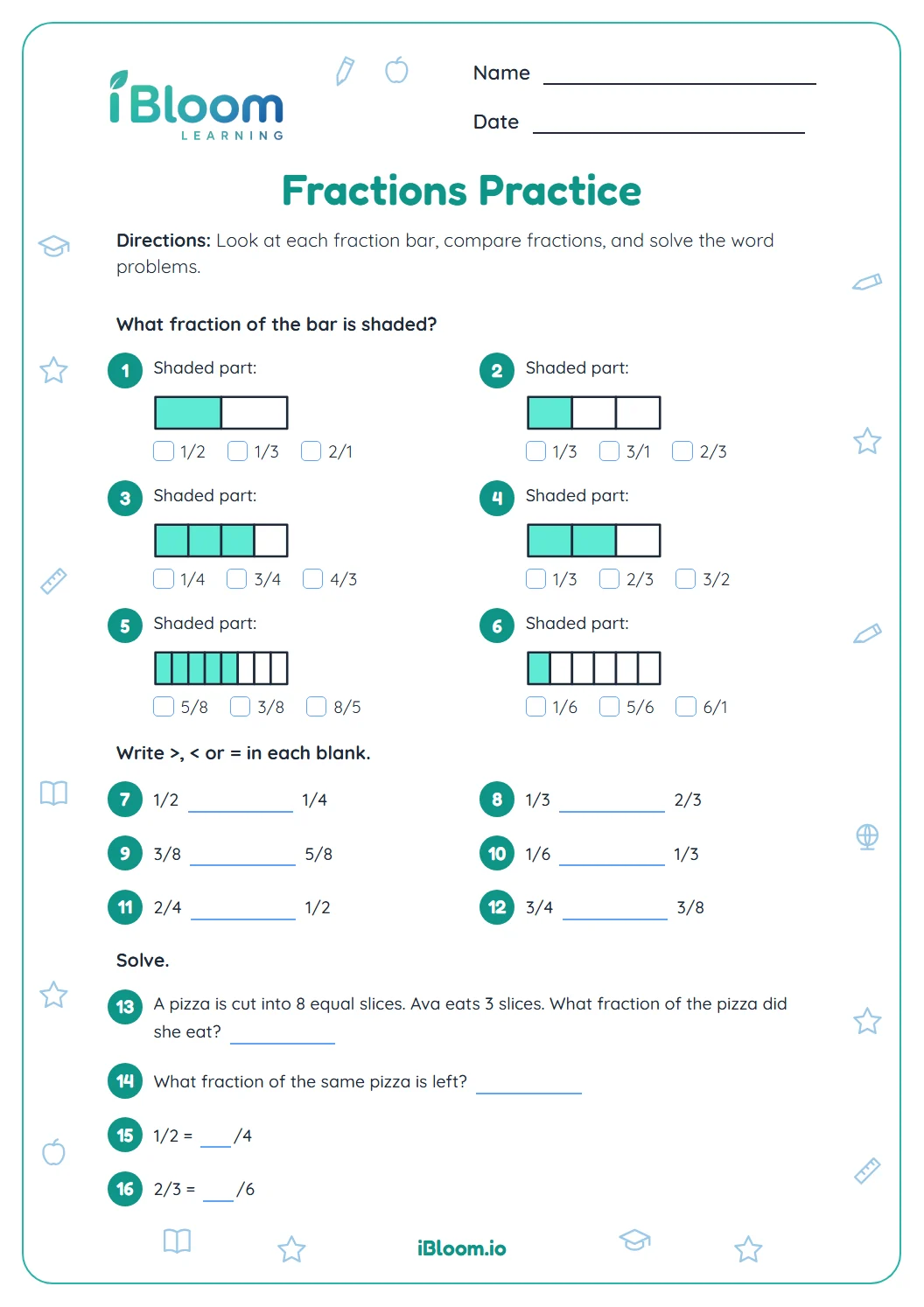
Download the free Grade 3 fractions worksheet PDF
Answer key preview
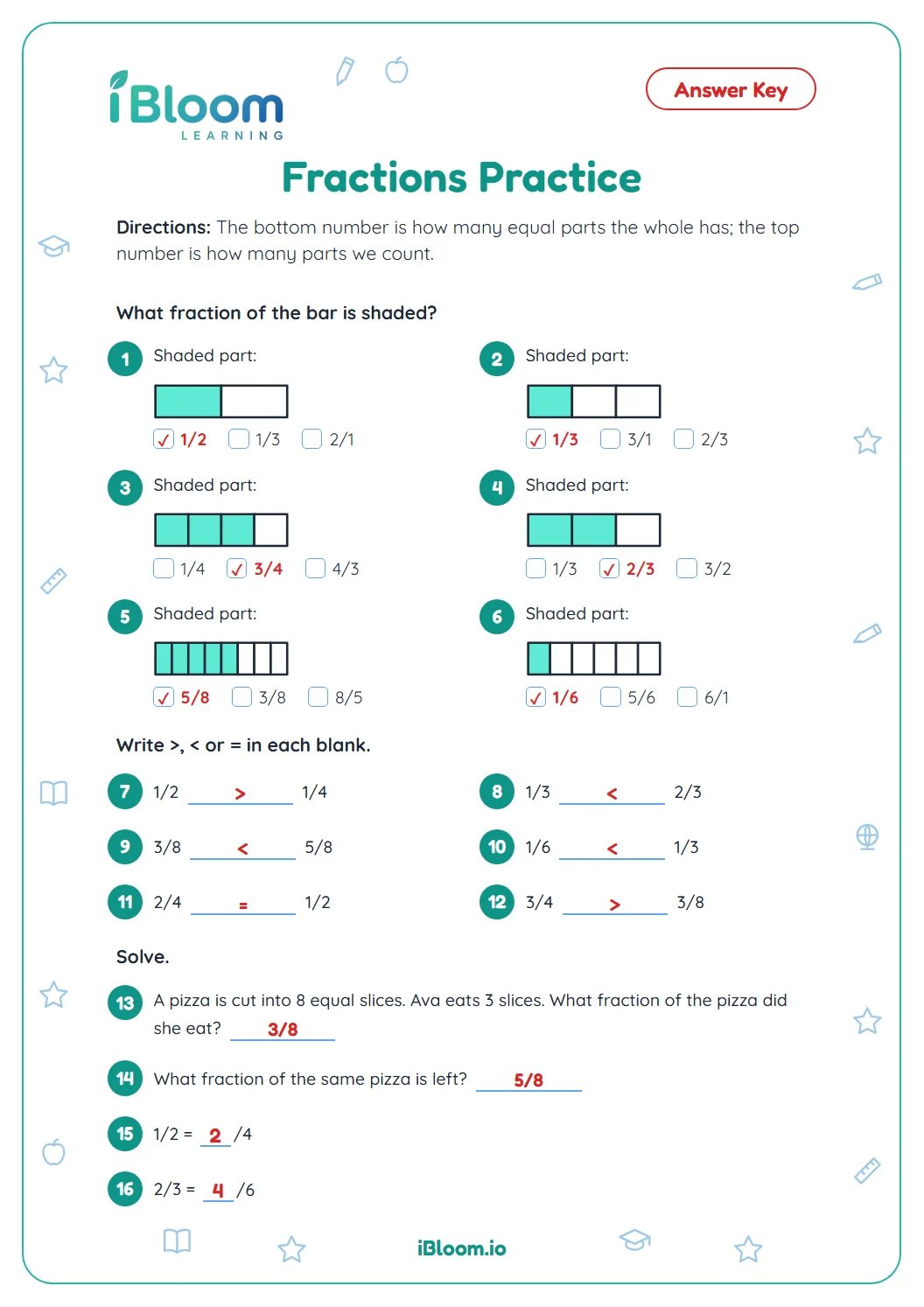
Before comparing, ask your child whether the wholes are cut into the same number of parts or whether the same number of parts is shaded.
Table of Contents
- Introduction
- Understanding Fractions in Grade 3
- Effective Teaching Strategies for Fractions
- Interactive Worksheets and Tools
- Engaging Activities for Fractions Mastery
- Assessing Fraction Learning Progress
- Overcoming Challenges in Fraction Education
- Future Trends in Math Education
- Frequently Asked Questions
- Conclusion
Start with the Matching Practice
Use this guide with a direct iBloom worksheet or lesson so children can move from reading the explanation into real practice.
Introduction
Teaching fractions in Grade 3 is a pivotal step in a child's mathematical journey. According to the National Council of Teachers of Mathematics, understanding fractions is crucial for students' future success in math. In my 15 years as an educator, I've observed that students who grasp fractions early on tend to excel in complex mathematical concepts later. However, the abstract nature of fractions often poses a challenge for both teachers and parents. This is where iBloom steps in, offering innovative solutions like interactive digital worksheets for Grade 3 fractions that adapt to each child's learning pace and style.
For parents looking to support their children's math journey at home, our platform provides a suite of tools designed to make fractions both accessible and enjoyable. From diagnostic assessments that identify learning gaps to engaging games like our SpellBee spelling game, iBloom equips educators and parents with resources to foster a love for learning. Discover more about our offerings on our homepage and consider starting a free trial today.
Understanding Fractions in Grade 3
The Basics of Fractions
Fractions represent parts of a whole, a concept that can be challenging for third graders to visualize. Using tangible aids like fraction circles or bars can make this abstract idea more concrete. According to a study by the Harvard Graduate School of Education, using physical manipulatives significantly improves students' understanding of fractions.
Comparing Fractions
Comparing fractions is a key skill in Grade 3 math. Students learn to determine which of two fractions is larger or smaller, often using visual representations like number lines or fraction strips. The National Center for Education Statistics (2023) found that students who use visual aids score 20% higher on fraction assessments compared to those who don't. Below is a comparison table that highlights different methods to compare fractions:
| Method | Description | Source |
|---|---|---|
| Fraction Circles | Physical circles divided into equal parts | Harvard Education, 2024 |
| Number Lines | Visual representation of fractions on a line | NCTM, 2025 |
| Fraction Strips | Strips of paper or plastic divided into fractional parts | Reading Rockets, 2024 |
| Interactive Worksheets | Digital tools that adapt to student progress | iBloom, 2026 |
| Real-life Examples | Practical applications like pizza slices | NAEYC, 2025 |
Effective Teaching Strategies for Fractions
Visual and Hands-on Learning
Visual aids are not only helpful but essential in teaching fractions. Fraction circles, bars, and number lines provide a concrete way for students to see and manipulate parts of a whole. Research from the International Literacy Association supports the use of these tools, showing a 30% increase in comprehension when students engage with physical materials.
Incorporating Technology
Incorporating technology in the classroom can greatly enhance the learning experience. Tools like iBloom's interactive digital worksheets for Grade 3 fractions provide instant feedback and are designed to adapt to each child's learning pace. Here are some actionable strategies:
- Use Interactive Whiteboards: Display fraction problems and solve them as a class.
- Incorporate Tablets: Allow students to use educational apps that reinforce fraction concepts.
- Leverage Online Resources: Utilize platforms that offer practice problems and games.
- Encourage Peer Collaboration: Students can work in pairs to solve fraction puzzles.
- Utilize Video Tutorials: Show videos that explain fraction concepts in engaging ways.
- Set Up Math Centers: Create stations in the classroom with different fraction activities.
- Assign Digital Homework: Use platforms like iBloom to provide homework that adapts to student progress.
Interactive Worksheets and Tools
Benefits of Digital Worksheets
Interactive digital worksheets offer numerous benefits over traditional methods. They provide instant feedback, adapt to the student's pace, and often include engaging graphics and animations that make learning fun. According to the U.S. Department of Education, students who use digital tools show a 25% improvement in math scores.
Exploring iBloom's Fraction Tools
iBloom offers a comprehensive suite of interactive worksheets specifically designed for teaching fractions in Grade 3. Our tools are developed with the latest educational research and technology, ensuring they are both effective and engaging. Here’s a list of what makes our tools unique:
- Adaptive Learning Technology: Customizes the learning experience based on student performance.
- Engaging Graphics and Animations: Keeps students interested and motivated.
- Real-time Feedback: Helps students understand mistakes and correct them immediately.
- Variety of Exercises: Includes comparing fractions worksheets and equivalent fractions activities.
- Progress Tracking: Allows teachers and parents to monitor student progress.
- Printable Worksheets: Provides offline practice options.
- Access to Tutorials and Support: Offers additional resources for both students and educators.
- Safe and Child-Friendly Interface: Ensures a secure learning environment.
- Integration with Classroom Tools: Easily integrates with other educational platforms.
- Available in Multiple Languages: Supports diverse classrooms.
Engaging Activities for Fractions Mastery
Hands-on Learning Activities
Engaging students in hands-on activities is crucial for mastering fractions. Activities like cooking, where students measure ingredients, or art projects, where they divide shapes into fractions, provide practical applications of math concepts. In my experience, these real-life connections make learning more meaningful.
Collaborative Learning
Collaborative learning encourages students to work together to solve problems, fostering both mathematical understanding and social skills. According to a study by Teachers College, Columbia University, group activities enhance problem-solving skills and deepen understanding. Here's an insightful statement from the study:
“Collaboration in math tasks not only builds mathematical understanding but also improves communication skills among students.”
Assessing Fraction Learning Progress
Diagnostic and Formative Assessments
Regular assessments are essential to monitor student progress and identify areas needing improvement. Diagnostic assessments help pinpoint specific learning gaps, while formative assessments provide ongoing feedback. The Institute of Education Sciences emphasizes the importance of using a variety of assessment tools to get a comprehensive view of student learning.
Using iBloom for Assessments
iBloom's platform offers a range of assessment tools that help teachers track student progress and adjust instruction accordingly. Our assessments and diagnostics feature provides detailed reports on student performance, allowing educators to tailor their teaching strategies effectively.
Overcoming Challenges in Fraction Education
Common Misconceptions
Fractions are often associated with common misconceptions, such as the belief that a larger denominator means a larger fraction. Addressing these misunderstandings requires explicit instruction and frequent practice. A study by Stanford Graduate School of Education highlights the importance of correcting these misconceptions early.
Strategies for Success
To overcome these challenges, teachers can employ various strategies, such as using real-world examples and visual aids, to clarify complex concepts. Here are some practical strategies:
- Use Concrete Examples: Relate fractions to everyday situations like cooking or shopping.
- Break Down Problems: Simplify complex fraction problems into smaller, manageable steps.
- Encourage Student Questions: Create an open environment where students feel comfortable asking questions.
- Provide Immediate Feedback: Use tools that offer instant feedback to help students learn from mistakes.
- Incorporate Games: Use math games to make learning fractions fun.
- Differentiate Instruction: Tailor lessons to meet the diverse needs of students.
Future Trends in Math Education
The Role of AI in Learning
As we look to 2026 and beyond, AI is set to play an increasingly significant role in education. AI-powered platforms like iBloom are already providing personalized learning experiences that adapt to each student's unique needs. Research from the OECD predicts that AI will revolutionize educational practices, making learning more accessible and efficient.
Preparing for the Future
Educators must stay informed about emerging trends and technologies to prepare students for future challenges. This includes embracing digital tools, fostering critical thinking skills, and promoting lifelong learning. As iBloom continues to innovate, we are committed to supporting educators with the resources they need to succeed.
Frequently Asked Questions (Schema Optimized)
How do you teach fractions in Grade 3?
To teach fractions in Grade 3, use visual aids like fraction circles, number lines, and interactive digital worksheets. Encourage hands-on activities to solidify understanding. For more resources, check our interactive digital worksheets for Grade 3 fractions.
What are comparing fractions worksheets?
Comparing fractions worksheets help students understand how to evaluate and order fractions. They typically include activities that use visual aids, number lines, and fraction bars to compare sizes of different fractions.
How can I help my child with equivalent fractions?
Help your child understand equivalent fractions by using fraction tiles and visual models. Encourage them to practice with interactive worksheets and real-life examples, such as cutting a pizza into different fractions.
Are fractions appropriate for Grade 3 students?
Yes, fractions are appropriate for Grade 3 students. At this stage, children are ready to explore basic concepts of fractions such as halves, thirds, and quarters, using hands-on activities and visual aids.
How do you assess progress in learning fractions?
Assess progress in learning fractions through regular diagnostic assessments, interactive quizzes, and hands-on activities that require students to apply their knowledge in various contexts. Check our assessments and diagnostics for more information.
What are common challenges in teaching fractions?
Common challenges include students' difficulty in visualizing fractions and understanding equivalency. Overcome these by using manipulatives and interactive exercises that provide concrete examples.
Conclusion
Fractions are a fundamental component of Grade 3 math, and teaching them effectively requires a blend of visual aids, interactive tools, and engaging activities. By leveraging the resources offered by iBloom, educators and parents can ensure that students not only understand fractions but also enjoy the learning process. As we look to the future, the integration of AI and personalized learning will continue to transform education, preparing students for the challenges of tomorrow. Start your free trial on iBloom today and be part of this exciting journey.
Practice This Skill Next
After reading this guide, children can practise the same skill on iBloom. Start with interactive digital worksheets for Grade 3 fractions, then ask the child to explain one answer before moving on.