How Do You Find a Missing Minuend in Subtraction?
A clear method for identifying the missing first number, proving why addition works, and avoiding the most common subtraction-equation mistake.
To find a missing minuend, add the subtrahend and the difference. In ? - 4 = 7, the missing first number is 4 + 7 = 11, because 11 - 4 = 7. Addition works because the missing minuend is the whole starting amount, while 4 and 7 are its two known parts.
The rule is short. The harder part is recognizing that the blank represents the starting amount. Before choosing an operation, ask whether the unknown is the whole, the amount removed, or the amount left.
First, Locate the Unknown
A subtraction equation has three positions:
minuend - subtrahend = difference
The minuend is the starting amount. The subtrahend is the amount taken away. The difference is the amount left or the distance between quantities.
Compare three equations:
- ? - 4 = 7 has a missing minuend, or starting whole.
- 11 - ? = 7 has a missing subtrahend, or removed part.
- 11 - 4 = ? has a missing difference, or remaining part.
The numbers can be identical while the blank moves. A child who reacts only to the minus sign may subtract the two visible numbers and choose the wrong operation. A child who names the role of the blank can reason from the quantities.
The Illustrative Mathematics Grade 1 task includes take-from stories with the result, change, and start in the unknown position. The action in a story therefore does not always tell a learner which calculation will most easily reveal the answer.
Why Addition Finds the Missing Minuend
Suppose a box held some crayons. Four crayons were removed, and seven remained. The unknown box amount must include both groups: the four removed crayons and the seven still present. Combine those parts: 4 + 7 = 11. Then check the original subtraction: 11 - 4 = 7.
This does not turn subtraction into an unrelated problem. It reconstructs the whole from two known parts. Achieve the Core's Grade 1 coherence map describes subtraction as an unknown-addend problem. The same three quantities can be related by addition and subtraction.
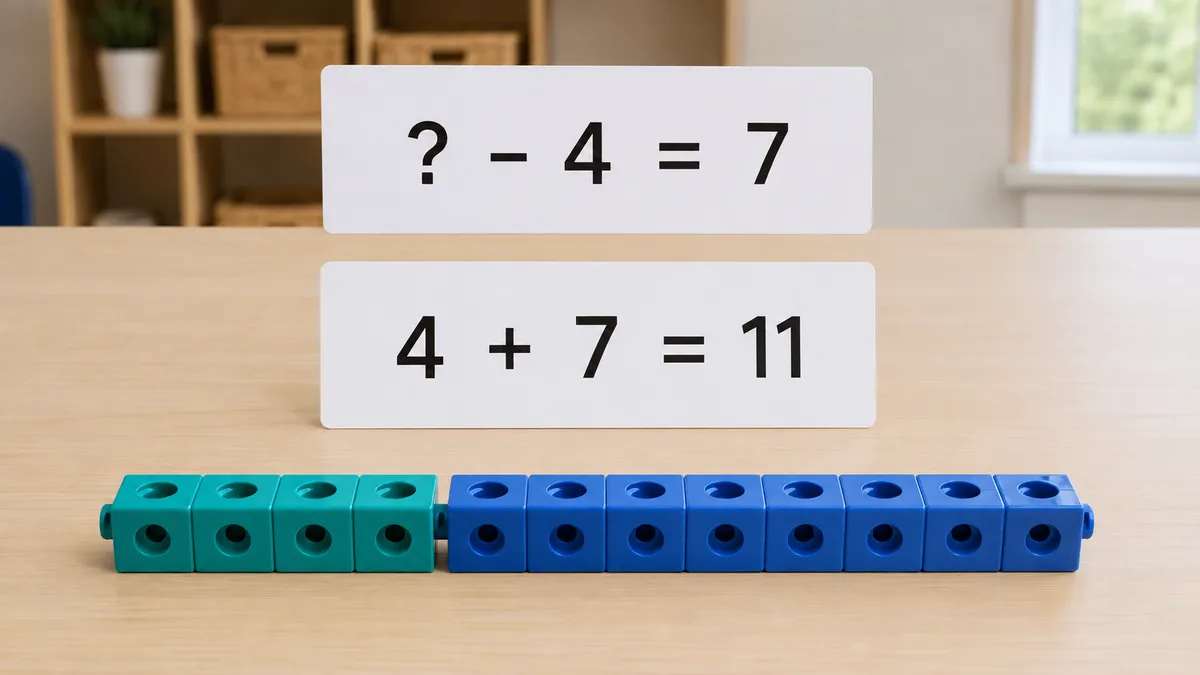
The unknown starting amount is the whole, so combine the removed part and amount left: 4 + 7 = 11.
Use “whole equals part plus part” before asking a child to memorize a formula. Once the relationship is secure, the child can summarize it as:
minuend = subtrahend + difference
Build a Bar Model
Draw one long bar for the unknown starting amount. Split it into two sections. Label one section 4 for the removed amount and the other 7 for the amount left.
The full bar is unknown, but both sections are known. Adding their lengths gives 11. The original equation then becomes 11 - 4 = 7.
Ask:
- Which bar represents everything at the start?
- Which part was removed?
- Which part remained?
If both smaller parts are known and the long bar is missing, add the parts. If the long bar and one part are known, subtract to find the other part. This visual decision is safer than using “add the visible numbers” as a rule for every blank.
Act Out a Start-Unknown Story
Start-unknown stories help when symbols alone do not explain why addition is needed.
Ava had some stickers. She gave 3 stickers to Leo. Ava had 8 stickers left. How many stickers did she have at the start?
Place 8 counters on the table for the stickers left. Place 3 more beside them for the stickers given away. Ask, “What two groups were inside Ava's starting collection?” Join the groups to make 11.
Now write:
- ? - 3 = 8 records the story.
- 3 + 8 = 11 finds the unknown whole.
- 11 - 3 = 8 checks the result.
The first equation describes what happened. The second is an efficient way to solve. The third verifies that the answer fits the original situation.
A Reliable Four-Step Method
1. Name each known number
In ? - 6 = 9, 6 is removed and 9 remains. Do not calculate yet.
2. Decide whether the blank is a whole or part
The blank is before the minus sign, so it is the starting whole.
3. Combine the known parts
Calculate 6 + 9 = 15.
4. Substitute and check
Calculate 15 - 6 = 9. If the check reproduces the given difference, the missing minuend is correct.
The method also works with larger numbers. For ? - 28 = 45, calculate 28 + 45 = 73, then verify 73 - 28 = 45. Use written addition if the numbers are difficult to hold mentally.
Five Worked Examples
Example 1: Within 10
For ? - 2 = 5, the blank is the starting whole. Combine the removed and remaining parts: 2 + 5 = 7. Check: 7 - 2 = 5.
Example 2: Make ten
For ? - 7 = 6, add 7 + 6. Move 3 from 6 to 7 to make 10, then add the remaining 3. The answer is 13. Check: 13 - 7 = 6.
Example 3: Two-digit numbers
For ? - 24 = 38, add the known parts: 24 + 38 = 62. Check: 62 - 24 = 38.
Example 4: A story without the word “left”
Some students were on a bus. Nine students got off. Fourteen students continued to school. How many students were on the bus before the stop?
The bus began with an unknown whole. The known parts are the 9 who got off and the 14 who continued. Add 9 + 14 = 23. Check: 23 - 9 = 14.
Example 5: Zero removed
For ? - 0 = 12, the removed part is zero and the remaining part is 12. Add 0 + 12 = 12. Check: 12 - 0 = 12.
Do Not Use One Rule for Every Blank
“Add the two visible numbers” works when the minuend is missing. It does not work for every subtraction blank.
For 14 - ? = 9, the whole is known. The blank is a missing part, so calculate 14 - 9 = 5. Check: 14 - 5 = 9.
For 14 - 5 = ?, the difference is missing, so calculate 14 - 5 = 9.
| Unknown position | Example | What is missing | Helpful calculation |
|---|---|---|---|
| Minuend | ? - 5 = 9 | Starting whole | 5 + 9 |
| Subtrahend | 14 - ? = 9 | Removed part | 14 - 9 |
| Difference | 14 - 5 = ? | Remaining part | 14 - 5 |
For targeted practice with the second position, use iBloom's missing-subtrahend worksheets. To compare the same part-whole relationship in addition, see Grade 1 missing-addend worksheets.
Common Mistakes and What They Reveal
Subtracting the visible numbers
A child sees ? - 4 = 7 and calculates 7 - 4 = 3. Do not respond only with “Use addition.” Build the situation with counters. The starting group cannot be smaller than the seven counters remaining. That reasonableness check exposes the problem with 3.
Reversing the check
A child finds 11 but checks 4 - 11. Return to the original order. The unknown replaces the first position, so the check is 11 - 4 = 7.
Treating equals as “the answer comes next”
In 7 = ? - 4, the same relationship is written with the difference first. Both sides of the equals sign have the same value. Rewrite it as ? - 4 = 7 without changing the meaning.
The Illustrative Mathematics 1.OA.D.8 standard page includes determining an unknown whole number in addition or subtraction equations relating three whole numbers.
Memorizing vocabulary without seeing quantities
Some learners can recite “minuend, subtrahend, difference” but still choose the wrong operation. Return to a whole bar split into two parts. Vocabulary should label a relationship the learner can point to.
Skipping the check
Addition can be calculated incorrectly. Substituting the result into the original equation catches errors and reinforces the inverse relationship.
A Five-Minute Teaching Routine
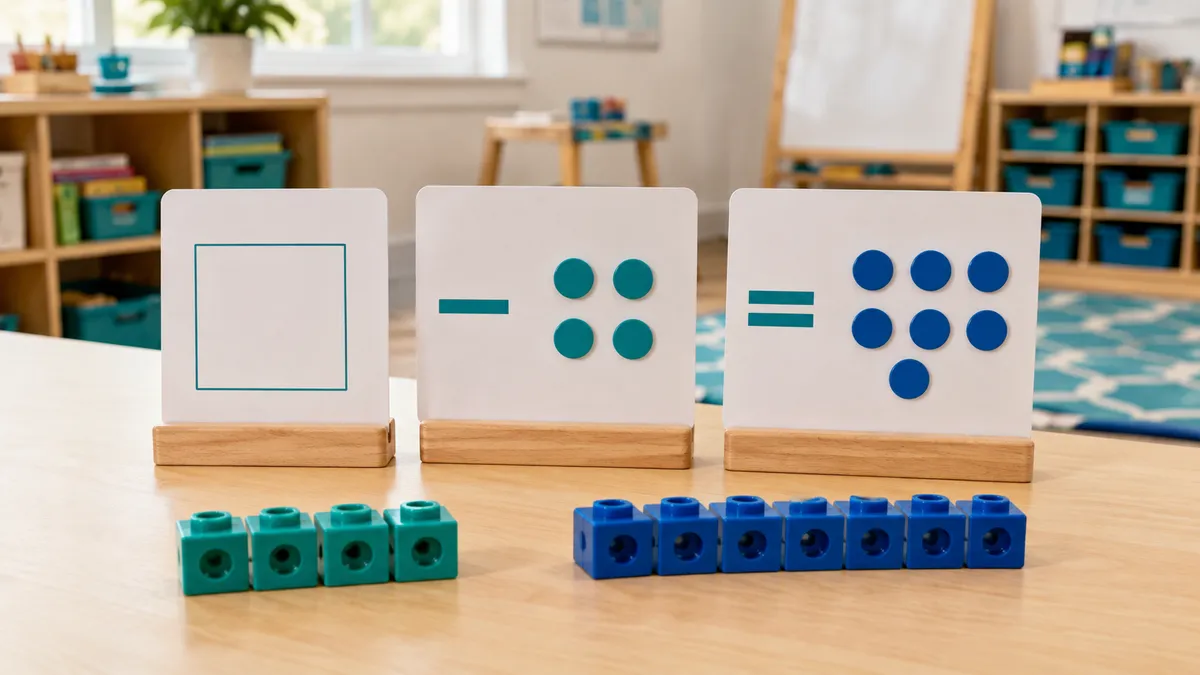
Use three cards: a blank card, a removed quantity, and an amount-left quantity.
- Show ? - 3 = 6.
- Identify the starting whole, removed part, and remaining part.
- Build 3 counters and 6 counters as separate groups.
- Join the groups and count 9.
- Replace the blank with 9.
- Remove 3 counters from 9 to verify that 6 remain.
- Move the blank to another position and discuss why the operation changes.
Keep the numbers small until the learner can explain the structure. Then increase the numbers without changing the story type.
Turn Equations Into Stories
Ask a learner to write a start-unknown story for ? - 5 = 8. A correct story must begin with an unknown quantity, remove 5, and end with 8.
For example: A jar held some buttons. Five buttons were used. Eight buttons remained. How many buttons were in the jar at first?
Ask the child to draw a bar model and write 5 + 8 = 13. Creating the story tests understanding more deeply than repeating “add the visible numbers.”
iBloom's Grade 1 subtraction word-problem guide offers related interpretation practice. The free printable worksheet library supports broader review after the learner understands which quantity is unknown.
When Should a Child Use Objects?
Use counters, cubes, or drawings when the learner cannot explain the first number, believes a starting amount can be smaller than the amount left, repeatedly subtracts the visible numbers, confuses a missing minuend with a missing subtrahend, or cannot connect the addition answer to the subtraction check.
Objects are not only for obtaining an answer. They make the hidden starting whole visible. Gradually move from objects to drawings, from drawings to a bar model, and from the bar model to equations.
Quick Practice With Answers
Name the unknown role before calculating:
- ? - 3 = 5
- ? - 8 = 6
- ? - 12 = 15
- ? - 20 = 34
- ? - 0 = 19
Answers:
- 3 + 5 = 8
- 8 + 6 = 14
- 12 + 15 = 27
- 20 + 34 = 54
- 0 + 19 = 19
Check each answer in the original subtraction equation. If a check fails, review the addition rather than changing the structural rule.
Parent and Teacher Prompts
Useful prompts keep attention on quantities:
- What did we have at the start?
- Which amount was removed?
- Which amount stayed?
- Is the blank the whole or one part?
- Can the starting amount be smaller than the amount left?
- Which addition equation uses the same three numbers?
- How can you place your answer back into the original equation?
Avoid asking only, “What operation do you see?” The visible minus sign describes the relationship, but the unknown position determines the most direct solving operation.
Progress From Concrete to Abstract
Begin by acting out a story with counters. Next, draw the same two parts inside a whole bar. Then label the bar with an equation. Finally, solve a bare equation without materials.
Do not remove models according to age alone. Remove them when the child can explain why the known parts combine to make the missing starting whole. A model remains useful whenever it reveals a misunderstanding.
Mix the unknown positions after the learner succeeds with several missing-minuend examples. Present ? - 4 = 7, then 11 - ? = 7, then 11 - 4 = ?. Ask what changed and what stayed the same. The three numbers form one fact family, but each blank asks for a different quantity.
Frequently Asked Questions
What is a minuend?
The minuend is the quantity from which another quantity is subtracted. In 12 - 5 = 7, 12 is the minuend.
What operation finds a missing minuend?
Add the subtrahend and difference. For ? - 5 = 7, calculate 5 + 7 = 12.
Why is the missing minuend usually larger?
In whole-number take-away situations, the starting whole contains both the amount removed and the amount remaining. It is at least as large as either part.
Is a missing minuend the same as a missing addend?
The positions have different names, but they can express the same part-whole relationship. Solving ? - 4 = 7 by writing 4 + 7 = ? turns the missing starting whole into the sum of two known addends.
How should a child check the answer?
Put the answer into the blank and perform the original subtraction. If ? - 4 = 7 gives 11, verify 11 - 4 = 7.
Should children memorize “subtrahend plus difference”?
The phrase can help after the model makes sense. First ensure the child can identify the whole and two parts with a story, objects, or a bar model.
The One-Sentence Test
Before calculating, ask the child to complete: “The blank is the ______.” If the answer is “starting whole” or “minuend,” add the amount removed and the amount left, then substitute the result into the original subtraction equation to check it.
Related practice
Practice this topic
Continue with a lesson, generator, or printable worksheet.