Kindergarten Reading Assessment Checklist
A practical kindergarten reading assessment checklist for phonological awareness, letters, sounds, fluency, comprehension, and home practice.
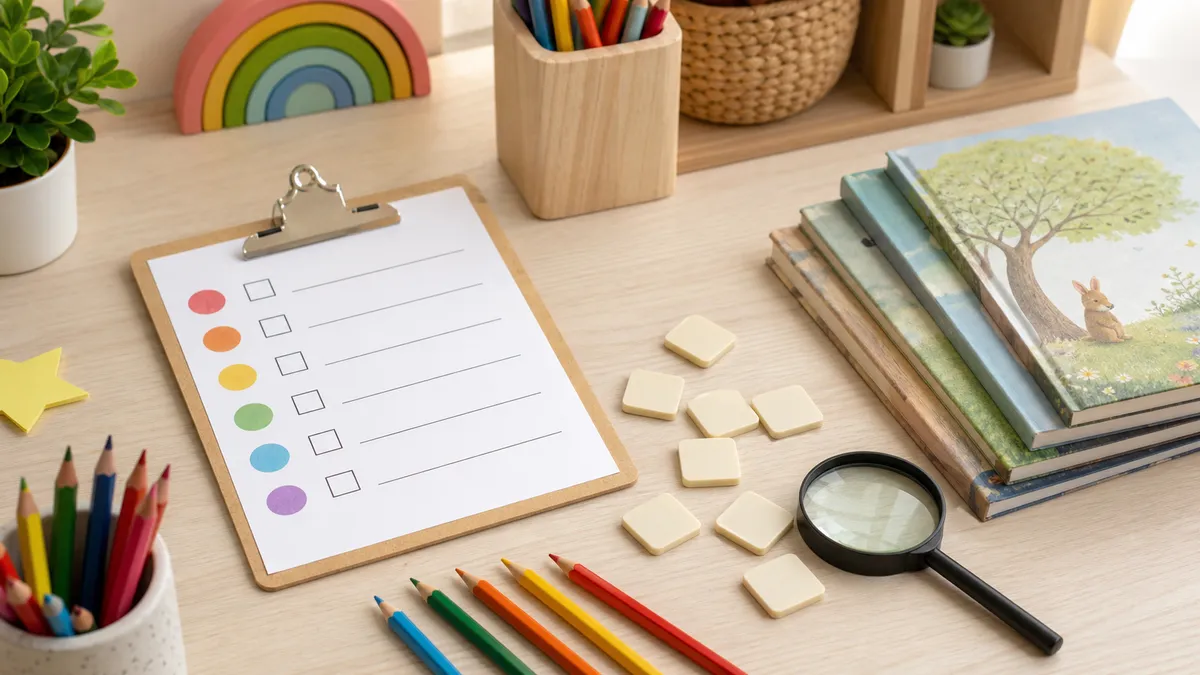
Kindergarten Reading Assessment Checklist is a practical guide for parents, kindergarten teachers, tutors, and early readers. It targets kindergarten reading assessment while staying useful for real children, not only for adults searching for a resource. Use it as a lesson-planning guide, a parent support page, a tutoring routine, and a bridge into the most relevant iBloom lessons, worksheets, and blog resources.
Table of Contents
Key Takeaways
- Kindergarten Reading Assessment Checklist should connect direct teaching, child-friendly examples, and short repeated practice.
- Parents should ask children to explain how they know, not only whether an answer is correct.
- Teachers can use this topic for whole-class modeling, small-group review, and quick checks.
- Internal iBloom practice should be used throughout the week, not placed only at the end.
- Strong outside references can guide adult decisions while iBloom pages give the child the practice path.
Why This Topic Matters
kindergarten reading assessment has value because it answers a real learning need. A parent wants a calm way to help after school. A teacher wants a page that supports instruction without overloading students. A tutor wants quick evidence of what the child understands. The best routine gives children examples, lets them try, asks for explanation, and then moves them to a related practice page such as Free Kindergarten Phonics Worksheets or Kindergarten Readiness Assessment Strategies.
Authoritative sources support this kind of explicit, connected practice. See https://ies.ed.gov/ncee/WWC/PracticeGuide/21/Published for the core source behind this article, https://ies.ed.gov/ncee/wwc/PracticeGuide/30 for related adult guidance, and https://ies.ed.gov/ncee/wwc/practiceguide/6 for a second research or standards reference. These sources help adults plan instruction; the iBloom links help children do the work.
What a Kindergarten Reading Assessment Should Notice
A useful kindergarten reading assessment checklist does not label a child by one score. It notices readiness for print, oral language, phonological awareness, letter knowledge, sound-symbol links, early decoding, listening comprehension, and confidence. The IES foundational reading practice guide recommends teaching academic language, linking speech sounds to letters, teaching decoding and word recognition, and ensuring students read connected text. Those areas make a practical checklist for parents and teachers.
| Area | What to observe | Child-friendly task |
|---|---|---|
| Print awareness | The child tracks pages and words | "Show where I start reading." |
| Sounds | The child hears rhyme and first sounds | "What sound starts sun?" |
| Letters | The child names common letters | "Find m on this page." |
| Early reading | The child blends simple sounds | "Read or build a simple word." |
| Meaning | The child talks about the story | "Who was in the story and what happened?" |
Assessment Without Pressure
The best checklist feels like a conversation. Read a short book, ask one sound question, ask one letter question, and ask one meaning question. If the child is tired, stop. The IES Preparing Young Children for School guide also reminds educators to support broad early learning, including language, executive function, math, and social-emotional foundations. Use iBloom resources such as Free Kindergarten Phonics Worksheets, Kindergarten Readiness Assessment Strategies, and Effective Reading Practice Strategies to connect assessment notes to actual practice.
What Parents and Teachers Can Do Next
If a child misses letter sounds, practise two or three sounds at a time. If the child knows sounds but cannot blend, use short oral blending games. If the child reads words but cannot retell, pause for story talk. If the child speaks confidently but writes little, let oral language lead first. A checklist is useful only when it guides the next kind, specific step.
How to Use the Guide
Begin with one clear goal. Do not ask a child to master every subskill at once. Model a short example, let the child try a similar item, ask for an explanation, and then choose one iBloom next step. For many families, the best sequence is: read or model for two minutes, practise for eight to twelve minutes, explain one answer, and stop before the child becomes tired.
Teachers can use the same structure in class. The first round is adult modeling. The second round is partner talk. The third round is independent practice. The fourth round is a quick check: one sentence, one clue, one model, one number, one word, or one explanation, depending on the topic.
Practice Examples
Example 1: The adult starts with a simple item and thinks aloud. The child hears how a strong learner approaches the task.
Example 2: The child tries a medium item. The adult asks, "What helped you decide?" The answer can be spoken before it is written.
Example 3: The child returns to the item after a short break and checks the answer. This matters because durable learning comes from retrieval and explanation, not only from first exposure.
For extra iBloom practice, move naturally between Explaining Kindergarten Readiness Assessment, Effective Reading Practice Strategies, and English Worksheets. These links should feel like the child's next step, not a separate list.
Parent Routine
Parents can keep this topic short and warm. Use a notebook, an iBloom page, a library book, a school assignment, or a printed worksheet. Ask the child to try one item, explain one decision, and correct one mistake gently. If the child is confident, add a challenge. If the child is frustrated, return to an easier example and let success rebuild attention.
Teacher Routine
Teachers can connect this topic to mini-lessons, centers, morning work, homework review, or intervention groups. The key is to make thinking visible. Ask students to underline evidence, build the number, say the sound, read the sentence, clap syllables, compare digits, or retell the story. The exact action changes by topic, but the classroom habit stays the same: show the thinking, not only the answer.
Regional Learning Notes
Families in India, the United States, and the UAE can use this guide without changing the learning goal. In India, examples can connect to CBSE, ICSE, and state-board routines in Delhi, Mumbai, Bengaluru, Chennai, Hyderabad, Pune, Kolkata, Ahmedabad, Jaipur, Lucknow, Kerala, Tamil Nadu, Karnataka, Maharashtra, Telangana, Gujarat, Rajasthan, and West Bengal. In the US, examples can connect to classroom and home practice in California, Texas, Florida, New York, Illinois, Pennsylvania, Ohio, Georgia, North Carolina, Michigan, Los Angeles, Houston, Chicago, Phoenix, Philadelphia, Dallas, Austin, Seattle, Boston, Denver, Atlanta, and Miami. In the UAE, the same routine works for Dubai, Abu Dhabi, Sharjah, Ajman, Ras Al Khaimah, Fujairah, Umm Al Quwain, and Al Ain families across British, American, IB, and Indian curriculum settings.
Common Mistakes
One common mistake is giving too many examples before the child has processed the first one. Another is correcting the final answer without asking how the child thought about it. A third is using worksheets without discussion, or discussion without practice. Use the balance: model, practise, explain, revisit.
Frequently Asked Questions
Who is Kindergarten Reading Assessment Checklist for?
It is for parents, teachers, tutors, and children who need a clear routine around kindergarten reading assessment. It can support home learning, school review, tutoring, and independent iBloom practice.
How long should practice take?
Most children do well with ten to fifteen focused minutes. Stop after one strong explanation rather than stretching the session until attention fades.
Which iBloom page should I use first?
Start with Free Kindergarten Phonics Worksheets when the child needs the main cluster page. Use Kindergarten Readiness Assessment Strategies when the child needs immediate practice.
How can teachers adapt this for groups?
Use a short model, partner explanation, independent item, and exit check. The group routine should give every student a chance to explain one choice.
What should parents do after a mistake?
Ask the child to reread, rebuild, resay, or retry the item. Then ask, "What changed your thinking?" This keeps correction gentle and useful.