Lines Rays and Line Segments Worksheets
Help children identify lines, rays, segments, points, parallel lines, and perpendicular lines with examples.
Free printable worksheet
Free lines, rays and line segments worksheet
This two-page printable has 14 geometry questions for Grade 4: six figures to name as a line, ray, line segment, or parallel, perpendicular or intersecting lines, six questions on endpoints and how lines meet, and two sentences to complete. Page 2 is the answer key.
- Free PDF download
- Answer key included
- Ready to print
Free to print and use at home or in class. How to use this worksheet
Lines Rays and Line Segments Worksheets is a practical guide for parents, teachers, tutors, and children who need helping children see geometry vocabulary as visual relationships instead of isolated terms. It builds on iBloom's existing math pages while adding a narrower worksheet-focused path for children who need direct practice. Use it with Grade 4 Geometry Worksheets, Identifying Lines, Rays, Line Segments, Points worksheet, and the exact iBloom practice pages linked throughout this guide.
Free lines, rays and line segments worksheet
This two-page printable has 14 geometry questions for Grade 4: six figures to name as a line, ray, line segment, or parallel, perpendicular or intersecting lines, six questions on endpoints and how lines meet, and two sentences to complete. Page 2 is the answer key.
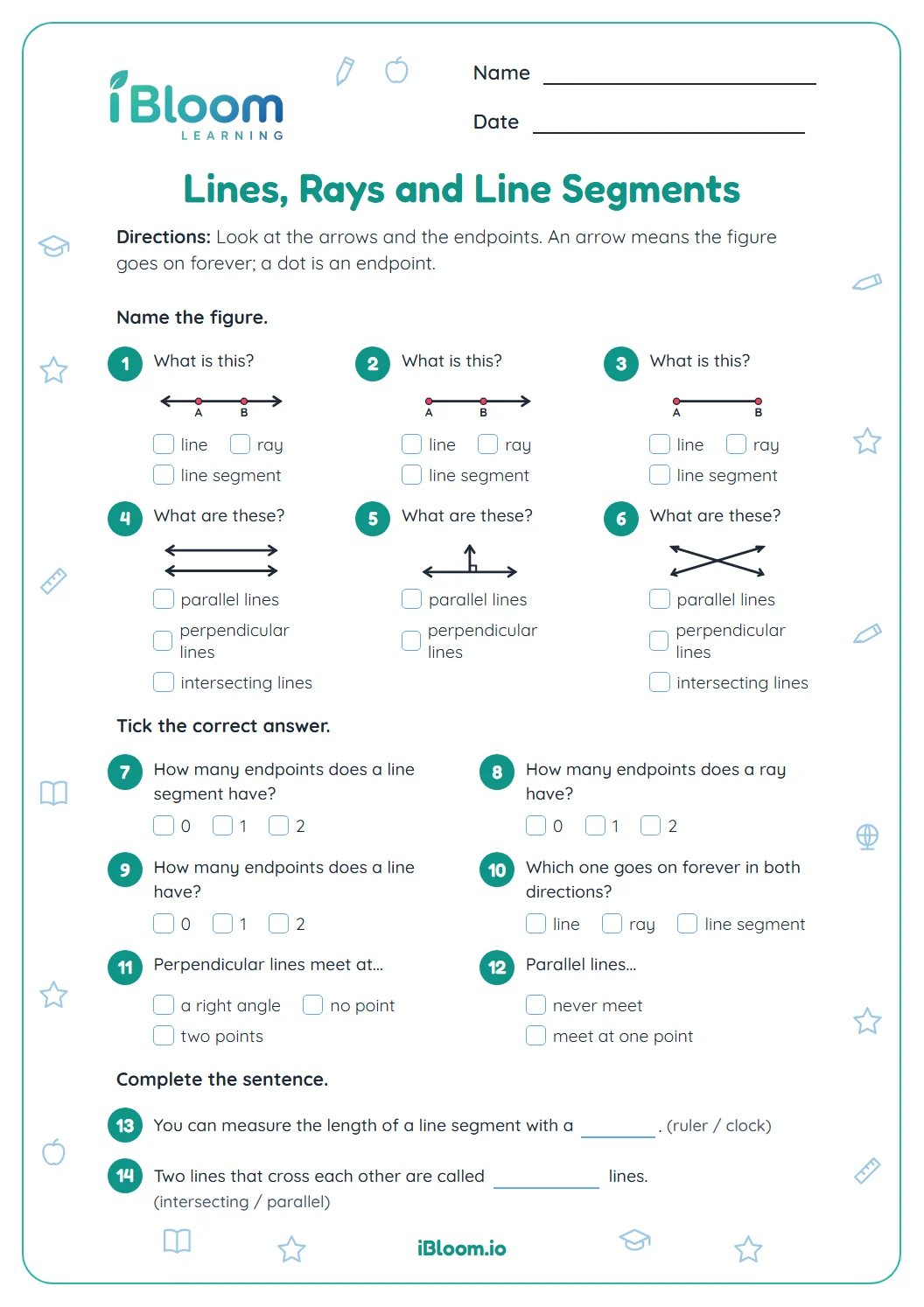
Download the free lines, rays and line segments worksheet PDF
Answer key preview
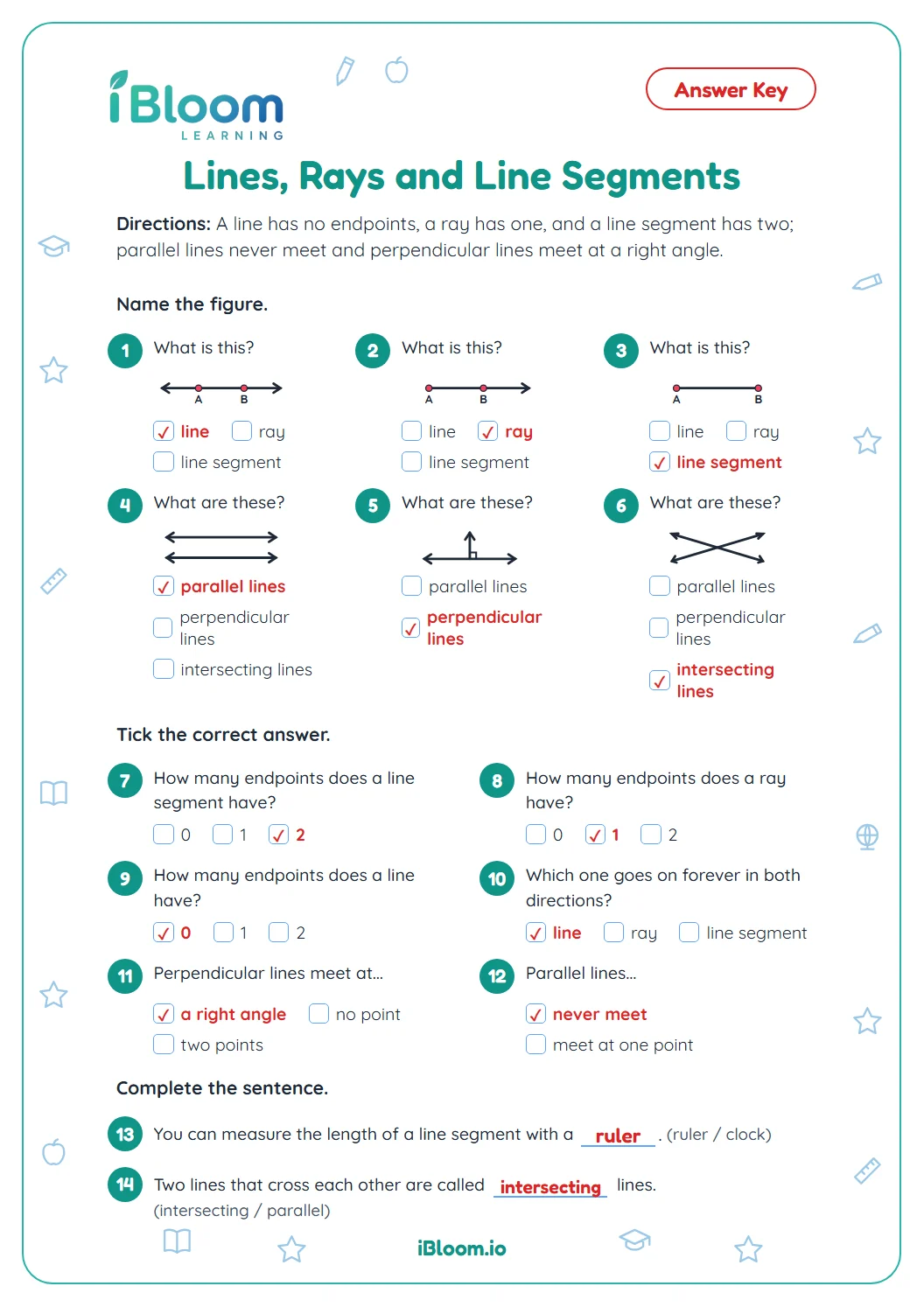
Ask your child to point to each endpoint and each arrow before naming the figure.
Start with the Matching Practice
Use this guide with a direct iBloom worksheet or lesson so children can move from reading the explanation into real practice.
Table of Contents
Worksheet And Lesson Previews
Identifying Lines, Rays, Line Segments, Points Worksheets for Fourth Grade Preview
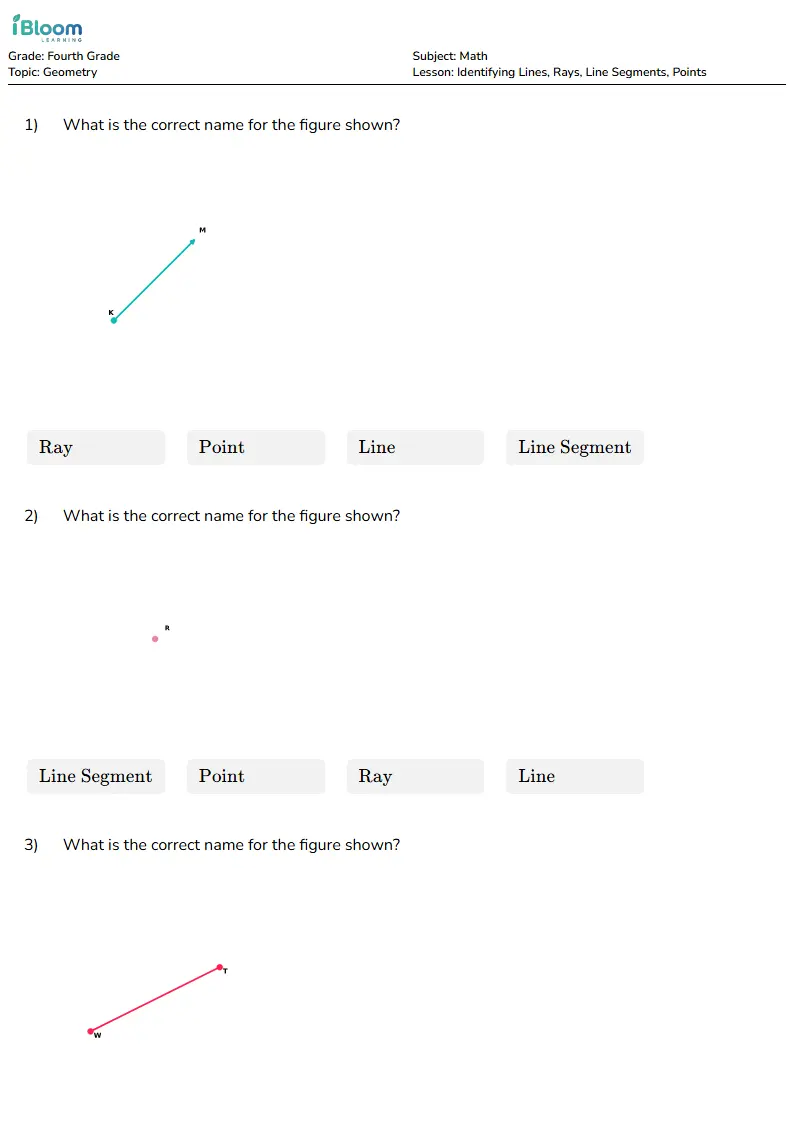
Use this preview to see the kind of practice children will open before you start the routine.
Identifying Lines, Rays, and Line Segments Worksheets for Class 4 Preview
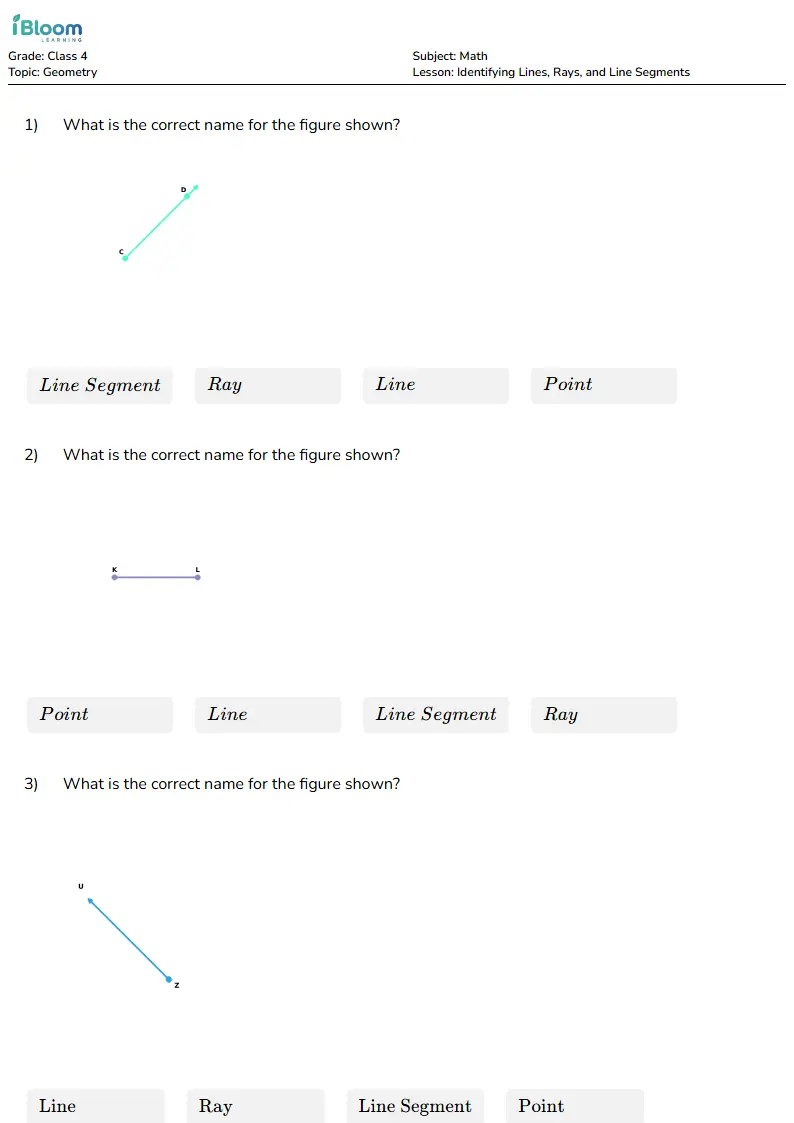
Use this preview to see the kind of practice children will open before you start the routine.
Exploring Perpendicular, Parallel, Intersecting Lines Worksheets for Third Grade Preview
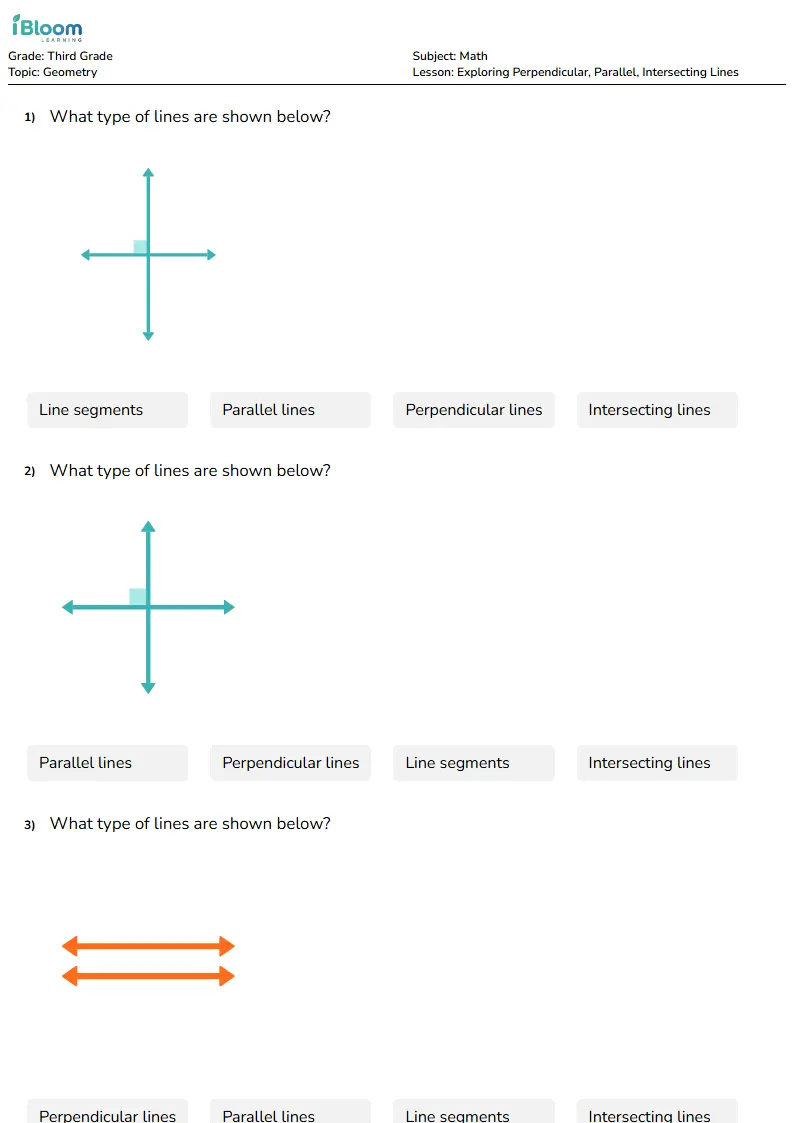
Use this preview to see the kind of practice children will open before you start the routine.
Key Takeaways
- Children learn lines rays and line segments worksheets best when they can explain the visual clue, not only mark an answer.
- A useful worksheet moves from concrete examples to independent questions.
- Parents can help by asking, "What part of the model proves your answer?"
- Teachers can improve retention with short think-alouds, partner checks, and repeated visual language.
- iBloom practice works well when linked with related lessons, worksheet pages, and grade-level hubs.
Why This Skill Matters
Math gets harder when children memorize a rule without understanding the picture behind it. Lines Rays and Line Segments Worksheets should help learners inspect a diagram, compare choices, and explain a step in their own words. That is especially important in grade 4, where children meet more formal vocabulary, multi-step geometry, decimal place value, and measurement reasoning.
Resources from NCTM, IES mathematics practice guidance, and Math Learning Center apps support explicit instruction, visual models, and repeated reasoning. The goal is to make each worksheet question a chance to explain mathematical structure, not just complete another page.
What a Strong Worksheet Should Include
A strong worksheet starts with one clear model. For angle work, that might be a labeled vertex and two rays. For lines and segments, it might be endpoints and arrow marks. For decimals, it might be a number line, tenths grid, or place-value chart. Children should see what matters before they are asked to choose or calculate.
It should also include different question types: identify, compare, measure, complete, explain, and correct a mistake. This variety prepares children for classroom work, homework, and assessments because they learn the idea from several angles.
Examples and Mini-Lessons
| Example | What Children Do | Why It Helps |
|---|---|---|
| A learner compares a ray and a segment by checking endpoints. | Notice the visual clue | It prevents guessing from memory |
| The class sorts cards into lines, rays, segments, parallel lines, and perpendicular lines. | Use a tool or model to check | It connects vocabulary to action |
| The explanation names the feature that proves the category. | Explain the reason | It turns a worksheet answer into understanding |
If a child answers too quickly, cover the choices and ask for the proof first. If a child knows the rule but misses the diagram, ask them to trace or point. If a child can solve orally but struggles to write, offer a sentence frame: "I know this because..."
Home Practice Routine
Parents can keep the routine short and calm:
- Open one iBloom page from the practice path.
- Solve one example together.
- Ask the child to point to the clue.
- Let the child solve two questions independently.
- End with one spoken explanation.
This routine works after school in Delhi, Mumbai, Bengaluru, Chennai, Hyderabad, Pune, Kolkata, Los Angeles, Houston, Chicago, Dallas, Seattle, Boston, Dubai, Abu Dhabi, Sharjah, Ajman, and Al Ain. The curriculum label may differ, but the learning routine stays the same: see the model, name the clue, solve, and explain.
Classroom and Tutoring Routine
Teachers can use Lines Rays and Line Segments Worksheets as a mini-lesson, station activity, homework bridge, or quick exit ticket. Model one example. Ask partners to explain a second example. Then move children to independent iBloom practice and review one common mistake at the end.
Tutors can use the same page diagnostically. A child who struggles to name the visual clue may need vocabulary support. A child who names the clue but chooses the wrong answer may need step-by-step reasoning. A child who solves correctly but cannot explain may need sentence frames and oral rehearsal.
Regional Practice Notes
In India, this supports CBSE, ICSE, and state-board math revision for Class 4 and nearby grades. In the United States, it fits fourth-grade math standards, classroom centers, small-group reteaching, and at-home practice. In the UAE, it supports British, American, IB, and Indian curriculum learners who may use different terms but still need the same visual reasoning.
iBloom Practice Path
- Start with Grade 4 Geometry Worksheets for the closest existing hub or related guide.
- Use Identifying Lines, Rays, Line Segments, Points worksheet for wider grade-level context.
- Practise directly with Class 4 Identifying Lines, Rays, and Line Segments worksheet.
- Add Exploring Perpendicular, Parallel, Intersecting Lines worksheet when the child needs a second worksheet format.
- Continue with Identifying Perpendicular and Parallel Sides worksheet for connected practice.
- Keep Angle Worksheets for Grade 4 as the next internal step.
Frequently Asked Questions
How often should children use lines rays and line segments worksheets?
Short, repeated practice works best. Ten minutes with explanation is usually more useful than a long worksheet completed silently.
What should parents ask when a child is stuck?
Ask, "What part of the model helps?" For geometry, this may be an endpoint, angle, side, or shape property. For decimals, it may be a place-value digit, grid, or number-line position.
Should children memorize definitions first?
Definitions help, but they should come with examples. A child should see, draw, point, and explain before relying on memory alone.
How can teachers use this in class?
Use one question as a think-aloud, one as a partner explanation, and one as independent practice. Then review a common mistake so children learn how to check their thinking.
Which iBloom page should I use next?
Choose the linked lesson or worksheet that matches the exact skill. If the child needs broader review, use the grade 4 geometry or decimals guide linked above.
Practice This Skill Next
After reading this guide, children can practise the same skill on iBloom. Start with Identifying Lines, Rays, Line Segments, Points worksheet or Class 4 Identifying Lines, Rays, and Line Segments worksheet, then ask the child to explain one answer before moving on.