What Is the Difference Between a Math Error and a Misconception?
A practical K-5 diagnostic guide for deciding whether wrong math work is a slip, a missing skill, or a stable incorrect idea.
What Is the Difference Between a Math Error and a Misconception?
A math error is usually a one-time slip: the student understands the idea but loses track of a sign, copies a number incorrectly, counts too quickly, or makes an arithmetic mistake. A math misconception is a repeatable but incorrect idea about how mathematics works. The difference matters because a slip often needs a quick check and another attempt, while a misconception needs the student to examine the idea, compare representations, and rebuild the concept.
One wrong answer cannot tell you which one you are seeing. The useful question is not simply, "Is this answer wrong?" It is, "What reasoning produced this answer, and does that reasoning appear again when the problem changes?" Parents and teachers can answer that question with a short diagnostic conversation rather than a long test.
This guide gives a practical routine for kindergarten through Grade 5. It also shows how to interpret common examples without labeling a child, overcorrecting every mistake, or guessing at a learning difficulty.
The Short Difference: Slip, Gap, or Misconception
It helps to sort incorrect work into three working categories. These are not diagnoses. They are starting points for choosing the next teaching move.
A math error is inconsistent with what the student knows
Suppose a second grader solves 47 + 26 correctly with base-ten blocks, explains that ten ones become one ten, and then writes 63 instead of 73 on one problem. If the student notices the mismatch when asked to estimate or solve it a second way, the error was probably a slip. The underlying place-value idea is present.
Other signs of a likely slip include:
- the student corrects it independently after rereading;
- the same strategy works on nearby problems;
- the explanation is mathematically sound even though the final computation is not;
- the mistake changes from one problem to another rather than following a stable pattern;
- fatigue, crowded handwriting, copying, or rushing plausibly explains what happened.
The response should be proportionate. Ask the student to locate the first line that no longer matches the plan, make the correction, and state one check to use next time. Re-teaching the entire unit after a single slip can communicate that a correctable mistake is a crisis.
A knowledge gap means a needed fact, word, or step is not secure yet
A student may understand multiplication as equal groups but not recall 7 x 8 efficiently. A child may understand a word problem but not know the meaning of difference. A student may know that regrouping is allowed but forget the written sequence. These are gaps rather than necessarily misconceptions.
Gaps often appear as hesitation, incomplete work, or reliance on a slow but valid method. The student may say, "I know what to do, but I cannot remember this fact," or produce a correct model while struggling with notation. A gap calls for targeted instruction or practice on the missing component, not a broad conclusion that the child does not understand math.
A misconception is a stable incorrect rule or model
A misconception produces a pattern. For example, a student may believe the denominator tells how many pieces are shaded, so the student names three shaded pieces out of eight as 8/3. Another student may subtract the smaller digit from the larger digit in each column, regardless of place value, because that invented rule seems to avoid regrouping. The response is internally consistent, but the governing idea is incorrect.
A misconception is more likely when the student:
- gives the same kind of wrong answer across several carefully varied problems;
- confidently explains an incorrect general rule;
- cannot reconcile the procedure with objects, drawings, a number line, or a reasonable estimate;
- returns to the same rule after a correction;
- succeeds only when the problem looks exactly like a memorized example.
The goal is not to make the student feel caught. It is to make the thinking visible. The National Council of Teachers of Mathematics position on formative assessment describes strategic questions, feedback, and student reflection as ways to obtain evidence about reasoning and adjust instruction. That is the purpose of the routine below.
Why One Wrong Answer Is Not Enough Evidence
An answer is the end of a process, not a record of the whole process. Two children can write 42 for 36 + 16 for completely different reasons. One may have added the ones correctly and then copied a 3 as a 2. Another may believe regrouped tens disappear. A third may have guessed after running out of time. Giving all three children the same correction misses the information in their reasoning.
The reverse problem also occurs: a correct answer can hide a misconception. A student who believes multiplication always makes numbers larger may still answer 4 x 5 correctly. A student who adds denominators when adding fractions can accidentally be right on an unusual example constructed poorly. Diagnosis therefore needs several forms of evidence: an explanation, a representation, a nearby problem, and a later check.
This is formative assessment in plain language: gather evidence while learning is still in progress, interpret it, and use it to decide the next step. A U.S. Department of Education review defines formative assessment as gathering, interpreting, and using evidence about learning to guide timely adjustments. The IES review of formative assessment in elementary school also notes that formative assessment can be quick and informal; it does not have to become another large test.
For families, the practical implication is simple: save the original work long enough to understand it. Erasing the answer before the child explains removes useful evidence. For teachers, avoid coding every incorrect item as the same skill failure. Look for patterns across tasks and representations.
A Five-Minute Diagnostic Routine
Use this routine after a wrong answer that seems important or repeatable. It works at a kitchen table, during a small-group lesson, or in a brief conference.
Step 1: Preserve the original thinking
Ask the student not to erase yet. Say, "Show me what you were thinking when you did this." Use a neutral tone. Avoid opening with "Why did you do that?" because children may hear it as blame rather than curiosity.
Write down the student's words if the explanation is hard to follow. A brief record such as "always subtract smaller digit" or "bottom number is pieces shaded" is more useful than a red X. It captures the proposed rule you need to test.
Step 2: Ask for a prediction before a procedure
Ask, "About what should the answer be?" or "Should the result be more or less than the number we started with?" Estimation can reveal whether the child understands the situation even when a calculation goes wrong.
For 47 + 26, a student might say the result should be a little more than 70. If the written answer is 63, the student now has evidence that something went wrong. For 3/8 of a set, ask whether the selected amount should be less than half. The prediction creates a reference point without giving away the answer.
Step 3: Change the representation
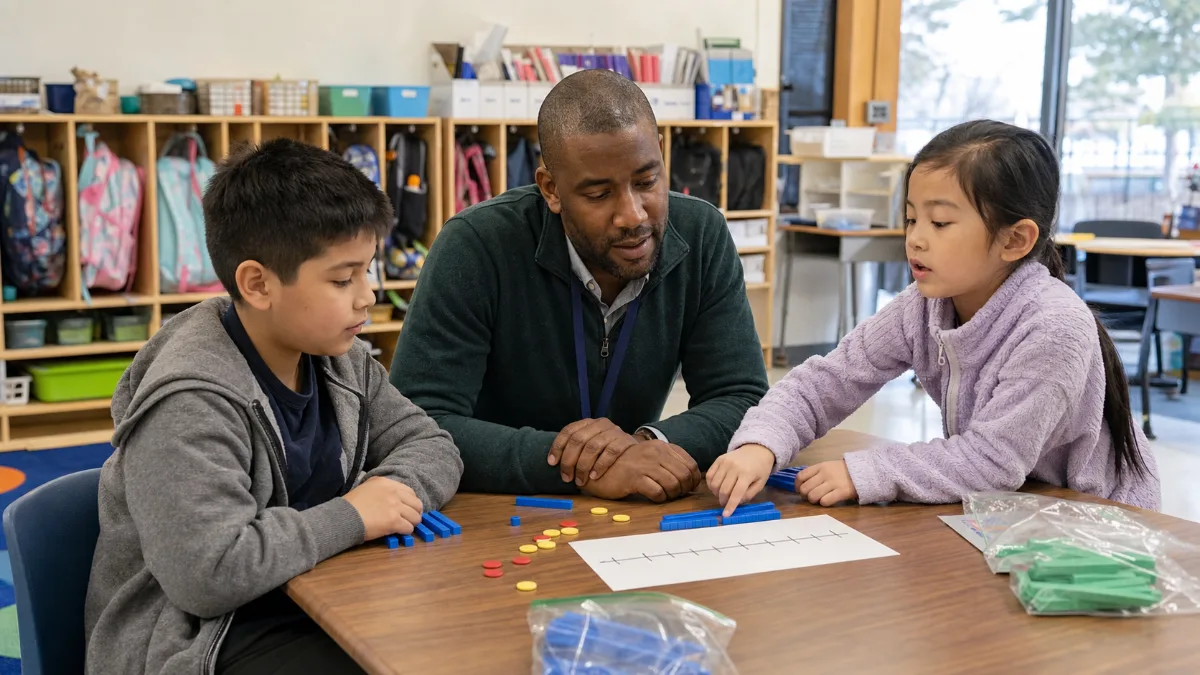
Move from symbols to objects, a drawing, a number line, a story, or spoken reasoning. The Institute of Education Sciences practice guide recommends concrete and semi-concrete representations as well as number lines for students who need mathematics support. The full set of recommendations appears in the IES elementary mathematics intervention practice guide.
Choose the representation that exposes the specific idea. For place value, bundle sticks or use base-ten blocks. For multiplication, build equal groups or an array. For fractions, partition identical wholes or sets. For word problems, act out what changes. Do not add several representations at once; the child needs to compare the symbol with one clear model.
For a first-grade place-value check, a student can use the understanding tens worksheet to connect a written numeral with grouped tens. The purpose is not extra volume. It is to see whether the numeral and the grouped model mean the same thing to the student.
Step 4: Vary one feature and keep the idea the same
Give two or three nearby examples, changing one feature at a time. This is the most important step for distinguishing a slip from a misconception.
If a child writes 51 - 28 as 37 by subtracting the smaller digit from the larger digit in each column, try 54 - 21, which does not require regrouping, and then 52 - 38, which does. Ask the student to model both. A child who understands subtraction but made a slip will usually adapt. A child using an incorrect digit-by-digit rule will reproduce the pattern.
If the topic is multiplication, compare 3 groups of 4 with 4 groups of 3, then ask the child to draw each arrangement. The third-grade repeated-addition worksheet provides a useful context for checking whether equal groups, addition, and multiplication notation are connected.
Step 5: Recheck after a delay
Immediate success after a hint does not prove that the idea has changed. Revisit one parallel problem later that day or during the next lesson. Do not announce that it is a test of the earlier error. Ask for a prediction, solution, and explanation again.
If the student uses the corrected idea independently, record that progress and move on. If the original rule returns, plan a short teaching sequence with contrasting examples and representations. A misconception often needs more than one correction because the incorrect rule previously seemed sensible to the learner.
Worked Example 1: Place Value and Regrouping
Consider this work:
  46
+ 27
----
  613
The student says, "Six plus seven is thirteen, so I wrote thirteen after the six and two." The answer shows more than a random arithmetic slip. It suggests that the student may not yet understand that ten ones must be renamed as one ten when writing a base-ten numeral.
Start with an estimate: 46 is near 50 and 27 is near 30, so the sum should be near 80, not a three-digit number. Then build 46 and 27 with tens and ones. Combine the ones and trade ten ones for one ten. Ask the child to point to where the new ten appears in the written method.
Next, use three contrasts:
- 42 + 25, where the ones do not make a new ten.
- 46 + 27, where the ones do make a new ten.
- 58 + 6, where adding a one-digit number still creates a new ten.
If the child handles the first but repeats the concatenation on the next two, the issue is probably conceptual, not simply careless writing. Practice should remain tied to place-value meaning. The second-grade addition with regrouping lesson can support a teacher-led explanation, while the matching two-digit addition worksheet can be used for a small, focused follow-up set.
Do not respond by assigning fifty nearly identical vertical problems. Repetition may make the student's invented rule faster. First establish why the trade preserves the quantity; then practice the procedure.
Worked Example 2: Multiplication as Equal Groups
A third grader answers 4 x 6 by writing 4 + 6 = 10. When asked, the student says, "The multiplication sign means put the two numbers together." This is a candidate misconception because the explanation states a general but incorrect rule.
Ask the student to build four groups with six counters in each. Count the total and write the repeated addition: 6 + 6 + 6 + 6. Then connect that sum to 4 x 6. Build six groups of four and compare the total. The child should notice that the arrangements differ but the total is the same.
Now vary the structure. Show three bags with five apples in each, an array with three rows of five, and the bare expression 3 x 5. Ask what remains the same. The central idea is the number of equal groups and the amount in each group, not the visual appearance of the objects.
For a second-grade bridge into this reasoning, the arrays word-problem lesson gives a context for coordinating rows, items per row, and total. For third grade, use a second example from the repeated-addition activity, then return to a new bare expression. If the student can move among story, array, repeated addition, and multiplication notation, the concept is becoming more flexible.
Worked Example 3: Fractions as Numbers and Parts
A third grader shades three of eight equal parts and labels the fraction 8/3. The child explains, "Eight is the whole, and three is shaded, so the whole number goes on top." The work is systematic. The student may know both relevant counts but have reversed their roles in fraction notation.
Begin without correcting the symbols. Ask the child to point to one equal part and explain what the eight tells us. Then ask what the three counts. Write a sentence: "Three of eight equal parts are shaded." Map the words to 3/8.
Use contrasts rather than a slogan alone:
- Keep eight equal parts but shade five.
- Keep three shaded parts but partition a second same-size whole into six equal parts.
- Show 3/8 on a set of eight counters and on an area model.
- Ask whether 3/8 should be less than or greater than one-half and why.
The third-grade fractions-in-a-group lesson can help test whether the student's meaning transfers from an area model to a set. The IES fractions toolkit demonstrates a broader principle for instruction: analyze student work and use visual representations to investigate misunderstandings rather than treating a fraction procedure as an isolated rule.
Be careful with language such as "top number" and "bottom number." Those location labels do not explain the quantities. Use numerator for the number of selected equal parts and denominator for the number of equal parts in one whole, while continually connecting both terms to a model.
Worked Example 4: Word Problems and Operation Choice
A first grader sees the word altogether and adds every time, even when the situation asks how many objects remain. This may be a learned keyword rule rather than an understanding of the quantities.
Give this situation: "Maya has 9 crayons. She puts 4 in a box. How many are still on the table?" Ask the child to act it out or draw before selecting an operation. Then change only the question: "Maya has 9 crayons on the table and 4 in a box. How many crayons does she have altogether?" The numbers are the same, but the relationship changes.
Ask three questions:
- What quantity do we know at the start?
- What changes or what parts are being combined?
- What quantity does the question ask us to find?
The student should learn to follow the quantities, not hunt for one trigger word. A younger learner can practice modeling with the kindergarten addition word-problem lesson. Then place an addition and subtraction situation side by side and ask what is different.
The IES elementary mathematics guide includes deliberate word-problem instruction among its recommendations. That supports teaching the structure of a problem explicitly; it does not support reducing every story to a keyword chart.
How Parents Can Respond Without Turning Homework Into a Test
Parents do not need to diagnose every mathematical issue. Their role is to gather a little evidence, keep the conversation safe, and communicate a clear pattern to the teacher when needed.
Use neutral prompts
Try these:
- "Tell me what this number means in your work."
- "What did you expect the answer to be about?"
- "Can you show it with objects or a quick drawing?"
- "Would your rule work on this nearby example?"
- "Which step are you most sure about?"
- "What changed between your first and second attempt?"
Avoid "You know this," "That is careless," or "The teacher must not have shown you." Those statements decide the cause before you have evidence. They can also make the child defend an answer instead of examining it.
Limit the diagnostic conversation
Five to ten focused minutes are usually more informative than a prolonged argument. If the child is upset, tired, or unable to explain, preserve the work and stop. Write a brief note to the teacher: "On three regrouping problems, Jordan subtracted the smaller digit from the larger digit in each column and explained that borrowing was optional. We modeled one example, but the same rule returned the next day."
That message is specific. It reports the task, pattern, explanation, support tried, and later result. It is more actionable than "Jordan does not understand subtraction."
Praise revision, not just speed
When a child changes an idea after seeing contradictory evidence, name the intellectual action: "You compared the model with your written answer and revised your rule." This does not celebrate being wrong for its own sake. It values the process that turns an error into learning.
The IES article Using Mistakes as a Vehicle for Learning in Mathematics describes instructional materials in which students examine worked examples marked right or wrong, explain the reasoning, and then solve a related problem. Families can use the same modest principle without making claims about a particular child's outcome: compare reasoning, explain what does or does not work, and apply the idea to a fresh example.
How Teachers Can Plan the Next Instructional Move
Group by reasoning, not only by wrong answer
During an exit ticket, several students may miss the same item for different reasons. Sort their work by the explanation or representation:
- computation slip after a valid setup;
- vocabulary or fact gap;
- place-value or operation misconception;
- unclear work that needs a brief interview.
The groups can then receive different next steps. The slip group checks and corrects. The gap group receives a short targeted review. The misconception group compares examples and representations. The unclear group explains one item aloud.
Use a minimal pair
A minimal pair contains two problems that look similar but require the student to notice one important difference. Examples include subtraction with and without regrouping, multiplication and addition using the same two numbers, or two fraction models with the same shaded count but different numbers of equal parts.
Ask, "What is the one difference that changes what we do?" A good pair exposes the boundary of an overgeneralized rule. It is often more useful than a mixed page where many features change at once.
Ask the student to critique a fictional solution
Some children explain more freely when the work belongs to an imaginary student. Present two short solutions, one valid and one containing the target misconception. Ask which one works, where the reasoning separates, and how a model could settle the disagreement.
Keep the fictional work plausible and concise. The goal is not to trick students with obscure errors. It is to create enough distance for them to inspect a rule. After discussion, give one new problem so each student must apply the corrected idea independently.
Record evidence before choosing an intervention
A compact record can contain four fields: problem type, student rule in the student's words, representation used, and independent recheck result. Over several lessons, this distinguishes a temporary instructional need from a persistent pattern.
Do not use a classroom routine to diagnose dyscalculia or another disability. Formal identification requires qualified professionals and school procedures. If a student shows persistent difficulty despite clear instruction and targeted support, follow the school's support process and involve the family. Describe observed performance rather than assigning a label.
Age and Grade Variations
Kindergarten and Grade 1
Use objects, drawings, ten-frames, and spoken stories. Ask children to point, move, and explain before expecting formal notation. Keep each diagnostic check to one idea and very few items. A reversed numeral may be a writing issue rather than evidence that the child lacks number meaning, so ask the child to show the quantity.
Grades 2 and 3
Place value, regrouping, equal groups, arrays, and early fractions create many opportunities for a memorized step to separate from meaning. Ask students to connect a written method with a model and estimate. Use problems with and without the feature being tested.
Grades 4 and 5
Students can compare worked solutions, write why a rule fails, and generate a counterexample. With multidigit operations and fractions, ask whether the answer's size is reasonable before inspecting the procedure. A student may execute an algorithm while holding an incomplete concept, so include number lines, area models, or contexts when they illuminate the idea.
Across grades, reduce language load when language is not the skill being tested. Read the problem aloud, define needed terms, allow the student to point or build, and separate mathematical reasoning from spelling or handwriting demands.
Accessibility and Multilingual Learner Considerations
An incorrect answer can reflect access barriers rather than a misconception. Before interpreting the mathematics, check whether the student could read the prompt, see the diagram, manipulate the materials, understand the vocabulary, and record an answer in the expected format.
For multilingual learners, ask for a drawing, gesture, objects, or an explanation in the language available to the student. Do not infer that limited English output equals limited mathematical understanding. Preteach words that carry the relationship in a problem, but continue to test the quantities through models.
For students with fine-motor or visual needs, offer larger manipulatives, uncluttered pages, oral response, or accessible digital formats. For students who need more processing time, separate speed from understanding. A timed response and an untimed explanation answer different questions.
Document the accommodation used. If a student succeeds when the language or response barrier is removed, that result changes the instructional interpretation.
Common Adult Mistakes When Correcting Math
Calling every error careless
"Careless" describes an impression, not a cause. Ask for the rule and test it. A child who repeatedly applies an invented procedure needs conceptual instruction, not repeated reminders to be careful.
Giving the correct procedure too soon
If an adult demonstrates immediately, the child can imitate without revealing the original idea. Ask for a prediction, explanation, and model first. Then teach explicitly once the issue is clearer.
Assigning more of the same
More practice helps only when the practice uses a sound idea. If the student is rehearsing an incorrect rule, volume can strengthen the wrong pattern. Use a small number of contrasting examples, then verify transfer.
Treating a correct re-do as proof
A correction completed beside an adult may depend on prompts. Recheck later with a parallel problem. Independent transfer is stronger evidence than immediate imitation.
Turning the misconception into an identity
Say, "This rule does not work when regrouping is needed," not, "You are bad at subtraction." Mathematical ideas can be revised. Labels make revision feel like a judgment about the child.
A Simple Decision Guide
Use the following sequence:
- One unexpected answer: ask for an explanation and estimate.
- Sound explanation, inconsistent result: treat it as a likely slip; correct and add a checking habit.
- Valid concept, missing fact or term: teach and practice the specific gap.
- Repeatable incorrect rule: use models, minimal pairs, and counterexamples to rebuild the concept.
- Success only with prompting: recheck independently after a delay.
- Persistent difficulty across instruction and representations: document the pattern and follow the school's support process.
This guide intentionally uses likely and candidate because classroom evidence is imperfect. The category can change as you learn more. What matters is that the next action responds to observed reasoning rather than a guess.
Frequently Asked Questions
Is every repeated mistake a misconception?
No. A repeated mistake can come from a fact gap, misunderstood vocabulary, inaccessible formatting, a consistently miscopied symbol, or an unfinished procedure. Ask the student to explain and represent the idea before deciding. A misconception is most plausible when a stable incorrect rule explains the repeated responses.
Should I correct a math error immediately?
Correct harmful confusion before it is rehearsed, but first give the student a brief chance to notice and explain. A prompt such as "Does that answer match your estimate?" preserves student thinking better than supplying the answer. If frustration is high, model one example clearly and return to an independent parallel problem later.
How many examples are needed to identify a misconception?
There is no universal number. Use several deliberately varied examples rather than many identical items. Evidence is stronger when the same incorrect rule appears in an explanation, a symbolic problem, and a model, and then returns after a delay. Keep conclusions provisional and continue observing.
What if my child can do the procedure but cannot explain it?
An explanation can be difficult because of language, confidence, or communication demands, so allow drawings, objects, pointing, or worked examples. Then ask the child to connect each procedural step to what changes in the quantities. Lack of a polished verbal explanation alone does not prove lack of understanding.
Can mistakes be useful for learning?
Yes, when the mistake is examined safely and specifically. A wrong answer can reveal an overgeneralized rule, a missing connection, or a checking habit that needs work. The useful part is the analysis and revision, not the error by itself.
When should a parent contact the teacher?
Contact the teacher when the same reasoning pattern returns across several tasks, the child is becoming distressed or avoiding math, or home prompts conflict with the classroom method. Share concrete examples and the child's explanation. Ask what representations and language the class uses so home support can align with instruction.
Does a persistent misconception mean a child has a learning disability?
Not by itself. Many students form plausible but incorrect rules while learning. If difficulties remain persistent despite appropriate instruction and targeted support, the school can use its established process to gather broader evidence. Parents and teachers should report observations and avoid making a diagnosis from homework alone.
What is the best question to ask after a wrong answer?
Start with, "Show me what you were thinking." Then ask for an estimate or another representation. Those prompts reveal more than "Are you sure?" because they focus on the mathematical relationship rather than asking the child to guess whether the adult approves.
The Practical Takeaway
Do not decide what a wrong answer means from the answer alone. Preserve the work, hear the student's rule, ask for a reasonable prediction, change the representation, vary one feature, and recheck later. A slip needs a checking habit. A gap needs focused teaching or practice. A misconception needs the underlying idea to be tested and rebuilt.
That distinction keeps correction efficient and humane. It also turns student work into evidence that parents and teachers can actually use.
Related practice
Practice this topic
Continue with a lesson, generator, or printable worksheet.