Online Spelling Practice for Kids
A parent and teacher guide to online spelling practice for kids, with daily routines, word lists, spelling games, progress tracking, and iBloom links.
Free printable worksheet
Free printable spelling practice worksheet
This two-page printable has eight missing-letter words with clues and four words to unscramble, with an answer key on page 2. Use it alongside online spelling practice.
- Free PDF download
- Answer key included
- Ready to print
Free to print and use at home or in class. How to use this worksheet
This two-page printable has eight missing-letter words with clues and four words to unscramble, with an answer key on page 2. Use it alongside online spelling practice.
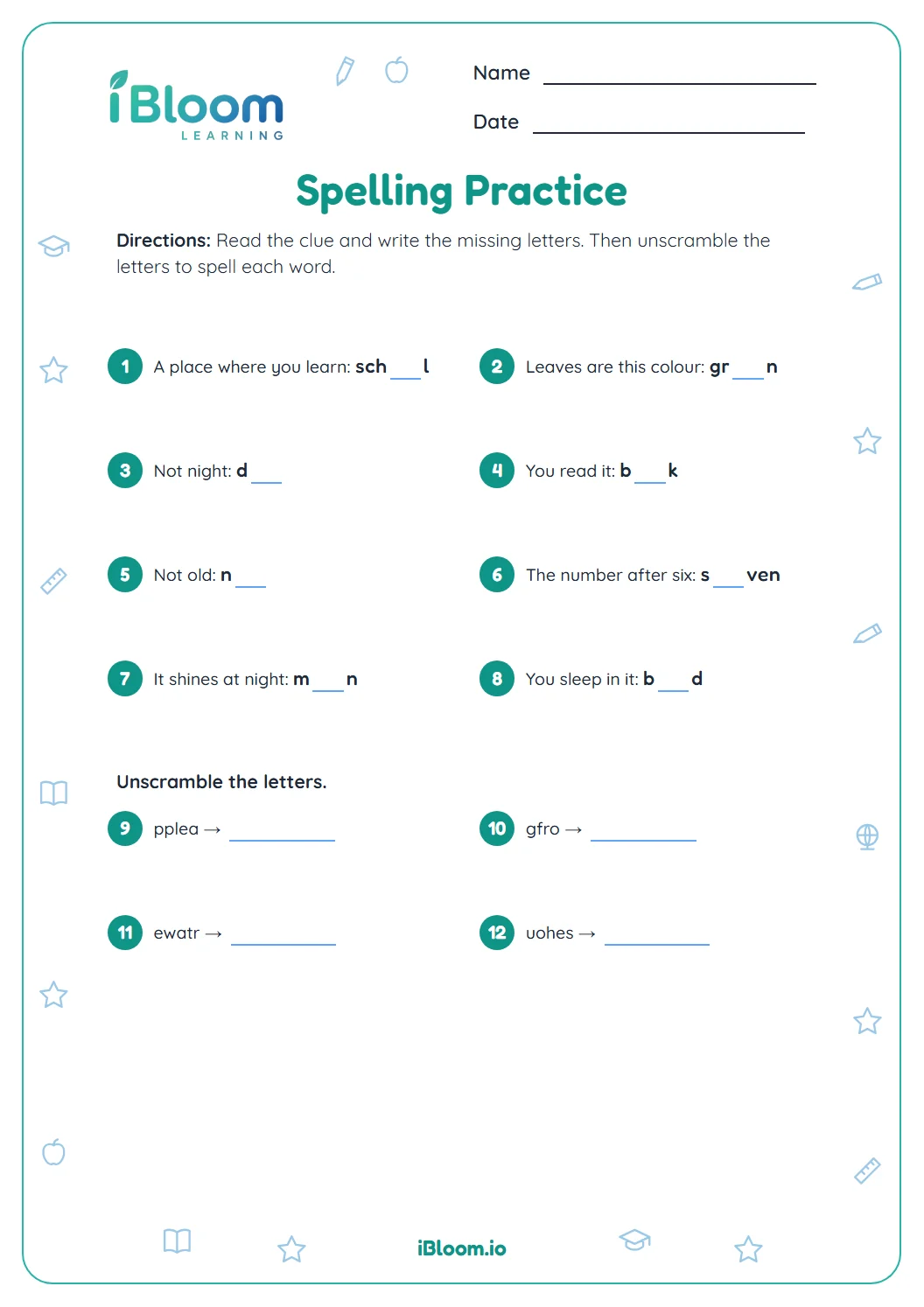
Download the free spelling practice worksheet PDF
Answer key preview
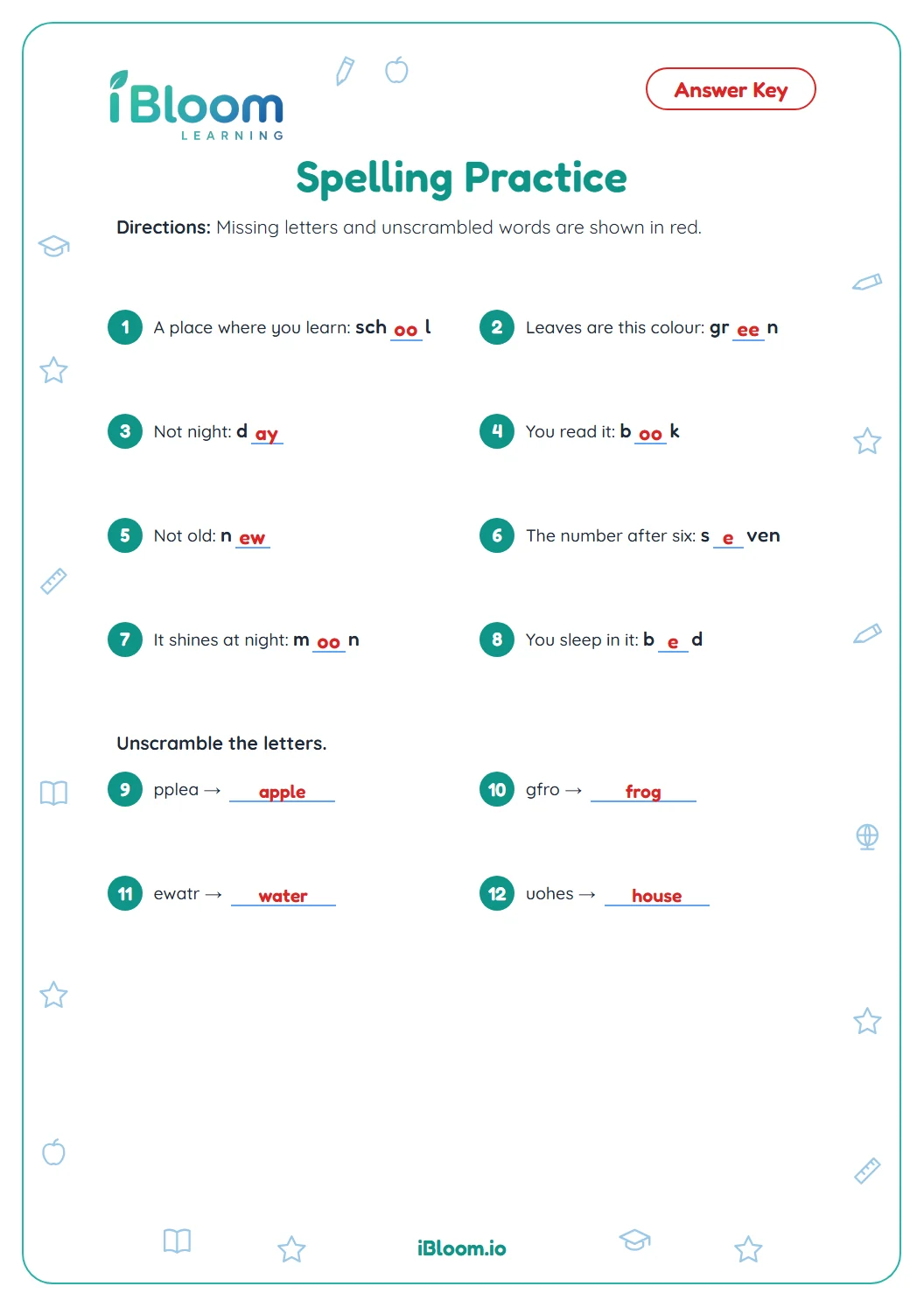
Practise the same words on paper and online. Writing a word by hand helps children remember its spelling.
Table of Contents
- Why online spelling practice works best with a routine
- What good online spelling practice should include
- The 15-minute daily spelling practice routine
- How to choose spelling words
- Online spelling games without shallow guessing
- Grade-by-grade practice ideas
- How parents and teachers can track progress
- How iBloom supports spelling practice
- Frequently Asked Questions
- Conclusion
Start with the Matching Practice
Use this guide with a direct iBloom worksheet or lesson so children can move from reading the explanation into real practice.
Why Online Spelling Practice Works Best With a Routine
Online spelling practice for kids can be powerful, but only when the practice is structured. A child can spend twenty minutes clicking letters and still remember very little the next day. A better routine makes the child hear the word, say the word, notice the pattern, spell it, correct it, and use it again.
Spelling is connected to reading. Reading Rockets explains in How Spelling Supports Reading that spelling helps children understand how sounds and letters work together. The Reading Rockets spelling overview also shows why children need more than memorization: they need phonics, patterns, and meaningful use. See Spelling: Reading and Writing Basics.
That is where online practice can help. A good tool gives immediate feedback, repeats missed words, adapts difficulty, and lets children practise more often than a weekly worksheet. The adult still matters. Parents and teachers choose the words, set the routine, check transfer into writing, and notice whether the child is actually learning.
What Good Online Spelling Practice Should Include
Use this checklist before choosing any spelling app, worksheet, game, or online spelling practice platform.
| Feature | Why it matters |
|---|---|
| Sound-to-letter practice | Children should connect phonemes, letters, blends, digraphs, and vowel patterns. |
| Pattern sorting | Words should be grouped by patterns such as short a, silent e, ai, oa, ar, or suffixes. |
| Immediate feedback | Children need to know which part of the word was missed. |
| Review cycle | Missed words should return later, not disappear after one try. |
| Meaning and sentence use | Spelling should connect to vocabulary and reading comprehension. |
| Oral and written practice | Children should spell aloud and write or type the word. |
| Adult visibility | Parents and teachers should know what was practiced and what was missed. |
The What Works Clearinghouse practice guide on Foundational Skills to Support Reading for Understanding is a useful research reference because it emphasizes systematic instruction in foundational reading skills. Online spelling practice should support that kind of structured learning, not replace it with random games.
The 15-Minute Daily Spelling Practice Routine
Short daily practice is usually better than a long weekly session. Use this routine at home, in tutoring, or as a classroom station.
Minutes 1-3: Warm up with old words
Review five words from the child's missed-word list. Ask the child to read each word, spell it aloud, and name the tricky part.
Minutes 4-7: Learn a pattern
Choose one pattern: short i, silent e, ai, ea, oa, ar, er, suffix -ed, suffix -ing, plural -s, or a word family. Ask the child to sort three to six words by sound or spelling.
Minutes 8-11: Practise online
Use a focused online activity such as iBloom SpellBee. The child should say the word before answering and repeat the correct spelling after feedback.
Minutes 12-14: Write and use
Ask the child to write two missed words and one sentence. If the child is young, the adult can write the sentence while the child spells the target word.
Minute 15: Confidence finish
End with one word the child can spell correctly. This protects motivation and makes the next session easier to start.
For children preparing for competitions, connect this routine to Spelling Bee Practice Schedule for Kids and Spelling Bee Rules for Kids. For general word learning, connect it to Crossword Puzzles for Vocabulary Practice.
How to Choose Spelling Words
Do not choose words randomly. A good list has a reason.
Use phonics patterns
For beginners, group words by sound-spelling pattern. Examples include cat, map, fan, and tap for short a; bike, kite, five, and smile for silent e; rain, train, mail, and paint for ai.
Use classroom words
If the child is learning a story, science unit, math unit, or social studies topic, choose important words from that unit. This turns spelling into vocabulary practice.
Use missed words
A child's miss list is one of the best sources. If the child repeatedly writes "becaus" for "because," that word belongs in the next review cycle.
Use grade-level challenge words
For competition or advanced practice, use Spelling Bee Words by Grade Level. For broader spelling support, use How to Teach Spelling to Kids as the parent strategy guide.
Online Spelling Games Without Shallow Guessing
Spelling games are useful when they make children think. They are weak when children can guess quickly without reading or hearing the word carefully.
Use these rules:
- The child must say the word before answering.
- The child must identify the sound or pattern being practiced.
- Missed words must be written down or saved.
- The child must use at least one word in a sentence.
- The adult should ask, "What made this word tricky?"
This is why spelling practice should connect to reading and vocabulary. A child who spells "relief" but does not know what it means has only partial knowledge. Pair online spelling with context clues, sentence building, vocabulary crosswords, and oral discussion.
Useful iBloom next steps include Use Context Clues to Determine Word Meaning, Building Sentences with Nouns and Verbs, Pictures Help Us Read, and English worksheets.
Grade-by-Grade Practice Ideas
Pre-K, LKG, UKG, and Kindergarten
Keep online spelling playful and adult-guided. Focus on letter sounds, beginning sounds, rhyming, oral blending, and a small number of simple words. Children should not be left alone to click through long lists.
Good activities:
- Match a beginning sound to a picture.
- Sort words by first sound.
- Build CVC words with letter tiles.
- Say the sounds slowly and blend them.
- Trace or write one target word after online practice.
Grade 1 and Grade 2
Move into short vowels, silent e, blends, digraphs, vowel teams, high-frequency words, and simple spelling patterns. Online practice should be paired with writing.
Good activities:
- Sort short vowel and long vowel words.
- Practise 6 to 10 words per day.
- Spell aloud before typing.
- Keep a weekly missed-word list.
- Use iBloom SpellBee for repeated practice.
Grade 3 to Grade 5
Older children need roots, prefixes, suffixes, syllables, homophones, academic vocabulary, and word meaning. They should also learn to check spelling inside their own writing.
Good activities:
- Group words by prefix or suffix.
- Compare homophones in sentences.
- Build a personal vocabulary list from reading.
- Practise spelling bee words by difficulty.
- Create crossword clues for vocabulary words using Crossword Puzzles for Teachers.
How Parents and Teachers Can Track Progress
Do not measure only the score inside an app. Track whether the child can transfer spelling into reading and writing.
Use this weekly spelling record:
| Item | What to record |
|---|---|
| New words learned | 5 to 12 words, depending on age. |
| Missed words | Words that need review in two days. |
| Pattern practiced | Example: silent e, ai, ar, suffix -ed. |
| Sentence use | One or two original sentences. |
| Transfer check | Did the child spell the word correctly outside the app? |
If the same word is missed three times, slow down. Ask what part is confusing. Use a visual cue, sound boxes, syllable tapping, or a word-family sort. If the child can spell inside the app but not in handwriting, add more written practice. If the child can spell the word but not use it, add vocabulary discussion.
How iBloom Supports Spelling Practice
iBloom's spelling and vocabulary ecosystem lets families move from practice to real learning.
| Need | iBloom resource |
|---|---|
| Online spelling practice | iBloom SpellBee |
| Grade-level word lists | Spelling Bee Words by Grade Level |
| Daily spelling routine | Spelling Bee Practice Schedule for Kids |
| Competition rules | Spelling Bee Rules for Kids |
| Parent strategy | How to Teach Spelling to Kids |
| Vocabulary review | Crossword Puzzles for Vocabulary Practice |
| Teacher word games | Crossword Puzzles for Teachers |
| Phonics practice | Free Kindergarten Phonics Worksheets |
This link map matters because spelling is not isolated. Children need phonics, reading, vocabulary, writing, and confidence. A strong online routine should send the learner to more reading and writing, not keep them trapped in one game.
Frequently Asked Questions
What is the best online spelling practice for kids?
The best online spelling practice gives immediate feedback, repeats missed words, groups words by patterns, and connects spelling to meaning. iBloom SpellBee is useful because children can practise spelling in a structured, child-friendly format.
How long should kids practise spelling online?
Most children do well with 10 to 15 minutes a day. Younger children need shorter adult-guided sessions. Older children can practise longer when the work includes writing, sentence use, and review.
Should spelling practice be typed or handwritten?
Use both. Typing is useful for online practice and quick feedback, but handwriting helps transfer spelling into schoolwork. After an online activity, ask the child to write two or three target words.
How do I teach a child who keeps forgetting spelling words?
Reduce the list, group words by pattern, review missed words after two days, and ask the child to identify the tricky part. Avoid giving a new list every day without review.
Are spelling games enough?
No. Spelling games are a good practice tool, but children also need phonics, reading, vocabulary, sentence writing, and adult feedback.
What iBloom resources should I use after this guide?
Start with iBloom SpellBee, then use How to Teach Spelling to Kids, Spelling Bee Words by Grade Level, and Free Kindergarten Phonics Worksheets.
Conclusion
Online spelling practice for kids works when it is short, structured, and connected to real word learning. The best routine asks children to hear the word, say it, notice the pattern, spell it, correct it, write it, and use it. That is how digital practice turns into better reading and writing.
Use online tools for repetition and feedback, but keep the adult role visible. Choose words carefully, review missed words, connect spelling to vocabulary, and celebrate progress. When children use iBloom SpellBee alongside word lists, phonics, reading, and writing, spelling practice becomes more than a game. It becomes a daily path toward confident literacy.
Practice This Skill Next
After reading this guide, children can practise the same skill on iBloom. Start with Use Context Clues to Determine Word Meaning or Building Sentences with Nouns and Verbs, then ask the child to explain one answer before moving on.
Worksheet And Lesson Previews
Building Sentences with Nouns and Verbs Lesson for Class 1 Preview
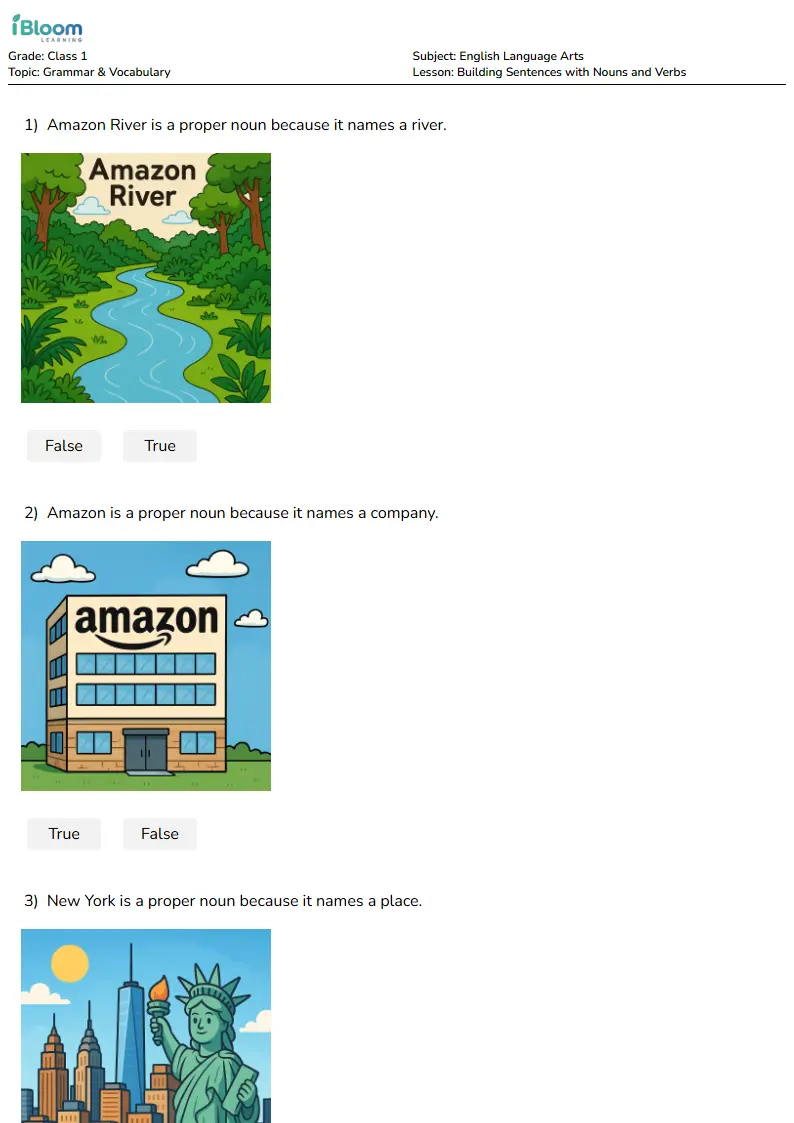
Use this preview to see the kind of practice children will open before you start the routine.
Pictures Help Us Read Worksheets for Class 1 Preview
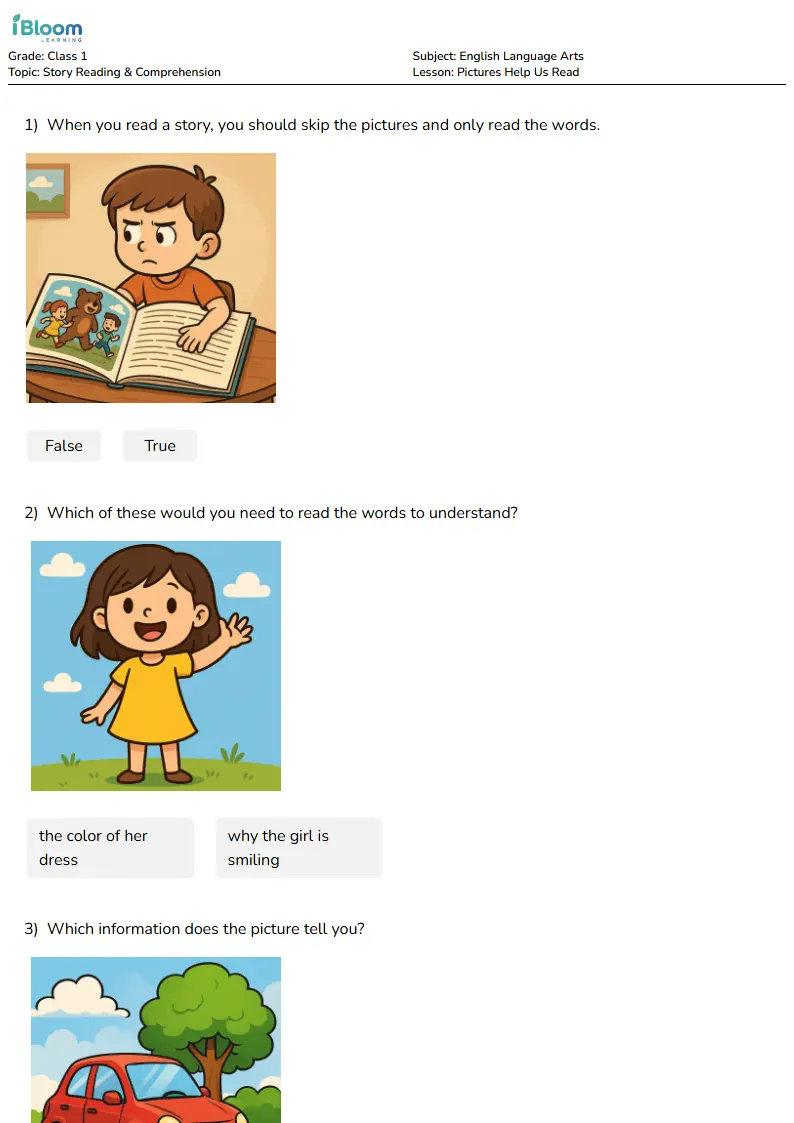
Use this preview to see the kind of practice children will open before you start the routine.