Picture Comprehension Worksheets for Class 1
Teach Class 1 learners to observe a picture, find evidence, answer clearly and write short sentences using exact iBloom practice pages.
Free printable worksheet
Free picture comprehension worksheet for Class 1
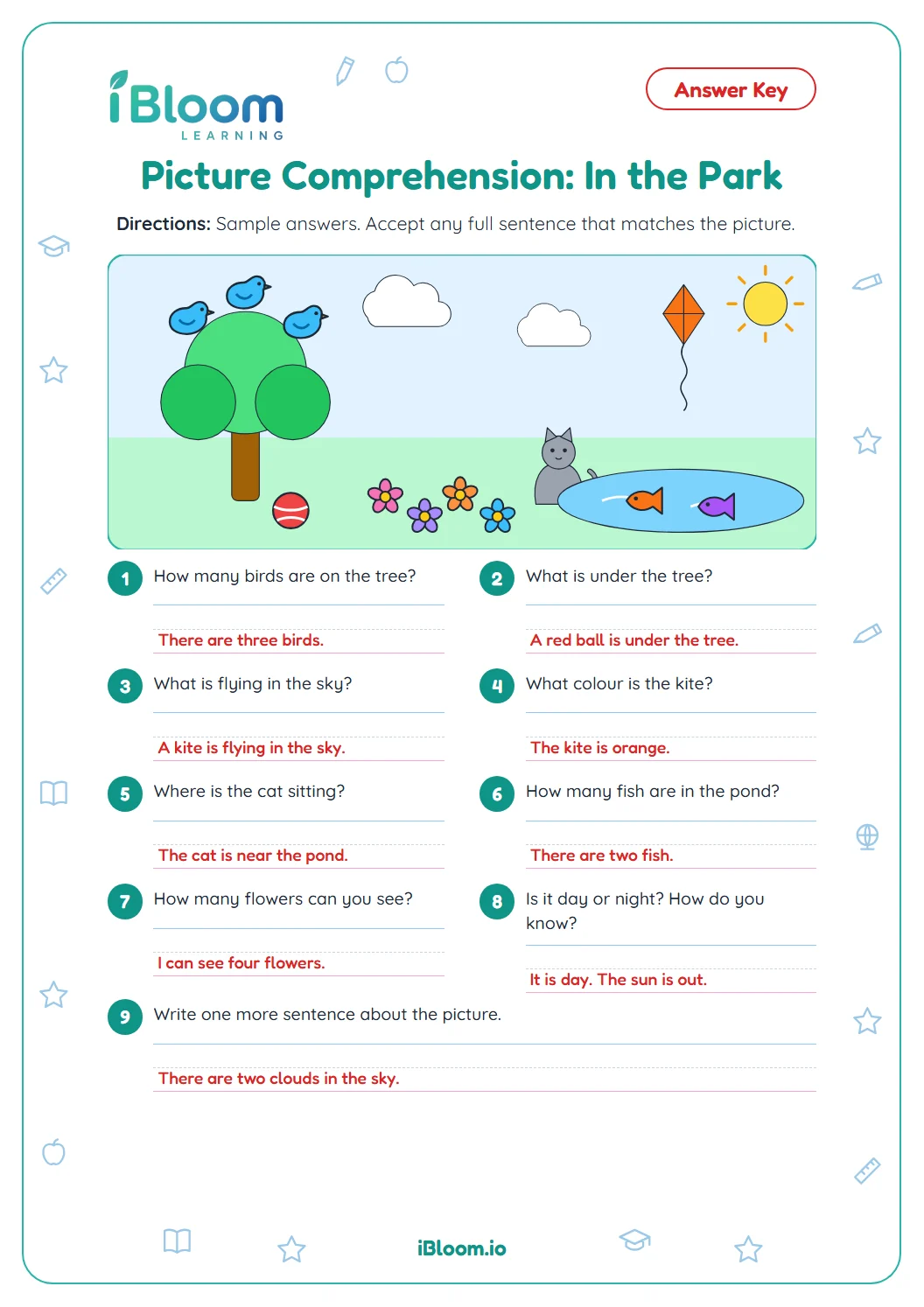
This two-page printable shows one park scene with nine questions to answer in full sentences. Page 2 has a sample answer for every question.
- Free PDF download
- Answer key included
- Ready to print
Free to print and use at home or in class. How to use this worksheet

Overview
Picture comprehension worksheets for Class 1 help children slow down, notice visual details and explain what those details mean. The important skill is not guessing a story as quickly as possible. It is learning to look carefully, point to evidence, choose accurate words and turn an observation into a clear oral or written answer.

Free picture comprehension worksheet for Class 1
This two-page printable shows one park scene with nine questions to answer in full sentences. Page 2 has a sample answer for every question.
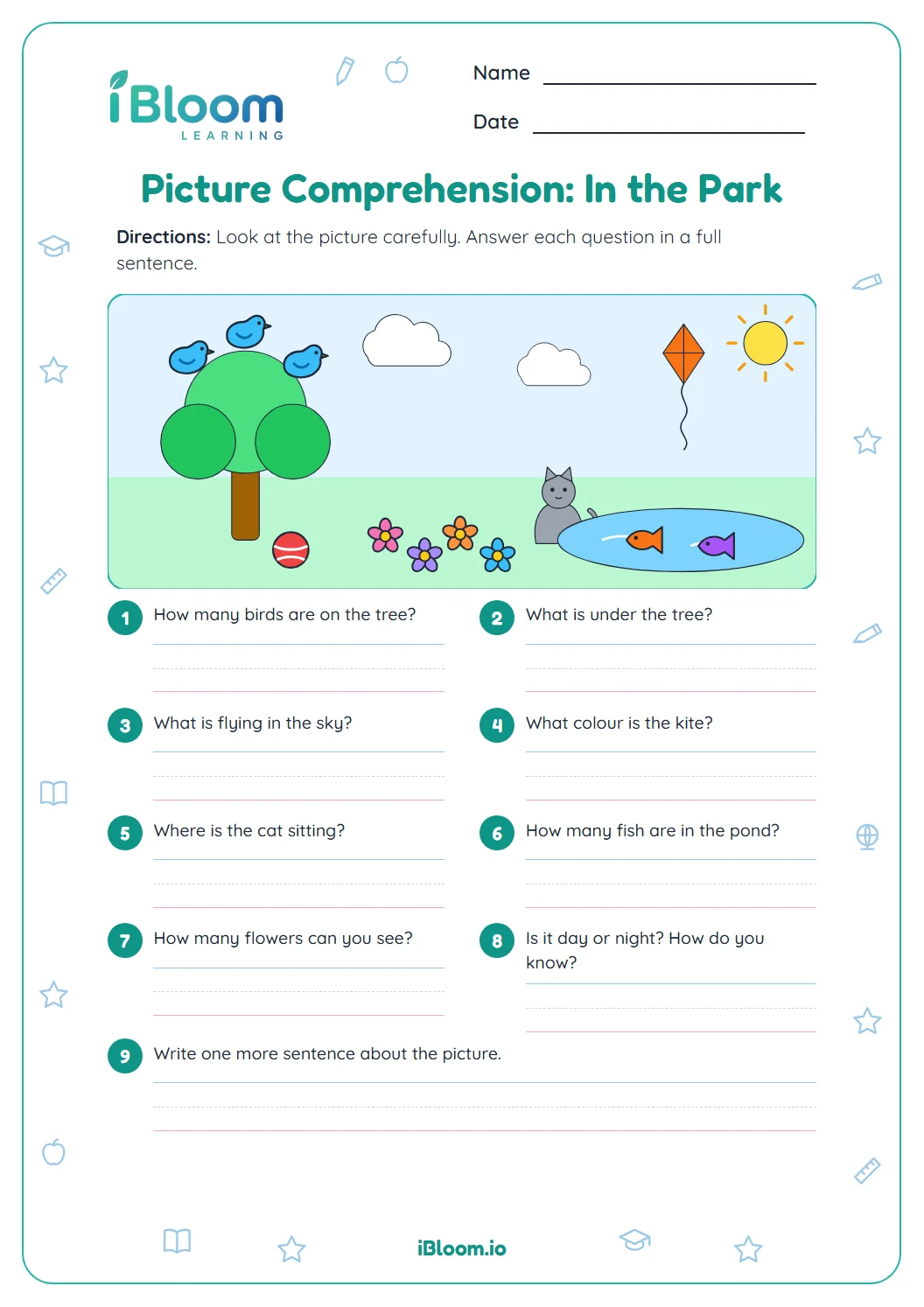
Download the free picture comprehension worksheet PDF
Answer key preview
Talk about the picture together before writing. Ask your child to point to the part of the picture that proves each answer.

Start with Matching India Practice
These pages match the Class 1 context of this guide:
Choose one page for a session. Let the child study each picture before reading all the questions, because the first goal is purposeful observation.

The Four Steps of Picture Comprehension
Look
Ask the child to scan the whole picture. Notice people, animals, objects, setting, weather, colours, facial expressions and actions.
Point
When the child gives an answer, ask them to point to the visual clue. This links the response to evidence instead of imagination alone.
Say
Encourage a complete spoken answer. If the question is “Where are the children?”, “park” can become “The children are in the park.”
Write
Only after the idea is clear should the learner write. Spoken rehearsal reduces the number of decisions the child must manage at the same time.
Observation Questions to Ask First
Begin with questions that have visible answers:
- Who can you see?
- What is each person or animal doing?
- Where does the scene take place?
- Which objects are near or far?
- What colours, shapes or sizes are important?
- What expression can you see on a face?
Then move to questions that require a reasonable inference:
- How might the person feel?
- What probably happened just before this moment?
- What might happen next?
- Which clue supports your answer?
Make the difference clear: an observation is directly visible, while an inference combines a visible clue with what the learner already knows.

A Short Home or Classroom Routine
First minute: quiet viewing
Give the child time to look without questioning. This helps learners who need longer to process a busy scene.
Next three minutes: name the evidence
Ask for five visible details. Group them into people, actions, place and objects. Introduce a useful word only when it helps describe something the child has noticed.
Next three minutes: answer in sentences
Choose two questions. The child says each answer in a complete sentence and points to the clue.
Final three minutes: write and review
Write one or two answers. Check whether the words match the picture, whether the sentence is complete and whether punctuation is present.
Example Picture Discussion
Imagine a picture of a rainy street. A child holds an umbrella, puddles are on the road and dark clouds fill the sky.
An observation answer could be: “The child is holding an umbrella.” The clue is the umbrella visible above the child.
An inference answer could be: “It is raining or has just rained.” The supporting clues are the umbrella, puddles and dark clouds.
A prediction could be: “The child may walk around the puddle.” This is possible, but it should be presented as a prediction rather than a fact shown in the picture.

Help Children Write Better Answers
If answers are too short, provide a sentence frame:
- “I can see ___.”
- “The ___ is ___.”
- “I think ___ because ___.”
- “The picture takes place in ___ because ___.”
- “Next, ___ might ___.”
Remove the frame gradually. The purpose is to model a complete response, not make every child use the same sentence forever.
Common Picture Comprehension Mistakes
Guessing without looking
Ask, “Which part of the picture helped you?” If there is no clue, label the idea as imagination rather than evidence.
Listing objects without explaining
Move from “tree, ball, boy” to “The boy is playing with a ball near the tree.” Show how details connect.
Writing before forming the answer
Let the child say the sentence first. This separates comprehension from handwriting and spelling.
Using vague words
Replace “thing,” “nice” or “doing” with a more precise noun, adjective or verb from the picture.
Classroom Differentiation
For emerging readers, read the question aloud and offer two possible answers. For confident learners, ask for evidence, a comparison or a prediction. In a mixed group, every learner can use the same picture while responding at a suitable level.
Teachers can also cover the question text initially and let learners generate their own questions. This reveals which details attracted attention and builds oral language.
How to Check Progress
Look for improvement in the reasoning process:
- the child scans more than one part of the picture;
- answers refer to visible clues;
- spoken responses become complete sentences;
- vocabulary becomes more precise;
- written answers match what the child said;
- predictions are distinguished from facts.
Keep one sample from an early session and compare it with a later response. Discuss the clearer evidence and language rather than only counting correct answers.
Related Reading Practice
Picture comprehension supports early story reading because illustrations can clarify setting, character actions and sequence. Continue with Picture Reading Worksheets for Kids when the child is ready to connect several pictures or combine images with a short text.
Frequently Asked Questions
Should children describe everything in a picture?
No. Teach them to select details that answer the question. A complete inventory can distract from the main idea.
What if the child notices a detail I missed?
Ask the child to point to it and explain. A different answer can be valid when the picture provides evidence.
Should spelling errors be corrected immediately?
First confirm that the answer makes sense and matches the picture. Then correct one or two spelling or punctuation points without losing the comprehension focus.
How can I help a child who gives one-word answers?
Repeat the answer inside a sentence frame and ask the child to say the complete sentence. Gradually reduce the prompt.
What is the difference between inference and guessing?
An inference is supported by a clue in the picture. A guess has no clear visual evidence. Ask “What makes you think that?” to help the child explain the difference.