Pre-Kindergarten Math Worksheets
A practical guide to pre-kindergarten math worksheets for counting, number sense, shapes, comparing, and short daily practice.
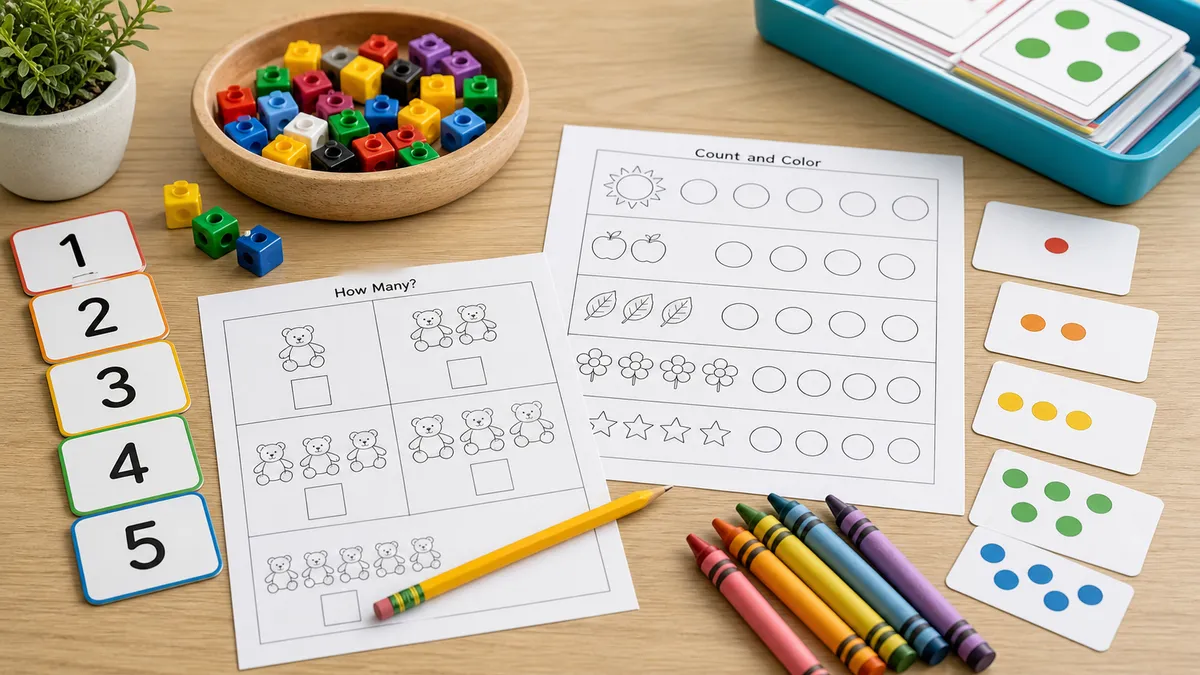
Pre-Kindergarten Math Worksheets help young children build number sense through counting, matching, speaking, drawing, and short written practice. This guide is for parents, teachers, tutors, and children who want early math worksheets that feel calm and useful rather than rushed. It connects directly to iBloom practice such as Pre-Kindergarten Math hub, Counting Numbers up to 5 worksheet, and Counting Numbers from 5 to 10 worksheet, then extends the routine with related support from Counting Objects Worksheets, Kindergarten Math Activities, and Learning at Home Guide.
Start with the Matching Practice
Use this guide with a direct iBloom worksheet or lesson so children can move from reading the explanation into real practice.
Table of Contents
Key Takeaways
- Pre-Kindergarten Math Worksheets should connect objects, number names, dot patterns, pictures, and written numerals.
- Children learn more when adults ask, "How did you know?" after each answer.
- Short daily practice is stronger than a long packet once a week.
- The best worksheet routine includes touching, counting, saying, drawing, matching, and explaining.
- Internal practice should move naturally between the worksheet, the paired lesson, and nearby counting or comparison pages.
Why Early Number Practice Matters
Early math is not only about writing neat numbers. Children need to understand that a number tells how many, that the last number counted names the whole group, and that numbers can be compared, ordered, composed, and decomposed. The IES practice guide for teaching math to young children recommends intentional math instruction that uses examples, language, and repeated practice across a developmental path. The NCTM principles and standards also support rich mathematical communication, problem solving, and representation from the earliest years.
For a young learner, this means a worksheet should never be only a page to finish. A good page asks the child to touch each object once, say the count aloud, connect the count to a written numeral, and then explain the answer. If a child circles 6, ask them to show six with fingers, counters, dots, or a ten-frame. That small explanation is what turns pre kindergarten math worksheets into real number sense.
The same routine works for families and schools in India, the United States, and the UAE: CBSE, ICSE, state-board, American, British, IB, and mixed homeschool settings all need short, clear number practice that children can explain aloud. A child in Delhi, Mumbai, Bengaluru, Chennai, Hyderabad, Pune, New York, Houston, Chicago, Dallas, Los Angeles, Dubai, Abu Dhabi, Sharjah, or Ajman can follow the same core routine: count slowly, match carefully, say the number sentence, and connect the page to a real object nearby.
What a Strong Worksheet Should Include
A strong pre kindergarten math worksheets page should focus on one main skill at a time. For young children, crowded pages create avoidable errors. Use clear spacing, large pictures, familiar objects, and a small number range. The worksheet should invite children to do something visible: count, match, trace, circle, draw, compare, or explain.
Useful worksheet formats include:
- Number tracing beside a matching quantity.
- Object counting with one-to-one touch points.
- Dot cards, five-frames, and ten-frames.
- Match the numeral to the group.
- Circle the group with more, fewer, or the same.
- Fill in the missing number before, after, or between.
- Draw objects to show a number.
- Sort shapes or objects, then count each set.
When a worksheet feels too easy, ask for a spoken explanation. When it feels too hard, move back to real objects. For example, after a child completes Counting Numbers up to 5 worksheet, they can repeat the same idea with pencils, blocks, toy cars, buttons, spoons, or snack pieces.
A Step-by-Step Practice Routine
1. Warm up with real objects
Put a small group of objects on the table. Ask the child to move each object while counting. This prevents skipped objects and double-counting. Keep the first set small, then increase only when the child is steady.
2. Move from objects to pictures
Open the worksheet and ask the child to point, not guess. If the page shows five stars, the child should touch each star and say one, two, three, four, five. Then ask, "What number tells the whole group?"
3. Connect the count to a numeral
Once the child knows the quantity, match it to a written numeral. Pages such as Counting Numbers from 5 to 10 worksheet help children connect number symbols with quantities instead of memorizing shapes only.
4. Add math language
Use words like more, fewer, same, before, after, between, first, next, last, group, total, and altogether. These words prepare children for addition, subtraction, comparison, and word problems.
5. End with one explanation
Ask the child to explain one answer. A simple sentence is enough: "I know it is 8 because I counted eight dots." Teachers can use this as a small-group check, while parents can use it during homework review.
Examples Children Can Try
Use these examples before or after the worksheet:
- Count 4 buttons, touch each one once, then draw 4 dots.
- Match the number 3 to three toy cars.
- Sort circles and squares before counting each group.
- Point to the shorter line and explain how you know.
For a challenge, ask the child to make a similar question for an adult. A UKG learner might say, "I made 12 with ten and two more." An LKG learner might say, "This is 6 because I counted six blocks." A pre-kindergarten child might say, "There are 3 circles." These short explanations show whether the child is reading the number, counting the group, or guessing.
Parent Practice Plan
Parents do not need a long lesson. Ten calm minutes can be enough. Start with one iBloom page, then use real objects at home. Count spoons while setting the table, shoes near the door, steps to the bedroom, or crayons in a box. In India, families may connect practice to school notebooks and CBSE/ICSE-style early numeracy expectations. In the US, families can connect it to kindergarten readiness and classroom math centers. In the UAE, expat families can use the same routine across British, American, IB, and Indian curriculum schools.
If your child resists writing, keep the first round oral. Count, point, match, and explain. Then ask for only two written answers. This keeps the focus on number sense and prevents handwriting from taking over the math task.
Teacher Practice Plan
Teachers can turn one worksheet into four classroom uses:
- Morning warm-up: one counting or matching question on arrival.
- Small group: children explain one answer with counters.
- Math center: pair the worksheet with number cards or ten-frames.
- Exit ticket: one quick before/after/between or counting question.
For children who finish quickly, ask them to build the number another way. For children who need support, reduce the number range and use manipulatives. A teacher in California, Texas, Florida, New York, Illinois, Dubai, Abu Dhabi, Sharjah, Delhi, Mumbai, Bengaluru, or Chennai can use the same differentiation: smaller numbers for confidence, larger numbers for extension, and oral explanation for everyone.
India, US, and UAE Learning Notes
Early math language changes by curriculum, but the child task stays similar. Some schools say LKG and UKG; others say preschool, pre-kindergarten, reception, kindergarten, KG1, or KG2. Some pages use maths, while others use math. The important part is that children connect number words, objects, pictures, and written numerals.
For India, Pre-Kindergarten Math Worksheets can support school readiness in CBSE, ICSE, and state-board classrooms. For the US, they can support pre-K and kindergarten counting, comparison, and early operations readiness. For the UAE, they can support multilingual learners who may hear number words in English at school and another language at home. Let children count in the home language first if needed, then connect to English number words on the worksheet.
Common Mistakes to Watch For
Children often make predictable errors:
- Counting too fast and skipping an object.
- Touching the same object twice.
- Recognizing the numeral but not the quantity.
- Counting correctly but choosing the wrong written number.
- Reversing digits while writing.
- Guessing more or fewer by visual size instead of counting.
When this happens, avoid saying only "wrong." Ask the child to recount slowly. Cover part of the page if it looks crowded. Use Counting Objects Worksheets or Kindergarten Math Activities as a nearby next step when the child needs more counting or comparison practice.
How iBloom Fits
iBloom works best as a connected path rather than a single worksheet. Start with the exact worksheet, review the paired lesson, then move to a related guide or adjacent skill. For example, children can use Pre-Kindergarten Math hub for the main practice, then build fluency through Learning at Home Guide. This gives parents and teachers a practical sequence without searching from scratch.
The NCES kindergarten fast facts page is useful background for adults thinking about early school participation, while iBloom gives children the hands-on practice surface. Use external resources for adult planning and iBloom pages for the child's next task.
Frequently Asked Questions
What age are pre kindergarten math worksheets best for?
They are best for children who are beginning to count, recognize numerals, compare small groups, or prepare for kindergarten and early primary math. The exact age depends on the child and curriculum.
Should children write numbers or count objects first?
Count objects first. Writing numbers matters, but young children need to know what the number means before handwriting becomes the main focus.
How long should practice take?
Five to ten minutes is enough for many children. Stop while the child is still successful, then return the next day.
What should I do if my child guesses?
Ask the child to touch and count each object. If guessing continues, reduce the number range and use real objects before returning to the worksheet.
Can teachers use these worksheets in centers?
Yes. Pair the worksheet with counters, dot cards, ten-frames, or number cards. Ask children to explain one answer before moving to the next center.
Practice This Skill Next
After reading this guide, children can practise the same skill on iBloom. Start with Pre-Kindergarten Math hub or Counting Numbers up to 5 worksheet, then ask the child to explain one answer before moving on.