Preschool and Kindergarten Readiness Activities at Home
Plan preschool and kindergarten readiness activities at home with books, counting, drawing, listening, and routines.
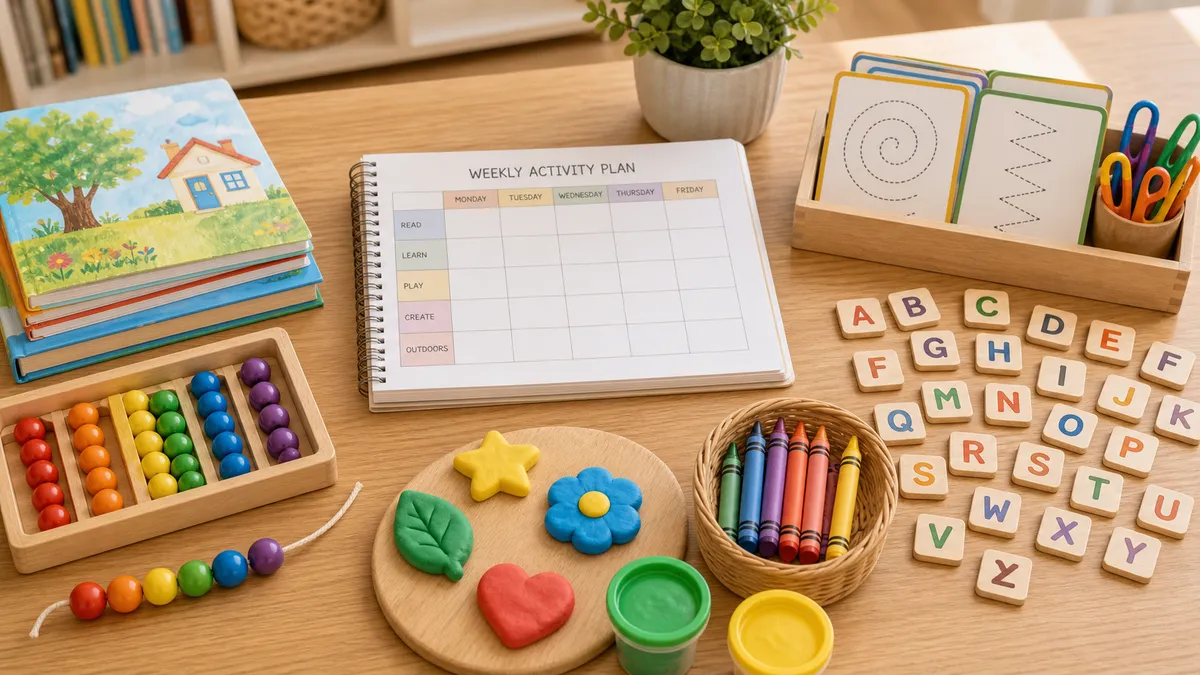
Preschool and Kindergarten Readiness Activities at Home should help children feel capable before they enter a formal classroom. This guide is for parents, teachers, tutors, and children who want short home activities that turn everyday reading, counting, drawing, conversation, and independence routines into school-ready practice. It connects the broader readiness conversation to practical iBloom practice such as 7 No-Screen Learning Activities, Effective Reading Practice Strategies, Listen to Stories lesson, Counting Numbers up to 5 worksheet, and Full and Empty Worksheets.
Start with the Matching Practice
Use this guide with a direct iBloom worksheet or lesson so children can move from reading the explanation into real practice.
Table of Contents
Key Takeaways
- Kindergarten readiness is not a race to make children act older. It is a balanced view of language, listening, early literacy, early math, motor control, social confidence, and independence.
- Short, warm practice works better than long test-like sessions.
- Adults should observe how a child thinks, explains, listens, tries again, and asks for help.
- Strong readiness practice can happen at home, in a preschool classroom, in a tutoring session, or during a short iBloom activity.
- The best next step is usually a connected activity, not a label.
What Kindergarten Readiness Really Means
Kindergarten readiness combines several areas of development. A child may know many letters but still need support with listening to directions. Another child may count confidently but need practice holding a pencil, waiting for a turn, or explaining an answer. That is why preschool and kindergarten readiness activities at home should look at the whole child.
The CDC overview of child development, NICHD guidance on teaching children to read, and early literacy research summaries from Reading Rockets all point toward a balanced approach: talk with children, read aloud, play with sounds, ask questions, count real objects, and give children chances to explain. Adult planning sources such as CDC child development, NICHD reading guidance, and early literacy practice guidance support that balance.
A Gentle Daily Routine
Use a simple rhythm: read, talk, count, draw, move, and reflect. A readiness routine can be ten minutes. Read a short page, ask the child what happened, count three to ten objects, draw one picture, and ask the child to put materials away. Then move to a related iBloom task such as Listen to Stories lesson or Counting Numbers up to 5 worksheet.
The adult language matters. Say, "Show me how you know," "Try one more way," "What did you notice?" and "Which part was easy or tricky?" These prompts help children explain their thinking without turning every moment into a test.
Literacy Skills To Watch
Early literacy includes listening to stories, noticing print, recognizing letters, hearing sounds in words, answering simple questions, retelling events, and using oral language. A child does not need to read independently before kindergarten, but the child should build comfort with books, pictures, sounds, and conversation.
If the child enjoys stories but struggles to answer questions, use picture walks. Look at one picture and ask, "Who is here?" "What is happening?" and "What might happen next?" If the child knows letters but not sounds, play short sound games. If the child speaks softly, use role play and daily routines to build confidence. 7 No-Screen Learning Activities and Listen to Stories lesson are useful next steps.
Math And Thinking Skills To Watch
Readiness math includes counting small groups, matching numbers to quantities, comparing more and less, naming shapes, noticing patterns, and using words such as first, next, same, different, full, empty, bigger, and smaller. Children learn these ideas best when they touch objects, move pieces, and talk about what they see.
Try this: place five blocks on a table, ask the child to count slowly while touching each block, then ask, "How many altogether?" Move one block away and ask what changed. Later, connect the same idea to Counting Numbers up to 5 worksheet or Full and Empty Worksheets.
Motor And Independence Skills
Fine-motor readiness includes holding a crayon, drawing lines and shapes, using child-safe scissors, opening a lunchbox, turning pages, and putting materials away. Independence readiness includes following one-step and two-step directions, asking for help, waiting briefly, and trying again after a mistake.
These skills are easy to practise in normal routines. Let the child zip a bag, sort crayons, carry a book, wash hands, place shoes together, or clean up a small activity. These actions build classroom confidence as much as a worksheet does.
Questions And Activities To Try
Use questions that invite thinking:
| Area | Gentle question | What to notice |
|---|---|---|
| Story | What happened first? | Sequence and oral language |
| Letters | Which letter do you see? | Print awareness |
| Sounds | What sound starts sun? | Phonological awareness |
| Counting | How many blocks are here? | One-to-one counting |
| Shapes | Which shape has three sides? | Visual discrimination |
| Independence | What should we do next? | Direction following |
If the child is unsure, model one answer and let the child try again. The goal is confidence plus information for the adult.
Parent Plan
Parents can use preschool and kindergarten readiness activities at home without buying complicated materials. Use books, spoons, socks, crayons, blocks, paper, cups, and daily routines. Five focused minutes before school, after dinner, or before bedtime can build steady readiness.
In India, families in Delhi, Mumbai, Bengaluru, Chennai, Hyderabad, Pune, Kolkata, Ahmedabad, Jaipur, Lucknow, Kerala, Tamil Nadu, Karnataka, Maharashtra, Telangana, Gujarat, Rajasthan, and West Bengal may connect readiness to LKG, UKG, CBSE, ICSE, and state-board expectations. In the United States, families in California, Texas, Florida, New York, Illinois, Pennsylvania, Ohio, Georgia, North Carolina, Michigan, Los Angeles, Houston, Chicago, Phoenix, Philadelphia, Dallas, Austin, Seattle, Boston, Denver, Atlanta, and Miami may use it for preschool-to-kindergarten transition. In the UAE, families in Dubai, Abu Dhabi, Sharjah, Ajman, Ras Al Khaimah, Fujairah, Umm Al Quwain, and Al Ain can adapt the same ideas across British, American, IB, and Indian curriculum settings.
Teacher Plan
Teachers can use this topic for small-group checks, morning work, parent conferences, readiness centers, or intervention planning. The strongest practice is observational: listen to how the child explains, watch how the child handles materials, and note whether the child can try again after support.
Use one skill at a time. Monday can focus on listening and retelling. Tuesday can focus on letter or sound play. Wednesday can focus on counting. Thursday can focus on drawing and fine-motor control. Friday can combine a story, a math prompt, and a short independence task.
Regional Learning Notes
Readiness expectations vary by school and region, but children everywhere benefit from warm language, meaningful play, careful observation, and short practice. A multilingual child may understand a concept in a home language before answering in English. Let the child show understanding with pointing, drawing, acting, counting, or choosing, then gradually build the English sentence.
Readiness should never be used to shame a child. It should help adults choose the next useful activity.
How iBloom Fits
iBloom works best when adults connect the article, the exact skill page, and a next activity. Start with 7 No-Screen Learning Activities for the broader readiness link, move to Listen to Stories lesson or Counting Numbers up to 5 worksheet for direct practice, and use Full and Empty Worksheets when the child needs a related math or early-learning step.
Frequently Asked Questions
What age is preschool and kindergarten readiness activities at home for?
It is mainly for preschool, LKG, UKG, Pre-Kindergarten, and Kindergarten children, usually ages 3 to 6. Older children can also use it when they need a gentle review.
Should readiness practice feel like a test?
No. It should feel like conversation, play, reading, drawing, counting, and short guided practice.
What if my child cannot answer a question?
Model the answer, reduce the task, and try again later. A missed question is information for the adult, not a failure for the child.
Which skill should I practise first?
Start with listening, language, and daily routines. Then add early literacy, counting, drawing, and independence tasks.
What should I use next on iBloom?
Use 7 No-Screen Learning Activities, Listen to Stories lesson, Counting Numbers up to 5 worksheet, or Full and Empty Worksheets depending on whether the child needs reading, math, or routine practice.
Practice This Skill Next
After reading this guide, children can practise the same skill on iBloom. Start with Listen to Stories lesson or Counting Numbers up to 5 worksheet, then ask the child to explain one answer before moving on.