Subtracting Across Zeros Worksheets
Help children subtract across zeros with clear place-value models, error checks, examples, and large-number worksheets.
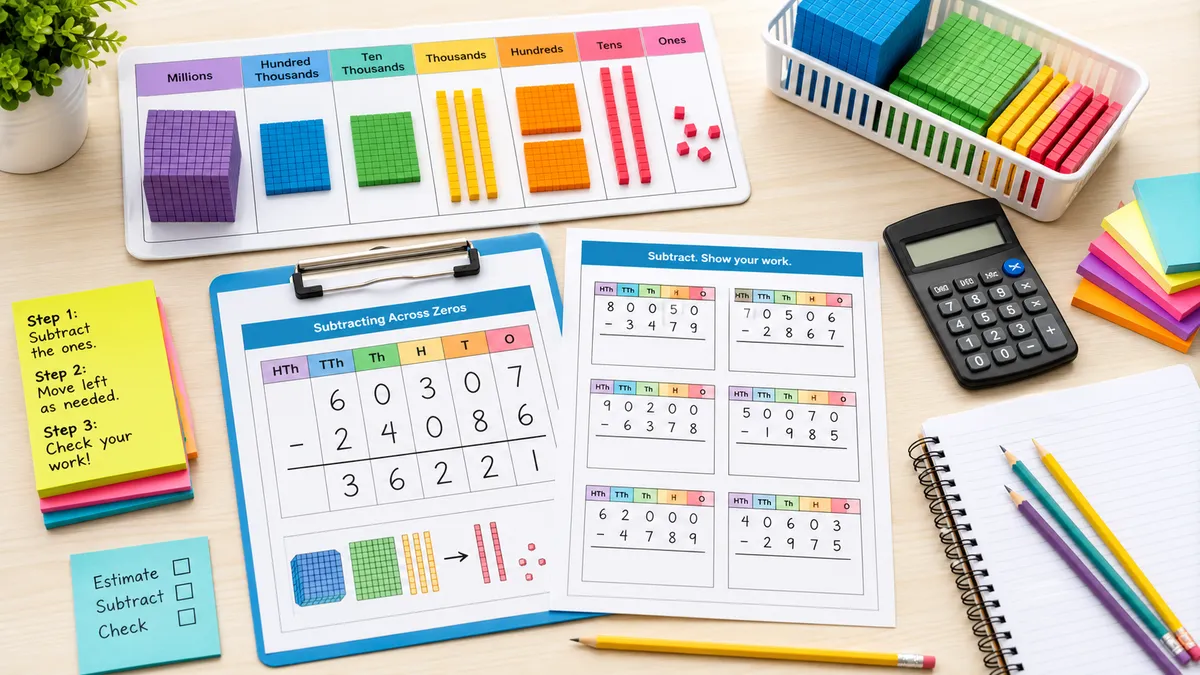
Subtracting Across Zeros Worksheets is a practical guide for parents, teachers, tutors, and children who need large-number subtraction practice for children who get stuck when zeros appear in the tens, hundreds, or thousands place. It supports the larger iBloom subtraction cluster without repeating the existing UKG and Grade 1 posts. Use it with Subtracting large numbers with zeros lesson, Subtracting large numbers with zeros worksheets, Subtracting multi-digit numbers across zeros worksheets, and the exact iBloom practice pages linked throughout this article.
Start with the Matching Practice
Use this guide with a direct iBloom worksheet or lesson so children can move from reading the explanation into real practice.
Table of Contents
Worksheet And Lesson Previews
Subtracting Large Numbers with Zeros Worksheets for Class 4 Preview
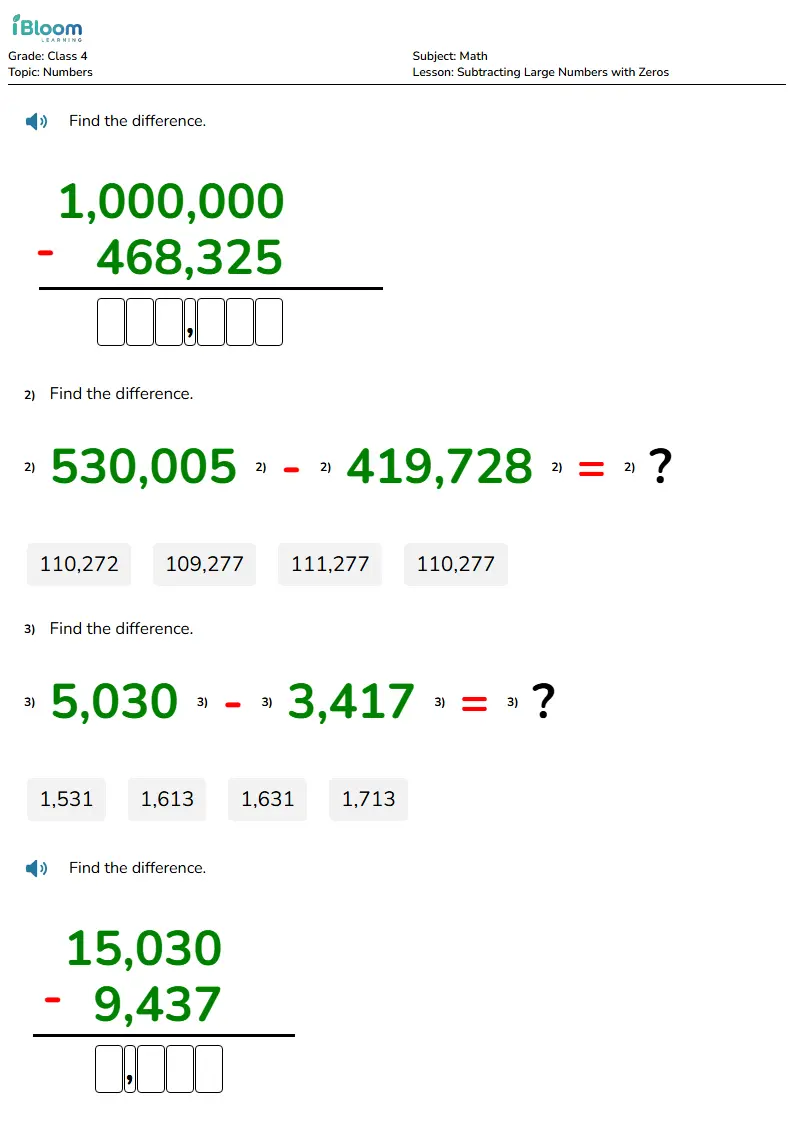
Use this preview to see the kind of practice children will open before you start the routine.
- Open the worksheet: Subtracting Large Numbers with Zeros Worksheets for Class 4
- Open the lesson: Subtracting Large Numbers with Zeros Lesson for Class 4
Subtracting Multi-digit Numbers Across Zeros Up to Million Worksheets for Fourth Grade Preview
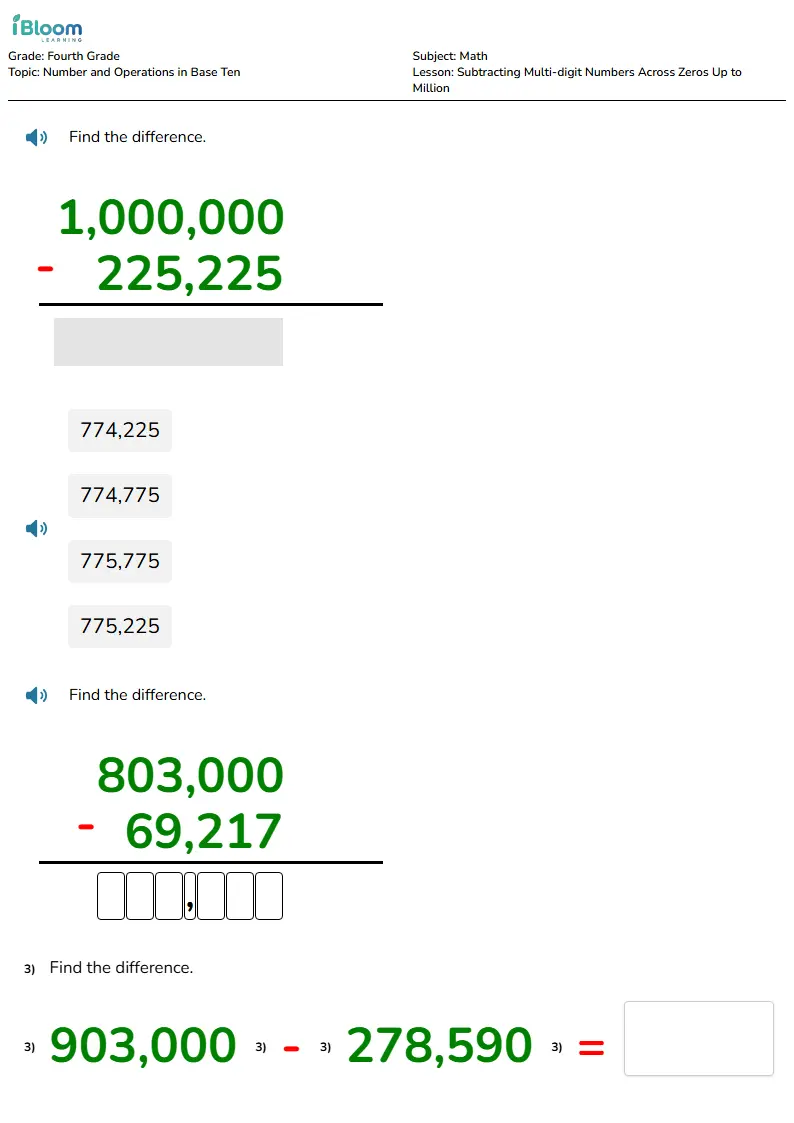
Use this preview to see the kind of practice children will open before you start the routine.
Key Takeaways
- Children need visual models, language, and repeated practice before subtraction becomes fluent.
- A strong worksheet should include examples, models, word problems, independent questions, and a checking step.
- Parents can help with short daily routines instead of long correction-heavy sessions.
- Teachers can use iBloom subtraction pages for instruction, math centers, small-group review, and homework support.
- The right next page depends on the child's error: fact recall, regrouping, zeros, word problems, or place value.
Why This Subtraction Skill Matters
Subtraction is not one single skill. A child first learns that taking away changes a quantity, then connects that idea to facts, missing numbers, word problems, number lines, place value, regrouping, fractions, decimals, and large numbers. Subtracting Across Zeros Worksheets focuses on the point where children often need the most structured support: they know subtraction exists, but they need a clear path to use it accurately.
Research-backed math guidance consistently supports explicit examples, concrete representations, discussion, and practice. Teachers can connect this guide with What Works Clearinghouse math resources, NCTM principles and standards, and visual tools such as math manipulatives and number pieces when planning instruction.
The Best Teaching Sequence
Start with meaning. Ask the child to describe a real situation: toys moved away, pencils shared, counters hidden, or points compared. Next, use a model. For younger learners, use counters, pictures, ten frames, or number lines. For older learners, use base-ten blocks, place-value charts, fraction bars, or decimal grids. Only after the model is clear should the child write the subtraction sentence.
Then add language. Children should say, "I started with..., I took away..., I have... left," or "I regrouped one ten into ten ones because..." This explanation step helps parents and teachers catch misunderstandings early. It also helps multilingual learners in India, the US, and the UAE connect classroom vocabulary to home practice.
Finally, check. Some problems can be checked with addition. Others can be checked by estimating, comparing with the starting number, or solving a second way. The check is not extra work. It is the habit that turns a worksheet into real mathematical reasoning.
Worked Examples
Use these examples as models before children work independently:
| Example | What to Ask | How to Check |
|---|---|---|
| 400 - 167 = 233 | What is the starting amount, and what changed? | Add the answer to the amount taken away. |
| 3,000 - 1,548 = 1,452 | Which model would help: ten frame, number line, or place value? | Estimate first, then calculate. |
| 70,004 - 28,619 = 41,385 | Did you subtract from the correct place or part? | Solve a second way. |
| 1,000,000 - 456,789 = 543,211 | Can you explain the answer in a sentence? | Compare the answer with the starting number. |
Children who need earlier visual support can review UKG subtraction worksheets or picture subtraction worksheets for UKG. Children ready for stronger independent work can move toward Subtracting large numbers 6 digits worksheets) and Subtraction with borrowing worksheets.
Worksheet Routine for Home
At home, keep the routine simple:
- Solve one example together with objects or a drawing.
- Ask the child to explain the story behind the subtraction.
- Complete three to six worksheet questions.
- Pause after the first mistake and model the thinking again.
- End with one check using addition, estimation, or a second model.
This works for a parent in Delhi helping with CBSE-style homework, a family in California reviewing after school, or a UAE parent in Dubai balancing British, American, IB, or Indian curriculum expectations. The same routine applies because the mathematical thinking is the same: understand the whole, identify the part removed or compared, find the difference, and check.
Classroom Routine for Teachers
Teachers can use a gradual-release routine: model one, solve one together, let partners discuss one, then move to independent iBloom practice. During partner work, listen for math vocabulary. A child who says "I moved a ten to the ones place" is showing different understanding from a child who says "I just crossed it out." Both may get an answer, but only one explanation reveals place-value reasoning.
For small groups, pick the linked iBloom page that matches the exact gap. Use Subtracting large numbers with zeros lesson as a cluster support page, Subtracting large numbers with zeros worksheets for worksheet practice, and Subtracting multi-digit numbers across zeros worksheets when the learner needs the next grade-level step. If the child is working on the specific skill from this post, use Subtracting large numbers 6 digits worksheets) and Subtraction with borrowing worksheets.
Common Mistakes
Children often make predictable subtraction mistakes:
- They reverse the numbers because the smaller number "looks easier" to subtract.
- They count the objects taken away instead of the objects left.
- They regroup mechanically without understanding tens and ones.
- They forget that zero in a place-value column still has meaning.
- They solve the arithmetic correctly but answer the wrong word-problem question.
- They rush facts before they can explain the relationship with addition.
The fix is not more pressure. The fix is a better model, a shorter set, and a clearer explanation prompt. Ask: "What did you start with? What changed? What is left? How do you know?"
Regional Practice Notes
In India, subtraction worksheets often appear in CBSE, ICSE, and state-board homework from LKG through Class 5. Families in Mumbai, Bengaluru, Chennai, Hyderabad, Pune, Kolkata, Jaipur, Lucknow, and Ahmedabad can use these routines for tuition review and school revision.
In the United States, subtraction connects naturally with first-grade, second-grade, fourth-grade, and fifth-grade math expectations depending on the skill. Teachers in Texas, California, Florida, New York, Illinois, Georgia, North Carolina, Seattle, Boston, Denver, Atlanta, and Miami can use the same page as a center task, intervention warm-up, or independent digital worksheet.
In the UAE, children may hear British, American, IB, and Indian curriculum terms in the same school community. Families in Dubai, Abu Dhabi, Sharjah, Ajman, Ras Al Khaimah, Fujairah, Umm Al Quwain, and Al Ain can keep the language steady: start, take away, regroup, left, difference, check.
iBloom Practice Path
Use this path to move without creating duplicate practice:
- Start with UKG subtraction worksheets when the child still needs pictures and objects.
- Move to Subtraction Worksheets for Grade 1 when the child can write number sentences.
- Use Subtraction Word Problems for Class 1 when the arithmetic is easier than the reading.
- Use Grade 2 subtraction worksheets when facts, two-digit thinking, and word problems need more practice.
- Use Subtracting large numbers 6 digits worksheets) and Subtraction with borrowing worksheets for the exact skill covered in this guide.
Frequently Asked Questions
How many subtraction problems should a child do each day?
For most children, five to ten thoughtful problems are better than a long page of rushed answers. The child should explain at least one answer and check at least one answer.
Should subtraction worksheets include word problems?
Yes. Word problems show whether the child understands the meaning of subtraction. They also connect math with reading and real-life reasoning.
What should I do if my child hates subtraction?
Reduce the number size, use objects, solve fewer questions, and let the child explain verbally before writing. Confidence usually improves when the child can see the action.
Are digital worksheets useful for subtraction?
Digital worksheets are useful when they give children focused practice and adults can still discuss the method. Use iBloom pages as the practice surface, then ask one explanation question after the activity.
When should children memorize facts?
Memorization is helpful after meaning is secure. A child who can model and explain facts will usually retain them better than a child who only repeats flashcards.
Practice This Skill Next
After reading this guide, children can practise the same skill on iBloom. Start with Subtracting large numbers with zeros lesson or Subtracting multi-digit numbers across zeros worksheets, then ask the child to explain one answer before moving on.
Related practice
Practice this topic
Continue with a lesson, generator, or printable worksheet.