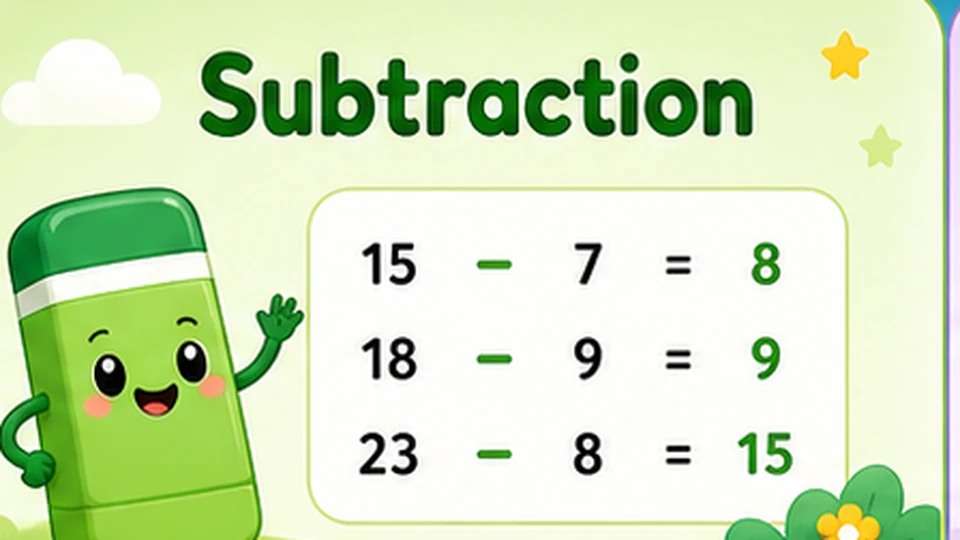
Subtraction Worksheets for Grade 1
A parent and teacher guide to Grade 1 subtraction worksheets, Class 1 subtraction facts, number lines, ten frames, and word problems.
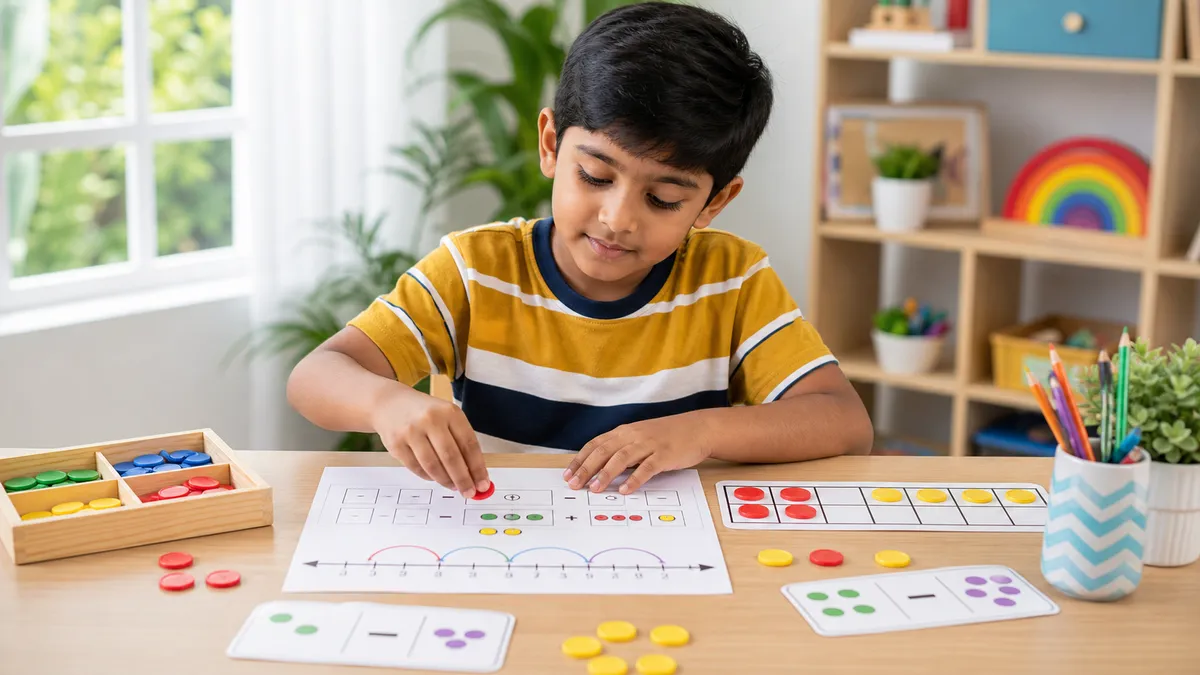
Grade 1 subtraction is where many children move from "I can count" to "I can reason about what changed." A good subtraction worksheet does more than ask for answers. It helps a child see the action of taking away, compare the starting number with the leftover number, and explain the number sentence in words.
This guide is written for Indian parents, Class 1 teachers, tuition centers, and homeschool families who want subtraction worksheets that fit early primary learning. It also supports families searching for grade 1 subtraction worksheets, Class 1 subtraction sums, subtraction word problems for Class 1, and simple subtraction practice without borrowing. If your child is still in UKG, begin with iBloom's UKG subtraction worksheet guide and the interactive worksheet for understanding subtraction with pictures. If your child is ready for Class 1 practice, use the sections below to choose the right worksheet type and link it to a lesson.
Start with the Matching Practice
Use this guide with a direct iBloom worksheet or lesson so children can move from reading the explanation into real practice.
- understanding subtraction with pictures
- [subtraction facts from 1 to 10](https://in.ibloom.io/landing-learning/class-1/math/subtraction-facts-(1-to-10)
Table of Contents
- Key Takeaways
- What a Grade 1 Subtraction Worksheet Should Teach
- The Best Order for Class 1 Subtraction Practice
- Worksheet Types That Work Well
- How to Use Subtraction Worksheets at Home
- How Teachers Can Use Them in Class
- Class 1 Subtraction Examples
- Subtraction Word Problems for Class 1
- Common Mistakes and Fixes
- India-Focused Practice Plan
- Internal Practice Links
- Frequently Asked Questions
Key Takeaways
- Grade 1 subtraction worksheets should start with pictures, objects, ten frames, and number lines before moving to plain equations.
- Class 1 children usually need repeated practice with subtraction facts from 1 to 10 before they work confidently with numbers up to 20.
- Word problems should use familiar Indian classroom and home examples: pencils, laddoos, mangoes, crayons, buses, kites, books, and lunch boxes.
- The best worksheets ask children to explain the story: start number, taken away number, and left number.
- iBloom's subtraction lessons and worksheets can be used as an online practice path after paper or notebook work.
What a Grade 1 Subtraction Worksheet Should Teach
A strong Grade 1 subtraction worksheet teaches meaning first and speed later. Children need to understand that subtraction can mean taking away, finding what is left, comparing two groups, or finding the missing part. When a worksheet is only a long page of sums, children may memorize answers but still struggle when the same idea appears in a story problem.
For Class 1, the worksheet should usually include:
- Subtraction facts from 1 to 5, then 1 to 10, then 1 to 20
- Picture subtraction where children cross out objects and count what remains
- Ten-frame subtraction for visual number sense
- Number line subtraction for counting back
- Simple word problems with one action
- Missing number subtraction such as 9 - __ = 5
- Mixed addition and subtraction only after the child understands both operations separately
The NCTM Number and Operations standards emphasize that young learners should build understanding of numbers, relationships, and operations. That fits subtraction worksheet design: children should not only answer 8 - 3 = 5; they should understand why five is left.
The Best Order for Class 1 Subtraction Practice
1. Begin With Real Objects
Start with a small group of real objects. Place 7 counters, pencils, erasers, buttons, or bottle caps on the table. Remove 2. Ask, "How many are left?" Let the child count the leftover objects. Then say the full sentence: "7 take away 2 is 5."
This step matters because many children in Class 1 can write numbers but still need a concrete image of the operation. Families in Delhi, Mumbai, Bengaluru, Chennai, Hyderabad, Pune, Kolkata, Ahmedabad, Jaipur, Lucknow, Surat, Kochi, Indore, and Coimbatore can use everyday objects at home before moving to printed or digital worksheets.
2. Use Picture Subtraction
Picture subtraction is the safest bridge from objects to equations. The child sees 8 balloons, crosses out 3, and counts 5 left. This is especially useful for children moving from UKG to Class 1. Link this with the earlier iBloom worksheet on understanding subtraction with pictures if the child still needs visual support.
3. Practice Subtraction Facts From 1 to 10
Once a child understands taking away, use short fact practice. iBloom's Class 1 lesson on subtraction facts from 1 to 10 and the matching interactive subtraction facts worksheet) are useful for this stage.
Keep each practice set small. Ten clear questions are better than forty rushed questions. A child who can explain five answers with confidence is building a stronger base than a child who guesses twenty answers quickly.
4. Add Number Line Subtraction
The number line teaches counting back. For 9 - 4, the child starts at 9 and jumps back four steps to reach 5. This is helpful for learners who lose track when crossing out many pictures. Use iBloom's subtraction on a number line lesson and the number line worksheet) when your child is ready to move beyond pictures.
5. Move to Ten Frames
Ten frames help children see numbers in relation to 10. If there are 10 boxes and 7 are filled, a child can see 7 as 5 and 2 more. In subtraction, they can remove counters and notice what remains. This strengthens mental math later. The iBloom ten-frame subtraction lesson and ten-frame worksheet) support that transition.
Worksheet Types That Work Well
| Worksheet Type | Best For | Example |
|---|---|---|
| Picture subtraction | Beginners and visual learners | Cross out 3 of 8 apples |
| Subtraction facts | Fluency within 10 | 9 - 4 = __ |
| Number line subtraction | Counting back | Start at 10, jump back 6 |
| Ten-frame subtraction | Number sense | Fill 8 boxes, remove 3 counters |
| Word problems | Reading and reasoning | Riya has 7 crayons and gives away 2 |
| Missing number subtraction | Inverse thinking | 8 - __ = 5 |
Use one worksheet type at a time when introducing a new skill. Mix formats only after the child can explain each format.
How to Use Subtraction Worksheets at Home
Parents often ask how much daily practice is enough. For Class 1, 10 to 15 minutes is usually more productive than a long worksheet session. Use this routine:
- Read one worked example together.
- Ask the child to act it out with fingers, counters, or drawings.
- Let the child solve 5 independent questions.
- Ask for one explanation: "How did you know?"
- Stop before the child becomes tired.
For homework in CBSE, ICSE, and state-board classrooms, parents in Kerala, Tamil Nadu, Karnataka, Maharashtra, Telangana, Gujarat, Rajasthan, West Bengal, and Uttar Pradesh can keep a small subtraction notebook. Write the mistake pattern beside each worksheet: "counts the crossed-out objects instead of leftovers," "forgets to count back from the starting number," or "reverses the word problem." These notes help you choose the next practice page.
How Teachers Can Use Them in Class
Teachers can use subtraction worksheets as quick checks, station work, remedial practice, or exit tickets. A useful classroom sequence is:
- Monday: object subtraction and picture subtraction
- Tuesday: subtraction facts within 5
- Wednesday: facts within 10
- Thursday: number line subtraction
- Friday: two word problems and one oral explanation
The IES mathematics practice guide supports explicit instruction and problem-solving practice for students who need stronger math support. In practice, this means teachers should model the thinking first, give guided examples, and then ask children to solve independently.
Class 1 Subtraction Examples
Here are practice examples that match Grade 1 readiness.
Subtraction Facts
- 5 - 1 = __
- 6 - 3 = __
- 8 - 2 = __
- 9 - 4 = __
- 10 - 7 = __
Number Line Questions
- Start at 8. Jump back 3. Where do you land?
- Start at 10. Jump back 5. Where do you land?
- Start at 7. Jump back 2. Where do you land?
Ten-Frame Questions
- Fill 6 boxes. Remove 2 counters. How many remain?
- Fill 9 boxes. Remove 4 counters. How many remain?
- Fill 10 boxes. Remove 1 counter. How many remain?
Missing Number Questions
- 7 - __ = 4
- 9 - __ = 6
- __ - 3 = 5
- 10 - __ = 2
Subtraction Word Problems for Class 1
Word problems should be short and familiar. Children must identify the start number, the number taken away, and the number left.
Try these:
- Aarav has 8 pencils. He gives 3 pencils to his friend. How many pencils are left?
- Meera has 9 mangoes. Her family eats 4 mangoes. How many mangoes are left?
- A bus has 10 children. 2 children get down. How many children remain on the bus?
- There are 7 kites in the sky. 1 kite comes down. How many kites are still flying?
- A teacher has 6 storybooks. She gives 2 books to the library corner. How many books are left?
When a child is ready for online practice, use iBloom's Class 1 subtraction word problems using objects lesson and the matching subtraction word problems worksheet).
Common Mistakes and Fixes
Mistake: Counting the Crossed-Out Objects
Some children cross out 3 apples and then write 3 as the answer. They counted the objects taken away, not the objects left. Fix this by asking them to circle the leftover objects after crossing out.
Mistake: Starting From the Wrong Number
In 9 - 4, some children start counting back from 4. On a number line, always point to the starting number first. Say, "We start at the big group. Then we move back by the taken-away number."
Mistake: Treating Every Story Problem as Addition
Many children see two numbers in a word problem and add them automatically. Teach action words gently: gave away, ate, removed, used, broke, left, remaining, and fewer often signal subtraction.
Mistake: Rushing to Borrowing
Grade 1 subtraction worksheets should mostly stay within simple facts and numbers up to 20. Borrowing and regrouping can wait until the child has strong number sense.
India-Focused Practice Plan
For Indian Class 1 learners, subtraction practice often needs to serve three contexts at once: school worksheets, tuition revision, and parent-led home practice. Use this weekly plan:
| Day | Practice Focus | Time |
|---|---|---|
| Monday | Picture subtraction within 10 | 10 minutes |
| Tuesday | Subtraction facts from 1 to 10 | 10 minutes |
| Wednesday | Number line subtraction | 12 minutes |
| Thursday | Ten-frame subtraction | 12 minutes |
| Friday | Two word problems and oral explanation | 15 minutes |
| Saturday | Mixed revision with mistakes reviewed | 15 minutes |
Keep the examples local and familiar. Children in Bengaluru may relate to buses, school bags, idlis, and crayons. Children in Jaipur, Lucknow, Kolkata, Ahmedabad, Surat, Kochi, Bhopal, Chandigarh, and Visakhapatnam may use classroom objects, fruits, sweets, toys, books, and festival examples. The location does not need to dominate the worksheet; it simply makes the story problem easier to picture.
Internal Practice Links
Use this path when building a subtraction practice cluster:
- Start younger learners with UKG subtraction worksheets.
- Move visual learners to understanding subtraction with pictures.
- Teach the Class 1 concept with subtraction facts from 1 to 10.
- Practice facts with the Class 1 subtraction facts worksheet).
- Add movement with subtraction on a number line.
- Reinforce it with the number line subtraction worksheet).
- Build number sense with ten-frame subtraction.
- Apply the skill through subtraction word problems using objects).
- For teaching strategy, read how to teach subtraction to first graders.
Frequently Asked Questions
What is the best subtraction worksheet for Grade 1?
The best subtraction worksheet for Grade 1 uses small numbers, clear visuals, and one skill at a time. Begin with picture subtraction, then move to facts within 10, number lines, ten frames, and word problems.
Should Class 1 subtraction worksheets include borrowing?
Usually no. Most Class 1 learners should first master simple subtraction without borrowing. Borrowing or regrouping is better introduced after children understand place value and subtraction facts confidently.
How many subtraction sums should a Class 1 child do daily?
Five to ten thoughtful questions are enough for many children. The goal is accuracy and explanation, not a full page completed in a hurry.
How do I help a child who reverses subtraction numbers?
Use objects and stories. In 8 - 3, show 8 objects first. Remove 3. Then count what remains. Repeat the language "start with 8, take away 3" until the order feels natural.
Are online subtraction worksheets useful for Grade 1?
Yes, if they are interactive and focused. Online worksheets are especially useful when they give quick practice with pictures, number lines, ten frames, and word problems. They should support teacher or parent explanation, not replace it.
What comes after subtraction facts from 1 to 10?
After facts within 10, move to numbers up to 20, number line subtraction, missing number subtraction, and simple one-step word problems.
Conclusion
Subtraction worksheets for Grade 1 work best when they follow the way children build number sense: objects first, pictures next, then facts, number lines, ten frames, and word problems. For Indian Class 1 learners, this approach supports school homework, tuition revision, and parent-led practice without making subtraction feel like memorization. Use the iBloom lessons and worksheets linked above to build a connected path from UKG picture subtraction to confident Class 1 subtraction practice.
Practice This Skill Next
After reading this guide, children can practise the same skill on iBloom. Start with understanding subtraction with pictures or [subtraction facts from 1 to 10](https://in.ibloom.io/landing-learning/class-1/math/subtraction-facts-(1-to-10), then ask the child to explain one answer before moving on.
Related practice
Practice this topic
Continue with a lesson, generator, or printable worksheet.