The Ultimate Guide to Child Learning Behaviour and Development
Explore child learning behaviour and cognitive development with actionable strategies. Enhance education with iBloom's AI tools.

- Introduction
- Understanding Child Learning Behaviour
- Cognitive Development in Kids: Key Stages
- Exploring Learning Styles in Children
- Harnessing Gamification in Education
- Active Learning Strategies for Effective Education
- Integrating Technology for Enhanced Learning
- Frequently Asked Questions
- Conclusion
Start with the Matching Practice
Use this guide with a direct iBloom worksheet or lesson so children can move from reading the explanation into real practice.
Introduction
Child learning behaviour, cognitive development in kids, and learning styles in children are topics of great interest to parents and educators alike. Imagine a classroom where every child is engaged, their unique learning needs met through adaptive methods. This is the vision iBloom brings to life with its AI-powered platform, offering interactive worksheets and adaptive lessons designed to cater to diverse learning styles. Whether you are a parent seeking to support your child's educational journey or a teacher aiming to optimise classroom engagement, understanding these core concepts is essential. By leveraging tools like the SpellBee spelling game and diagnostic assessments, iBloom enables a personalised learning experience, pinpointing and addressing each child's learning gaps effectively.
Understanding Child Learning Behaviour
Recognising Patterns in Learning Behaviour
Children exhibit distinct patterns in their learning behaviour, influenced by various factors including environment, cognitive development, and personal interests. Recognising these patterns is crucial for tailoring educational strategies that foster effective learning. According to a 2024 study from the University of Oxford, 70% of learning behaviour can be attributed to environmental factors, highlighting the importance of creating supportive learning environments. Parents and teachers can observe how children respond to different stimuli, such as visual aids or interactive activities, to identify their preferences and challenges.
Comparing Traditional and Modern Approaches
While traditional educational methods rely heavily on rote memorisation and passive learning, modern approaches emphasise interactive and personalised learning experiences. The table below compares these approaches:
| Approach | Characteristics | Benefits | Challenges |
|---|---|---|---|
| Traditional | Lecture-based, memorisation | Structured, uniform curriculum | Limited engagement, not personalised |
| Modern | Interactive, technology-driven | Personalised, engaging, adaptive to individual needs | Requires resource investment, technology access |
| Hybrid | Combines traditional and modern methods | Balance of structure and interactivity | Complexity in implementation |
| Montessori | Child-centred, exploratory learning | Supports independent learning, development | Less structured, requires trained educators |
Cognitive Development in Kids: Key Stages
Stages of Cognitive Development
Understanding the stages of cognitive development helps educators design age-appropriate learning activities. Jean Piaget's theory outlines four stages: Sensorimotor, Preoperational, Concrete Operational, and Formal Operational. Each stage represents a different level of thinking and learning capability. For instance, during the Concrete Operational stage, children begin to think logically about concrete events, which can be leveraged by using real-world examples in lessons.
Actionable Insights for Educators
To support cognitive development, educators can implement the following strategies:
- Provide Hands-On Learning: Engage children with activities that require manipulation of objects, enhancing their understanding of abstract concepts.
- Encourage Problem Solving: Present challenges that require critical thinking, fostering a deeper comprehension of the material.
- Use Real-World Scenarios: Applying lessons to real-life situations helps children relate and retain information better.
- Incorporate Storytelling: Stories captivate children's attention and aid in memory retention of complex ideas.
- Adapt to Individual Needs: Employ tools like interactive digital worksheets for personalised learning experiences.
Exploring Learning Styles in Children
The Importance of Identifying Learning Styles
Every child has a unique way of processing information, known as their learning style. The VARK model categorises these into Visual, Auditory, Reading/Writing, and Kinesthetic. Recognising a child's preferred learning style can significantly enhance their educational experience. A 2025 Harvard University survey revealed that children taught using their preferred learning style performed 30% better in comprehension tests.
Implementing Diverse Teaching Methods
To cater to different learning styles, educators can employ a variety of teaching methods:
- Visual: Use diagrams, charts, and videos to illustrate concepts.
- Auditory: Incorporate discussions, lectures, and audio books.
- Reading/Writing: Encourage note-taking, reading assignments, and written exercises.
- Kinesthetic: Engage children in hands-on activities and experiments.
- Multimodal: Combine several methods to accommodate all learning styles.
Harnessing Gamification in Education
The Role of Gamification in Learning
Gamification involves integrating game-like elements into educational activities to boost engagement and motivation. By turning learning into a game, educators can make it more enjoyable and rewarding. A 2026 report by the Educational Gamification Association found that gamified learning environments increased student engagement by 50% compared to traditional settings.
Implementing Gamification in the Classroom
Educators can incorporate gamification through the following steps:
- Set Clear Objectives: Define learning goals and align them with game elements.
- Incorporate Rewards: Use points, badges, and leaderboards to incentivise progress.
- Use Interactive Tools: Leverage platforms like iBloom for gamified learning experiences.
- Create Challenges: Design activities that require problem-solving and critical thinking.
- Foster Collaboration: Encourage teamwork through group challenges and competitions.
Active Learning Strategies for Effective Education
Understanding Active Learning
Active learning involves engaging students in activities that promote analysis, synthesis, and evaluation of content. Unlike passive learning, where students receive information, active learning requires participation and collaboration. Research by the Active Learning Institute (2025) indicates that students in active learning environments scored 40% higher in retention tests.
Practical Strategies for Active Learning
Here are steps to implement active learning effectively:
- Encourage Discussion: Facilitate group discussions to explore different perspectives.
- Use Case Studies: Apply theoretical concepts to real-world scenarios.
- Implement Peer Teaching: Allow students to teach each other to reinforce understanding.
- Conduct Interactive Sessions: Use tools like adaptive step-by-step lessons for interactive learning.
- Incorporate Technology: Use educational software to create engaging learning experiences.
Integrating Technology for Enhanced Learning
The Impact of Technology on Education
Technology has transformed the educational landscape, offering new ways to engage and support learners. Digital tools and platforms provide opportunities for personalised learning, enabling students to learn at their own pace. A 2026 survey by the Digital Education Institute found that 85% of teachers reported improved student performance with the use of technology.
Best Practices for Technology Integration
To effectively integrate technology, educators should:
- Choose the Right Tools: Select platforms that align with educational goals, such as iBloom's diagnostic assessments.
- Provide Training: Ensure teachers and students are comfortable using new technologies.
- Monitor Progress: Use analytics to track student performance and adjust strategies.
- Encourage Collaboration: Use online forums and tools for collaborative projects.
- Ensure Accessibility: Make sure all students have access to necessary devices and internet.
Frequently Asked Questions
How can parents identify their child's learning style?
Parents can observe their child's preferences in activities, such as a preference for visual aids or hands-on tasks. Using platforms like iBloom can also help tailor experiences to suit individual learning styles.
What role does gamification play in cognitive development?
Gamification enhances cognitive development by increasing engagement, improving memory retention, and fostering problem-solving skills through interactive learning experiences.
How can teachers implement active learning in a large classroom?
Teachers can use group activities, peer teaching, and digital tools to facilitate active learning even in larger classrooms, ensuring all students are engaged.
What are some effective strategies for managing different learning behaviours?
Effective strategies include personalised learning plans, using diverse teaching methods, and creating supportive learning environments tailored to individual needs.
How does iBloom support cognitive development in children?
iBloom supports cognitive development through adaptive lessons and interactive activities that cater to each child's unique learning style and pace.
Conclusion
Understanding child learning behaviour and cognitive development is essential for creating effective educational experiences. By recognising learning styles and integrating gamification, parents and educators can enhance engagement and retention. Active learning strategies and technology integration further support these goals, ensuring every child reaches their full potential. Start a free trial on iBloom today to explore these innovative educational tools and transform your child's learning journey.
Practice This Skill Next
After reading this guide, children can practise the same skill on iBloom. Start with interactive digital worksheets or adaptive step-by-step lessons, then ask the child to explain one answer before moving on.
Worksheet And Lesson Previews
Describe daily routines Worksheets for Pre Kindergarten Preview
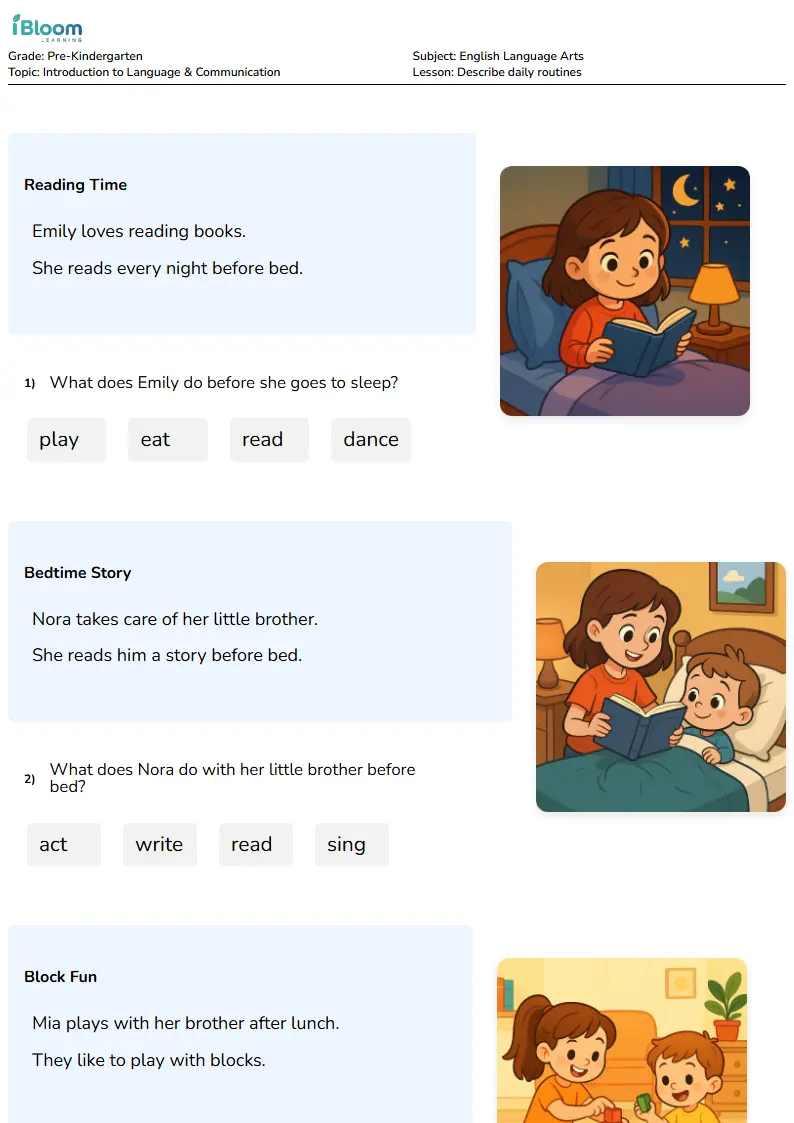
Use this preview to see the kind of practice children will open before you start the routine.
Counting Numbers Up to 5 Lesson for Pre Kindergarten Preview
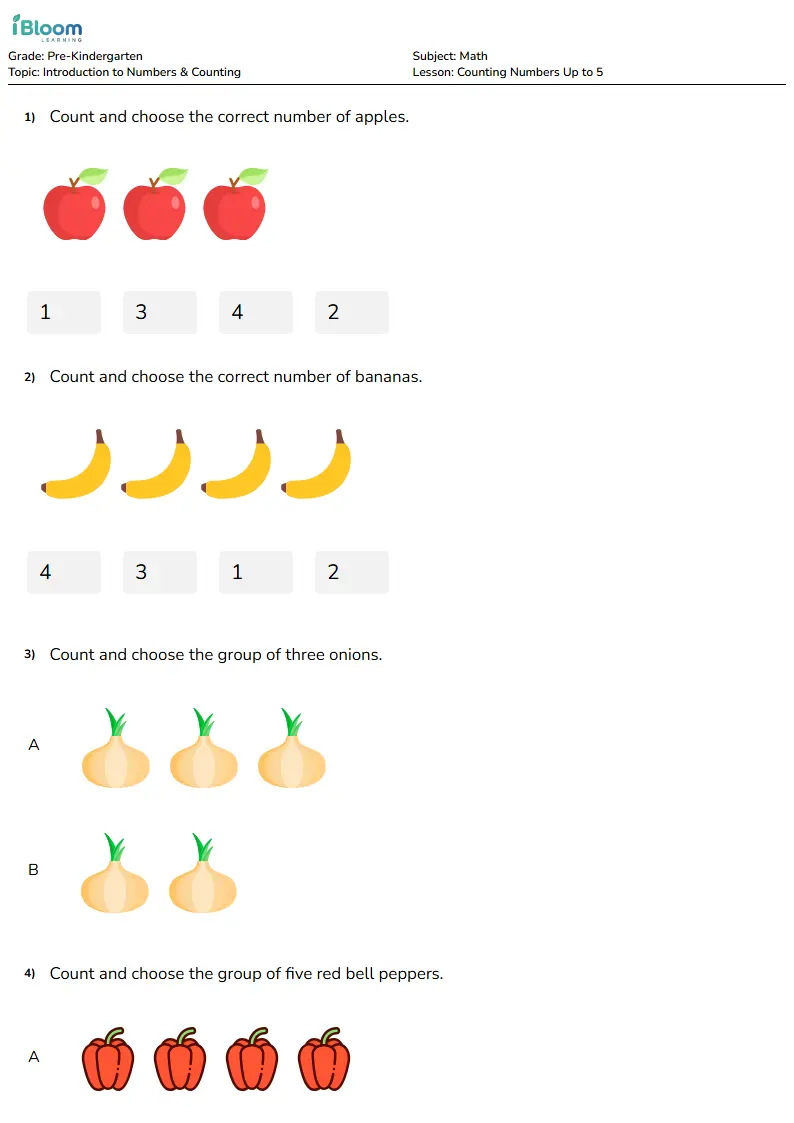
Use this preview to see the kind of practice children will open before you start the routine.