What Is the Difference Between Paraphrasing and Copying?
Paraphrasing preserves a source's meaning in genuinely new wording and structure while crediting the source; copying repeats its language.
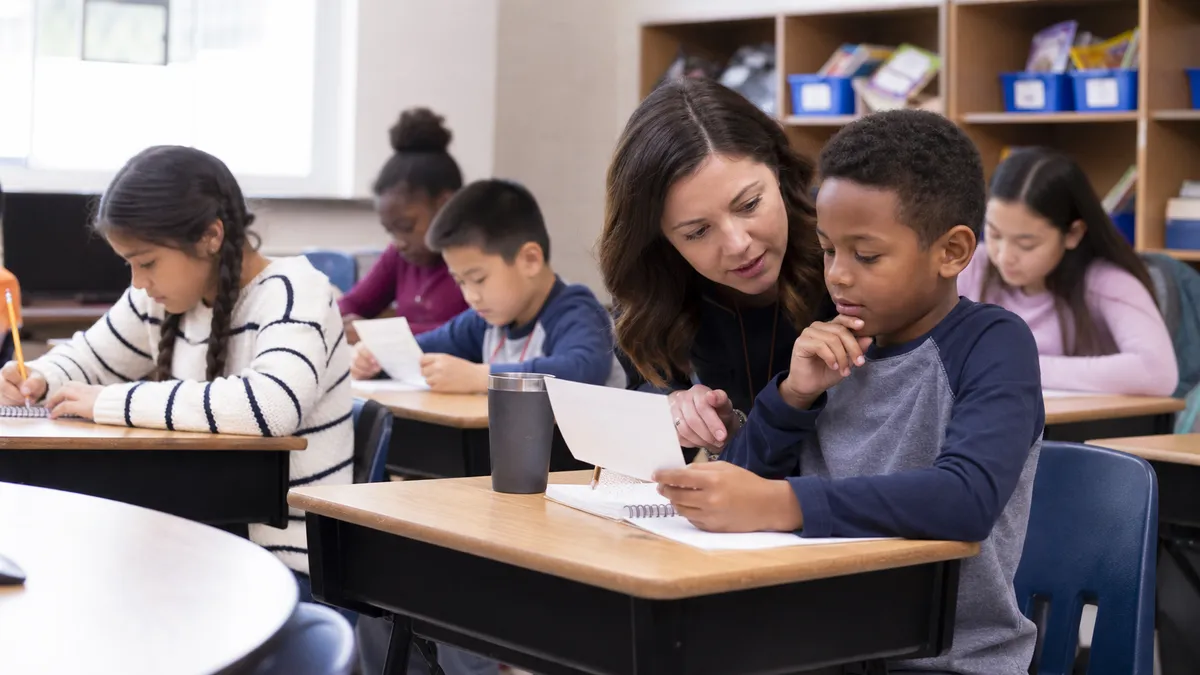
Children learn to paraphrase when adults teach them to understand an idea first, look away from the source, explain the meaning aloud, write a fresh sentence, compare it with the original, and name where the idea came from. This guide gives U.S. parents and teachers a complete routine for ages 8 to 12, roughly Grades 3 to 5.
Paraphrasing is not a synonym-swapping game. A successful paraphrase preserves the source's meaning while changing the wording and sentence structure. It also gives credit to the source. The goal is not to hide where information came from; the goal is to show that the child understood it.
What Paraphrasing Means for a Child
A child-friendly definition is: “A paraphrase tells the same idea accurately in a new way and says where the idea came from.”
That definition contains four important tests:
- Same idea: The child must not distort, exaggerate, or omit a necessary part of the source.
- New expression: The child uses a different sentence plan, not merely a few substitute words.
- Appropriate detail: A paraphrase usually stays close to the original level of detail, unlike a summary, which becomes much shorter.
- Source credit: The reader should know whose information or idea is being used.
The Purdue Online Writing Lab explanation of paraphrasing makes the same essential distinction among quoting, paraphrasing, and summarizing. The University of Utah guide to paraphrasing and summarizing also separates a detailed restatement from a shorter account of main points. For children, this means the lesson should begin with meaning, not vocabulary tricks.
Paraphrase, summary, and quotation are different
Use this comparison with learners:
| Tool | What the writer does | Typical length | When to use it |
|---|---|---|---|
| Quotation | Copies the exact words and marks them as a quotation | Same as selected words | When the exact wording matters |
| Paraphrase | Restates the meaning in a genuinely new sentence | Similar to the selected passage | When a specific idea or detail matters |
| Summary | Gives only the main points | Much shorter | When the reader needs the overall message |
Children often confuse these tools because all three begin with another person's material. Model them side by side. If the source says, “Mangrove roots slow moving water and trap sediment,” a quotation keeps those exact words. A paraphrase might say, “According to the source, sediment settles when mangrove roots reduce the speed of water.” A summary of a whole paragraph might simply say, “Mangroves protect and reshape coastlines.”
The Reading Rockets classroom strategy for summarizing can help children identify main ideas before they decide whether a task needs a short summary or a detailed paraphrase.
The Six-Step Paraphrasing Routine
Teach one stable routine until children can use it independently:
1. Read for meaning
The child reads a manageable section, usually one to three sentences at first. Ask, “What is this mostly telling us?” Clarify unfamiliar words before writing. A child cannot accurately restate an idea that remains confusing.
For informational reading practice, the iBloom Class 3 lesson on finding key details helps children separate essential information from interesting extras. The matching finding key details worksheet provides a useful follow-up after an adult models the thinking.
2. Close or cover the source
Ask the child to turn the page over, minimise the tab, or cover the relevant sentence with a card. This small action matters. When the source remains visible, children naturally borrow its sequence and phrasing. Closing it creates enough distance for understanding to guide the response.
Do not expect perfect memory. The child may keep three to five keywords on a note card. Keywords such as “mangrove roots,” “slow water,” and “sediment” preserve facts without preserving the author's full sentence.
3. Tell the idea aloud
The child explains the information as if speaking to a younger student, family member, or classmate who did not read the source. Oral rehearsal reduces the combined load of remembering, organising, spelling, and handwriting.
Useful prompts include:
- “What happened, and why?”
- “How would you explain this at dinner?”
- “What must the listener know?”
- “Can you start with a different part of the idea?”
- “Which words are special terms that should stay the same?”
Accept natural language during this step. The sentence can become more formal later. The immediate purpose is to hear whether the child understands the relationship among the ideas.
4. Write without looking
The child writes the oral explanation. Encourage a different sentence structure. If the source begins with a cause, the paraphrase might begin with the result. Two short source sentences might become one combined sentence. One long sentence might become two clear sentences.
The George Mason University paraphrasing guide explains that changing a few words while retaining a source's structure is not an acceptable paraphrase. Although its examples target older students, that principle is exactly what primary learners need adults to model.
5. Check meaning and independence
Uncover the source and compare. Ask two separate questions:
- Meaning check: Did the new sentence keep every important fact and relationship?
- Independence check: Is the sentence structure and most of the wording genuinely different?
Circle necessary technical terms that legitimately appear in both versions. Underline any long phrase that was copied. If six or seven words remain in the same order, the child should usually try another sentence plan unless the phrase is a name or fixed technical expression.
6. Credit the source
Finish with simple attribution. For younger children, “The National Geographic Kids article explains that…” may be enough. Older elementary learners can record the author, title, website or book, and access date in the format required by their teacher.
Attribution is not a punishment added after writing. It is how writers show that they are joining a conversation honestly. The Virginia Commonwealth University Writing Center guide explicitly connects paraphrasing with both understanding and source acknowledgement.
A Complete Worked Example
Consider this invented source sentence:
During hot weather, elephants may flap their large ears to move air across blood vessels near the skin, helping heat leave the body.
Weak attempt: synonym swapping
“During warm weather, elephants might wave their big ears to push air over blood vessels close to the skin, helping warmth exit the body.”
This version changes individual words but keeps the source's order and structure. The child may not understand why ear flapping helps.
Weak attempt: inaccurate meaning
“Elephants use their ears as fans because they cannot stay outside in hot places.”
This adds a claim that the source did not make. Accuracy matters more than sounding different.
Strong paraphrase
“Elephants can cool their bodies by flapping their ears, because moving air helps heat escape from blood flowing close to the ear's surface.”
This version keeps the causal relationship, changes the sentence plan, retains necessary scientific terms, and uses fresh phrasing.
Adult think-aloud
Say:
“First, I need the meaning. The ears are not simply making the elephant feel a breeze. Air moves over blood vessels near the skin, so heat can leave the body. I will cover the sentence. My keywords are ‘ears,’ ‘air,’ ‘blood,’ and ‘heat.’ I can begin with the result instead of the weather. Now I will compare my version with the source. I kept the science but changed the structure. Finally, I will name the source in my project.”
Think-alouds make invisible decisions visible. Do not merely show a polished answer and ask children to imitate it.
Why Children Copy Even When They Know the Rule
Copying is not always defiance. It often reveals a specific learning barrier.
The source is too difficult
If the passage contains several unfamiliar terms or complicated sentence structures, the child uses the original wording as a lifeline. Reduce the text, explain vocabulary, and use a diagram before asking for a paraphrase.
The child thinks every word must change
Some words should remain. Names, dates, measurements, scientific terms, and precise subject vocabulary may have no safe synonym. Changing “evaporation” to “water disappearing” can make the science less accurate. Teach children to keep necessary terms while changing the surrounding explanation.
The child has too much to hold in memory
Let the learner make a small keyword card, sketch a quick diagram, or record a short oral explanation. These supports preserve meaning without preserving whole sentences.
The task does not state a purpose
“Put this in your own words” can feel arbitrary. Give the paraphrase a reader and purpose: explain a textbook idea to a younger class, create a museum label, answer a research question, or prepare notes for a science presentation.
The child has only seen correction
If adults only mark copied phrases after the work is complete, children learn that paraphrasing is a trap. Model examples and non-examples before independent writing. Praise an accurate change in structure, then address one remaining copied phrase.
A Five-Day Teaching Plan
Day 1: Hear the difference
Read one short sentence. Offer three responses: a copy, an inaccurate retelling, and a strong paraphrase. Ask students to justify which one works. Keep the focus on meaning and structure rather than a percentage of changed words.
Day 2: Paraphrase orally
Use pictures, short videos, or familiar classroom events. One child explains the event; a partner restates that explanation. Compare meaning. Oral practice allows emerging writers and multilingual learners to participate fully.
Day 3: Use keyword notes
Read two sentences and write no more than five keywords. Hide the original, explain from the keywords, and draft. For structured reading practice, the iBloom Class 4 lesson on summarizing important information helps learners decide which ideas deserve a place on the note card. Follow it with the Class 4 summarizing worksheet.
Day 4: Compare two sources
Give two short passages about the same topic. Students paraphrase one useful idea from each and then combine them into an answer. The iBloom worksheet on combining information from two texts supports this move from isolated facts to a connected explanation.
Day 5: Write, check, and credit
Students complete the full routine independently. Use a four-part checklist: accurate meaning, new structure, appropriate details, and source credit. End with a short reflection: “Which step helped me avoid copying?”
Parent Guidance for Homework and Projects
Parents can help without writing the sentence for the child.
First, ask the child to read a short section and explain it aloud. If the explanation is unclear, ask a meaning question rather than supplying polished wording. Next, cover the source and write down only the child's keywords. Let the child draft from those notes. Finally, compare the two versions together.
Use prompts that preserve ownership:
- “Tell me what you understand.”
- “What is the connection between those facts?”
- “Can you begin with the result?”
- “Which term has to stay because it is the exact scientific word?”
- “What information did you accidentally add?”
- “How will your reader know where this idea came from?”
Avoid dictating a replacement sentence. A parent-produced sentence may pass a copying checker, but it does not develop the child's comprehension or writing.
For a child who needs more main-idea practice before paraphrasing, use the iBloom Grade 4 guide to summarizing informational passages. If the project uses websites, first apply the iBloom guide to checking reliable sources, because accurately paraphrasing unreliable information does not make it reliable.
A ten-minute home routine
- Choose one paragraph with two or three sentences.
- Read it once for general meaning.
- Clarify one or two difficult words.
- Write up to five keywords.
- Hide the paragraph.
- Let the child explain and draft.
- Compare for accuracy and copied structure.
- Add a simple source phrase.
Stop after one successful paraphrase. Brief, repeated practice usually teaches more than rewriting an entire page while tired.
Teacher Implementation in the Classroom
Model with colour coding
Display a short source and a paraphrase. Use one colour for ideas that must remain, another for technical terms, and a third for changed sentence structure. Colour coding helps students see that meaning stays while expression changes.
Use gradual release
Begin with “I do”: the teacher models the complete routine. Continue with “We do”: the class identifies meaning and suggests a new sentence plan. Move to “You do together”: partners orally rehearse. Only then assign an independent paragraph.
Separate composing from citation formatting
Young writers can learn source credit without memorising every punctuation rule at once. During the first lesson, require a clear source phrase. During later lessons, teach the school's citation format. This prevents formatting anxiety from overwhelming the core comprehension work.
Assess the process, not just the final sentence
Collect the keyword card, oral rehearsal notes, draft, and comparison checklist. These reveal whether a child understood and transformed the idea. A final sentence alone cannot show whether it came from independent thinking, adult help, or automated rewriting.
Use peer review carefully
Partners should answer two questions: “Does this say the same thing?” and “Does it sound like a new sentence?” They should not rewrite each other's work. Provide a respectful response frame: “I think the meaning is accurate because… One phrase that still follows the source is…”
Grade and Age Adaptations
Ages 8 to 9 or Class/Grade 3
Use one sentence, familiar topics, oral rehearsal, and three keywords. Accept simple source credit such as “The book says…” Evaluate accurate understanding and a changed sentence beginning.
Ages 9 to 10 or Class/Grade 4
Use two or three connected sentences. Ask children to combine or divide sentences, preserve subject vocabulary, and record the title of the source. Begin comparing paraphrase with summary.
Ages 10 to 12 or Class/Grades 5 and 6
Use short paragraphs from two sources. Require attribution, accurate handling of evidence, and an explanation of why a quotation, paraphrase, or summary is best in each location.
Do not advance only by making passages longer. Increase the complexity of decisions: selecting relevant details, combining related ideas, maintaining nuance, and integrating source credit smoothly.
Support for Multilingual Learners and Diverse Needs
Multilingual learners may understand a concept in one language before they can express it fluently in the language of instruction. Let them discuss the meaning in their strongest language, draw it, or use bilingual keywords before drafting. The paraphrase should test understanding, not punish limited access to vocabulary.
Provide sentence frames that support attribution without dictating the content:
- “According to ___, ___ happens because ___.”
- “The source explains that ___.”
- “In other words, the main process is ___.”
- “While ___, the source also shows ___.”
For learners with dyslexia or handwriting difficulties, allow speech-to-text for oral rehearsal, then review the wording together. For attention difficulties, cover all but the current sentence and use a visible six-step checklist. For learners who need stronger language support, offer a small bank of transition words but do not provide a bank of substitute synonyms.
For advanced learners, introduce nuance. Ask whether “often,” “may,” and “always” can be exchanged. They cannot: those words change certainty. Challenge students to preserve the source's level of confidence and limitations.
Common Misconceptions and Fixes
“I changed every third word, so it is a paraphrase.”
Fix: Compare sentence structure, not only vocabulary. Ask the child to cover the source and start with a different relationship, such as result before cause.
“If I paraphrase, I do not need to name the source.”
Fix: Explain that the words are new but the information still belongs to a source. Add attribution every time a borrowed idea is used.
“A paraphrase must be shorter.”
Fix: That describes a summary. A paraphrase often keeps a similar amount of detail while using a new expression.
“Technical words count as copying.”
Fix: Keep precise terms when changing them would damage meaning. Transform the explanation around them.
“A thesaurus can do the work.”
Fix: Synonyms can change meaning or create unnatural language. Understand, close, tell, and write before consulting a thesaurus for one carefully chosen word.
“An AI rewriter proves the work is original.”
Fix: Automated output may be inaccurate, too advanced, or still too close to a source. More importantly, it can remove the thinking practice the assignment is designed to provide. Children should create and explain their own paraphrase. Any permitted tool use should follow school policy and remain transparent.
Meaning-Preserving Sentence Moves
Children need alternatives to synonym swapping. Teach these moves one at a time:
- Change the starting point: Begin with the result instead of the cause.
- Combine: Join two related short statements into one clear sentence.
- Divide: Split a dense sentence into two simpler ones.
- Name the relationship: Use because, therefore, while, although, or as a result accurately.
- Change the audience: Explain the same meaning to a younger learner.
- Use a category: Replace a list with a correct category when no necessary detail is lost.
- Turn a noun into a verb: “The evaporation of water occurs” can become “Water evaporates.”
These are meaning moves, not tricks. After every move, the child must compare the result with the source.
A Simple Paraphrasing Rubric
Score each area from 0 to 2:
| Area | 0 | 1 | 2 |
|---|---|---|---|
| Meaning | Important meaning is wrong | Mostly accurate with a missing detail | Accurate and complete |
| Independence | Mostly copied | Some new wording but similar structure | Genuinely new wording and structure |
| Detail | Too much omitted or added | Minor imbalance | Appropriate detail for the task |
| Source credit | Missing | Incomplete or unclear | Source is clearly acknowledged |
| Explanation | Cannot explain choices | Explains one choice | Explains meaning and transformation |
A strong score is not the only goal. Use the pattern of scores to choose the next lesson. Low meaning suggests more comprehension work. Low independence suggests more oral rehearsal and sentence restructuring. Missing credit suggests a source-use routine.
Practice Activities That Do Not Feel Like Copying Drills
News reporter relay
Read a short, non-sensitive school announcement. One student explains it to a partner without seeing the text. The partner checks whether the essential meaning survived.
Museum label
Students read a paragraph about an animal, object, or historical place and create a two-sentence label for younger visitors. They must keep one technical term and add the source title.
Same fact, three audiences
Paraphrase one science fact for a six-year-old, a classmate, and a school newsletter. Discuss which words changed and which facts could not.
Paraphrase detective
Give four versions of a source: copied, synonym-swapped, inaccurate, and strong. Students label each one and cite evidence for the decision.
Keyword postcard
Students may place only five words and one sketch on a card. They then hide the source and draft from the card.
Two-source bridge
Students take one idea from each of two short sources, paraphrase both, and write a connecting sentence. This prepares them for research reports without asking them to handle a full project immediately.
How to Know When a Child Is Ready to Work Independently
A learner is ready when they can:
- explain the source accurately before writing;
- select a few useful keywords rather than copy sentences;
- draft while the source is hidden;
- notice a copied phrase during comparison;
- preserve technical terms and levels of certainty;
- distinguish paraphrase from summary and quotation;
- add clear source credit;
- explain why their version keeps the original meaning.
If two or more of these behaviours are missing, return to guided practice. Independence should mean control of the process, not merely completing the task alone.
Frequently Asked Questions
What is the easiest way to teach a child to paraphrase?
Use one short passage and repeat six steps: read, cover, tell, write, check, and credit. Oral explanation while the source is hidden is the most useful bridge between comprehension and independent wording.
At what age can children learn paraphrasing?
Many children can begin with oral restatement around ages 7 or 8. Written paraphrasing becomes more realistic in Classes or Grades 3 to 5 as reading comprehension and sentence control grow. Adjust passage length and source-credit expectations to the learner.
How different must a paraphrase be?
There is no reliable percentage of words that must change. Judge whether the child preserved meaning while creating a genuinely new sentence structure and mostly new wording. Necessary names and technical terms may remain.
Does a child need to cite a paraphrase?
Yes. The wording is the child's, but the information or idea came from another source. Use a simple source phrase for younger learners and the teacher's required citation format for older learners.
What if the child cannot think of different words?
Stop searching for synonyms. Ask the child to explain the idea aloud, draw the relationship, make a few keyword notes, and begin from a different part of the idea. If they still cannot explain it, return to comprehension and vocabulary.
Is paraphrasing the same as summarizing?
No. A paraphrase restates a specific passage at roughly the same level of detail. A summary compresses a larger text into its main points.
Can children use quotations instead?
Sometimes. A quotation is appropriate when exact wording matters, but it must be marked and credited. Research writing usually needs a purposeful mixture of quotation, paraphrase, summary, and the child's own analysis.
Should children use paraphrasing tools?
Not as a substitute for learning. A tool cannot demonstrate that the child understood the source, and its output may change meaning. Follow school policy, disclose permitted tool use, and require the child to explain every final sentence.
Final Teaching Checklist
Before accepting a paraphrase, ask:
- Can the child explain the source without reading it aloud?
- Does the draft keep the source's meaning and level of certainty?
- Is the sentence plan genuinely new?
- Are copied phrases limited to names or necessary technical terms?
- Did the child avoid adding unsupported claims?
- Is the amount of detail appropriate?
- Is the source clearly acknowledged?
- Can the child describe what they changed and why?
Paraphrasing improves when it is taught as comprehension, communication, and honest source use at the same time. Start with one sentence, make thinking visible, and practise the routine often. The result is not merely writing that looks different; it is a learner who can understand information, explain it accurately, and use it responsibly.