What Makes a Good Research Question for Students?
A good student research question is focused, answerable with suitable sources, open enough to require explanation, and useful for the assignment.
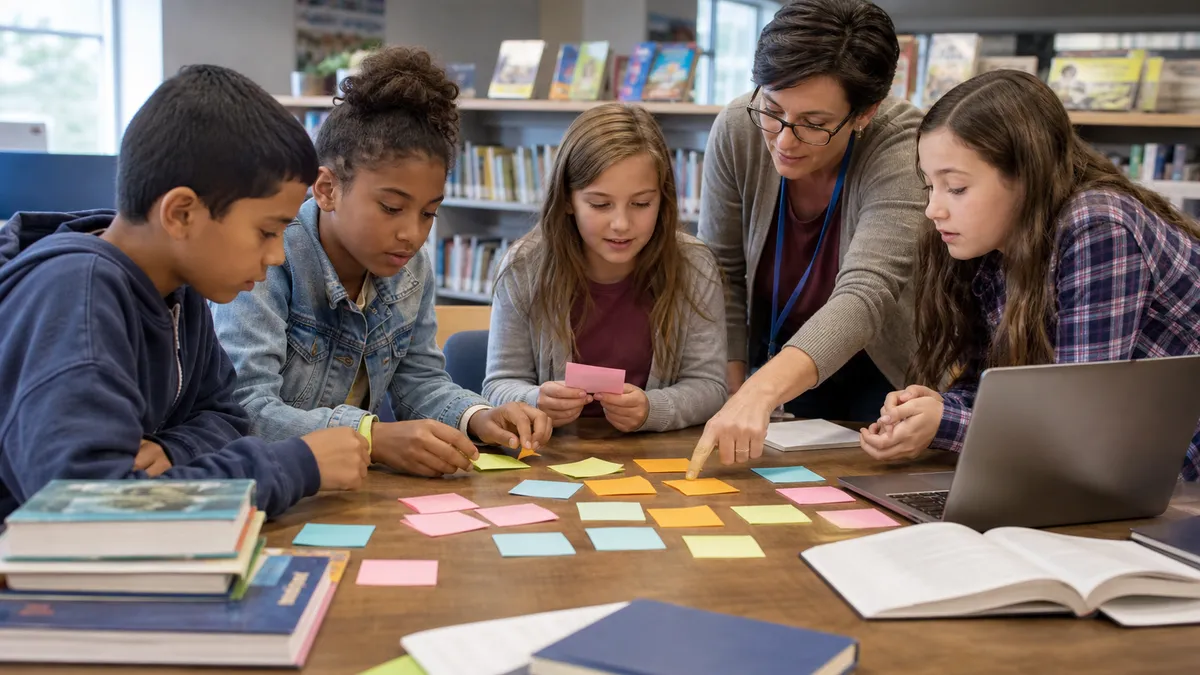
Children ask better research questions when adults teach them to move from a broad topic to one clear, answerable question with a useful purpose. The most reliable routine is: notice what interests you, list many questions, sort them, improve one question, check whether suitable sources exist, and plan smaller questions that lead to an evidence-based answer.
This guide is designed for U.S. parents and teachers of children ages 8 to 12, roughly Grades 3 to 5. It works for science, social studies, English language arts, library projects, exhibitions, and curiosity-led learning at home.
What Makes a Strong Research Question?
A strong research question is:
- interesting to the learner, so the child wants to keep investigating;
- focused enough to manage, rather than covering an entire subject;
- open enough to investigate, rather than ending with one word;
- answerable with age-appropriate evidence, not only personal opinion;
- clear about what will be compared, explained, or discovered;
- safe, respectful, and suitable for the assignment.
Use the child-friendly test FOCUS:
- Fascinating: Do I genuinely want to know the answer?
- Open: Will the answer require explanation rather than yes or no?
- Clear: Will another person understand exactly what I am asking?
- Useful: Will the answer help me explain, compare, decide, or solve something?
- Source-ready: Can I find trustworthy books, people, observations, or websites that contain relevant evidence?
The Right Question Institute's Question Formulation Technique treats question generation as a skill people can learn through a structured process. The classroom implication is important: do not expect children to produce one perfect question immediately. Let them create many questions before evaluating and improving them.
Topic, Question, and Thesis Are Not the Same
Children frequently arrive with a topic and believe the research question is finished.
| Part | Example | What it does |
|---|---|---|
| Topic | Urban trees | Names the general subject |
| Research question | How do trees near schools affect shade and surface temperature? | Directs the investigation |
| Working answer | Trees can reduce direct sunlight on paved areas, but the effect depends on location and canopy size. | Gives a provisional answer that evidence may change |
| Final claim | Evidence from maps, temperature observations, and reliable sources shows... | Presents the conclusion after research |
Tell learners, “A topic is where you begin looking. A research question tells you what you are looking for.” Do not ask for a thesis before the child has gathered evidence. Otherwise, the project becomes a hunt for facts that support an early guess.
The Seven-Step Research Question Routine
1. Begin with a real point of curiosity
Show an object, photograph, map, short passage, demonstration, or local problem. Ask children to notice before they explain. Useful prompts include:
- What surprises you?
- What changed?
- What seems connected?
- What do you wish you could see more closely?
- What might different people think about this?
- What would happen if one condition changed?
A concrete focus reduces the pressure of “Choose any topic.” The Harvard Library guide to primary sources explains that primary sources provide firsthand testimony or direct evidence about a topic under investigation. Parents can prompt observation and questioning with a family photograph, bus timetable, leaf, receipt, newspaper image, or neighborhood map.
2. Generate questions without judging them
Set a short timer and record every question. Children may speak while an adult or classmate writes. Include closed questions, open questions, simple questions, unusual questions, and questions that may later be rejected.
During generation:
- do not answer the questions;
- do not praise only the most academic-sounding ones;
- do not correct wording unless it is impossible to understand;
- do not turn the child's question into the adult's preferred question;
- number each question so the group can discuss it later.
This stage protects curiosity. Evaluation comes next.
3. Sort questions by the kind of answer
Teach children to recognize several useful types:
- Fact questions: What is a mangrove?
- Process questions: How does salt move through mangrove roots?
- Cause questions: Why do some coastlines lose soil faster than others?
- Comparison questions: How do mangroves and concrete sea walls protect a coast differently?
- Change-over-time questions: How has this lake changed over ten years?
- Perspective questions: How might fishers, residents, and scientists describe the same change?
- Design questions: Which school-garden layout could collect rainwater most effectively?
Fact questions are not bad. They often become supporting questions. A project usually becomes richer when the main question asks how, why, which, or to what extent and uses fact questions underneath.
The iBloom Class 3 lesson on asking and answering questions gives children a useful foundation for connecting a question to information in a text. The matching asking and answering questions worksheet can provide a short practice round before students formulate questions for a larger project.
4. Improve one promising question
Use four moves:
Narrow the subject. “How does pollution affect Earth?” is too broad. “How does litter near our local storm drains affect where rainwater can flow?” is more manageable.
Name a relationship. Ask how one factor affects, changes, connects with, or differs from another.
Add a useful boundary. Specify a place, time, group, text, event, or condition when it makes the project realistic.
Remove hidden assumptions. “Why are school uniforms better?” assumes they are better. A fairer question is, “What benefits and challenges do students and teachers report about school uniforms?”
Do not add so many limits that the question becomes awkward. The child should be able to say it aloud and remember it.
5. Run the source-ready check
A question may be fascinating but impossible to answer with the learner's time and resources. Before committing, list possible evidence:
- books from a school or public library;
- reliable websites from government, universities, museums, or professional organizations;
- primary sources such as photographs, maps, letters, or public records;
- safe observations or measurements;
- an interview with an appropriate knowledgeable adult;
- a simple survey, if the school permits it and protects privacy;
- more than one source or perspective.
The American Association of School Librarians guidance on elementary research emphasizes planning the research process and explicitly teaching how to develop a guiding question. If no suitable evidence exists, revise the question rather than filling the project with unrelated facts.
6. Build supporting questions
Turn the main question into three to five smaller questions. For “How do trees near schools affect shade and surface temperature?” supporting questions might be:
- What causes outdoor surfaces to become hot?
- How does tree shade change the amount of direct sunlight?
- Which surfaces around the school are shaded at different times?
- How could temperatures be measured safely and consistently?
- What other factors, such as wind or surface material, might affect the readings?
Supporting questions become a research plan. They also help a child decide whether a source is relevant. A page can be reliable yet still fail to answer the project question.
7. Revisit the question during research
Research is not a straight line. New evidence may reveal that the original wording is too broad, too narrow, or based on a mistaken assumption. Permit a documented revision:
- Original: Why do bees disappear?
- Revised: Which changes in food, nesting space, and pesticide exposure can affect wild bee populations in cities?
Revision is evidence of learning, not failure. Ask the child to explain what new information caused the change.
Worked Examples: Weak to Strong Questions
Example 1: Animals
Topic: Tigers
Too broad: Tell me everything about tigers.
Closed: Do tigers hunt at night?
Improved: How do a tiger's senses and striped coat help it hunt in different light conditions?
The improved question connects features with function. Supporting fact questions can identify habitat, eyesight, hearing, and camouflage.
Example 2: Water
Topic: Saving water
Loaded: Why do people waste so much water?
Improved: Which everyday changes could reduce water use in our school without affecting hygiene?
The improved version avoids blaming people and creates room for measurement, comparison, and practical recommendations.
Example 3: History
Topic: A local building
Too simple: When was the railway station built?
Improved: How did the opening of the railway station change travel and trade in the surrounding town?
The date remains a supporting fact. The main question requires evidence about change over time.
Example 4: Literature
Topic: A story character
Opinion only: Is the main character good?
Improved: How do the character's decisions in the beginning and ending reveal a change in responsibility?
The learner can answer with textual evidence rather than preference alone.
Example 5: Technology
Topic: Learning apps
Loaded: Why are learning apps bad for children?
Improved: Which app features help children practise independently, and which features require adult guidance?
This question invites balanced criteria and evidence. It does not assume every tool has the same effect.
How to Teach Open and Closed Questions
Closed questions usually have a short factual answer: who, what, when, or where. Open questions require explanation, evidence, comparison, or reasoning: how, why, what might happen, or which option best meets stated criteria.
Children need both. A closed question can establish a necessary fact. Several closed questions can support one open research question.
Try this conversion activity:
- Closed: Does compost help plants?
- Open: How does adding different amounts of compost affect the growth of the same kind of plant?
- Closed: Was the fort used by soldiers?
- Open: How did the fort's location and design support the people who used it?
- Closed: Do students like the library?
- Open: Which library features do students use most, and what changes would make reading access easier?
Ask what changed. Stronger versions identify variables, evidence, purpose, or perspective.
A Five-Day Classroom Plan
Day 1: Observe and wonder
Present one rich focus such as a historical image, science demonstration, local map, or short informational passage. Students write observations separately from questions. This prevents guesses from being mistaken for visible evidence.
Day 2: Produce and sort questions
Generate as many questions as possible. Label each as closed or open, then identify its type: fact, cause, comparison, change, perspective, or design.
Day 3: Improve and test
Pairs select two promising questions. They narrow the scope, remove assumptions, and perform the source-ready test. Each pair explains why one question is more researchable.
Day 4: Build a question map
Write the main question in the center. Add three to five supporting questions. Beside each one, list the kind of source or evidence likely to help.
Day 5: Conduct a mini-investigation
Students use two short sources or one source plus an observation. They record evidence, revise the question if needed, and give a one-minute answer that names the evidence used.
For younger students beginning the process, iBloom's research-to-answer-questions lesson demonstrates how a question guides information gathering. The matching research worksheet offers a contained follow-up rather than an overwhelming full report.
Parent Guidance for Projects at Home
Parents often see the assignment after a child has chosen a topic that is far too broad. Help by asking process questions instead of selecting the final question:
- What part of this topic surprises you most?
- What do you already know, and what is still uncertain?
- Could one book answer this completely, or will you need several sources?
- Which words in the question are vague?
- Is the question assuming something before we investigate?
- What evidence would change your mind?
- Can you finish this investigation in the available time?
Write three versions and compare them. The first may be broad, the second more focused, and the third source-ready. Let the child make the final choice and explain it.
A fifteen-minute home routine
- Choose one object, photo, headline, nature observation, or school topic.
- Spend two minutes noticing details.
- Generate at least eight questions.
- Star two questions that require explanation.
- Improve each using a relationship and boundary.
- Check for two suitable source types.
- Select one main question.
- Add three supporting questions.
Stop before writing the report. The purpose of this session is to make a useful plan.
Teacher Implementation That Preserves Student Ownership
Use a question parking lot
Keep a visible space where students can add questions that arise during lessons. Revisit it weekly. Some questions will be answered quickly; others can become investigations.
Model revision, not perfection
Show the teacher's first weak question and improve it aloud. Students need to see that strong questions are designed through revision.
Separate question quality from handwriting
Allow oral dictation, sticky notes, drawings, or speech-to-text during generation. Evaluate the thinking first. Formal writing can follow after the question is selected.
Avoid the hidden teacher question
If only one answer or direction is acceptable, state the assignment clearly. Do not pretend students have ownership while steering every child toward the same question.
Conference with criteria
Instead of saying, “That question is not good,” use the FOCUS test. Identify the specific issue: too broad, unclear relationship, unavailable sources, loaded wording, unsafe method, or unrealistic time.
Connect questions to note-taking
Each note should answer a supporting question. Notes that answer none of them are probably interesting but irrelevant. This simple rule reduces copy-and-paste research.
The iBloom Class 4 research report lesson connects gathering information with an organized final product. Its research report worksheet can support practice after students have built a clear question map.
Grade and Age Adaptations
Ages 6 to 8
Use oral questions about a concrete object, picture, or shared text. The adult records questions. Choose one that can be answered with a short book, observation, or safe interview. At this age, “How does a seed change as it grows?” is sufficiently rich.
Ages 8 to 10
Ask learners to distinguish a topic from a question, sort open and closed questions, narrow by place or condition, and create two to four supporting questions.
Ages 10 to 12
Introduce perspective, cause, comparison, variables, source availability, and revision based on evidence. Students can explain limitations: what their project can and cannot prove.
Beyond age 12
Add disciplinary expectations, counterarguments, ethical methods, formal citations, and questions about how evidence was produced. The same FOCUS foundation still applies.
Support for Multilingual Learners and Diverse Needs
Let multilingual learners generate questions in their strongest language, then work with a peer or adult to express the selected question in the language of instruction. Curiosity and reasoning should not be limited by temporary vocabulary gaps.
Use visual question stems:
- How does ___ change when ___?
- Why might ___ happen?
- What is similar and different about ___ and ___?
- How has ___ changed over time?
- Which ___ best meets the criteria ___?
- How might ___ look from the perspective of ___?
For learners with attention difficulties, present one step at a time and use movable question cards. For dyslexia or handwriting difficulty, accept oral recording. For learners who become overwhelmed by open choice, offer three rich starting objects rather than assigning one narrow question.
Advanced learners can identify assumptions, define ambiguous terms, compare evidence types, and explain what evidence could disprove a working answer.
Safety and Ethics in Child Research
Some questions require methods that are inappropriate for children. Do not ask students to collect private health details, family income, immigration status, passwords, precise addresses, or sensitive experiences. Avoid experiments that risk harm to people, animals, or the environment.
If a survey is used, follow school policy, collect the minimum information, avoid names, and make participation voluntary where appropriate. If interviewing an adult, obtain permission and conduct it in a safe setting.
Questions about conflict, discrimination, illness, or traumatic history may be important but require age-appropriate sources and careful teacher support. A researchable question is not automatically an ethical classroom question.
The National Archives education resources demonstrate how historical records can support inquiry without asking children to gather private information from people around them. Primary sources should still be contextualized and compared rather than treated as complete truth by themselves.
How to Check Sources After Choosing a Question
Question quality and source quality work together. Ask:
- Who created the source?
- What expertise or direct access did the creator have?
- When was it produced or updated?
- What evidence does it provide?
- What purpose or perspective shaped it?
- Does another independent source agree?
- Does it actually answer the research question?
Use the iBloom guide to checking reliable sources before children rely on websites. Then use the iBloom paraphrasing guide to help them record information accurately without copying.
Common Problems and Practical Fixes
The question is too broad
“How does climate change affect the world?” requires far more time and evidence than a child has. Add one effect, place, ecosystem, group, or time frame.
The question has only one factual answer
Keep it as a supporting question. Add a relationship: how, why, compared with what, or with what effect?
The question is actually an opinion prompt
“What is the best animal?” has no shared evidence criteria. Define the purpose: “Which local animal has adaptations that best support survival during dry months?”
The question is loaded
Remove the assumed judgment. Replace “Why is homework harmful?” with “How do different amounts and types of homework affect students' time, practice, and stress?”
No age-appropriate sources exist
Change the scope, source type, or question. Do not let the child rely on pages they cannot understand merely because the title looks relevant.
The child keeps changing topics
Use a “later questions” page. Preserve new interests without abandoning the current investigation. Revisit the main question and supporting-question map at each session.
The child has already decided the answer
Ask, “What evidence would make you revise that idea?” If the answer is “nothing,” the task is persuasion, not research. Reword the question to allow more than one possible finding.
A Simple Research Question Rubric
Score each area from 0 to 2:
| Area | 0 | 1 | 2 |
|---|---|---|---|
| Curiosity | No clear interest | Some connection | Clear, authentic interest |
| Focus | Unmanageably broad | Needs one boundary | Manageable scope |
| Openness | One-word answer | Some explanation | Requires evidence and reasoning |
| Clarity | Meaning is uncertain | Mostly clear | Precise and understandable |
| Source readiness | No suitable evidence | One limited source type | Multiple suitable evidence sources |
| Fairness | Loaded or unsafe | Assumption needs revision | Neutral, ethical wording |
The rubric should guide revision, not punish early ideas. A low score tells the learner exactly what to improve.
Research Question Activities
Question ladder
Write a broad topic at the bottom. Each rung makes the question more focused, evidence-based, or explanatory.
Question auction
Groups receive pretend tokens and “bid” on questions they believe are most researchable. They must justify each bid using FOCUS criteria.
Source match
Display several source types. Students decide which could help answer each supporting question and explain why.
Assumption detector
Students highlight words such as best, worst, obviously, always, and harmful. They rewrite the question without assuming the conclusion.
One question, three subjects
Use a shared object such as a river. Form a science question, a history question, and a civic-design question. Discuss how disciplines change what counts as evidence.
Revision timeline
Students keep the first, middle, and final versions of a question. At the end, they annotate what changed and what evidence prompted the revision.
Frequently Asked Questions
What is a research question for elementary students?
It is a focused, answerable question that guides a child to gather and use evidence. It should require more than a one-word answer but remain manageable with age-appropriate sources and time.
How is a research question different from a topic?
A topic names a subject, such as volcanoes. A research question identifies what the learner will investigate, such as, “How does the thickness of lava affect the shape of a volcano?”
Should a research question begin with why or how?
Often, but not always. Comparison and design questions may begin with “Which” or “What.” The important test is whether the question requires evidence and explanation.
How many supporting questions should a child use?
Three to five is usually enough for a primary or upper-elementary project. Each should contribute a necessary part of the main answer.
Can a child change the question after starting research?
Yes. Evidence may reveal a hidden assumption or an unrealistic scope. Ask the child to record the revision and explain why it improved the investigation.
What if the child cannot think of any questions?
Provide a concrete object, image, map, short passage, or demonstration. Ask the child to notice details first, then use how, why, change, comparison, perspective, and design stems.
Are yes-or-no questions bad?
No. They can establish facts and become supporting questions. A main research question usually needs to invite explanation, comparison, or reasoning.
How can parents help without taking over?
Ask the child to generate several versions, then use shared criteria to compare them. Do not supply the final polished question. The child should choose it and explain why it is researchable.
Final Checklist
Before research begins, confirm:
- The learner can explain the question in their own words.
- The question is narrower than the topic.
- It requires evidence and explanation.
- Important terms are clear.
- It does not assume the conclusion.
- The scope fits the available time.
- At least two suitable sources or evidence types are available.
- Three to five supporting questions create a practical plan.
- The method is safe and ethical.
- The child is allowed to revise the question as understanding grows.
A good research project does not begin with collecting random facts. It begins with a question that gives those facts a purpose. Teach children to generate freely, evaluate clearly, and revise honestly. That process turns curiosity into disciplined inquiry while keeping ownership with the learner.