Why Can My Child Read a Word Once but Not Again?
A practical guide to inconsistent word reading, with a look-back routine, regular and irregular word support, fluency steps, and teacher questions.
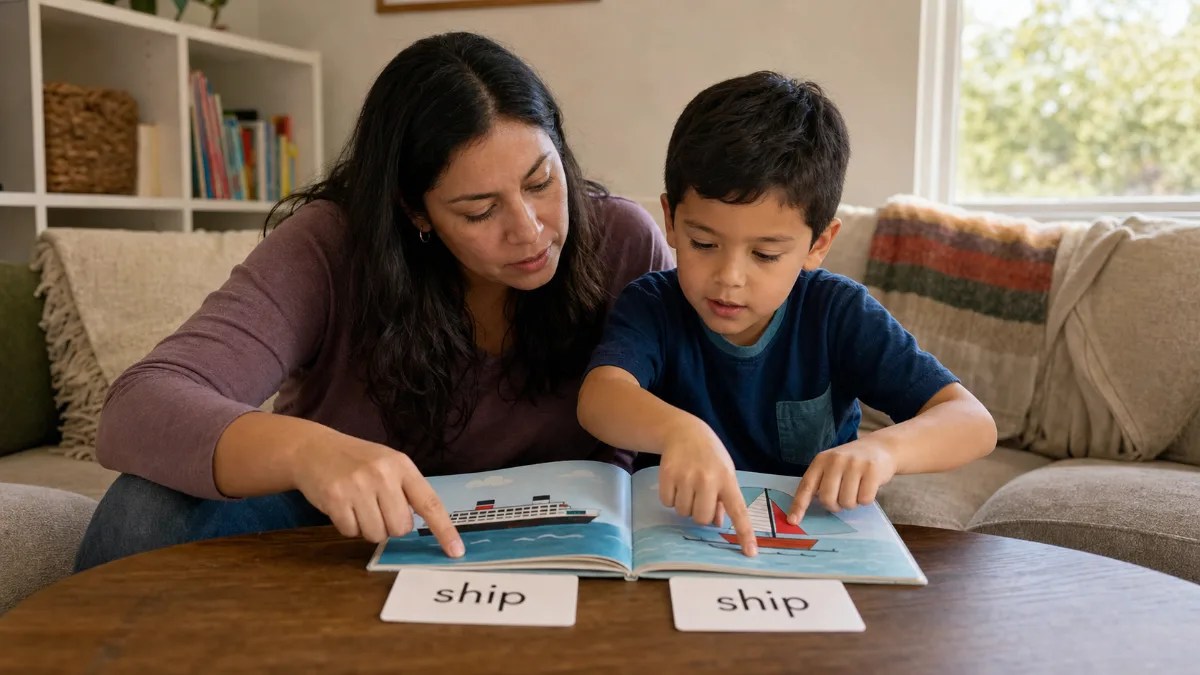
A child may read a word correctly once and struggle with it moments later because the first success did not necessarily create stable, automatic word recognition. The child might have used a picture, sentence context, adult help, or slow sound-by-sound decoding. On the next page, those supports may be different, or the child may need to decode the word again. That is not proof of laziness, poor memory, or dyslexia. The useful response is to find out what information the child used, prompt a fresh look at the letters and sounds, and provide a few accurate encounters with the word while protecting the meaning and enjoyment of the text.
This guide is for U.S. parents, homeschoolers, and teachers supporting beginning readers, mainly in kindergarten through second grade. It explains how to observe the problem, what to say during reading, how regular and irregular words need different support, and when to bring a pattern to the teacher. It is educational guidance, not a diagnosis.
What Is Actually Happening When the Word Seems “Forgotten”?
Two correct responses can look identical while coming from different reading processes. A child may recognize ship immediately, decode ship by blending /sh/ /i/ /p/, infer ship from a picture of a boat, or repeat the word after hearing an adult. Only the first two responses demonstrate that the letters contributed enough information to identify the word.
On a later page, the picture may be gone, the sentence may offer a different clue, or the adult may wait instead of helping. The child now appears to have forgotten the word, but the first response may never have been stable recognition in the first place.
Five routes to a correct first answer
- Automatic recognition: The child sees the spelling and identifies the word quickly and accurately.
- Successful decoding: The child connects letters or letter groups with sounds, blends them, and reaches the word.
- Context-supported decoding: The child uses print information plus sentence meaning to confirm a partly decoded word.
- Guessing: The child uses the picture, first letter, or story topic without checking the complete spelling.
- Prompt dependence: The child repeats or completes a word after an adult supplies enough of it.
The first-grade decode-words lesson can help you observe whether a child is attending to the complete written word. Use it as guided practice, not as a test of intelligence or a replacement for the teacher's assessment.
Why One Successful Decode May Not “Stick” Immediately
Decoding a new word can require several deliberate steps: notice the letters, recall their sounds, combine the sounds, adjust the pronunciation if necessary, and check whether the result makes sense. A beginning reader may complete those steps correctly but still need to repeat them when the word appears again.
The U.S. Department of Education's foundational reading practice guide recommends teaching students to decode words, analyze word parts, and read connected text with accuracy and fluency. The guide also notes that increasing ease of word recognition allows more attention to meaning. This supports a patient progression: accurate analysis comes before effortless recognition, and meaningful text remains the purpose.
Accurate is not yet automatic
Imagine a child solving 7 + 5 by counting objects. The correct answer shows understanding, but it may not yet be recalled automatically. Reading can follow a similar progression. A correct sound-by-sound decode is valuable. It is evidence that the child can use the code. Repeated accurate encounters can make the process more efficient, but one success does not guarantee immediate automaticity.
Avoid saying, “You just read that word.” The statement is factually true but does not reveal what to do next. It can also suggest that needing to decode again is a failure. A better prompt is, “You worked this word out before. Let's look at every part again.”
A One-Minute Observation Before You Help
When the child stops at the repeated word, wait briefly and observe. You are not trying to catch a mistake. You are identifying the next useful cue.
Ask yourself:
- Does the child look at the word or immediately look at the picture?
- Does the child say the first sound only?
- Does the child attempt all letter-sound connections?
- Does the child blend sounds but produce a similar word?
- Does the child substitute a word that fits the sentence but not the spelling?
- Does the child recognize a familiar part, such as -ing, sh, or at?
- Does the child correct the attempt after rereading the sentence?
- Is the word regular enough for the phonics pattern the child has been taught?
- Is the text so difficult that nearly every word requires help?
Write down the exact word and response rather than a broad judgment. “Read plant as place and looked only at the first two letters” is actionable. “Keeps forgetting words” is harder for a teacher to interpret.
The first-grade decoding worksheet can provide a controlled example after natural reading. If the child decodes the same pattern accurately in isolated words but not in a dense passage, text complexity, attention, or fluency may be part of the picture.
Use the Look-Back, Compare, Try-Again Routine
A parent booklet from the Evidence-Based Literacy Training for Educators Partnership addresses the exact situation in “Sometimes my child reads a word correctly on one page but can't figure it out on the next”. It advises avoiding impatience, looking back to the earlier successful occurrence, rereading that sentence, and then returning to the challenging page. The goal is to help the child use the successful example as evidence, not to shame the child for inconsistency.
Here is a practical version of that routine.
Step 1: Mark the current place
Keep a finger or small sticky tab near the difficult word so the child does not lose the page. Say, “This word is giving us useful information. Let's compare it with the one you read before.”
Step 2: Find the earlier occurrence
Ask the child to locate the same word on the earlier page. If searching creates frustration, find it together. Do not hide the spelling with your finger or point only to the first letter.
Step 3: Reread the earlier sentence
Let the child read the whole sentence again. Then isolate the target word. Ask, “What letters or word parts helped you?” If the child cannot explain, model the analysis briefly.
Step 4: Compare the two printed forms
Place a finger under each occurrence. Ask, “Do these have the same letters in the same order?” The child should confirm the print, not just the meaning or picture.
Step 5: Return and decode again
Go back to the second page. Prompt the child to say the sounds or parts and blend them. After the word is identified, reread the sentence naturally so meaning is restored.
Step 6: Continue the story
Do not turn every repeated word into a drill. Continue reading. If the word appears again, wait and see what the child does independently.
This routine usually takes less than a minute. If it repeatedly takes much longer, the text may be too demanding for productive independent reading.
Distinguish Regular Words From Irregular Words
The right prompt depends on the word. A regular word can be decoded using sound-spelling relationships the child knows. An irregular word includes a part that does not follow the pattern the child would reasonably expect at that stage.
For a regular word
Use prompts that direct attention through the spelling:
- “Point to each sound part.”
- “What sound does this team make?”
- “Blend from the beginning without stopping between sounds.”
- “Check the last sound. Did your word match every letter?”
The first-grade phonics-pattern word-building lesson can help a child compare words that share a pattern. For example, reading shop, ship, and shut makes the sh unit visible while preserving the changing vowel and ending.
For an irregular word
Do not force a child to produce a pronunciation that the spelling pattern cannot fully support. Identify the regular part and explicitly teach the unexpected part. For said, a child can connect s and d with expected sounds while learning that the middle spelling represents an unexpected vowel sound in this word.
The IES foundational reading summary distinguishes regular words, for which students can apply letter-sound skills, from irregular words that include exceptions. It describes strategies such as teaching irregular words within a decoding sequence and drawing attention to the unexpected sounds. This is more precise than labeling every frequently seen word a shape to memorize.
Why the distinction matters
If a parent tells a child to “sound it out” when the taught patterns do not produce the conventional pronunciation, the child may conclude that phonics is unreliable. If an adult gives every regular word immediately, the child loses a chance to practice decoding. Before prompting, ask: “Is this word decodable with what the child has been taught?”
The kindergarten sight-word lesson can support recognition practice, but keep the term sight word clear: a word is read by sight when the individual reader recognizes it automatically. Some words become sight words through repeated decoding; others require explicit attention to an irregular part.
How to Practice Without Creating a Memory Test
The goal is not to flash the same word until the child guesses faster. Practice should strengthen the connection among spelling, pronunciation, and meaning.
Use a three-context sequence
- Word alone: Decode or analyze the word on a simple card.
- Word in a sentence: Read a short sentence where the word makes sense.
- Word in a second context: Read another sentence with a different picture or topic.
For the word stamp, a child might first blend the sounds, then read “Put the stamp on the letter,” and later read “We can stamp a shape in paint.” The changing context reduces dependence on one picture while preserving the same spelling.
Keep the set small
Choose two or three target words that reflect the current phonics instruction. Ten unrelated words can overload the task and make it difficult to identify which pattern needs support.
Space practice across days
Return to the words briefly on another day rather than completing a long session once. Begin with a fresh decode if needed. The aim is accurate retrieval and analysis, not proving that the child remembers every previous session.
Mix known and new examples
Include words the child can read confidently so the activity has momentum. Add one or two new words that use the same pattern. Ask the child to explain what stays the same and what changes.
The phonics-pattern worksheet for first grade can provide a structured follow-up. Stop before accuracy deteriorates from fatigue.
Repeated Reading Should Preserve Meaning
Rereading can support accuracy and fluency when the passage is manageable and the purpose is clear. It should not become a race or a punishment for errors.
Use this short sequence:
- Preview two target words.
- Read the passage together or let the child read with support.
- Discuss one idea from the passage.
- Reread a short section for smoother phrasing and accurate words.
- Ask one meaning question or invite a retell.
The first-grade reading-fluency lesson can help connect accurate word reading with phrased, meaningful reading. Fluency is not simply speed. A child who rushes and substitutes words needs accuracy and print attention, not a faster timer.
When rereading is not the right move
Pause or change the text when the child is missing many words, becoming upset, or spending so much effort on decoding that the story disappears. Read the rest aloud, share the reading, or choose an easier book. Productive practice gives the child many opportunities to succeed with the taught patterns.
Reading Rockets answers a closely related parent question in “Why can't my child re-read a word in a sentence that she just sounded out?”. The response emphasizes asking a teacher, librarian, or reading specialist for appropriately matched books and explains that practice in suitable text helps decoding become more automatic. This is not a promise that any particular book level will fix the issue; it is a reason to check whether the text permits useful practice.
Protect Comprehension While Working on Words
A child can spend so much attention identifying words that little attention remains for the sentence's message. Word reading and comprehension should support each other, not compete for the entire session.
After a difficult word is solved, always reread the sentence. Then ask a light meaning question:
- “What happened?”
- “Who did that?”
- “What does this word mean here?”
- “Does your sentence make sense now?”
Avoid questioning after every line. Choose moments that restore the story. If the child can decode the words but cannot explain the sentence, vocabulary, language comprehension, background knowledge, or attention may need separate support.
The first-grade reading-fluency worksheet can be used for a brief accuracy-and-phrasing sample. Pair it with conversation about meaning rather than treating completion as evidence of comprehension.
What Parents Should Say, and What to Avoid
Helpful prompts point the child toward information in the print.
Try:
- “Look through the whole word.”
- “Which part do you recognize?”
- “Say each sound, then blend without a break.”
- “Does your word match the ending?”
- “This part is unexpected; I will show you.”
- “Let's look back at the earlier sentence and compare.”
- “Now reread so the sentence makes sense.”
Avoid:
- “You knew this a minute ago.”
- “Just remember it.”
- “Look at the picture and guess.”
- “Skip it; it doesn't matter.”
- “Sound it out” when the child has not learned the necessary pattern or the word is irregular.
- Supplying the word instantly every time.
If a child becomes tense, switch roles. Read the sentence aloud and ask the child to find the target word. Or alternate sentences. The relationship matters more than finishing the page.
A Diagnostic Three-Day Home Check
This is not a screening test. It is a way to collect precise information for instruction and a teacher conversation.
Day 1: Natural reading
Choose a familiar, manageable book. Note two words the child reads correctly and later misses. Record whether pictures or sentence clues differ. Do not add extra practice yet.
Day 2: Word analysis
Write each word clearly. Ask the child to identify known parts, say sounds, and blend. For an irregular word, teach the unexpected part. Create one new sentence for each word without a picture.
Day 3: Transfer
Return to the book and a new sentence. Observe whether the child recognizes the word, decodes it again, or guesses. Any accurate route through the spelling is useful progress. Record the level of help required.
Share statements such as “She decoded chop independently on a card but guessed chair for it in a picture book” or “He reads said after we mark the unexpected middle, but not when it appears in a new sentence.” Those details help a teacher distinguish pattern knowledge, irregular-word learning, text difficulty, and prompt dependence.
Classroom Implementation for Teachers
Teachers can use repeated-word errors as formative information without singling out a student.
- Ask students to point through all graphemes rather than announcing a first-letter guess.
- Include cumulative review of previously taught patterns.
- Use connected text containing patterns students have learned.
- Contrast a small set of regular and explicitly taught irregular words.
- Give immediate, specific correction, then have the student reread the word and sentence.
- Track error types: vowel pattern, ending, word part, irregular segment, or context substitution.
- Separate decoding practice from comprehension discussion while reconnecting them at the sentence.
- Offer choral, echo, or partner reading when independent oral reading would create excessive pressure.
The first-grade word-building and phonics lesson can support cumulative comparison. Verify that its pattern matches current instruction before assigning it.
Multilingual Learners and Accessibility
A multilingual child may decode an English word accurately without knowing its meaning, or know the spoken word but be less familiar with its spelling. Ask whether the challenge is pronunciation, print analysis, vocabulary, or all three. Let the child explain the concept in another language when possible, then teach the English spelling and pronunciation explicitly.
Children with speech differences may produce a sound differently while still understanding the letter-sound relationship. Coordinate with the teacher or speech-language professional rather than treating every pronunciation difference as a decoding error.
For children who need visual or motor access support:
- Increase print size and spacing.
- Reduce competing pictures or text on the page.
- Use a reading window or index card to isolate one line.
- Allow the child to point to sound parts instead of writing them.
- Provide audio for content learning when decoding is not the objective.
- Keep decoding instruction explicit and separate from accommodations that provide access to meaning.
Do not remove needed accommodations to see whether the child “really knows” a word. Instead, identify the specific skill you are observing and choose an accessible response format.
Common Misconceptions
“If the child read it once, the word is memorized”
One correct response shows success in that moment. It does not reveal whether the child recognized, decoded, guessed, or repeated the word, and it does not guarantee automatic recognition later.
“Context clues are always bad”
Meaning and syntax help readers check whether a decoded word makes sense. The problem is using context as a substitute for attending to the complete spelling. Encourage the child to use print first and context to confirm.
“Every word must be sounded out every time”
Automatic recognition is an important outcome. When recognition is not stable, decoding provides a reliable route for regular words. Irregular portions require explicit teaching rather than forced regularization.
“The child has a memory problem”
Inconsistent word reading can arise from guessing, incomplete pattern knowledge, text difficulty, irregular spelling, attention, or limited practice. A memory diagnosis cannot be made from repeated-word errors.
“More flashcards will solve it”
Flashcards may rehearse recognition, but they do not automatically teach the sound-spelling relationships needed to read new words. Connect practice to spelling, pronunciation, and meaning.
When to Talk With the Teacher
Talk with the teacher whenever you want to compare patterns across home and school. Bring a short list of exact words, the child's attempts, and the prompts that helped.
Ask:
- Which phonics patterns has the class taught?
- Are the difficult words regular for those patterns or explicitly taught irregular words?
- Does the child decode accurately in isolated words and connected text?
- Is reading accuracy becoming more stable across weeks?
- Is the text matched to productive practice?
- How are fluency, vocabulary, and comprehension developing?
- What correction language should we use consistently at home?
- Does the school recommend screening or targeted support based on the complete pattern?
Seek the conversation promptly when difficulty is frequent, persistent despite systematic instruction, or accompanied by trouble hearing and manipulating sounds, learning letter-sound relationships, reading simple taught patterns, spelling words by sound, understanding oral language, or engaging with text. A single blog or worksheet cannot identify a reading disability.
The kindergarten word-by-sight worksheet can provide one small observation of recognition. It should never be used alone to decide whether a child needs evaluation.
A One-Week Plan for a Repeated Difficult Word
Day 1: Identify the route
Observe the word in natural reading. Note whether the child decoded, guessed, used context, or needed a prompt.
Day 2: Analyze the spelling
Mark the sound-spelling parts. Teach any irregular segment directly. Blend and read the whole word.
Day 3: Build a word family or pattern set
Use two or three related regular words. Compare the constant pattern and changing letters. Do not include visually similar words that use an untaught pattern.
Day 4: Read in two sentences
Place the target in different meaningful contexts. Ask the child to verify every part of the spelling.
Day 5: Return to connected text
Read a short passage containing the word. Reread the sentence after solving it so meaning stays central.
Day 6: Pause
Read for enjoyment without targeting the word. Shared reading, conversation, and vocabulary remain valuable.
Day 7: Review and record
Present the word in a fresh sentence. If the child decodes it again, count that as success even if recognition is not instant. Record what support remains necessary and share a persistent pattern with the teacher.
Frequently Asked Questions
Is it normal to sound out the same word more than once?
Beginning readers may need to decode a word again before recognition becomes automatic. Look for accurate use of letters and sounds rather than demanding instant recall after one encounter.
Should I tell my child the word?
Give the child a brief chance to use the print. If the word uses a taught pattern, prompt the relevant sounds or parts. If the word contains an unexpected spelling or the struggle is disrupting meaning, teach or supply it, then have the child reread the sentence.
Does forgetting a word mean dyslexia?
No single repeated-word error diagnoses dyslexia. Consider the broader, persistent pattern of decoding, spelling, fluency, and response to instruction. Discuss concerns with the teacher and ask about appropriate screening.
Should my child use pictures and context?
Pictures and context support meaning and can help confirm a decoded word. They should not replace checking the full spelling. Ask the child to use letters and sounds first, then confirm that the result makes sense.
How many times should a child reread a passage?
There is no universal number for every child and text. Use a small amount of purposeful rereading while accuracy and engagement remain strong. Stop when fatigue, guessing, or frustration increases.
Are sight words supposed to be memorized as shapes?
Automatic word recognition is the goal, but many frequently occurring words can be connected to taught sound-spelling patterns. For irregular words, explicitly identify the expected and unexpected parts instead of relying only on visual shape.
What if the child reads the word alone but misses it in a sentence?
The passage may add visual load, punctuation, vocabulary, or competing context. Reduce clutter, point through the word, and check whether the text contains many untaught patterns. Share repeated context-specific errors with the teacher.
What is the best thing to say in the moment?
Try: “You solved this word before. Let's look through every part again, then reread the sentence.” The prompt acknowledges prior success, directs attention to print, and returns reading to meaning.