Why Can My Child Solve Math but Not Explain It?
A practical guide to correct math answers without clear explanations, with a five-step routine, worked examples, and parent and teacher prompts.
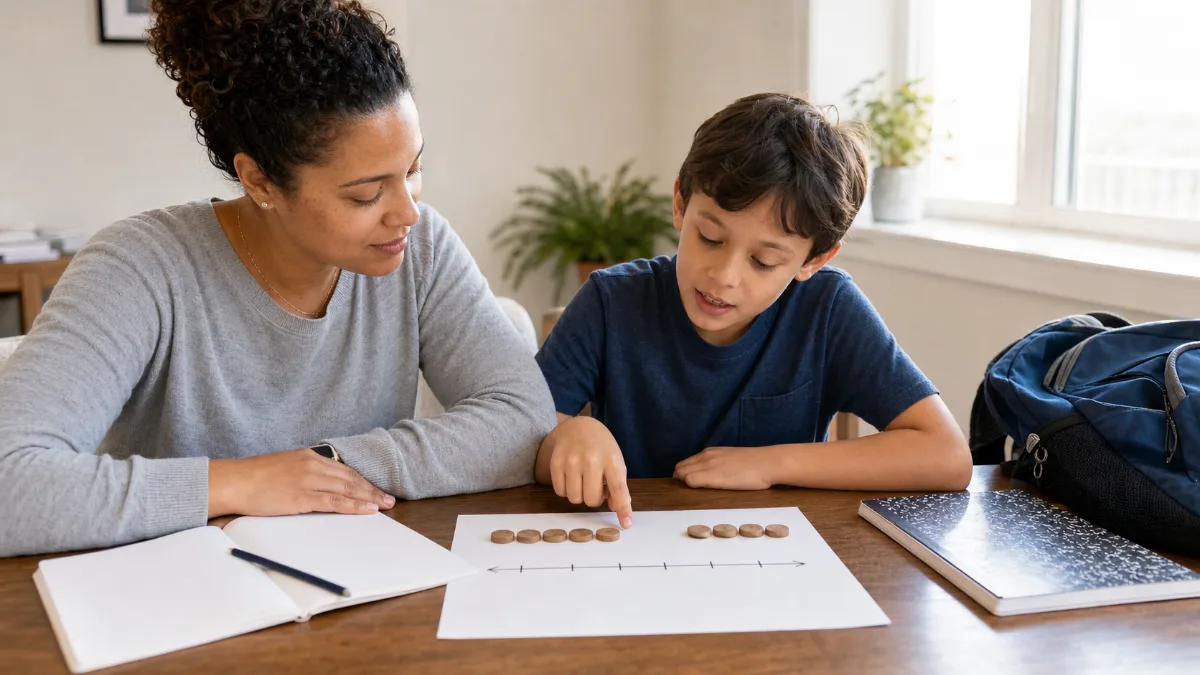
Your child may get a math answer right but struggle to explain it because solving and explaining place different demands on them. The child might recognize a familiar pattern, recall a fact, follow a practiced procedure, or work mentally without yet having the mathematical words, sequence, or representation needed to make that thinking visible. A weak explanation does not automatically mean the answer was a guess, and a correct answer does not automatically prove deep understanding. The useful next step is to ask for one small piece of evidence at a time: show it, draw it, act it out, or finish a sentence such as “I knew ___ because ___.”
This guide is for families, homeschoolers, and teachers working mainly with children in Grades 2 through 5. It explains what a correct answer can and cannot reveal, how to tell whether the barrier is mathematical or expressive, and how to build explanations without turning every homework problem into an interrogation.
What a Correct Answer Does and Does Not Show
A correct answer is valuable evidence. It tells you that something in the child’s approach worked on that problem. It does not tell you exactly what worked. Consider the problem 6 x 4. A child who says 24 might have recalled a multiplication fact, pictured six groups of four, skip-counted by sixes, doubled 12, or copied a nearby pattern. Those routes are not interchangeable. Each reveals different knowledge and leads to a different useful follow-up.
This is why teachers ask children to explain. The purpose is not to make a simple problem unnecessarily long. An explanation helps reveal the relationship the child noticed, the operation selected, the representation used, and whether the approach will still work when a number or context changes. The U.S. Institute of Education Sciences practice guide on improving mathematical problem solving in Grades 4 through 8 recommends instructional attention to visual representations, multiple strategies, reflection, and mathematical explanations. These are ways to make thinking inspectable, not decorations added after the “real” work.
At the same time, do not treat speech as the only evidence of understanding. A child may be able to arrange counters, draw equal groups, label a number line, or point to corresponding parts of a model before giving a polished verbal explanation. Those actions are explanations in development. The adult’s job is to help connect the action to accurate language.
Why Children Sometimes Cannot Explain Their Math Thinking
There is no single cause. Watch what happens when you change the way the child is allowed to respond.
The Answer Has Become Automatic
Some facts are retrieved quickly. Ask an adult how they know 2 + 2 is 4, and the first honest response may be “I just know.” Children can have the same experience with familiar facts. Automatic recall is useful, but the child may need a model to reconstruct why the fact is true.
For 6 x 4, place six groups of four counters on the table. Ask, “What does the 6 tell us in this model? What does the 4 tell us?” If the child can match the equation to the groups, the difficulty was probably not the calculation. It was unpacking fast knowledge into visible relationships. A short practice such as multiplying two-digit numbers by two-digit numbers can later provide more complex examples, but begin the explanation routine with numbers the child can manage comfortably.
The Child Followed a Procedure but Lost Its Meaning
A child may know the steps of an algorithm without being able to say why each step is valid. For example, a fifth grader can divide 84 by 4 correctly by following a taught procedure but may not connect the steps to sharing 8 tens and 4 ones among four groups. When asked “Why?” the child repeats the rule: “Because you bring down the 4.” That response describes an action, not its mathematical meaning.
Do not respond by banning the procedure. Connect it to a representation. Build 84 with place-value pieces, sketch four equal groups, or write partial quotients. Then ask the child to match each written step to what changed in the model. The two-digit divided by one-digit practice is useful when the goal is to connect a written method with grouping and place value rather than merely produce more answers.
The Child Understands the Math but Lacks the Words
Mathematical language is precise. Difference, product, factor, equivalent, numerator, angle, unit, and estimate each carry meaning that ordinary conversation may not require. A child can notice a relationship before being able to name it. The IES professional-learning resource on supporting mathematical language in Grades 3 through 6 includes sentence starters and frames as ways to support verbal and written explanations.
Use a frame as a temporary bridge, not a script to memorize:
- “First I noticed ___.”
- “I chose ___ because the problem says ___.”
- “My drawing shows ___.”
- “The two amounts are equivalent because ___.”
- “I checked my answer by ___.”
If the child can complete a frame while pointing to a model, the language demand may have been the main barrier. Gradually remove the frame as the child becomes more independent.
The Child Did the Work Mentally and Cannot Replay It
Mental math can be efficient but fleeting. A child might transform 49 + 28 into 50 + 27 and get 77 without consciously narrating every move. When asked to explain after the fact, the path is already hard to retrieve.
Ask the child to solve a similar problem and pause once, not after every tiny step. For 39 + 26, say, “Tell me the first change you make.” If the child says, “I move one from 26 to 39,” record 40 + 25. Now there is a visible trace. The goal is not to slow all mental work. It is to capture one decision that reveals the strategy.
The Question “How Did You Know?” Feels Like a Warning
Children often hear adult questions after mistakes. If “How did you get that?” usually means “You are wrong,” a child with a correct answer may assume trouble is coming. They may change the answer, shrug, or shut down.
Normalize explanation by asking for it after obviously correct, easy, and even adult-solved examples. Say, “I got 32. Let me show you how I checked it.” Ask siblings or classmates to compare two valid methods without ranking the children. Make the routine predictable: answer, show one reason, check. This separates explanation from punishment.
Writing Is the Bottleneck
A child may explain clearly aloud but produce only “because I did the math” on paper. Writing requires planning a sentence, spelling, handwriting or typing, and deciding which details matter. That load can hide mathematical knowledge.
Let the child speak while you write exactly one sentence, use a speech-to-text accommodation when appropriate, draw and label a model, or choose from two sentence starters. Then ask the child to add one mathematical word. If oral explanations are strong and written explanations remain consistently difficult across subjects, share that pattern with the teacher rather than assuming the math is weak.
The Child Is Guessing From Surface Clues
Sometimes the correct answer really is fragile. The child may choose multiplication whenever they see “groups,” subtract whenever a number gets smaller in the story, or copy the operation used in the previous problem. A lucky answer can survive one item but not a small change.
Test the idea without accusation. Change 6 bags with 4 apples each into 4 bags with 6 apples each. Ask what stayed the same. Then change it to 24 apples shared into 6 bags and ask what changed. A child who can distinguish making equal groups from finding the size of each group is showing more than keyword matching.
A Five-Step Routine That Makes Thinking Visible
Use this routine on one or two problems, not an entire assignment.
Step 1: Ask for a Prediction Before a Procedure
Before calculating, ask, “About what should the answer be?” For 47 + 31, a child might say “around 80.” For 198 divided by 4, the child might say “a little less than 50.” A reasonable estimate reveals attention to magnitude and gives the child a way to reject an implausible result.
Keep the prediction low pressure. It does not need to be exact. Ask what made the child choose it. Even “Both numbers are close to 40” is useful mathematical reasoning.
Step 2: Choose One Representation
Offer a choice: objects, drawing, number line, table, equation, or words. Do not demand all of them. A representation should clarify the relationship in the problem.
For 3/4 compared with 5/8, a child may draw two equal-size bars. For area, the child may draw rows and columns. For an unknown angle, the child may decompose a turn into familiar parts. The visual fraction comparison activity provides a natural place to ask, “Which part of the model proves your comparison?”
Step 3: Name the Important Relationship
Ask one focused prompt:
- “What is equal here?”
- “What is changing?”
- “What does each group represent?”
- “Which number tells the size of one unit?”
- “Where do you see the remainder?”
- “Which angle parts make the whole?”
These questions are more useful than repeatedly asking “Why?” because they tell the child what kind of evidence to inspect.
Step 4: Connect the Model to a Sentence
Have the child point while speaking. For example: “These five rows each have seven squares, so the area is 5 x 7, or 35 square units.” The rectangle area practice can support this connection between rows, columns, multiplication, and square units.
If the child says only “I multiplied,” ask, “What in your picture is being multiplied?” If the child gives a long story with no mathematical relationship, ask, “Can you point to the part that proves 35?” The target is not length. It is a clear connection between evidence and conclusion.
Step 5: Check With a Different Route
A check should be mathematically related to the problem. Addition can check subtraction. Multiplication can check division. An estimate can check magnitude. A second representation can check a fraction comparison. Substituting the answer can check an unknown value.
Ask the child to finish: “I think my answer is reasonable because ___.” If the child cannot check independently, model one check and invite them to interpret it. Checking is part of explanation because it shows why the answer deserves confidence.
Worked Examples by Grade and Skill
Grade 2: Addition on a Number Line
Problem: 38 + 25.
A child writes 63 but says, “I did it in my head.” Rather than demanding every mental step, draw an open number line and ask for the first jump. The child may start at 38, jump 20 to 58, then jump 5 to 63.
A concise explanation is: “I split 25 into 20 and 5. I added 20 to 38 to get 58, then added 5 to get 63.”
If the child instead moves 2 from 25 to 38, record 40 + 23. The explanation becomes: “I made a friendly ten by moving 2. The total stayed the same, so 40 + 23 is 63.” Both explanations are valid. The important relationship is conservation of the total, not whether the child used the teacher’s favorite route.
Grade 3: Equal Groups
Problem: 7 x 6.
Place seven groups of six counters. Ask the child to show a fact they already know. They might split seven groups into five groups and two groups: 5 x 6 = 30 and 2 x 6 = 12, so 7 x 6 = 42.
The explanation is: “I broke seven groups into five groups and two groups. Thirty plus twelve is forty-two.” A child can practice maintaining the meaning of factors with simple examples before moving to less familiar facts.
If the child says “I counted by sevens,” ask them to point to what each seven represents. Do not reject skip-counting; connect it to the equal groups so the sequence has meaning.
Grade 4: Area and Perimeter
Problem: A rectangle is 8 units long and 3 units wide. Find its area.
A child gives 24. Ask, “What does 24 count?” If the child says “the squares inside,” the answer is tied to area. If the child says “the distance around,” the calculation may be correct by coincidence for this rectangle because 2 x (8 + 3) is 22, not 24, and the distinction becomes visible.
A strong explanation is: “There are three rows of eight square units. Three times eight is twenty-four, so the area is twenty-four square units.” Ask the child to label units. The label helps distinguish area from side length and perimeter.
Grade 4: Unknown Angles
Problem: A right angle is split into 35 degrees and an unknown angle.
A child answers 55 degrees. Ask which whole the two parts compose. The child can say: “A right angle measures 90 degrees. The two parts must total 90, so I subtract 35 from 90 and get 55.”
The unknown-angle practice is useful for asking children to identify the whole angle before choosing an operation. If a child merely sees two numbers and subtracts, change the diagram so the whole is not a right angle and see whether the explanation adapts.
Grade 5: Decimal Addition
Problem: 4.7 + 2.35.
A child writes 7.05 after aligning decimal points. Ask why the decimal points align. A procedural answer is “That is the rule.” A place-value explanation is: “I add tenths to tenths and hundredths to hundredths. I can write 4.7 as 4.70, so 4.70 + 2.35 is 7.05.”
Use the decimal addition to tenths practice as a starting point, then compare tenths and hundredths with a place-value chart. The chart should explain the alignment rather than merely enforce it.
Grade 5: Volume
Problem: A rectangular prism has 4 layers, with 3 rows of 5 cubes in each layer.
A child multiplies 4 x 3 x 5 and gets 60. Ask the child to explain each factor. “Five is the number of cubes in each row, three is the number of rows in a layer, and four is the number of layers.” The unit-cube volume activity can help connect the three factors to physical dimensions.
If the child can calculate but cannot map factors to dimensions, build or sketch one layer first. Then repeat the layer. The representation supplies the structure the words need to describe.
How Parents Can Prompt Without Taking Over
Start with curiosity: “Show me the part you are most sure about.” This is easier to answer than “Explain everything.” Wait several seconds. Children often need time to translate a mental action into language.
Use neutral prompts:
- “What did you notice first?”
- “Can you show that with objects or a sketch?”
- “Which number in the story matches this number in your equation?”
- “What would change if this number changed?”
- “How could we check without doing the exact same steps?”
Avoid leading the child through a chain of questions whose answers you supply with your tone. “There are six groups, so we multiply, right?” produces agreement, not evidence. Ask, “What do the six groups tell you to find?” and allow the child to choose.
The U.S. Department of Education family guide Helping Your Child Learn Mathematics emphasizes asking children to explain what they must do, discussing different routes to an answer, and using mistakes as opportunities to understand. At home, that can be brief. One thoughtful explanation is better than requiring paragraphs for every item.
Do not correct vocabulary before understanding the idea. If a child says “the bottom number” while pointing to a denominator, respond, “Yes, the denominator tells how many equal parts make the whole.” You acknowledge the idea and supply the precise term without derailing the explanation.
How Teachers Can Build Explanation Into Instruction
Ask all students to prepare a reason, not only students who answer incorrectly. Otherwise explanation becomes associated with remediation. Use turn-and-talk, mini whiteboards, pointing, manipulatives, and sentence frames so more children can rehearse before speaking publicly.
Compare two anonymous methods. For 48 + 36, display compensation and place-value decomposition. Ask what is the same, what is different, and why both preserve the total. This shifts discussion from judging children to examining ideas.
Plan one “hinge question” where explanations reveal a misconception. For fraction comparison, ask whether 3/8 or 3/5 is greater and require a model or statement about equal-size parts. A correct choice without a reason gives limited evidence; a model can reveal whether the child understands that fifths are larger than eighths when wholes are equal.
Use precise feedback. Instead of “Explain more,” say, “Name what the 4 represents,” “Connect your drawing to the equation,” or “Tell why subtraction matches the story.” The revision target becomes manageable.
Research on parent-child mathematics interactions has examined how different kinds of questions relate to children’s mathematical talk and performance. The open-access study on parents’ math questions during shared activities also illustrates an important caution: not every question has the same cognitive demand, and frequency alone does not guarantee stronger mathematics. Quality, timing, and connection to the child’s current idea matter.
Accessibility and Language Considerations
Allow multiple modes of expression. A child can point, gesture, arrange objects, draw, speak, type, or use an approved communication support. Judge the mathematical relationship separately from handwriting, spelling, speech fluency, or confidence in English.
For multilingual learners, invite an explanation in the language the child uses most comfortably, then help map key mathematical terms into English. Mathematical understanding does not begin only after English vocabulary is fluent. A bilingual word bank, labeled diagram, or sentence frame can reduce the language barrier while preserving the reasoning demand.
For children with fine-motor or writing challenges, reduce copying. Provide the equation, let the child annotate a model, or accept an audio explanation. For children who become overwhelmed by open-ended prompts, offer two choices: “Would you rather show it with counters or a number line?” Choice narrows the task without giving away the reasoning.
For children who process language slowly, preview the prompt and permit rehearsal. “In a minute, I’ll ask what the 6 represents.” This makes the question predictable and allows attention to remain on mathematics.
Common Misconceptions About Math Explanations
“A Long Explanation Is a Better Explanation”
Length is not the goal. “I used subtraction because I knew the whole and one part, and I needed the missing part” may be stronger than a paragraph that retells the problem without naming a relationship.
“There Is Only One Acceptable Strategy”
The strategy must be mathematically valid and appropriate to the task, but different representations can reveal the same relationship. Ask whether the child can connect the method to quantities and check the result.
“If the Child Cannot Explain, the Child Does Not Understand”
An explanation problem can come from vocabulary, memory for mental steps, writing, anxiety, or unfamiliarity with the prompt. Gather evidence in another mode before drawing a conclusion.
“If the Answer Is Correct, No Explanation Is Needed”
Correctness matters, but explanation helps test whether the method is transferable and whether the child understands what quantities and operations represent. Use explanation selectively, especially on problems chosen to reveal an important idea.
“Parents Must Teach the School’s Exact Method”
Parents can ask the child to show the class method, but they do not need to imitate a lesson they have not seen. Ask the child to explain the representation, consult teacher-provided examples, and share where the explanation breaks down. Avoid replacing the class method with a shortcut before understanding the instructional goal.
Troubleshooting When the Routine Stalls
If the child says “I don’t know,” reduce the size of the request. Ask them to point to the number they used first. If they cannot, ask them to rebuild the problem with objects. If they can build but not speak, describe what you see and ask them to confirm or correct you.
If the child changes a correct answer after being questioned, say explicitly, “I am asking because I want to learn your method, not because your answer is wrong.” Then ask for a check rather than another solution.
If the child repeats a rule, ask for a matching example. “You said line up the decimal points. Show me the tenths in each number.” If no representation matches the rule, return to smaller numbers and concrete place value.
If every explanation becomes an argument, stop using unfinished homework as the practice setting. Choose a low-stakes puzzle or one already-solved problem. Take turns explaining and let the child question the adult’s method.
If explanations are consistently difficult across many topics and response modes, collect examples for the teacher. Record the problem, the answer, the child’s model, the prompt that helped, and what remained hard. Avoid diagnosing from a few homework moments. A teacher can compare home observations with classroom work and decide what instructional or support questions should come next.
A One-Week Practice Plan
Keep each session under ten minutes and stop while the conversation is still productive.
Day 1: Use an easy fact. Ask the child to show it with objects and finish “I know ___ because ___.”
Day 2: Solve one addition or subtraction problem mentally. Capture only the first strategic move on paper.
Day 3: Compare two representations of the same problem. Ask what each symbol or part means.
Day 4: Present a correct answer with a flawed explanation. Let the child find and repair the mismatch.
Day 5: Ask for an estimate before solving, then check whether the exact answer is reasonable.
Day 6: Let the child choose an iBloom practice problem and explain it with a drawing, objects, or words.
Day 7: Ask the child which prompt helped most. Keep that prompt for future homework and retire prompts that felt confusing.
Success is not a polished speech. Look for a clearer connection among the quantities, representation, operation, and conclusion.
Frequently Asked Questions
Should my child explain every math answer?
No. Select a few problems that reveal an important concept, strategy, or misconception. Requiring a full explanation for every routine item can add unnecessary writing and reduce attention to the most useful discussion.
What if my child says, “I just knew it”?
Accept that the answer may have been retrieved automatically, then ask for a model: “Can you show why it is true with groups, a number line, or a related fact?” This reconstructs meaning without pretending the quick answer was invalid.
Is drawing a picture a real explanation?
Yes, when the drawing represents the quantities and relationship accurately. Ask the child to label or point to the part that proves the conclusion. A decorative picture that does not map to the math is not enough by itself.
Should I correct mathematical vocabulary immediately?
First confirm the idea. Then recast it with the precise term. For example, “You noticed the bottom numbers are different; those are the denominators, and they tell how many equal parts make each whole.”
Why can my child explain aloud but not in writing?
Writing adds planning, transcription, spelling, and organization demands. Let the child rehearse aloud, use a sentence frame, label a model, or dictate one sentence. Share a persistent oral-written gap with the teacher so the mathematics and writing demands can be considered separately.
How do I know whether the correct answer was a guess?
Make a small change to the problem and ask the child to predict what will change. Ask for a model or a check. A child who can connect the new problem to the original relationship is showing more transferable understanding than a child who repeats an operation without meaning.
What should I tell the teacher?
Bring one or two specific examples. Include the original problem, answer, any drawing or objects used, the child’s exact explanation, and which prompt helped. Ask whether the teacher sees the same pattern and which language or representation is used in class.
Can sentence frames make explanations too formulaic?
They can if used permanently or copied without thought. Use them as temporary supports. Offer a small choice of frames, require the child to connect the sentence to evidence, and fade the frame as independent explanations become easier.
What is the best first prompt to use tonight?
Try: “Show me one thing you noticed that helped you get the answer.” It is specific enough to start, open enough to reveal the child’s method, and less threatening than a broad demand to explain everything.