Why Does My Child Think a Bigger Denominator Means a Bigger Fraction?
A practical guide to whole-number bias in fraction comparisons, with diagnostics, models, worked examples, classroom routines, and troubleshooting.
Why Does My Child Think a Bigger Denominator Means a Bigger Fraction?
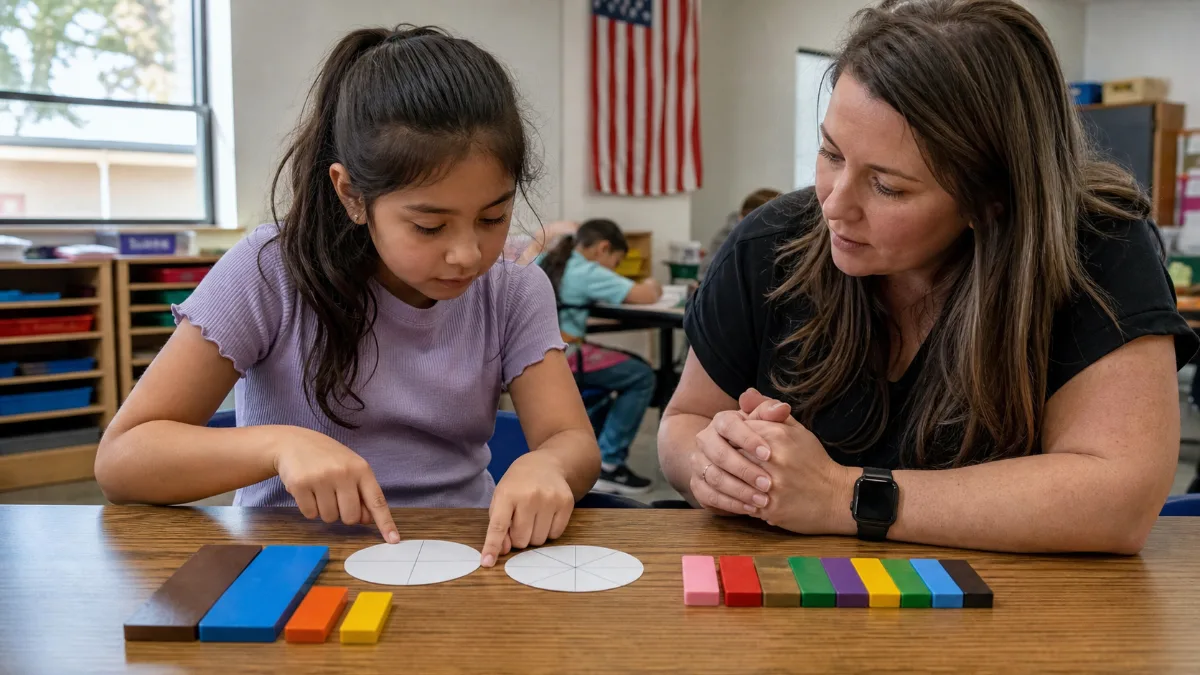
Your child may think a bigger denominator makes a bigger fraction because whole-number thinking has worked reliably until now: eight is greater than four, so one eighth can look as though it should be greater than one fourth. In a fraction, however, the denominator does not name an amount by itself. It tells how many equal parts make one whole. When the whole stays the same, dividing it into more equal parts makes each part smaller. That is why one eighth is less than one fourth.
This is a common and understandable reasoning error, not evidence that a child is careless or “bad at math.” The most effective response is to reconnect the symbols to equal wholes, unit fractions, and positions on a number line. Ask the child to predict, build, compare, explain, and then check. Avoid giving only a slogan such as “the bigger denominator means the smaller fraction,” because that shortcut fails when numerators also change.
What the denominator actually tells us
A fraction such as three fourths describes one number, not two unrelated whole numbers. The denominator, four, identifies the size of the fractional unit: the whole has been partitioned into four equal parts, and each part is one fourth. The numerator, three, tells how many of those one-fourth units are being counted. Three fourths therefore means three copies of one fourth.
The words equal parts and same whole matter. If one paper circle is much larger than another, one fourth of the large circle could be larger than one half of the small circle. Fraction comparisons are meaningful only after the referent whole is clear. Start every model comparison by placing two identical strips, circles, or lengths together and asking, “Are these wholes equal?” This prevents a visual trick from being mistaken for a mathematical rule.
The U.S. Institute of Education Sciences fractions instruction practice guide recommends helping learners understand fractions as numbers with magnitudes rather than treating numerators and denominators as separate whole numbers. That distinction explains the misconception. A child who sees 1/8 as “one and eight” is likely to compare the visible digits. A child who sees it as one copy of an eighth-sized unit can reason about its actual value.
Use precise language during ordinary conversation. Say “one fourth is one of four equal parts of the same whole,” rather than “four is on the bottom.” Say “three one-fourth units” for three fourths. This language turns notation into a relationship and gives the child something meaningful to picture.
Why whole-number thinking causes this mistake
For years, children learn that counting forward reaches greater whole numbers. Eight objects are more than four objects. A two-digit whole number is generally greater than a one-digit positive whole number. Those ideas are useful and correct in their domain. Fractions introduce a different relationship: the denominator controls the size of each equal part, so a greater denominator creates smaller parts when the whole is fixed.
Researchers often describe the inappropriate transfer of whole-number rules to fractions as whole-number bias. A peer-reviewed study on children's understanding of fraction magnitude explains why attending to the numerator or denominator separately can produce incorrect comparisons. Another study of fraction calculation error patterns emphasizes that fraction magnitude depends on the relationship between numerator and denominator, not on the two whole-number values considered independently.
This framing is useful because it changes the adult response. Instead of saying, “You should know eight is smaller here,” say, “Your whole-number rule makes sense for counting objects. Let’s test whether it still works when one whole is cut into equal shares.” The child keeps a valuable whole-number idea while learning when it applies and when it does not.
The misconception can appear in several forms. A child may say one eighth is greater than one fourth because eight is greater than four. The child may choose 5/8 over 3/4 because both visible numbers look larger. Another child may memorize the opposite slogan and always select the fraction with the smaller denominator, even when both numerators and denominators differ. These answers look different, but each shows that the whole fraction is not yet being treated as a single magnitude.
A five-minute diagnosis before teaching
Do not begin with a long explanation. Give four quick prompts and ask the child to explain each answer aloud.
- Which is greater, one third or one eighth?
- Which is greater, three eighths or five eighths?
- Which is greater, three fourths or five eighths?
- Where would one fourth and one eighth go between zero and one on a blank number line?
The first item checks whether the child understands unit fractions. The second keeps the denominator fixed and checks whether the numerator is interpreted as a count of equal units. The third requires attention to the whole value rather than one component. The fourth checks whether the symbols represent numbers with locations, not merely shaded pictures.
Ask, “How do you know?” A correct answer with an incorrect explanation still needs attention. If the child says one third is greater because three is smaller, the answer is right but the reasoning is a memorized reversal rule. If the child draws unequal wholes, revisit the referent whole. If the child compares only the shaded piece count, ask about the size of each piece. If the child can build the answer but not explain the symbols, connect each model part to its fraction name.
Record the child’s exact words without immediately correcting them. Their explanation identifies the next teaching move. A child who says “eight wins because it is bigger” needs a same-whole partition experiment. A child who says “the smaller bottom number always wins” needs counterexamples with different numerators. A child who cannot place fractions on a number line needs work on distance from zero.
The best first model: identical paper strips
Take two identical paper strips and align their endpoints. Keep the first whole and fold it into four equal sections. Fold the second into eight equal sections. Open both, place them one above the other, and outline one section on each. Ask these questions in order:
- Are the two wholes the same length?
- Which strip was divided into more equal parts?
- What happened to the size of each part?
- Which is longer, one fourth or one eighth?
- How could we prove it without trusting our eyes?
The child can place two eighth sections over one fourth section. The exact fit shows that one fourth equals two eighths, so one eighth must be less than one fourth. This is stronger than a verbal rule because the child can see and verify the unit relationship.
The visual lesson for comparing fractions with unlike denominators can extend the same idea after the hands-on demonstration. Follow it with the interactive comparison worksheet so the child applies the reasoning to fresh models rather than repeating only the original pair.
Keep all strip wholes identical. Draw partition marks carefully enough that the pieces are visibly equal. If folding eighths is difficult, fold halves, then fourths, then eighths and name the repeated halving. Do not shade decorative portions that distract from the equal units. One clean comparison is more useful than a page crowded with unrelated fraction pictures.
Move from area models to the number line
Area models help children see equal shares, but fractions are numbers, and numbers have positions. Draw a horizontal line from zero to one. Mark one fourth by partitioning the interval into four equal lengths. On a second aligned line, partition the same zero-to-one distance into eight equal lengths. The first eighth mark is closer to zero than the first fourth mark. This makes the comparison independent of how much paper is shaded.
The IES Teaching Fractions Toolkit facilitator guide describes number lines as a way to reinforce relative fraction size and shows that, for positive unit fractions, increasing the denominator decreases magnitude. The key condition remains fixed: the numerator is one and the whole interval is the same.
Ask the child to walk a floor number line. Tape zero and one several feet apart. Divide that same distance into fourths, then eighths. Let the child stand at one eighth and one fourth. Physical distance can make “closer to zero” and “farther from zero” more concrete.
Use the fractions on a number line lesson to practice locating values, then check independent understanding with the fractions on a number line worksheet. Require an estimate before counting tick marks. The estimate reveals whether the child understands magnitude: one eighth should be near zero, one half in the middle, and seven eighths near one.
Teach unit fractions before complicated comparisons
A unit fraction has numerator one. It names one equal part of a whole: one half, one third, one fourth, and so on. Unit fractions isolate the denominator’s role, making them the cleanest place to repair this misconception.
Build a unit-fraction wall with equal-length strips. Put one whole on top, halves below, then thirds, fourths, sixths, and eighths. Align every strip at the left endpoint. Ask the child to trace the first unit in each row. As denominators increase, more units must fit into the same whole, so each unit becomes smaller.
Then vary the task:
- Put one sixth and one third in order from least to greatest.
- Find a unit fraction between one eighth and one half.
- Name a unit fraction less than one tenth.
- Explain why one hundredth is tiny even though 100 is a large whole number.
- Decide whether one fifth is closer to zero or one.
Do not state that a bigger denominator always means a smaller fraction without qualification. It is reliable for positive unit fractions sharing the same whole. It also helps when fractions have the same positive numerator: three eighths is less than three fourths because eighth-sized units are smaller, and both quantities contain three units. Once numerators differ, the child must compare the complete magnitudes.
When both numerator and denominator change
Consider three fourths and five eighths. Looking only at denominators suggests fourths are larger units. Looking only at numerators suggests five is greater. Neither observation settles the comparison. The question is how much of the same whole each complete fraction represents.
Use one of four meaningful strategies.
Strategy 1: Compare with a benchmark
Three fourths is greater than one half because three of four equal parts is more than two of four. Five eighths is also greater than one half because five of eight is more than four of eight. That benchmark alone does not finish this pair, but it narrows the range. With a different pair, such as three eighths and five sixths, one half and one are powerful benchmarks: three eighths is below one half, while five sixths is above one half and below one.
Strategy 2: Create equivalent units
Fourth-sized units can be renamed as eighth-sized units. One fourth equals two eighths, so three fourths equals six eighths. Six eighths is greater than five eighths. The equivalent fractions visual-model lesson shows why renaming preserves value, and the matching equivalent fractions practice can check whether the child changes numerator and denominator together rather than changing only one component.
Strategy 3: Use a same-numerator comparison
For three fourths and three eighths, both fractions contain three units. Fourth-sized units are larger than eighth-sized units, so three fourths is greater. The same-numerator fraction comparison lesson makes that relationship visible. Use the same-numerator comparison worksheet only after the child can explain why the direction works.
Strategy 4: Locate both values on a number line
Estimate each fraction relative to zero, one half, and one, then partition precisely if needed. This keeps the focus on magnitude and helps detect impossible answers. A child who claims five eighths is greater than nine tenths should notice that five eighths is only slightly above one half, while nine tenths is close to one.
A parent-friendly teaching routine
Use a short routine over several days rather than one exhausting session.
Day 1: Predict and test
Ask which is larger, one fourth or one eighth. Accept the prediction without judgment. Build identical strips, compare one unit, and ask the child to revise or defend the prediction. End with one sentence: “When the same whole is split into more equal parts, each part is smaller.”
Day 2: Connect model and symbols
Show a partitioned strip and ask the child to label the denominator, unit fraction, and selected quantity. Reverse the task by showing a fraction and asking the child to build it. Mix correct and incorrect models so the child must check equal parts and same wholes.
Day 3: Use a number line
Place unit fractions between zero and one. Ask which point is farther from zero. Include one half as a benchmark. Have the child explain how the spacing changes when the interval is divided into more equal sections.
Day 4: Compare complete fractions
Mix same-denominator, same-numerator, and unlike-denominator pairs. Before calculating, ask which strategy fits and why. The strategic choice matters more than speed.
Day 5: Explain an error
Present a fictional student's claim: “Four ninths is greater than three fifths because nine is the biggest number.” Ask your child to find what is reasonable in that thinking, what was overlooked, and how a model or benchmark could check it. Explaining someone else’s error is often less threatening than defending one’s own.
Keep sessions to ten or fifteen focused minutes. Stop after a clear explanation, not after a fixed number of problems. Praise the action you want repeated: checking the whole, identifying the unit, estimating, choosing a model, or revising a claim after evidence.
A classroom small-group plan
For a fifteen- to twenty-minute intervention, begin with an exit-ticket sort. Give students cards showing several fraction comparisons and group them by reasoning pattern, not merely correct or incorrect answers. One group may compare denominators as whole numbers. Another may know the unit-fraction rule but overapply it. A third may need support with equivalent fractions.
Start the small group with identical fraction strips and a common prompt: “What changes and what stays the same?” Students should identify the fixed whole, changing number of equal parts, and changing unit size. Next, place corresponding values on aligned number lines. Finally, show the symbolic comparison and ask students to write an explanation using the words whole, equal parts, numerator, denominator, and magnitude.
Use contrast cases deliberately. Compare one fourth with one eighth, then three fourths with three eighths, then three fourths with five eighths. The first isolates unit size. The second holds the numerator constant. The third demonstrates why neither visible component can be used alone. Ask students to name which earlier shortcut no longer resolves the third comparison.
An exit ticket should contain one unfamiliar pair and one explanation prompt. A useful example is: “Jordan says two ninths is greater than two fifths because nine is greater than five. Is Jordan correct? Show with a model or number line.” The explanation distinguishes conceptual change from lucky guessing.
Grade-level adjustments
Grade 3
Emphasize equal shares, unit fractions, same wholes, and positions on the zero-to-one number line. Use denominators students can partition accurately, such as two, three, four, six, and eight. Keep most comparisons to the same numerator or same denominator and insist on a visual justification.
Grade 4
Connect models to equivalent fractions and benchmarks. Compare fractions with unlike denominators when a visual model or simple equivalent relationship is available. Ask students to justify why multiplying numerator and denominator by the same number renames the quantity rather than changing it.
Grade 5
Expect flexible comparison using benchmarks, equivalent fractions, and number lines. Include fractions greater than one and mixed numbers so children do not assume every fraction lies between zero and one. Connect magnitude estimates to fraction addition and subtraction: an estimated range can expose an unreasonable calculated answer.
Do not rush a younger child into a formal algorithm to hide an unstable magnitude concept. Conversely, do not keep an older child only on shaded circles. Move among objects, drawings, number lines, words, and symbols so understanding transfers across representations.
Misconceptions adults should avoid reinforcing
The phrase “the bottom number tells how many pieces” is incomplete. It must be how many equal parts make the whole. Unequal partitions do not represent the named fractional units.
The phrase “a bigger denominator means a smaller fraction” is also incomplete. It works for positive unit fractions with the same whole and supports same-numerator comparisons. It does not decide every pair. For example, seven eighths is greater than one fourth even though eight is the larger denominator.
Cross multiplication can produce a correct comparison, but introducing it as unexplained diagonal multiplication may conceal the very misconception you are trying to repair. If it is used later, connect it to equivalent fractions or products that compare quantities in a common unit.
Pizza examples can help, but they can also mislead if the pizzas differ in size or the slices are not equal. Verify the whole and partitions before asking about the shaded amount. Paper strips and number lines are often easier to align precisely.
Avoid speed contests while the concept is developing. Fast component comparison is the error pattern. Give the child time to estimate, model, and explain. Fluency should grow from a dependable meaning, not from replacing one unexamined rule with another.
Accessibility and language support
For a child with fine-motor difficulty, provide pre-cut identical strips, magnetic fraction pieces, or digital models rather than requiring accurate folding and drawing. The mathematical goal is comparison, not cutting skill. Use large, high-contrast partition lines and avoid relying on color alone; label or texture corresponding units when needed.
For a child with low vision, use tactile strips with raised boundaries and a raised-line number line. Let the child align endpoints and feel the relative unit lengths. Describe every visual relationship verbally: “Both wholes begin and end at the same points; the eighth interval is shorter than the fourth interval.”
For multilingual learners, pair consistent sentence frames with models: “The wholes are the same. ___ has more equal parts, so each part is ___. Therefore ___ is greater than ___.” Encourage explanation in the child’s strongest language first if that helps reveal the mathematical reasoning, then connect key terms across languages.
For learners who become overwhelmed by dense pages, present one comparison at a time. Cover unused problems, reduce decorative graphics, and keep notation large. A child who can reason successfully with a clean model may not yet be able to filter a crowded worksheet.
Troubleshooting when the idea does not stick
If the child repeats the same error after a demonstration, change the task rather than repeating the explanation louder. Ask the child to distribute one identical granola bar among two people and another among eight people. Which person receives more? Then map each share to one half or one eighth.
If the child understands objects but fails with symbols, place the fraction card directly under its model. Point to the denominator while counting all equal units in the whole, then point to the numerator while counting selected units. Remove the model briefly, ask for a prediction, and bring it back to check.
If the child applies “smaller denominator wins” to every comparison, offer seven eighths and one fourth. Ask for an estimate relative to one half. Seven eighths is close to one; one fourth is below one half. This counterexample shows why both numerator and denominator must be interpreted together.
If the child confuses fraction size with the number of shaded pieces, show equivalent fractions such as one half, two fourths, and four eighths. The number of selected pieces changes, but the location on the number line does not. Ask what stayed constant.
If frustration rises, return to a pair the child can prove and end with a successful explanation. Persistent difficulty across representations and repeated instruction is worth discussing with the child’s teacher, who can compare classroom work, identify prerequisite gaps, and plan targeted support. Do not infer a diagnosis from one fraction error.
How to know the misconception is changing
Look beyond a correct answer. The child should be able to:
- verify that the wholes are equal before comparing models;
- explain the denominator as the number of equal units in one whole;
- explain the numerator as the number of those units being counted;
- compare unit fractions by reasoning about unit size;
- place familiar fractions approximately on a zero-to-one number line;
- use benchmarks such as zero, one half, and one;
- reject a denominator-only rule when numerators differ;
- choose and explain an appropriate comparison strategy;
- revise an answer after a model contradicts the first prediction.
Check transfer with an unfamiliar example a few days later. Ask about two sevenths and two thirds, then five sixths and three fourths. Do not tell the child which method to use. A durable understanding appears when the child selects a meaningful representation or benchmark and can explain the entire fraction as one value.
Frequently Asked Questions
Is a fraction with a bigger denominator always smaller?
No. With the same positive numerator and the same whole, the fraction with the bigger denominator is smaller because it contains the same number of smaller units. But if numerators also differ, compare the complete values. Seven eighths is greater than one fourth.
Why is one eighth smaller than one fourth if eight is bigger than four?
The eight and four describe how many equal parts make the same whole. Eight equal parts must each be smaller than four equal parts. One eighth is one of the smaller pieces, while one fourth is one of the larger pieces.
Should my child memorize “bigger bottom, smaller fraction”?
Treat it as a pattern to explain, not a universal rule to memorize. It is useful for positive unit fractions and same-numerator comparisons, but it can produce wrong answers when applied to arbitrary fractions.
What model should we use first?
Start with identical paper strips because their endpoints can be aligned. Follow with a number line so the child sees fractions as numbers with positions. Use circles only when both wholes and all sectors are clearly equal.
Why can my child shade fractions correctly but compare them incorrectly?
Shading may be a learned procedure. Comparison requires the child to coordinate the whole, unit size, numerator, denominator, and total magnitude. Ask the child to place each fraction on a number line and explain which is farther from zero.
When should we use common denominators?
Use common denominators when they create a shared unit that makes a comparison or addition meaningful. Connect the procedure to equivalent fractions so the child understands why both numerator and denominator change together.
Is this mistake a sign of dyscalculia?
Not by itself. The error can result from applying a valid whole-number idea in a new context. If difficulty persists across models, number lines, repeated instruction, and related number tasks, discuss the pattern with the teacher or an appropriate qualified professional rather than diagnosing from one misconception.
What is one question I can ask tonight?
Ask, “If two identical sandwiches are cut into four equal pieces and eight equal pieces, which person gets more from one piece, and how does that explain one fourth compared with one eighth?” Let the child draw, build, or act out the answer before writing symbols.