


About this worksheet
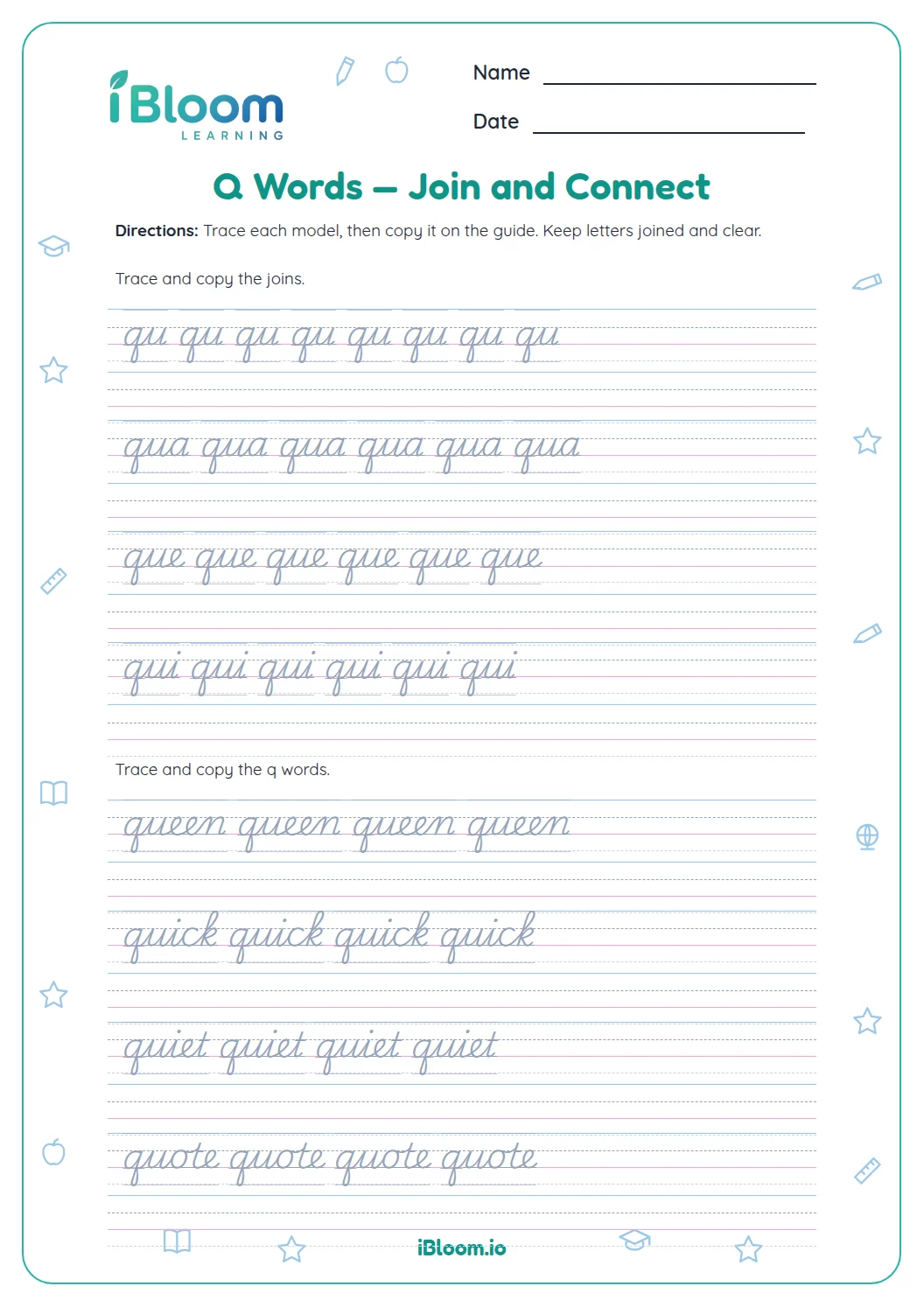
This cursive worksheet gives Grades 2–5 learners a warm-up with repeated Q joins, seven individual Q words, and seven complete sentences. Learners trace each model, then copy it in cursive on handwriting lines. The sentences add practice with capitals, spaces, and punctuation, and the separate answer key repeats the exact models.
How do the Q joins warm up cursive writing?
The first two prompts repeat qu joins in short groups. Trace each group, then copy it while keeping letters joined within a group and leaving clear spaces between groups.
How does word copying build the practice?
The next prompts use seven Q words, including queen, quiet, and quilt. Trace each whole word before copying it on the handwriting line.
What changes when learners copy sentences?
The last seven items are complete sentences. Copying each whole sentence adds capitals, word spacing, and punctuation to the cursive practice.
A simple practice routine
- 1Trace each join group without joining across its spaces.
- 2Copy each group on the line.
- 3Trace the complete Q word.
- 4Copy full sentences with clear spaces.
- 5Check capitals and punctuation against the model.
Watch for these slips
The mistake
Changing the order of the values
The fix
Keep the original order when checking.
The mistake
Stopping after one operation
The fix
Read the full question and check the result.
The mistake
Copying a value inaccurately
The fix
Compare each digit or word with the prompt.
What to practice next
Make more practice
Questions parents and teachers ask
How many items are on the sheet?
There are 14 prompts: seven individual Q words followed by seven complete sentences. Each prompt includes a model to trace and a row for copying it in cursive, so learners practice both word forms and continuous writing. Check that each copied word stays readable and every sentence includes its capital and ending mark.
Are the sentences complete?
Yes. Each sentence has a subject and predicate and ends with punctuation. Learners copy the whole sentence rather than a fragment, including its capital letter and final punctuation mark. Check that each copied word stays readable and every sentence includes its capital and ending mark.
Why are some Q words capitalized?
Quinn is a person’s name, so it begins with a capital Q. Other prompts use lowercase q in words such as queen, quiet, quilt, and quail. The sentences also model sentence-initial capitals. Check that each copied word stays readable and every sentence includes its capital and ending mark.
What should learners focus on besides letter shape?
Learners can attend to joins inside words, spaces between words, capital letters, and punctuation. The sentence models include each of these features while keeping the requested copying practice in cursive. Check that each copied word stays readable and every sentence includes its capital and ending mark.
Does the key show handwriting?
The key lists the exact words and sentences used as models. Learners can compare their copied text with the model; individual letter shapes may vary while remaining readable and connected appropriately. Check that each copied word stays readable and every sentence includes its capital and ending mark.