




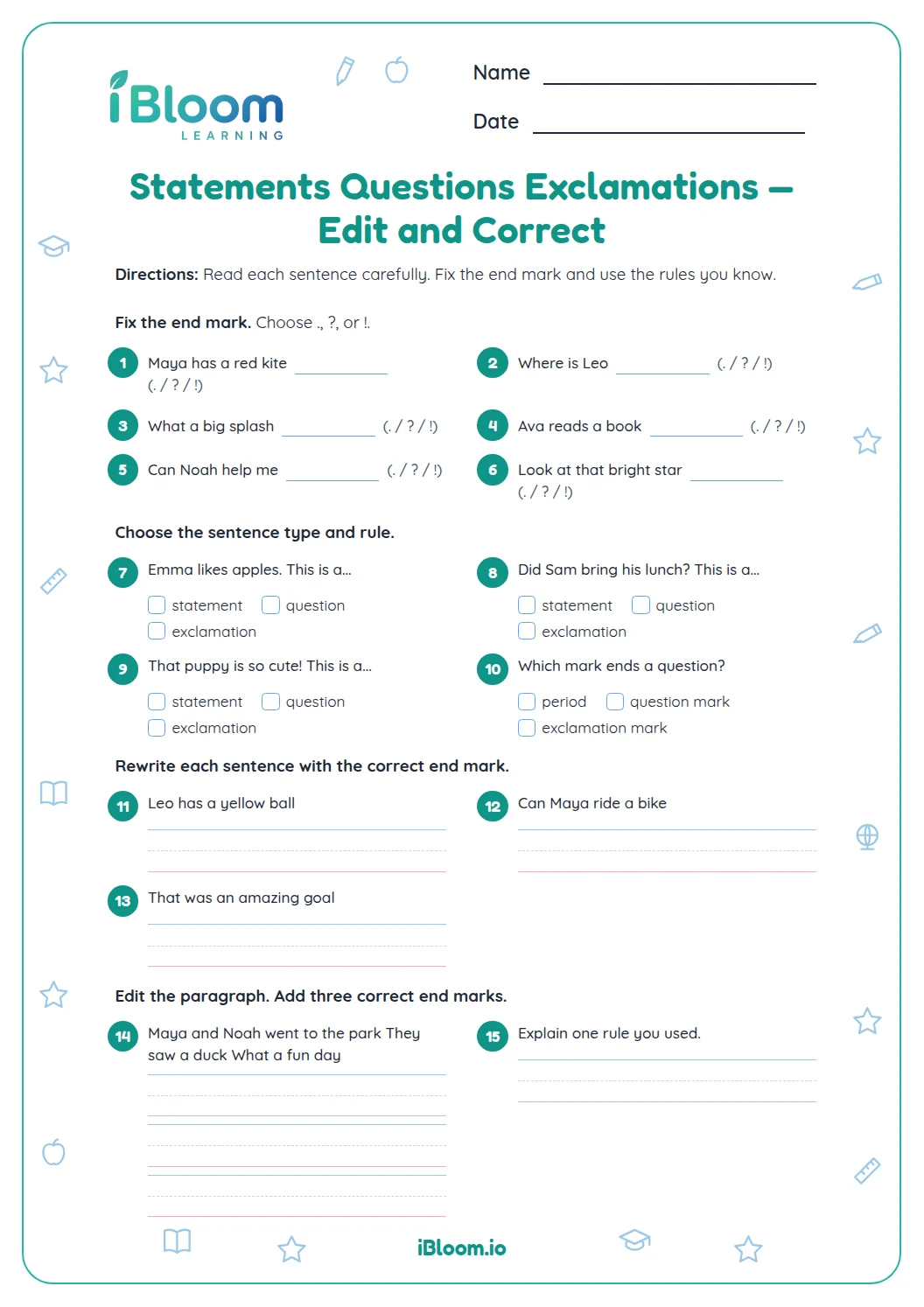
About this worksheet
This free Grade 1 worksheet guides children through 14 comma questions. The first part adds commas to lists; the next practices names used in direct address and greetings; another part adds commas after opening words or phrases. Two final prompts ask children to write their own examples. The key gives the missing comma for each completion and sample sentences for the open responses. The punctuation practice aligns with Common Core L.1.2.
Aligned to L.1.2
Where do commas go in a list?
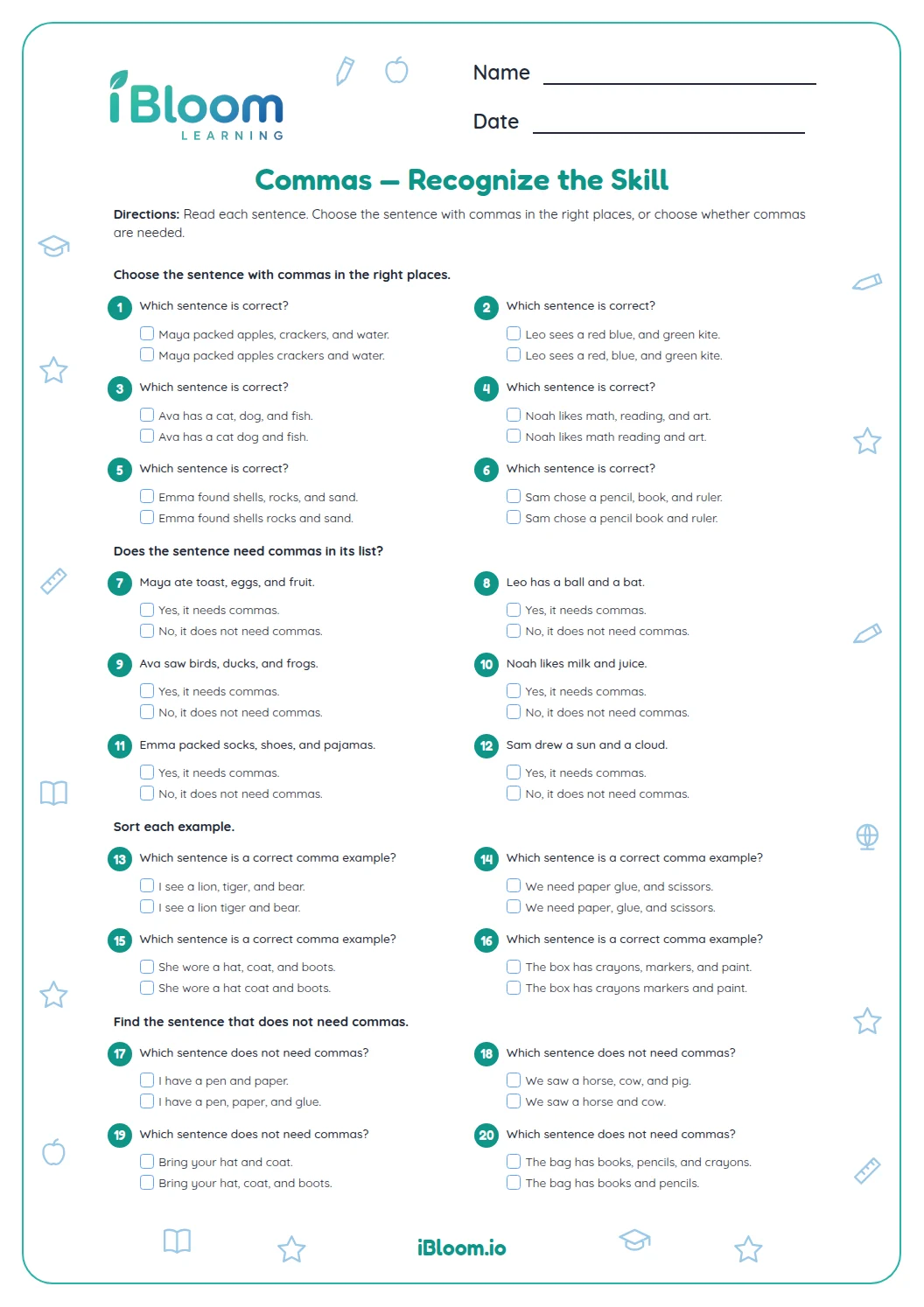
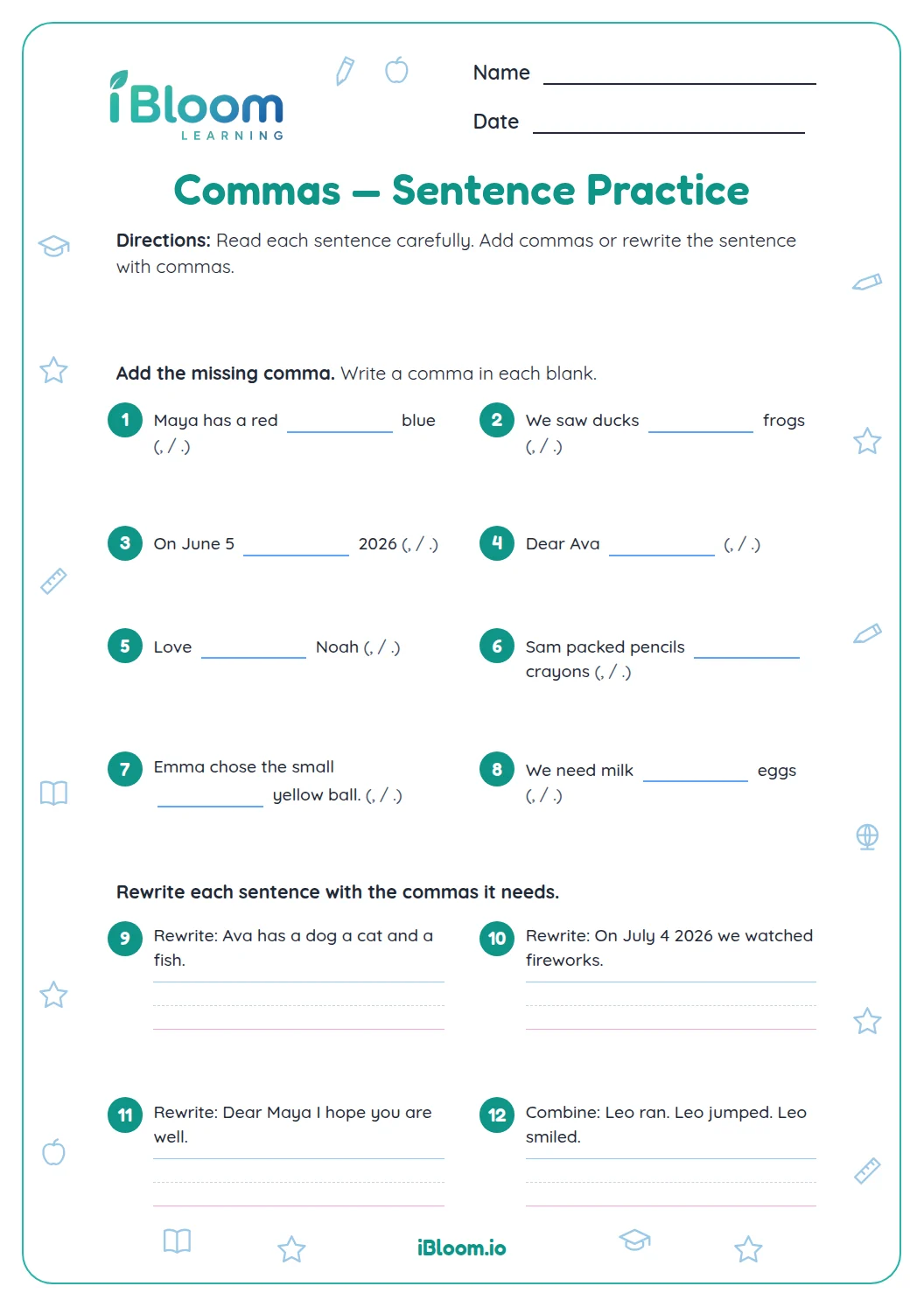
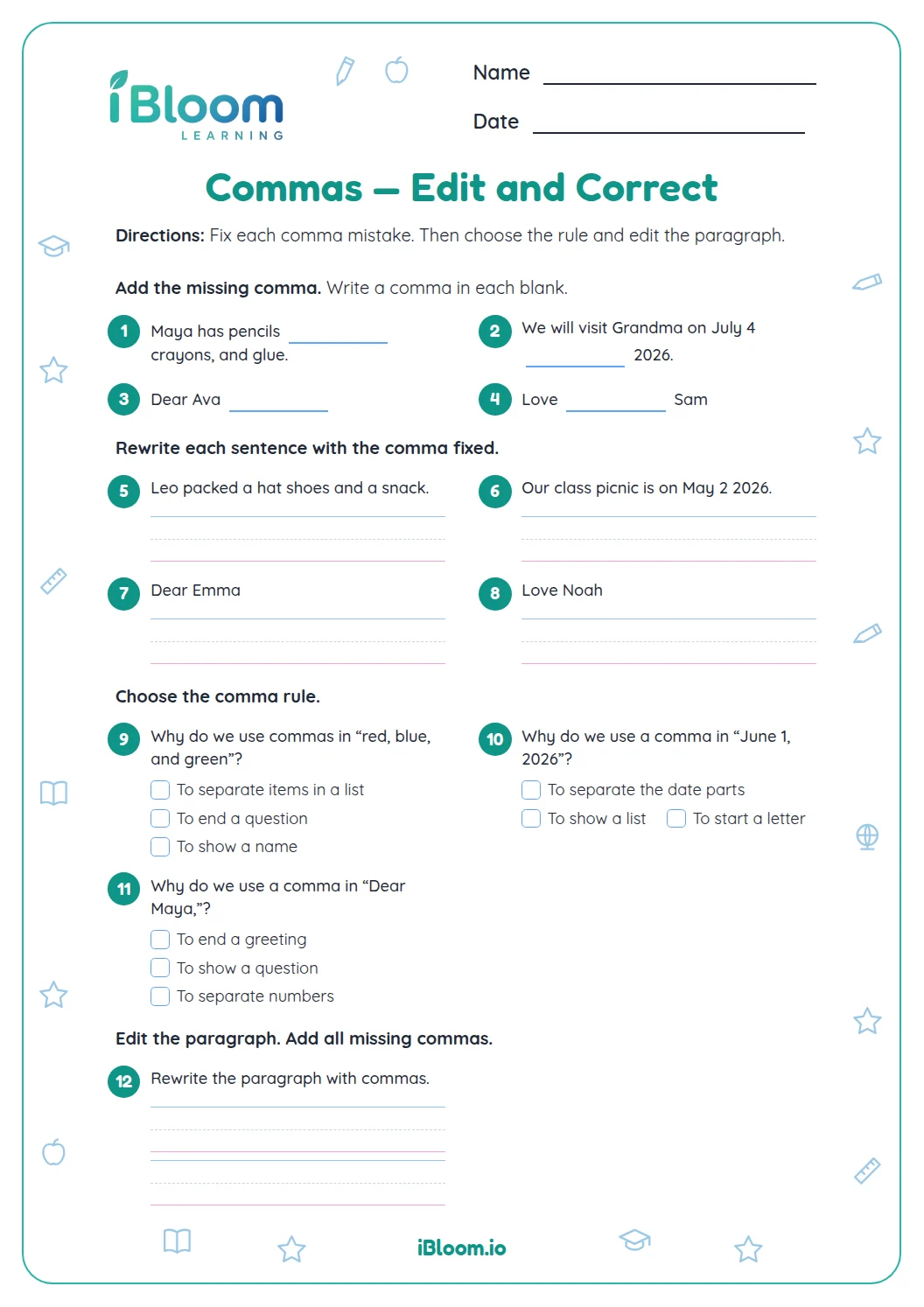
A comma separates items in a list. In “We saw a dog, a cat and a duck,” the comma separates dog from cat; “and” introduces the last item. The first four questions practice adding the missing comma.
When does a name need a comma?
Use a comma to set off a person’s name when speaking directly to that person. A comma also follows a greeting such as “Thank you, Ava.”
- 1Mia, can you help me?
- 2Mia is the person being spoken to.
- 3Write the comma after the name.
What happens after an opening phrase?
A short opening such as “On Monday” or “After school” is followed by a comma before the main part of the sentence. The final two prompts ask children to apply the patterns in original sentences.
How to use the worksheet
- 1Read each full sentence aloud.
- 2In list sentences, find the items being named.
- 3Add a comma after a person’s name when the speaker addresses that person.
- 4Look for an opening word or phrase before the main sentence.
- 5Write two original examples and check the completed work with the key.
Comma mistakes and quick fixes
The mistake
Putting the list comma after “and.”
The fix
Place it between list items, before the final item introduced by “and.”
The mistake
Leaving out the comma after a person’s name.
The fix
Ask who is being spoken to, then place the comma after that name.
The mistake
Adding a comma in the middle of the main sentence.
The fix
Read the opening phrase and place the comma before the sentence’s main idea.
Common Core alignment
Children apply punctuation conventions while completing and writing sentences.
Apply standard punctuation conventions when writing sentences.
On this sheet: Children add commas to sentences and write two original sentences using the practiced patterns.
Show the official wordingHide the official wording
Demonstrate command of the conventions of standard English capitalization, punctuation, and spelling when writing.
What to practice next
Make more practice
Further reading
Questions parents and teachers ask
What comma patterns are on this page?
Children add commas in lists, after a person’s name in direct address or a greeting, and after an introductory word or phrase. Two final prompts ask them to write sentences applying list and name-comma patterns. Ask the child to read the sentence aloud and point to the words that show where the comma belongs.
How many questions are included?
There are 14 questions across two worksheet pages, followed by an answer key that spans two pages. Twelve questions ask children to complete a sentence; the last two ask them to write an original sentence. Have the child read each sentence aloud and point to the comma clue.
Does a list need a comma before “and”?
This worksheet uses a simple list style without a comma before “and.” Children place the comma between the earlier list items, as in “paper, glue and crayons.” Follow the style used in your child’s class when writing other lists. Ask the child to read the sentence aloud and point to the words that show where the comma belongs.
When should a comma follow a name?
Use a comma after a name when speaking directly to that person: “Mia, can you help me?” The worksheet also includes greetings such as “Thank you, Ava,” where the comma separates the greeting from the person’s name. Ask the child to read the sentence aloud and point to the words that show where the comma belongs.
What is an introductory phrase?
It is a word or group of words at the beginning of a sentence that sets up what follows. Examples here include “On Monday” and “After school.” The comma marks the end of that opening before the main sentence continues. Ask the child to read the sentence aloud and point to the words that show where the comma belongs.