









About this worksheet
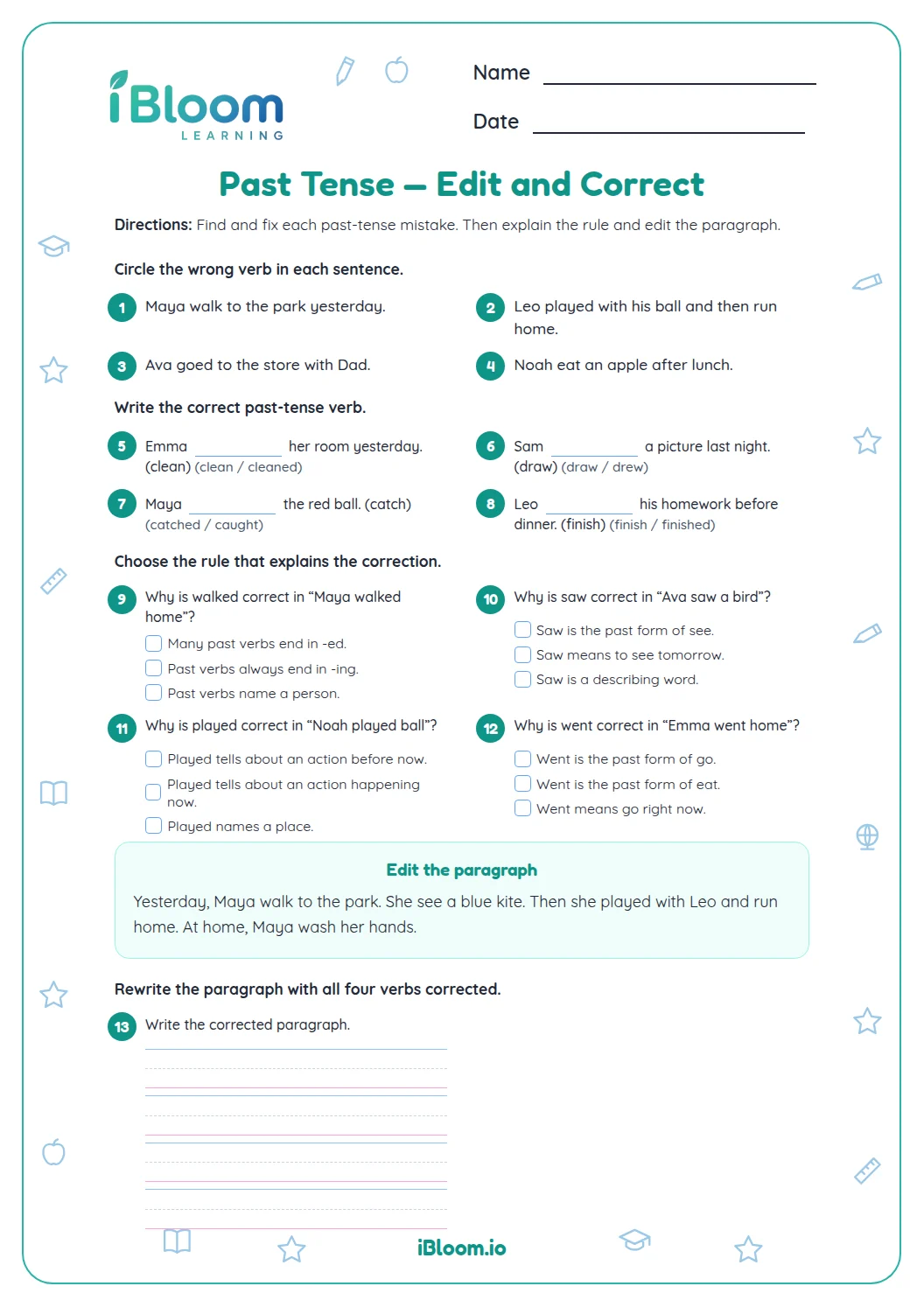
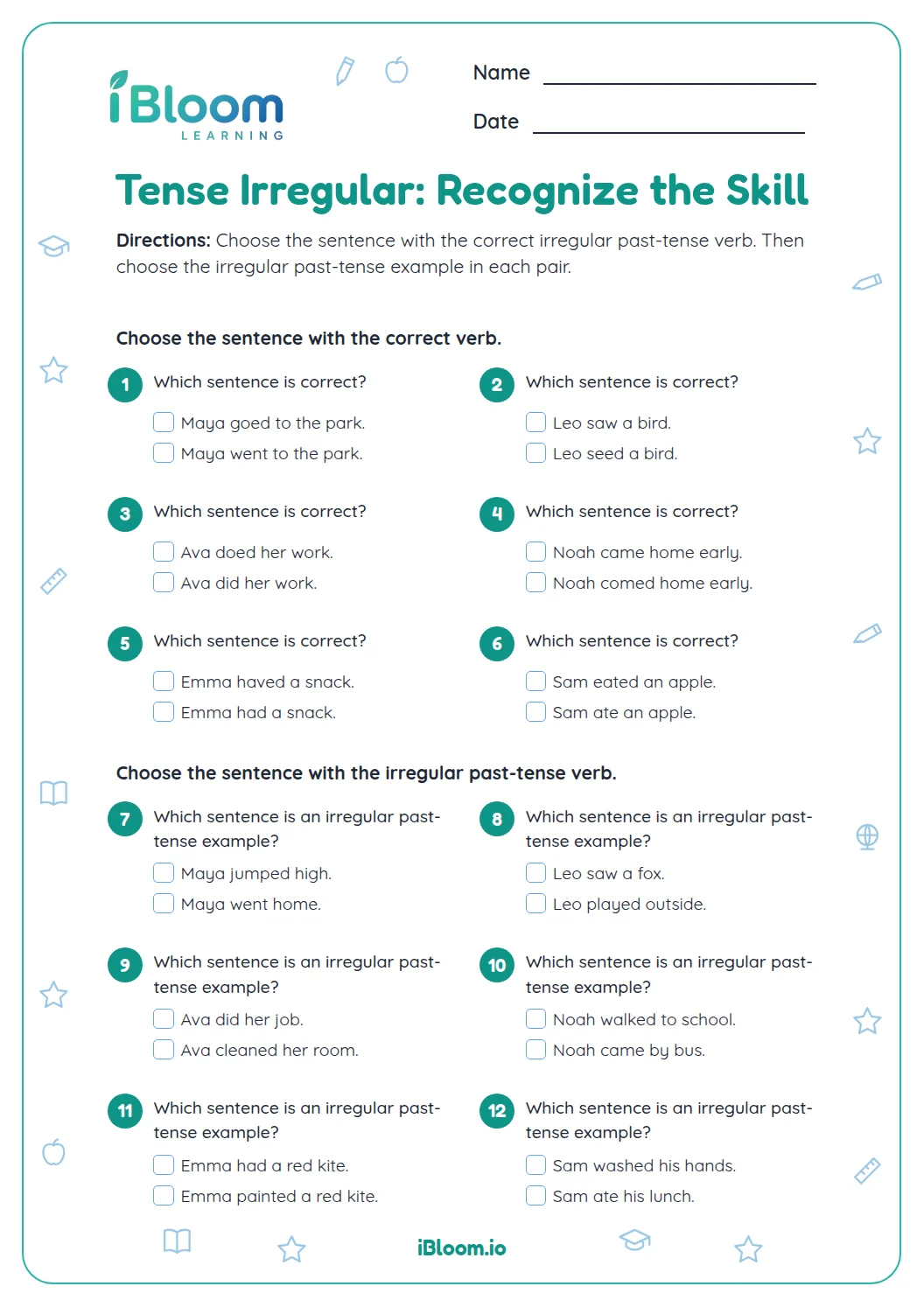
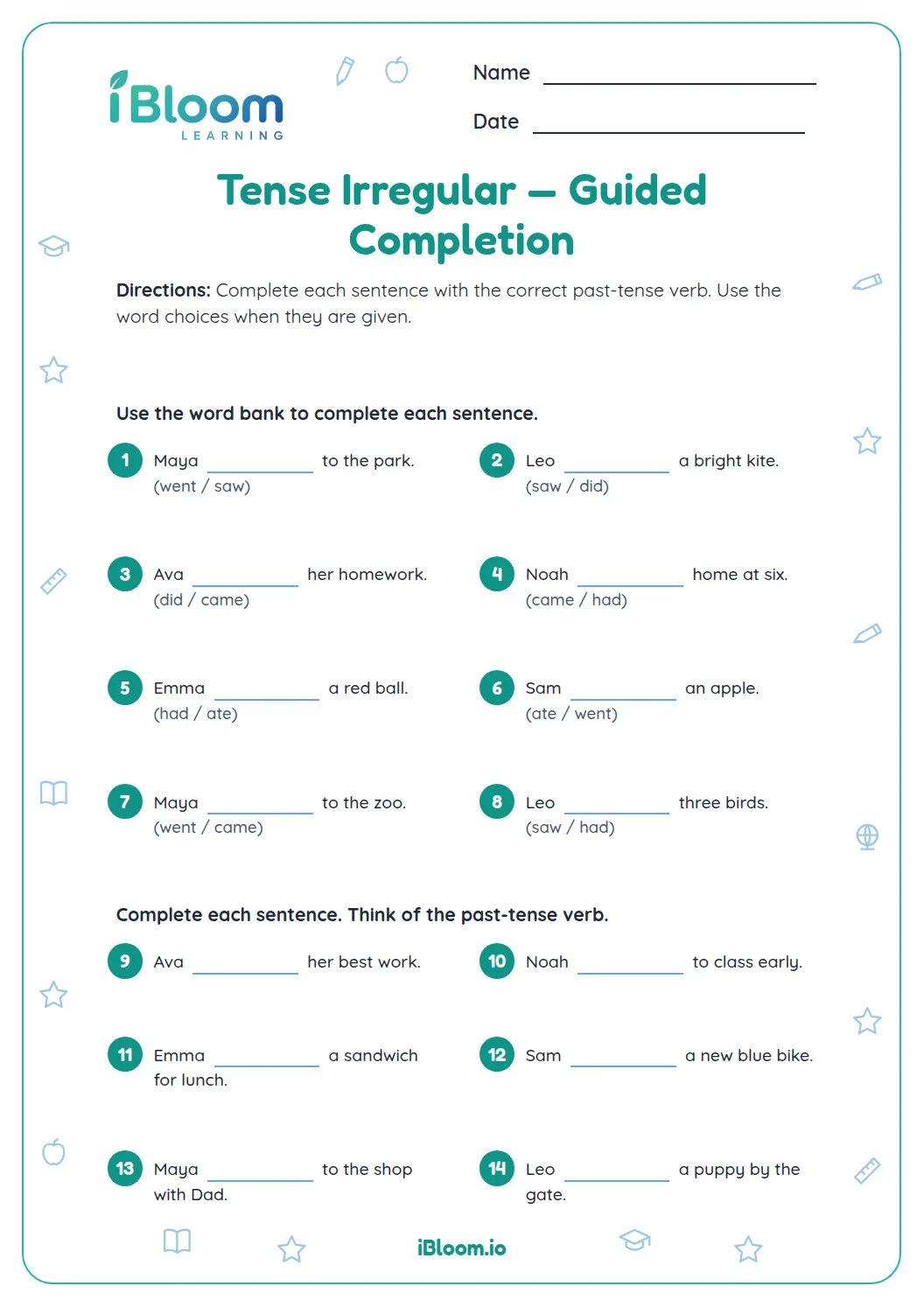
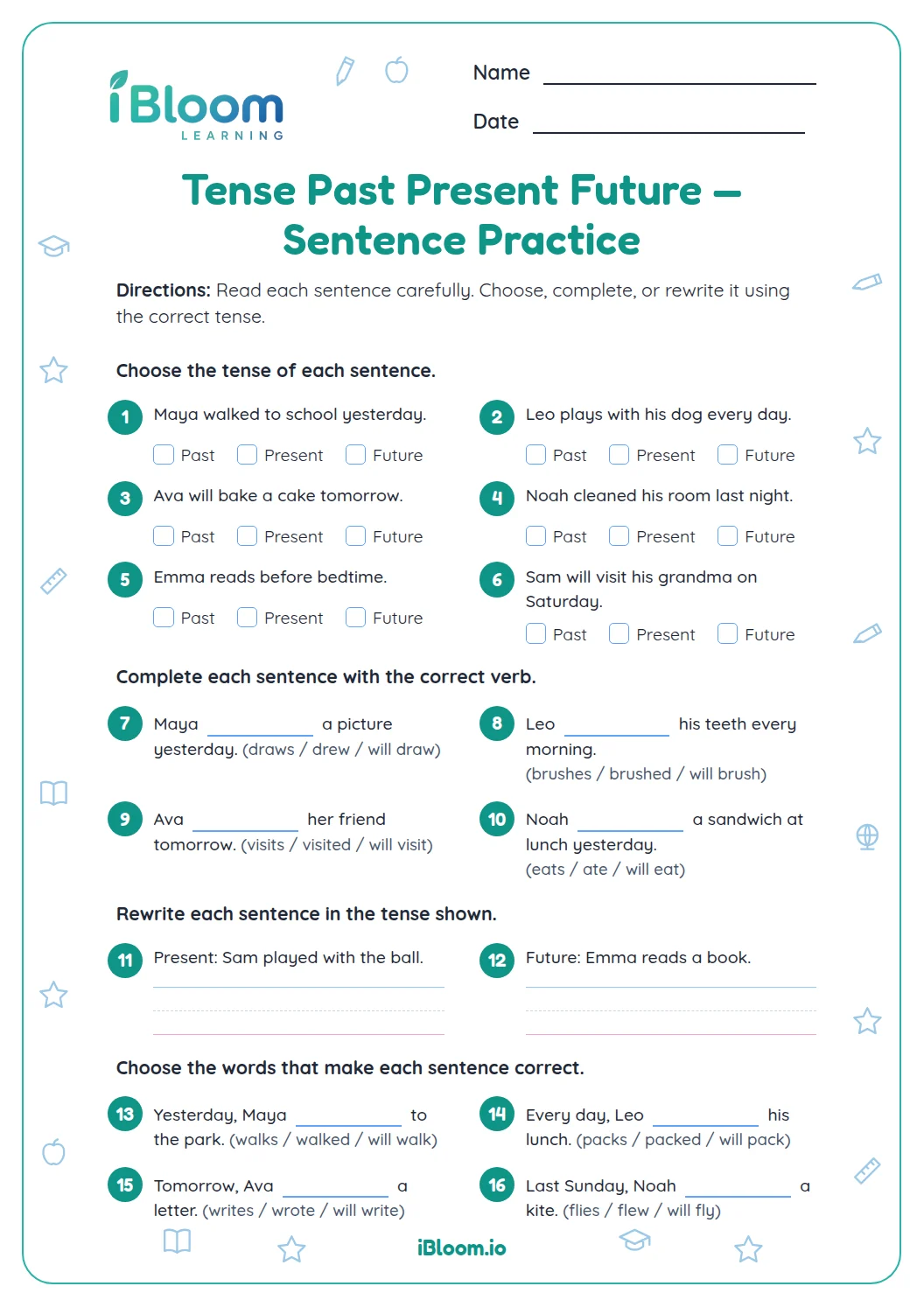
This Grade 1 worksheet helps children write about finished actions. Part A has eight past-tense verb blanks, and Part B has four choices. In Part C, students write two individual sentences, build a two-sentence account of a fun day and rewrite that account after checking it. The work practices Common Core L.1.1.e, using verbs to convey time. The answer key gives fixed answers for Parts A and B and sample sentences for Part C.
Aligned to L.1.1.e
How can a time clue help?
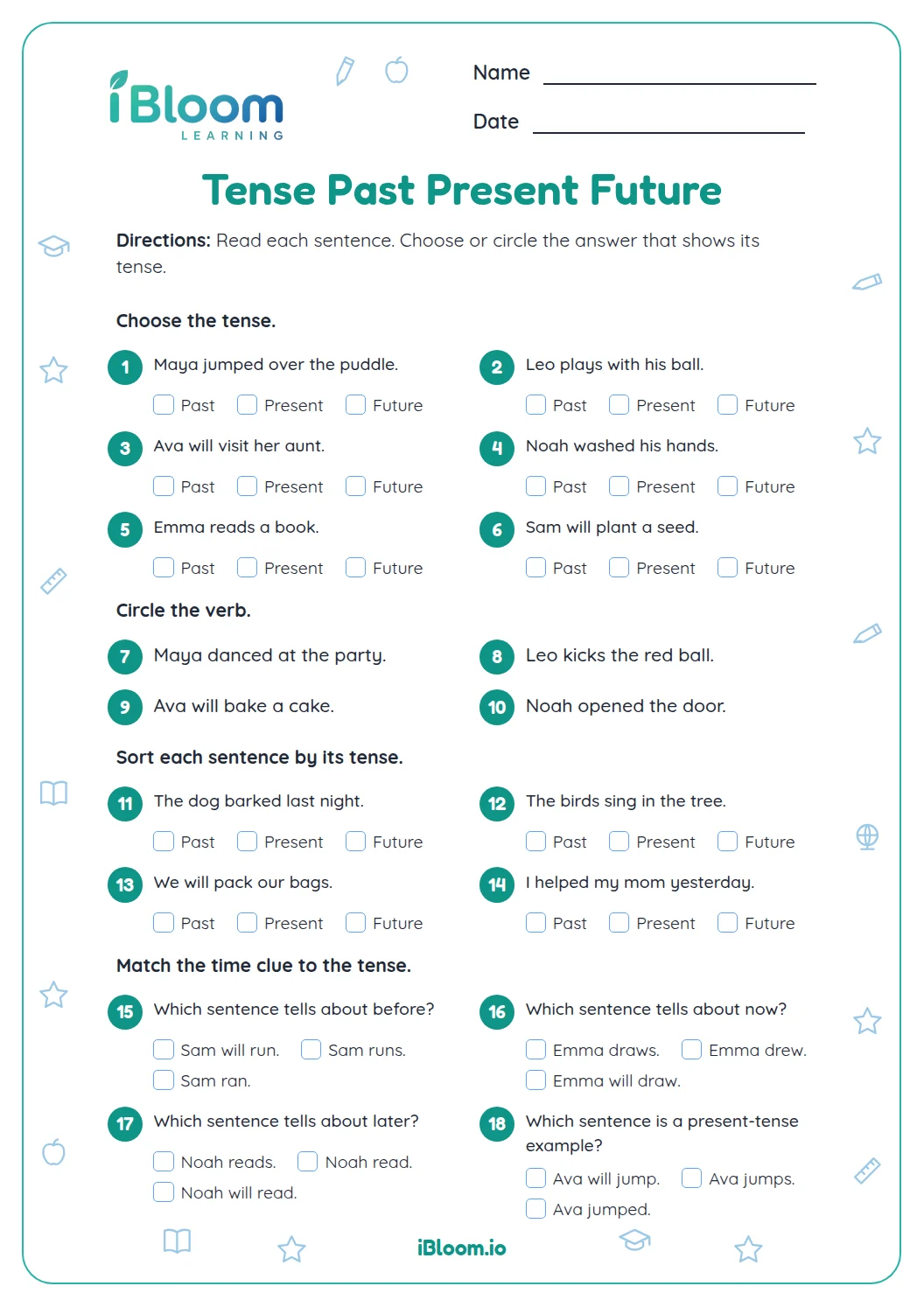
Words such as yesterday, last night and last Saturday tell when an action happened. Use a verb that fits that finished time.
- 1Yesterday, the dog ___ in the yard. (play)
- 2played
What happens to a regular verb in the past?
Many regular verbs add -ed: play becomes played and help becomes helped. Some common verbs change in a different way, such as go becoming went.
- 1What is the past tense of go?
- 2went
How do students apply the skill?
Part C moves from two individual sentences to two connected sentences about a fun day. The final task asks students to rewrite that short account after checking past-tense verbs, capitals and periods.
- 1Write a sentence about something you saw yesterday.
- 2Sample: I saw a bird yesterday.
How to use this worksheet
- 1Find the time clue in the sentence.
- 2Say the base verb and its past form.
- 3Use -ed for many regular verbs.
- 4Remember that some verbs change form, such as go to went.
- 5Reread your sentence to make sure it tells about the past.
Common mistakes and quick fixes
The mistake
Using the present form after “yesterday.”
The fix
Change walk to walked when the action happened yesterday.
The mistake
Adding -ed to every verb.
The fix
Learn common irregular forms such as went, ate and made.
The mistake
Changing back to present tense in a past account.
The fix
Read both sentences and check that each action verb describes the finished day.
Common Core alignment
Students use verb forms to show that an action happened in the past.
On this sheet: Students complete, identify and write sentences using past-tense verbs.
Show the official wordingHide the official wording
Use verbs to convey a sense of past, present, and future (e.g., Yesterday I walked home; Today I walk home; Tomorrow I will walk home).
What to practice next
Make more practice
Further reading
Questions parents and teachers ask
What is a past-tense verb?
A past-tense verb tells about an action that already happened. In the worksheet sentence about a dog in the yard, play changes to played because the action happened yesterday. Children can say the complete sentence aloud to check that the verb fits the time clue.
Do all past-tense verbs end in -ed?
No, some familiar verbs have irregular past forms. This sheet includes make and made, eat and ate, sleep and slept, and go and went. Regular verbs such as play and help take -ed. Read each base verb with the child before asking for its past form.
How does read change in the past?
Read keeps the same spelling in the past but changes its pronunciation. In “Last night, Dad read a story aloud,” read sounds like red. The time phrase last night tells children that the action is finished, even though the written verb looks the same as its base form.
What should students write in Part C?
Students write a sentence about something they saw and another about something they did at home. Next they write two connected sentences about a fun day. The final task asks them to rewrite that account after checking past-tense verbs, capital letters and periods in both sentences.
Must the writing match the sample answers?
No, the writing prompts accept different sensible sentences about finished actions. The key shows examples to help adults check the task. Look for a complete thought and a past-tense verb, then check the capital letter and ending mark when the child revises the two-sentence account.