


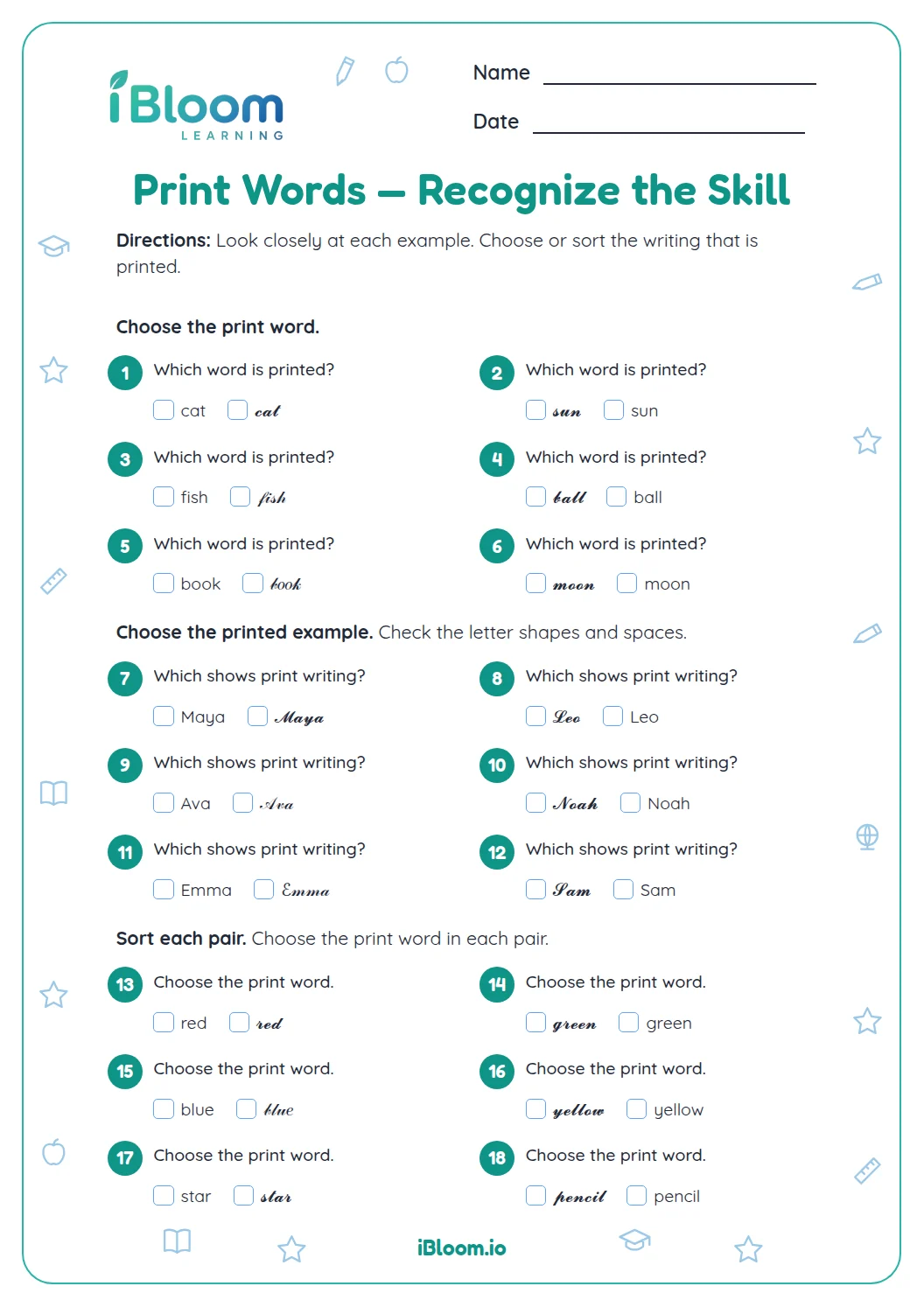
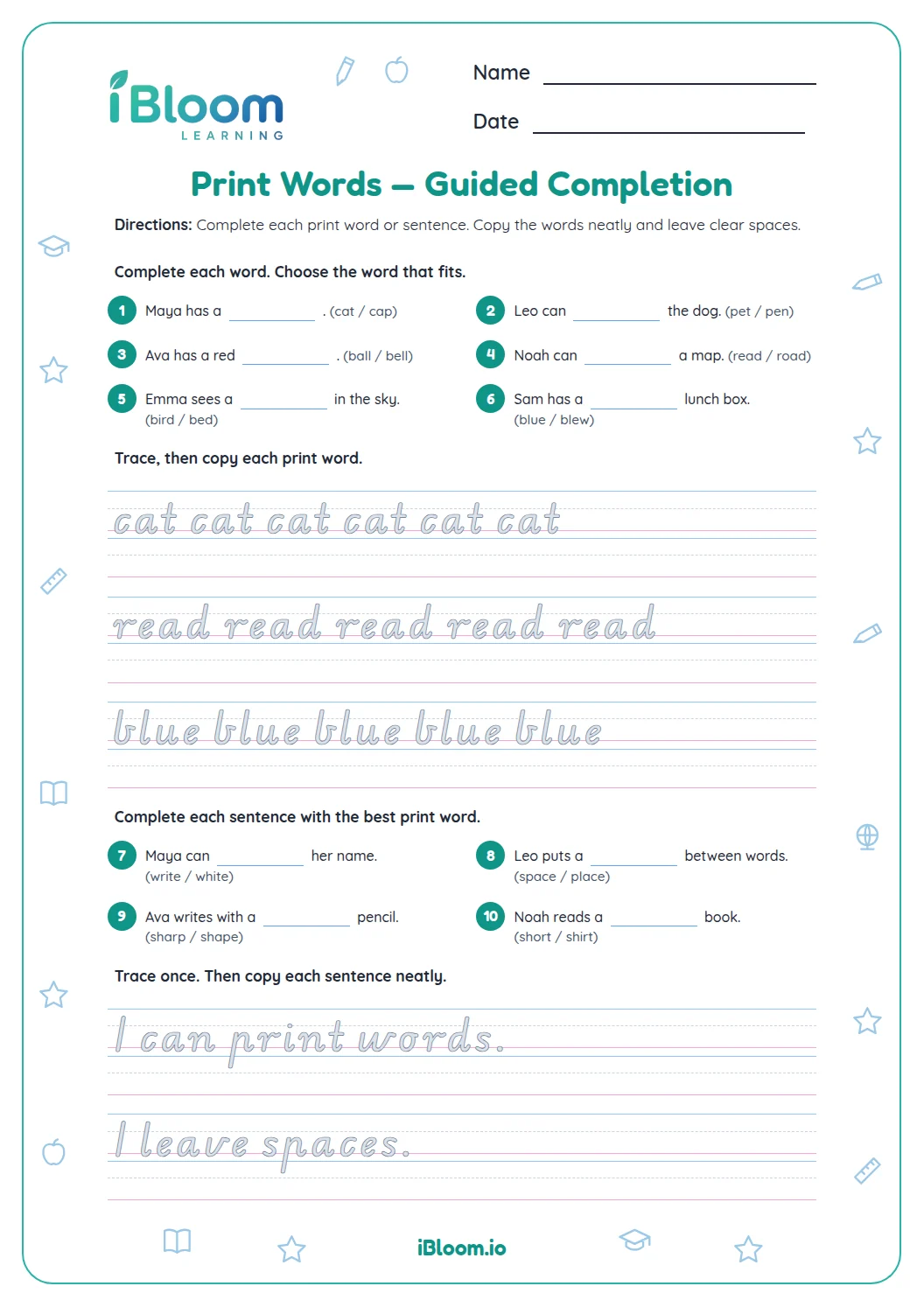

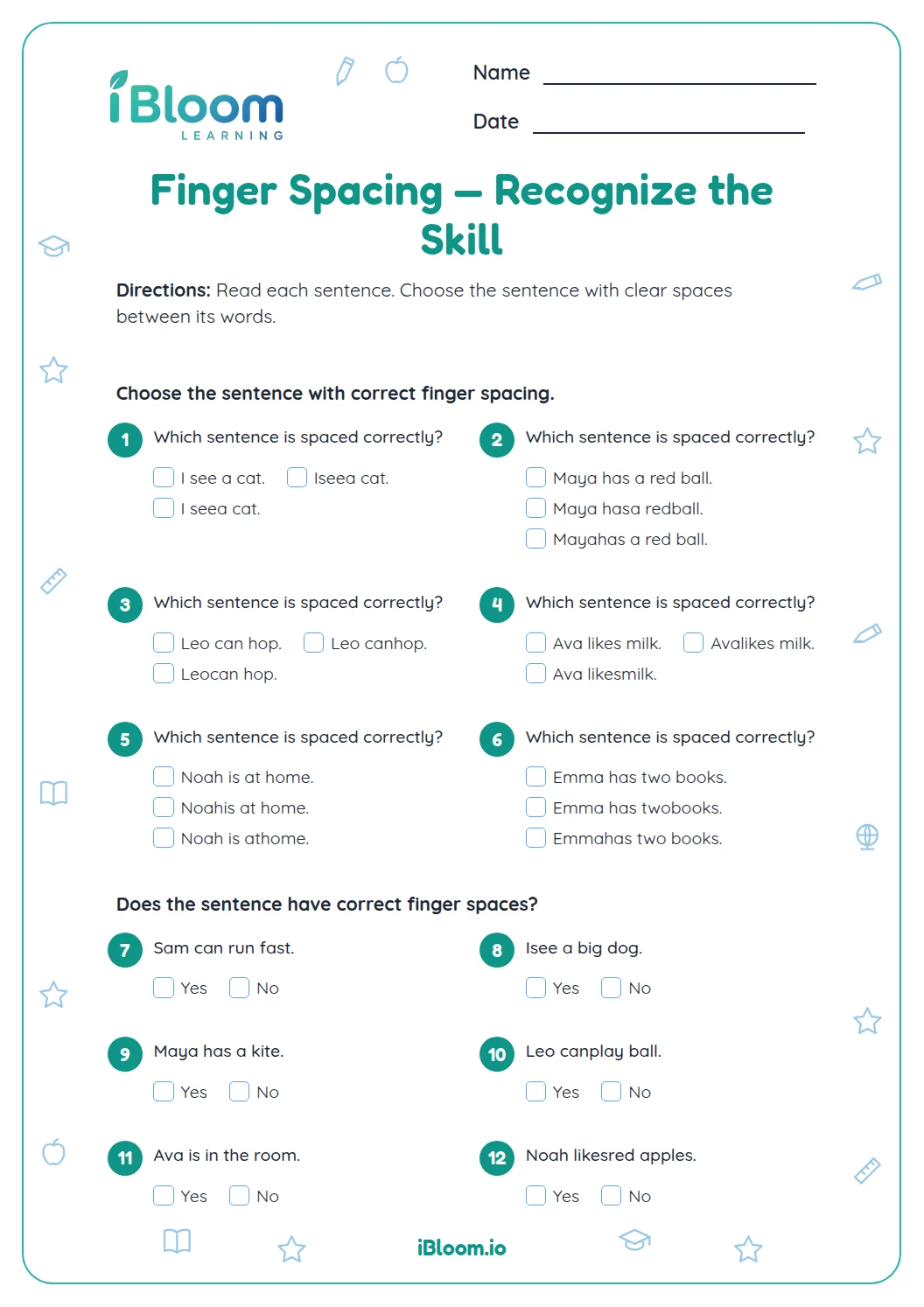
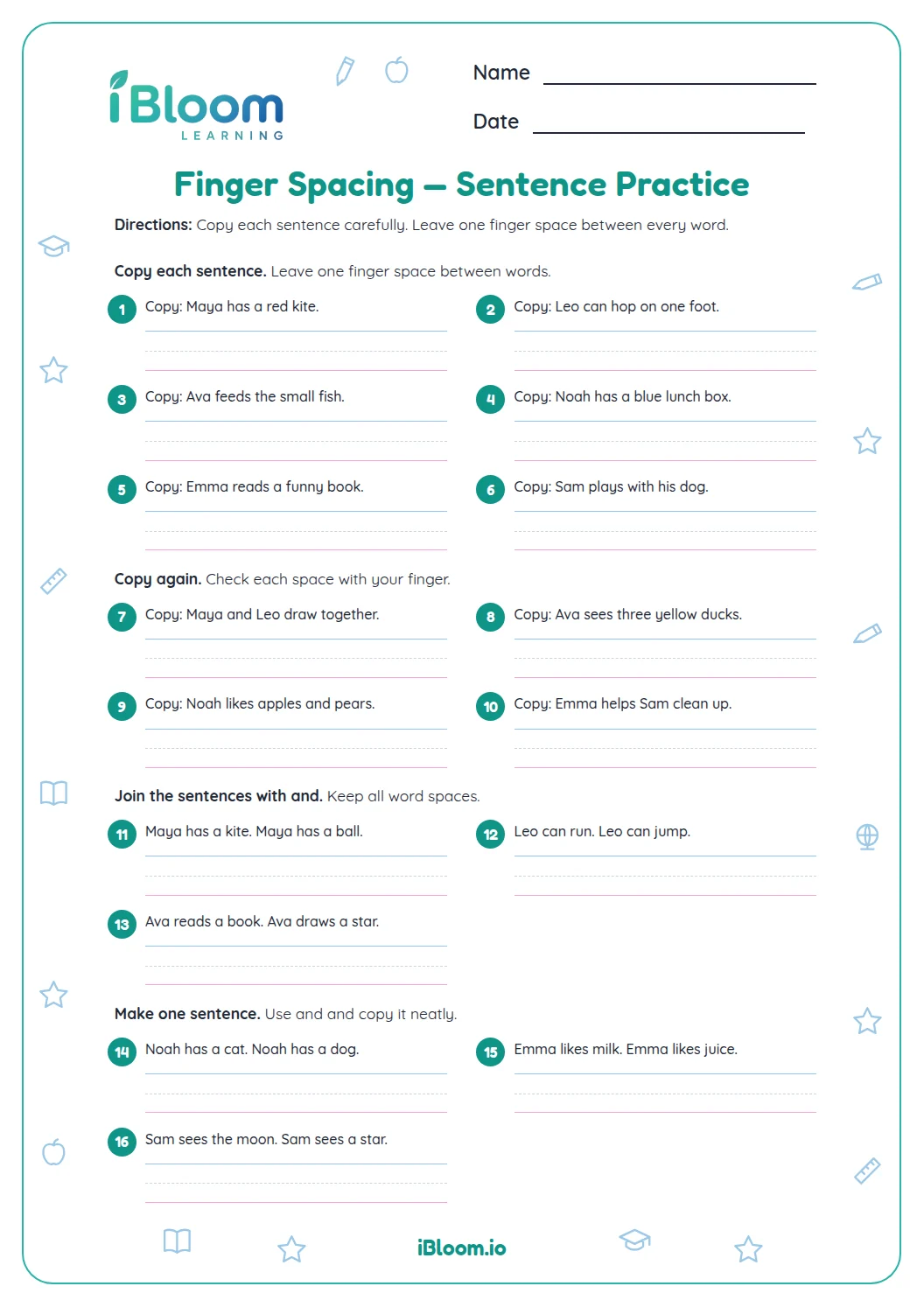
About this worksheet
This free Grade 1 worksheet practices alphabet order and letter recognition. Learners fill missing letters from A through Z, identify uppercase partners, complete short sequences, name neighboring letters, and use picture names for beginning sounds. Four writing prompts cover every letter in the alphabet. The printing practice supports CCSS L.1.1.a: print all uppercase and lowercase letters.
Aligned to L.1.1.a
What skill does this sheet practice?
Crayon artwork fits the alphabet and handwriting focus. The picture clues show apple, cat, and fish, matching their beginning letters.
Work one item at a time, then check the result with a second method when possible.
What is on the worksheet?
Sixteen items cover every letter A–Z through alphabet gaps, uppercase partners, neighboring letters, and ordered letter groups.
- Part A: fill alphabet gaps and identify uppercase partners.
- Part B: complete sequences and find neighboring letters.
- Part C: write the complete alphabet in four ranges and use picture clues.
- The answer key is separate from the student pages.
How can an adult support practice?
Say the alphabet slowly from the nearest known letter, then check which letter comes immediately before or after the gap.
Ask the learner to point to the fraction, place-value shift, or letter clue that supports each response.
How to use this worksheet
- 1Read the one-line directions and check the first item together.
- 2Complete Part A, pausing to check the strategy rather than only the answer.
- 3Use the next part to try a different representation or question type.
- 4Finish Part C, then use the answer key to review and revisit any missed item.
Common mistakes and quick fixes
The mistake
Skipping a letter while reciting the alphabet.
The fix
Start with the nearest known letter and say each next letter aloud.
The mistake
Confusing a lowercase letter with a different uppercase shape.
The fix
Match the letter name, then write its uppercase partner.
The mistake
Writing letters out of order in a range.
The fix
Say the alphabet while checking each written letter from left to right.
Common Core alignment
The writing prompts ask learners to print uppercase and lowercase letters.
Print uppercase and lowercase letters across the alphabet writing prompts.
On this sheet: The worksheet directly practices the skill named in this standard through its questions and models.
Show the official wordingHide the official wording
Print all upper- and lowercase letters.
What to practice next
Make more practice
Further reading
Questions parents and teachers ask
How many questions are on this printable?
The worksheet has 16 questions across three parts. The four writing prompts cover A–F, G–L, M–R, and S–Z, so no alphabet range is skipped. The separate answer key makes it possible to check each response after the learner finishes. The key gives the letter sequence and picture initials for checking.
What does this Grade 1 worksheet practice?
It practices alphabet order, letter names, uppercase partners, and printing letters. The first part starts with direct examples, while later items ask learners to apply the same idea in another format or setting. Read the directions aloud if useful, then let the learner work through the page at a comfortable pace.
Is an answer key included?
Yes. A separate answer key follows the worksheet pages. Keep it aside while the learner works, then use it to check responses and discuss a particular step when an answer differs. A grown-up can look for clear letter shapes and order when reviewing written responses.
How can I help if a learner gets stuck?
Ask the learner to explain the first step aloud and point to the information they used. Find the nearest known letter, then say the sequence one letter at a time until you reach the gap. Let them try again with that clue before showing a complete solution.
Can this be used for independent practice?
Yes. The worksheet is labeled for independent practice, and its directions are printed on the page. An adult may demonstrate the first example if needed; the answer key can be used afterward to review the work. The final item groups cover all letters from A through Z.