Free printable practice
Adjectives Practice Activities
Grade 2 adjective worksheets for identifying describing words, pairing adjectives with nouns, writing sentences, and practising comparatives.
Explore Adjectives
Free printable worksheet PDFs
Preview every available page, then download the free worksheet PDF for home, homeschool, tutoring, or classroom practice.
Preview the exact activity before downloading it.
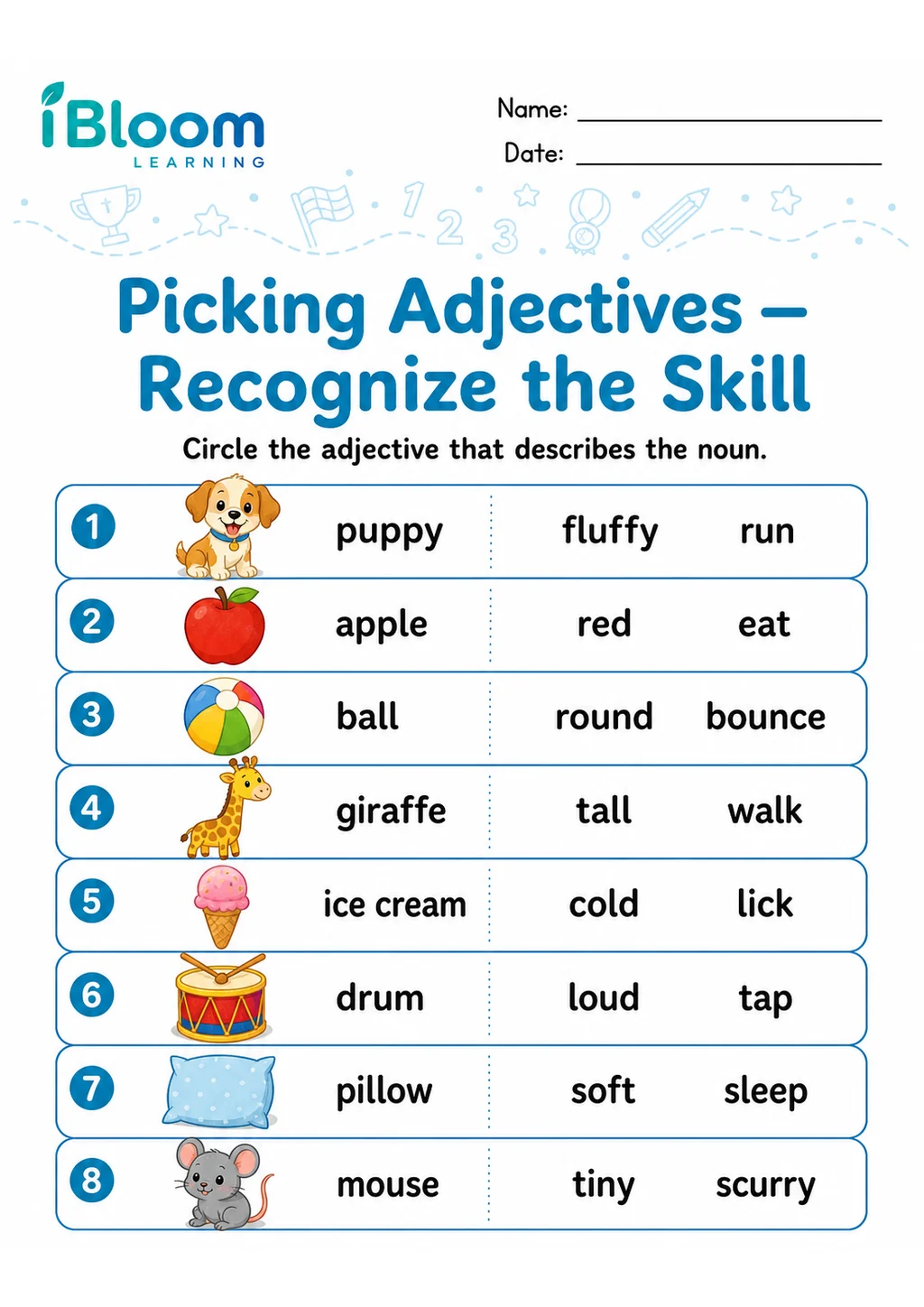 Picking — Recognize the SkillExplore picking practice activities within Adjectives Practice Activities, organised so children, families, and elementary teachers can move from broad learning areas to focused printable practice. This recognize the skill worksheet provides a distinct, age-appropriate way to practise the same lesson.Grade 2Free PDF preview
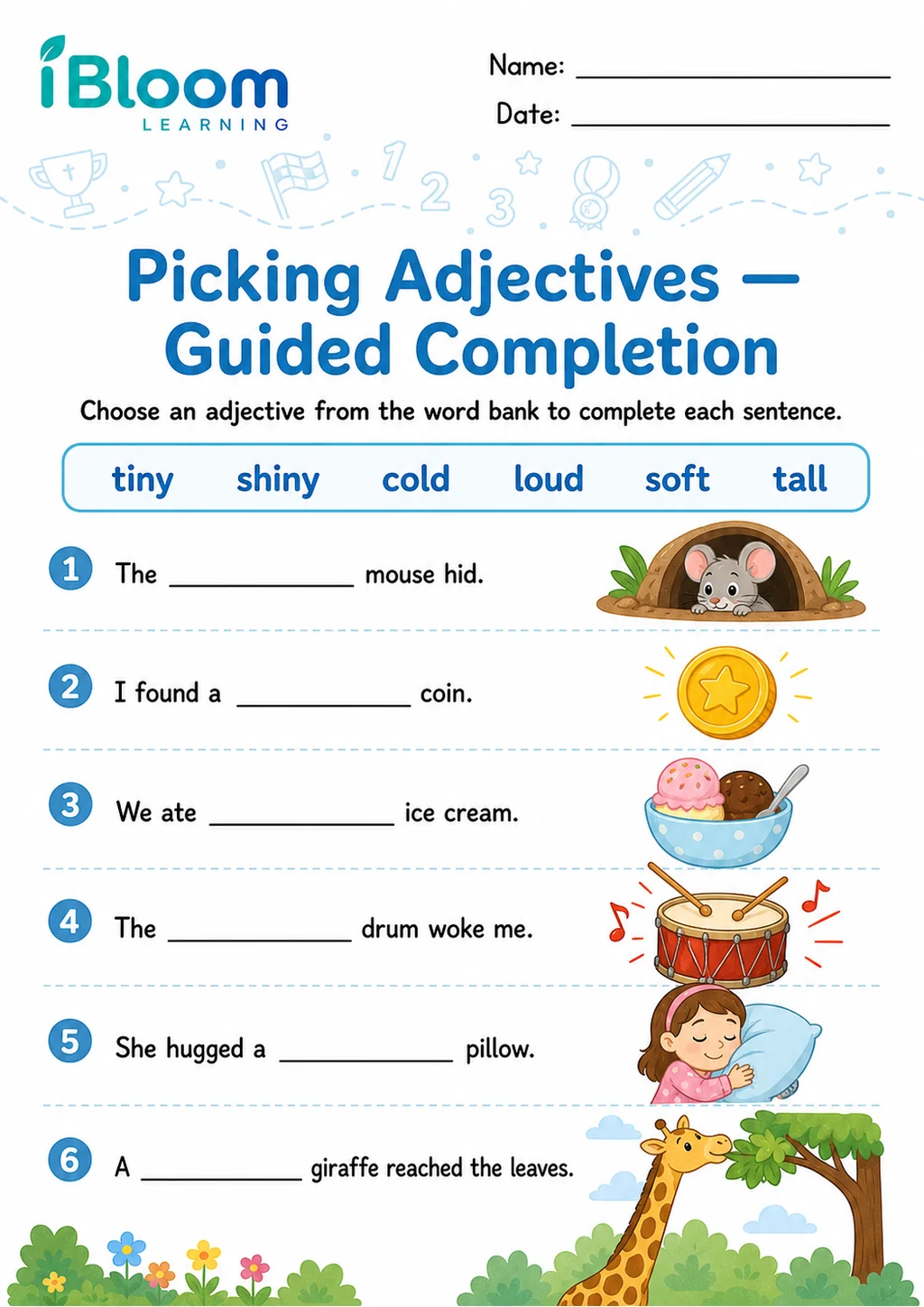 Picking — Guided CompletionExplore picking practice activities within Adjectives Practice Activities, organised so children, families, and elementary teachers can move from broad learning areas to focused printable practice. This guided completion worksheet provides a distinct, age-appropriate way to practise the same lesson.Grade 2Free PDF preview
Practice that builds confidence
Building the idea of adjectives
These Grade 2 adjectives worksheets help children notice how describing words make nouns clearer and more interesting. Students practise identifying adjectives, choosing suitable adjectives for nouns, using adjectives in sentences, and understanding how comparative adjectives show a difference.
The printable activities include sorting, picking, sentence checks, adjective-noun pairs, short writing prompts, alliteration practice, and examples where adjectives come after nouns, such as “The sky is bright.” Each page builds grammar knowledge while supporting stronger descriptive writing.
Grade 2 learners move from simply spotting describing words to using them with purpose. These worksheets focus on adjectives that tell what kind, which one, or how many, while keeping the work clear and age-appropriate. Children may identify words like soft, tiny, blue, or three, then connect them to the noun they describe.

From identifying to writing
The collection progresses through several useful skills: finding adjectives in a sentence, deciding whether a sentence contains an adjective, matching adjectives with nouns, and picking the best adjective to complete a phrase. Writing tasks encourage children to create fuller sentences instead of stopping at one-word answers. For example, “dog” can become “The playful dog ran home.”
Comparatives and adjective placement
Comparative practice introduces forms such as bigger, smaller, faster, and slower when two people, animals, or objects are compared. Children also meet adjectives after nouns in simple sentence patterns, such as “The soup is hot” or “The flowers are yellow.” This helps them see that adjectives do not always sit directly before the noun.
Parent routine for steady practice
At home, choose one worksheet and read the directions together. Ask your child to underline the noun first, then circle the adjective that describes it. After the page, invite your child to improve three everyday nouns: backpack, snack, or room. Say the plain noun, then make a stronger phrase, such as “a heavy backpack” or “a crunchy snack.”

Classroom uses for teachers
Teachers can use these printables for grammar centers, morning work, small-group review, or writing warm-ups. The alliteration pages are especially helpful before poetry or creative writing because students practise adjective-noun combinations like “busy bee” or “silly seal.” Sentence identification pages work well for quick checks before students revise their own writing.

Common errors and a child-friendly strategy
Watch for children circling nouns instead of adjectives, using a comparison when none is needed, or choosing an adjective that does not make sense with the noun. A helpful strategy is: “Find the noun, ask what it is like, then test the describing word.” Why iBloom worksheets help: each activity narrows the focus, so children practise one adjective skill at a time before combining skills in sentences and writing.
Free printable PDF download
Use this grade 2 adjectives worksheet page to preview the activity, print it, or download it as a PDF for quick practice. It works well for homework, homeschool lessons, tutoring, morning work, revision, and classroom centers.
Answers and answer key support
After the child completes the worksheet independently, parents and teachers can use the answer support or answer key information to check the work, review mistakes, and choose the next practice step.
Helpful answers
Frequently asked questions
What adjective skills do these Grade 2 worksheets cover?
They cover identifying adjectives, choosing adjectives for nouns, using adjectives in sentences, writing with adjectives, recognising comparative adjectives, and noticing adjectives that appear after nouns.
How do these worksheets explain comparative adjectives?
Children practise simple comparisons between two nouns using words such as bigger, smaller, faster, and slower, so they can see how an adjective changes when two things are compared.
What does “adjectives after nouns” mean for a second grader?
It means the describing word comes later in the sentence, often after words like is or are. For example, in “The kitten is sleepy,” sleepy describes kitten even though it comes after the noun.
Can these pages help with writing, not just grammar?
Yes. Many activities ask children to build phrases and sentences, helping them turn plain nouns into more detailed ideas, such as changing “car” into “a shiny red car.”
How should I help if my child keeps circling the noun instead of the adjective?
Have your child find the noun first, then ask, “What is it like?” The answer to that question is usually the adjective, such as soft in “soft blanket.”
Is this grade 2 adjectives worksheet free?
Yes. You can preview it for free and use the printable worksheet for home or classroom practice.
Can I download this grade 2 adjectives worksheet as a PDF?
Yes. Use the worksheet download option to save a printable PDF, or print the worksheet directly from the page.
Does this grade 2 adjectives worksheet include answers or an answer key?
When the activity has fixed answers, iBloom includes answer support so parents and teachers can check the completed worksheet.