








About this worksheet
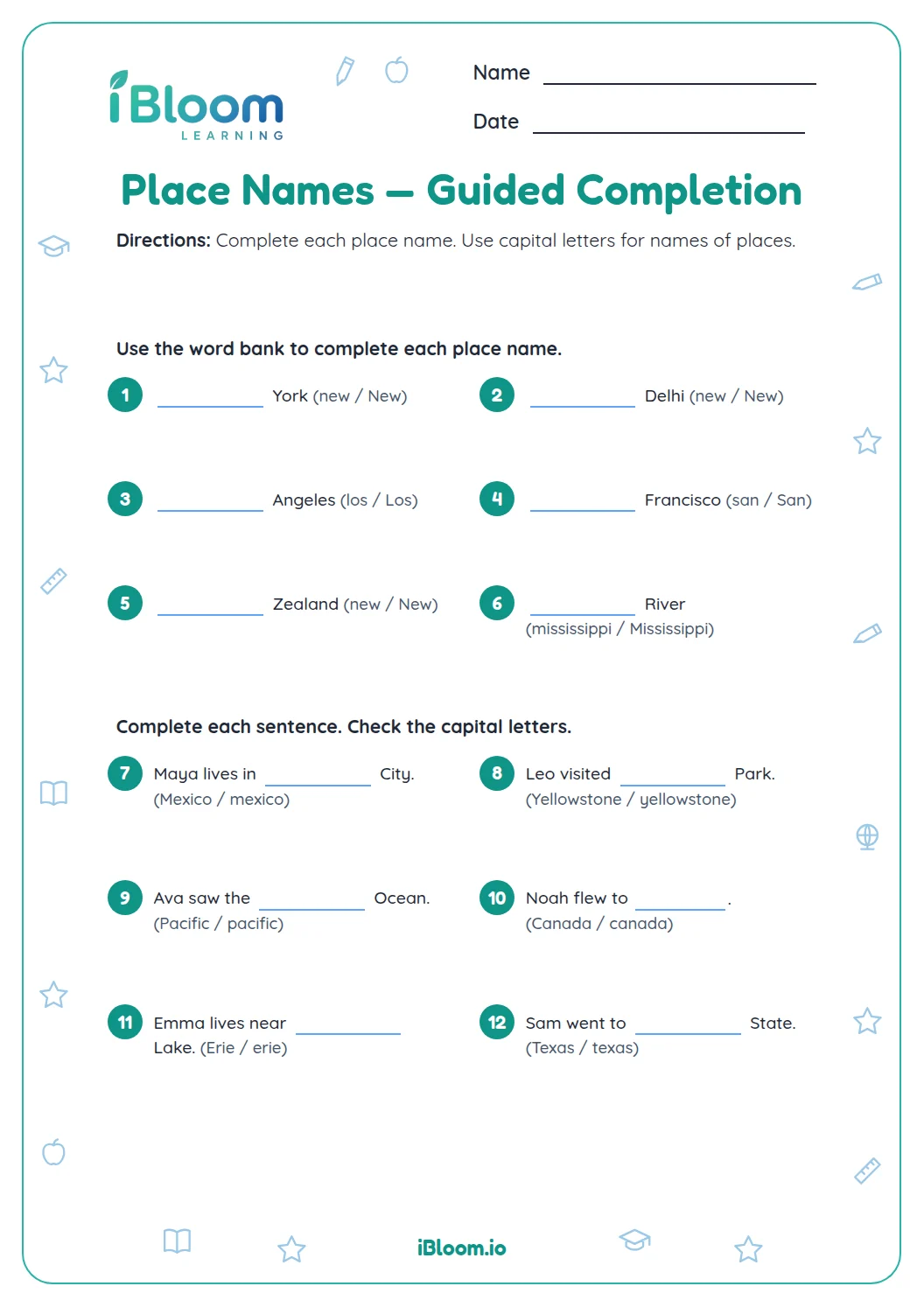
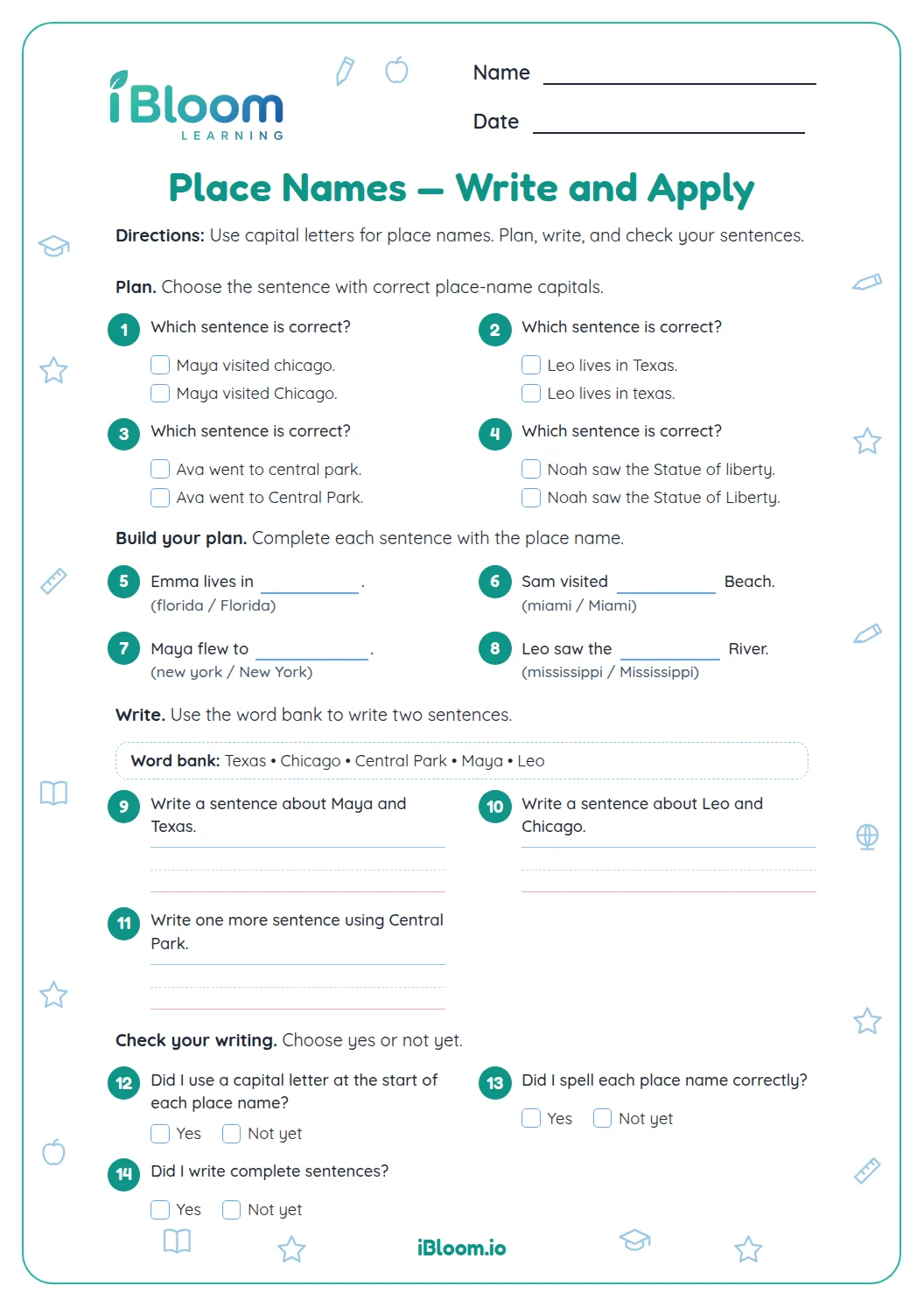
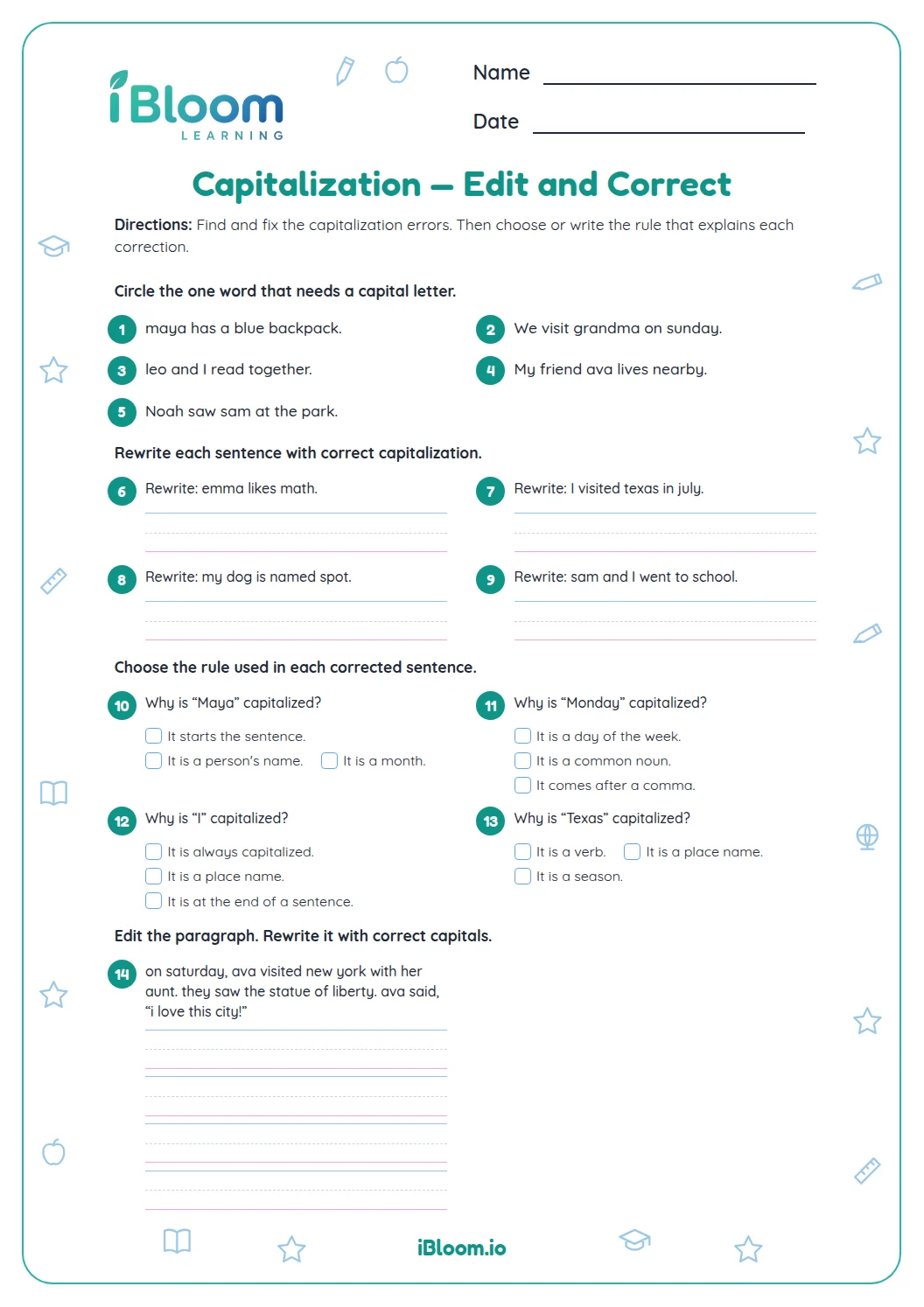
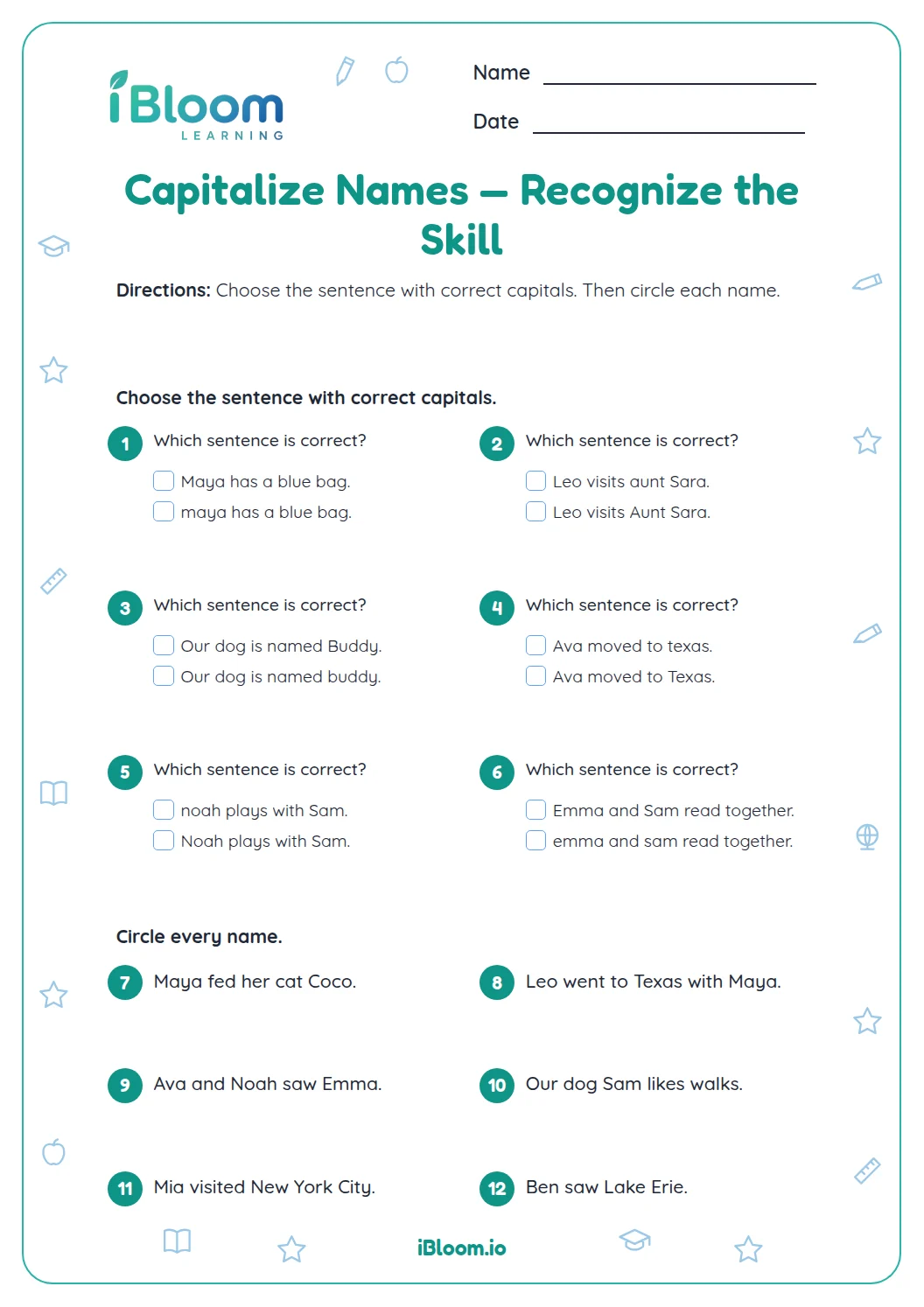
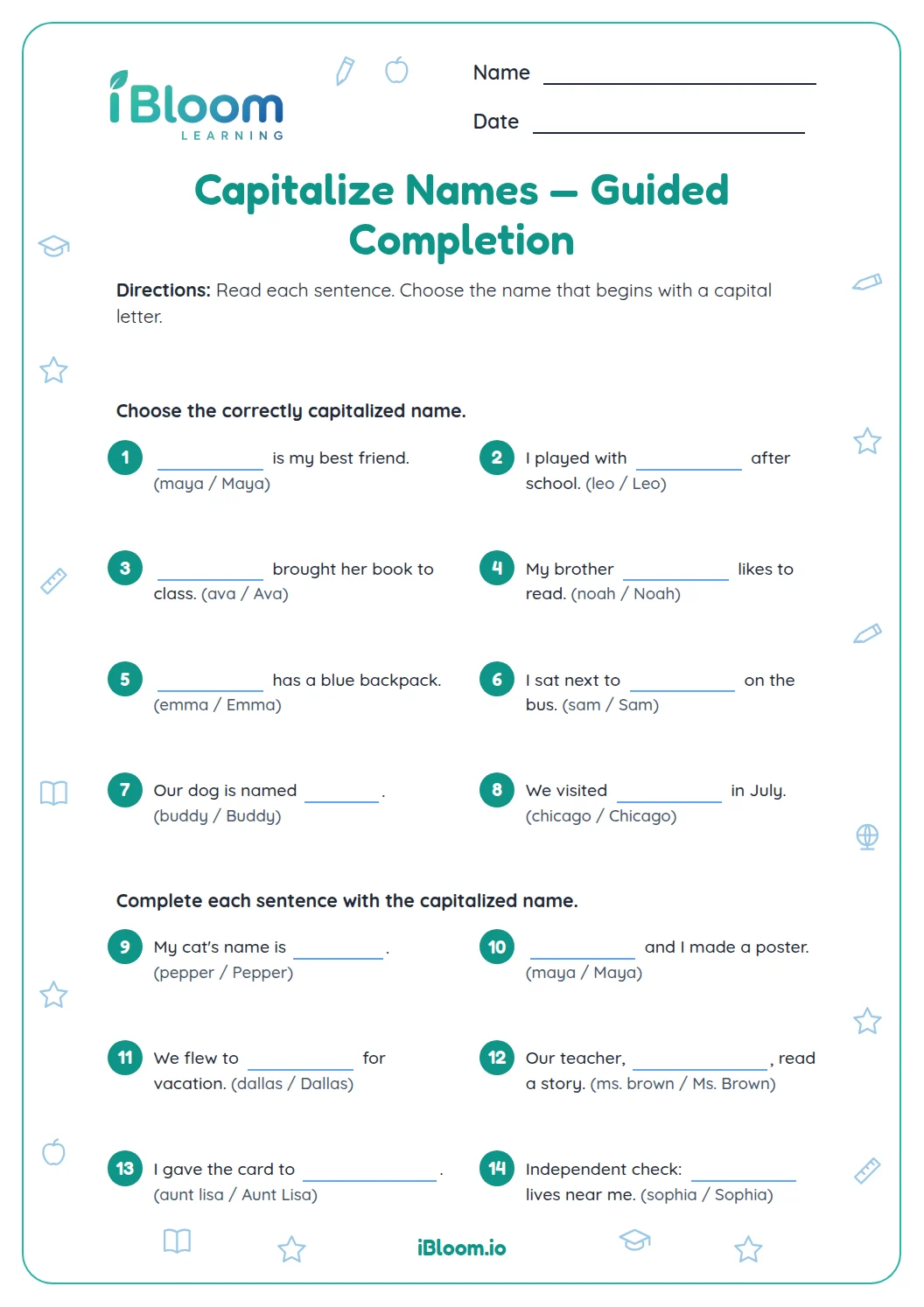
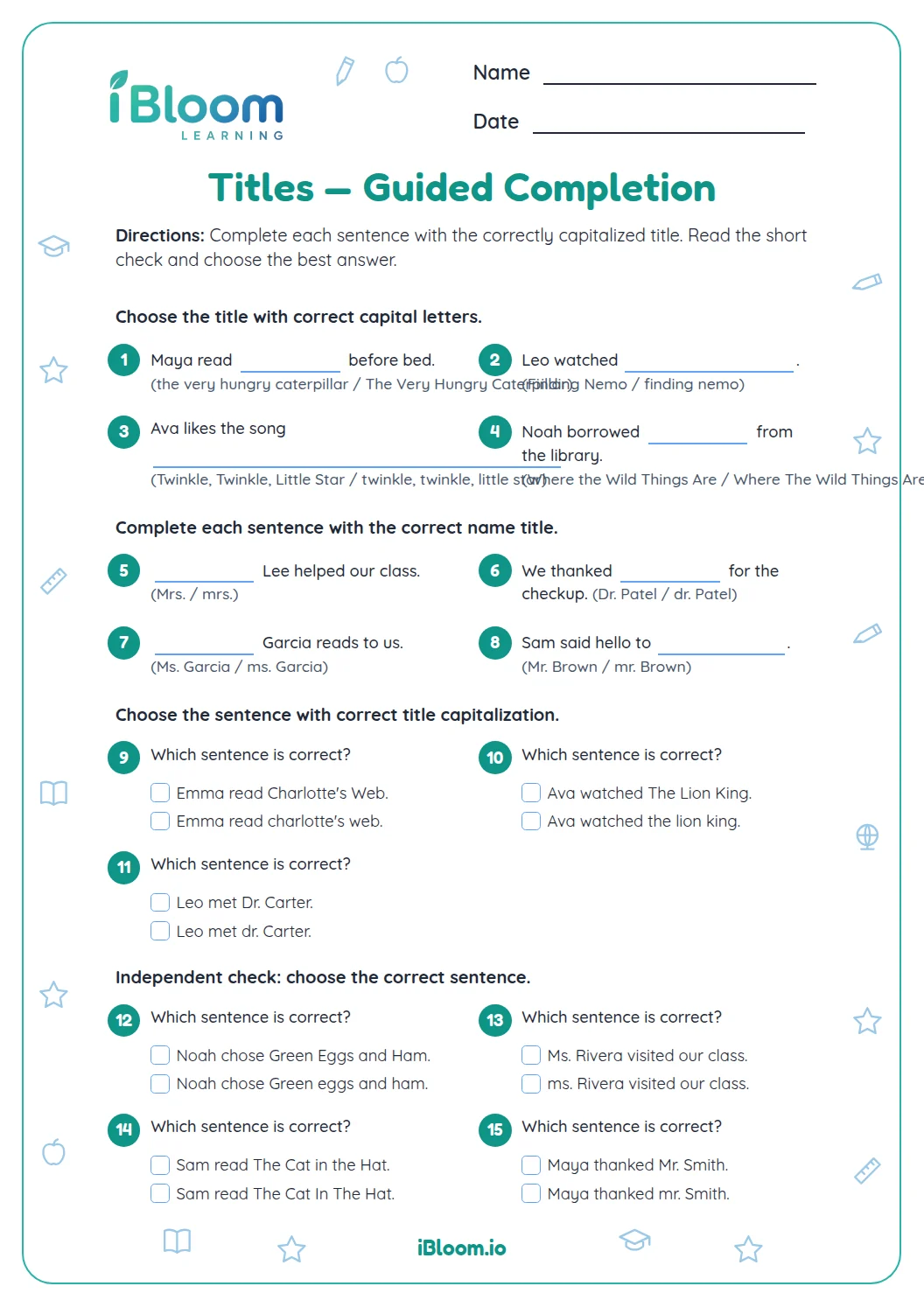
This free Grade 2 worksheet gives children 16 chances to capitalize place names in sentences. Part A asks them to choose a correctly capitalized sentence; Part B supplies a capitalized spelling for a blank; Part C asks them to edit or combine sentences. The separate answer key includes model responses for the writing items. The practice aligns with Common Core language standard L.2.2.
Aligned to L.2.2
Which words are part of a place name?
A specific name begins with capital letters: Dallas, Texas, Pine Street, and the Grand Canyon. A general word such as city or street stays lowercase when it is not part of the name.
How do children edit a sentence?
Read the entire sentence and look for names of people and places. Capitalize each word that belongs to the name, then reread the sentence.
- 1Rewrite: ava lives in denver.
- 2Ava and Denver are names, so capitalize their first letters.
- 3Answer: Ava lives in Denver.
What does each part practice?
Part A asks children to choose among sentence versions. Part B completes place-name spellings in sentence blanks. Part C asks for sentence edits and combinations.
How to use this worksheet
- 1Read the whole sentence before choosing an answer.
- 2Find the words that name one particular place.
- 3Capitalize every word that belongs to a multiword name.
- 4Complete the spelling choices in Part B.
- 5Reread each Part C sentence and check its names.
Common mistakes and quick fixes
The mistake
Capitalizing a general word such as city in every sentence.
The fix
Capitalize the name, as in Dallas, and leave city lowercase.
The mistake
Leaving one word in a multiword name lowercase.
The fix
Check the full name, as in Pine Street or Grand Canyon.
The mistake
Editing the place but missing a person’s name.
The fix
Reread the sentence and check every proper name.
Curriculum alignment
The worksheet gives children direct practice with this standard.
Capitalize proper nouns, including place names, in sentences.
On this sheet: The selection, completion, and editing questions all practice capitalization and sentence conventions.
Show the official wordingHide the official wording
Demonstrate command of the conventions of standard English capitalization, punctuation, and spelling when writing.
What to practice next
Make more practice
Further reading
Questions parents and teachers ask
Which place names need capitals?
Capitalize the names of particular places, such as Dallas, Texas, Canada, Pine Street, and the Grand Canyon. This page includes city, state, country, street, and landmark examples. General words such as city and street remain lowercase when they are not part of a name.
Does every word in a place name get a capital?
Capitalize the words that belong to the name, such as Pine Street and Grand Canyon. A general label can remain lowercase when it is not part of a proper name. In Part C, children practice these choices while rewriting sentences such as “we saw the grand canyon in arizona.”
What does Part A ask children to do?
Part A contains six multiple-choice questions. Children choose the correctly capitalized version of sentences about Dallas, Texas, Canada, Pine Street, Ohio, and Seattle. Each pair changes the capitalization, so children can focus on the place name while reading the whole sentence.
How does the answer key handle sentence writing?
The key supplies a correct model for each rewrite or combined sentence. For questions with more than one natural wording, it labels one response as a sample. Check that the child capitalized the names even if their sentence differs from the model.
Can a child use this worksheet independently?
Yes. Children can answer the choices and spelling blanks independently, then use the separate key to check their work. An adult can help by asking which words name a particular place and which words are only general labels, such as city or street.
How many questions and pages are included?
The printable includes 16 questions in three parts and a separate answer key. It fits on two worksheet pages, with a two-page key. Children choose sentence forms, complete place-name spellings, and correct short sentences. Review the answer key after each part.