






About this worksheet
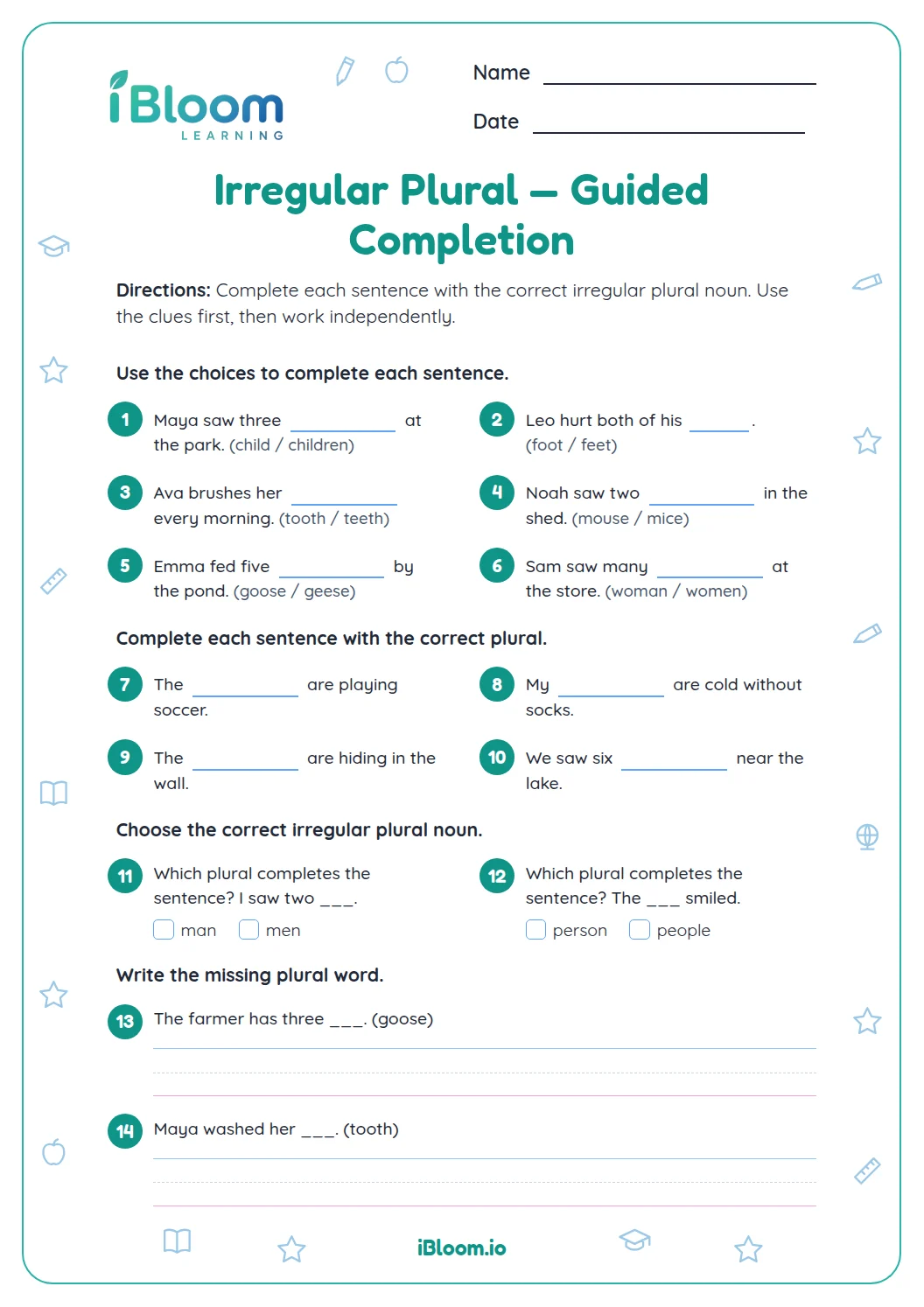
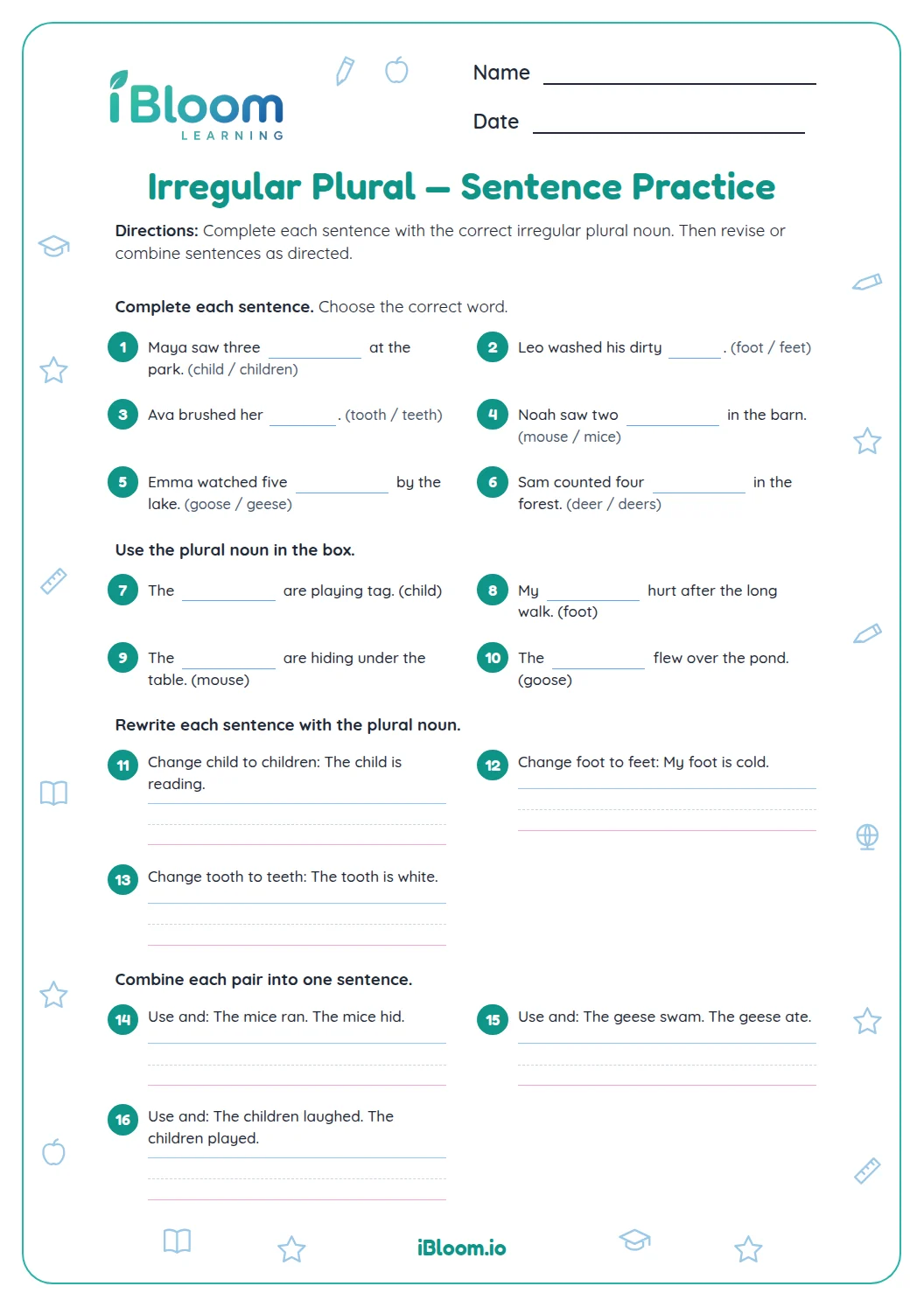
This free Grade 2 irregular plural nouns worksheet moves from form to use. Students complete eight sentence blanks, choose four irregular plural forms, and write two original sentences using children and mice. Examples include changes such as child to children and wolf to wolves. The practice supports CCSS L.2.1.b, which asks students to form and use frequently occurring irregular plural nouns. The answer key provides the forms and sample sentences.
Aligned to L.2.1.b
How do irregular plural nouns change?
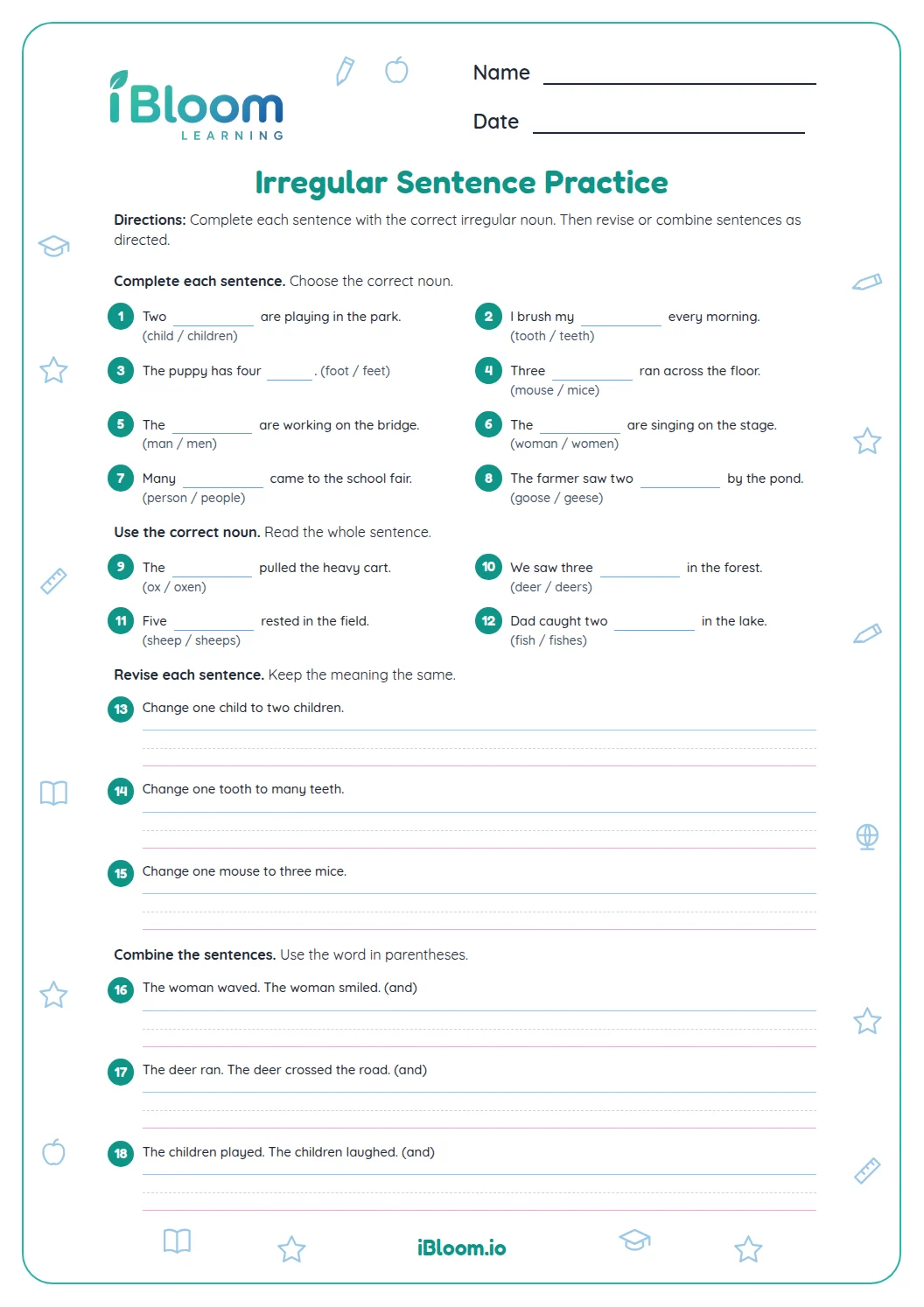
Part A has eight sentence blanks. Use the singular word in parentheses to choose its irregular plural. Some words change their vowel or ending, as child becomes children and mouse becomes mice.
Question 1 gives the clue “two,” so the plural form of child is needed.
- 1Two children played tag.
Which plural form fits the word?
Part B offers four choices with irregular forms that change their endings. Read both options, then select the form used for more than one.
For example, wolf changes to wolves and leaf changes to leaves; neither plural is made by adding s alone.
How can you use a plural noun in a sentence?
Part C asks for two original sentences using children and mice. Give the plural noun a clear role in the sentence, such as naming who acts or what is seen.
The key offers sample sentences, but students may use different details if the sentence is complete and the plural form is correct.
- 1The children built a tall block tower.
How to use this worksheet at home or in class
- 1Use the number clue in each sentence to identify a plural.
- 2Check the singular word in parentheses before filling the blank.
- 3Select the plural form that changes the word correctly in Part B.
- 4Use children and mice in complete original sentences.
- 5Compare forms with the key and accept other clear sentences.
Common mistakes and quick fixes
The mistake
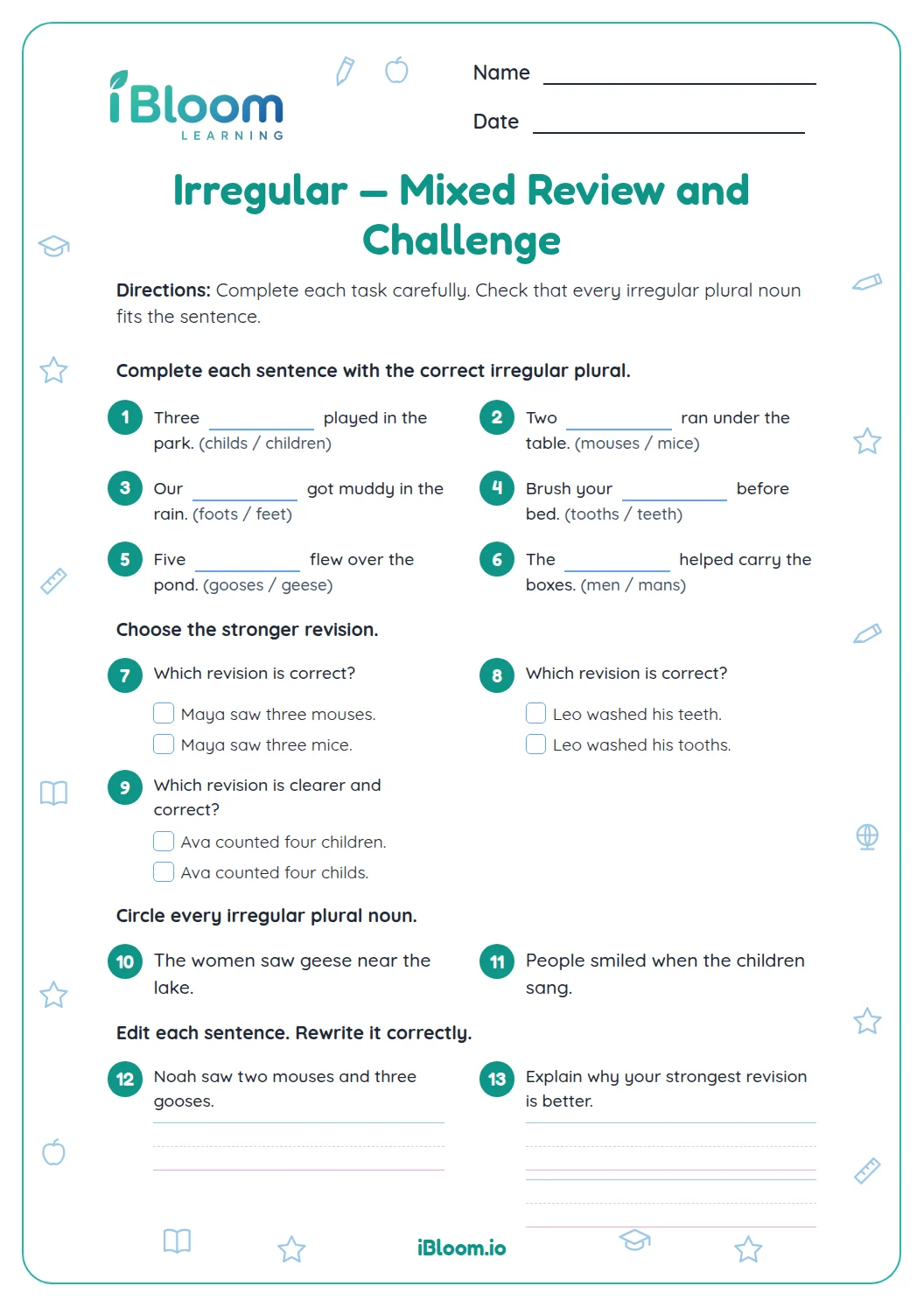
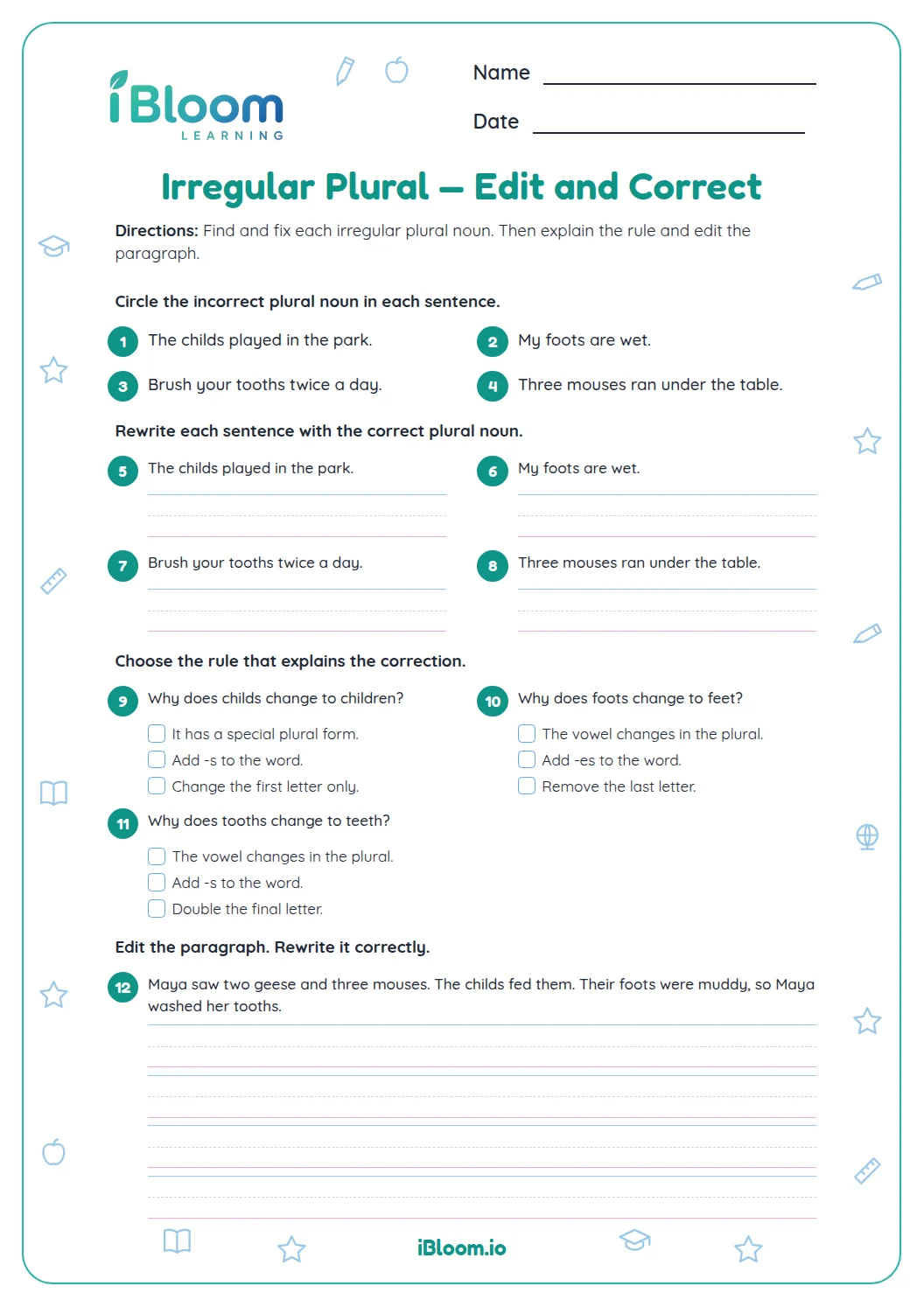
Writing childs instead of children.
The fix
Learn child and children together; this plural changes form rather than adding s.
The mistake
Adding s to wolf or leaf.
The fix
Recall that these words change to wolves and leaves.
The mistake
Using a singular form after a clue such as two or several.
The fix
Match the noun to the number clue and reread the sentence aloud.
Common Core alignment
Students form and use frequently occurring irregular plural nouns in short sentences.
Form and use common irregular plural nouns in sentence contexts.
On this sheet:
Show the official wordingHide the official wording
Form and use frequently occurring irregular plural nouns (e.g., feet, children, teeth, mice, fish).
What to practice next
Make more practice
Further reading
Questions parents and teachers ask
What is an irregular plural noun?
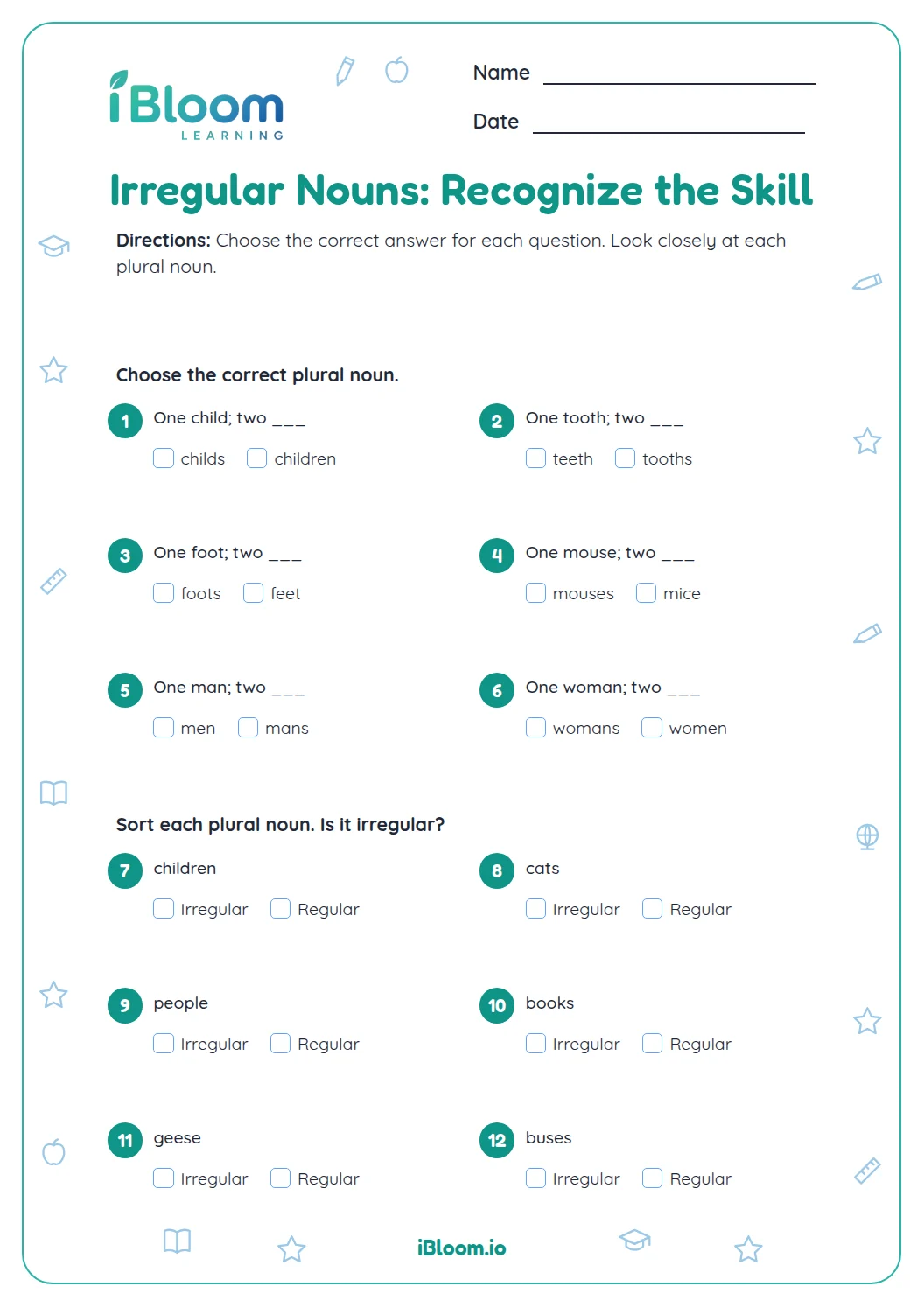
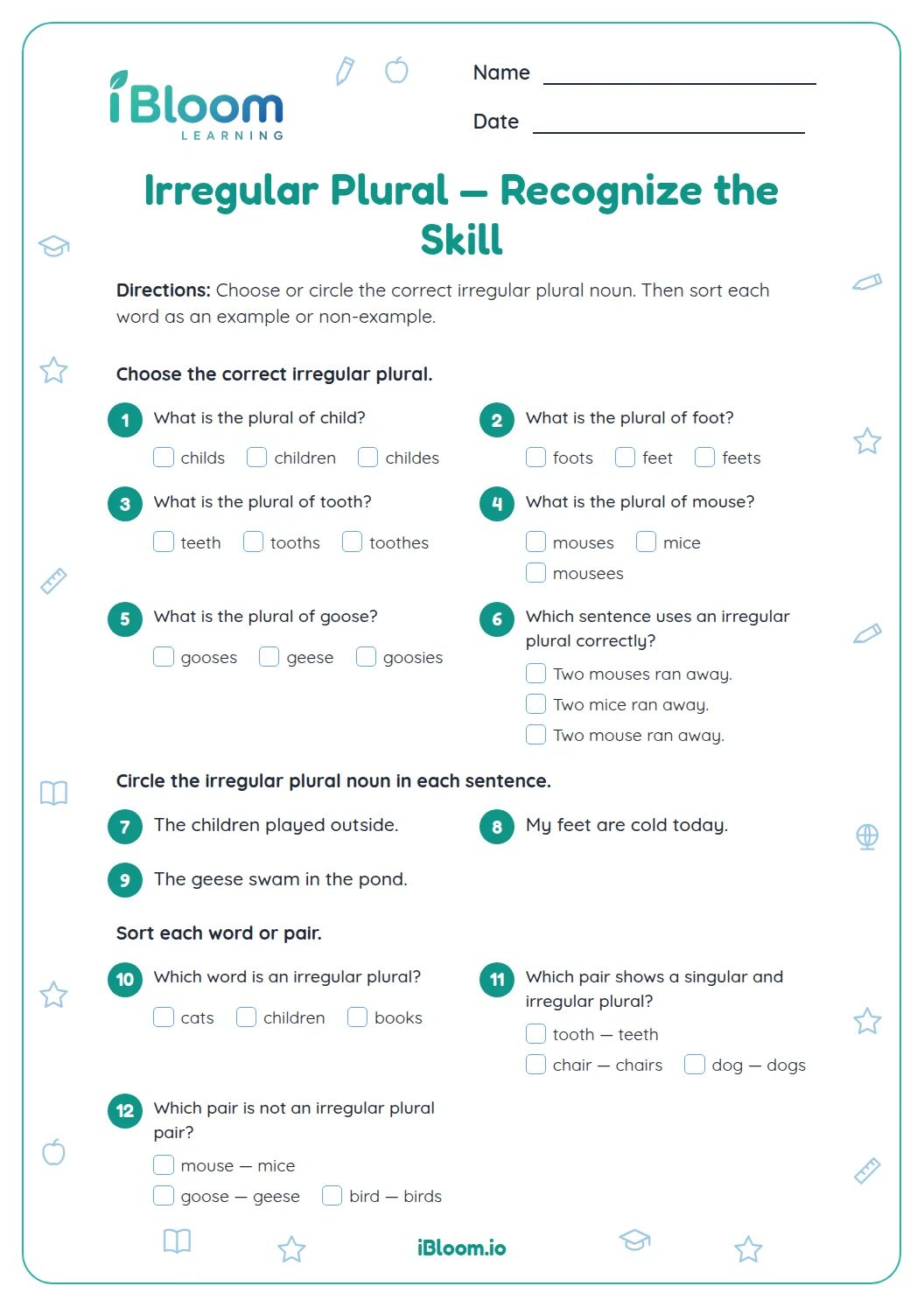
An irregular plural noun names more than one person, animal, or thing without simply adding s or es. Words such as child and mouse change to children and mice. Other examples, including tooth and goose, also change form when they name more than one.
Which irregular plural forms appear on the worksheet?
The page practices children, mice, teeth, geese, feet, people, men, women, wolves, and leaves. Students complete eight sentence blanks, choose four plural forms, and use children and mice in two original sentences. These forms appear across both the fill-in and choice sections.
Why does the worksheet include original sentences?
Writing a sentence helps students apply an irregular plural in context instead of only memorizing a word pair. The two prompts supply the plural noun to use. Students show that the noun can name several people or animals in a complete sentence.
Can a sentence differ from the answer key?
Yes. The key gives a sample sentence for each writing prompt, not the only possible response. Check that the sentence uses the requested plural noun correctly, reads as a complete thought, and makes sense. Details such as the setting or action may differ.
How can a child remember irregular plural forms?
Say the singular and plural together, then use them in a short phrase: one child, two children; one mouse, two mice. Reading the completed sentence aloud can also help a child hear whether the plural matches a clue such as “two” or “several.”