


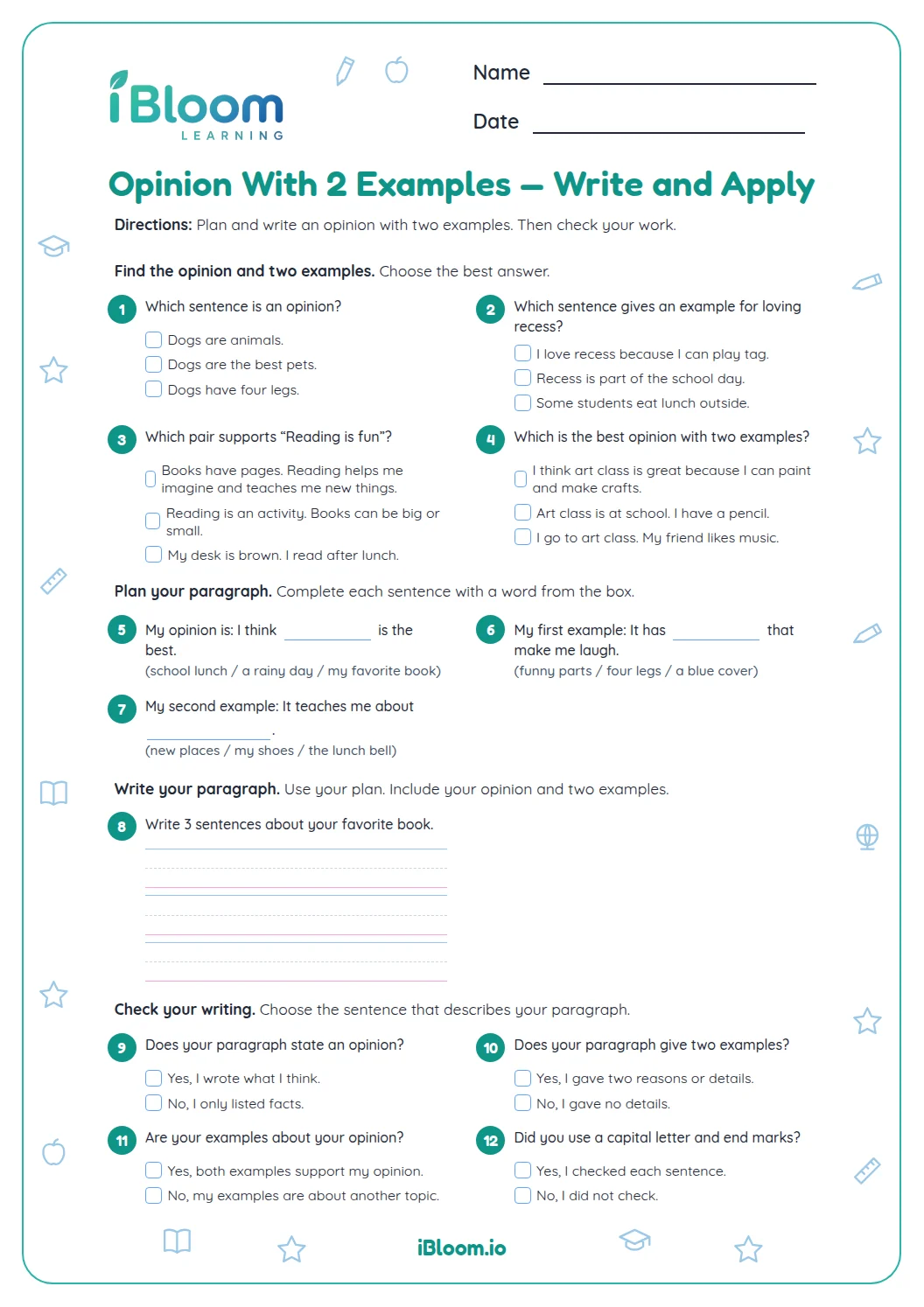
About this worksheet
This worksheet gives students focused practice with opinion writing. Questions move from identifying the skill to using it independently, with a separate answer key for checking.
Aligned to CCSS W.2.1
How to approach opinion writing
Read each question carefully and identify the skill it asks you to use. Work through the parts in order; later questions ask you to apply the same idea with less support.
Use the answer key to check your work. When an answer differs, return to the question and explain the rule or evidence that supports the correct response.
What is on this worksheet?
The printable includes 15 questions across several parts. It begins with recognition or guided practice and ends with independent application.
Print the worksheet pages for practice and keep the separate key nearby for review.
How to use this worksheet
- 1Read the one-sentence directions before starting.
- 2Complete each part in order and use the provided response space.
- 3Check the answer key and explain any corrections.
Common mistakes and quick fixes
The mistake
Rushing and overlooking a key word or detail.
The fix
Reread the full prompt and point to the clue that supports your answer.
The mistake
Changing an answer without checking the rule.
The fix
Use the skill named in the question to verify your choice.
Common Core alignment
This page supports the named skill at the listed grade level.
State an opinion, connect supporting reasons, and write a concluding statement.
On this sheet: Students identify opinions and reasons, practice linking ideas, and write an opinion with two examples and an ending.
Show the official wordingHide the official wording
Write opinion pieces in which they introduce the topic or book they are writing about, state an opinion, supply reasons that support the opinion, use linking words (e.g., because, and, also) to connect opinion and reasons, and provide a concluding statement or section.
What to practice next
Questions parents and teachers ask
What is an opinion paragraph?
An opinion paragraph tells what the writer thinks about a topic. It gives reasons or examples that help readers understand the opinion, then ends with a sentence that reminds readers of the main point. This worksheet practices building those parts one sentence at a time.
What counts as a supporting example?
A supporting example gives a specific reason, fact, or illustration connected to the opinion. For a claim about daily reading, learning new words and discovering information are two relevant examples. A detail about an unrelated classroom object does not support that claim.
How many examples should students include?
The target skill is an opinion supported by two examples. Students can state an opinion, add a first supporting example, add another distinct example, and write a closing sentence. Each example should connect clearly to the same opinion.
Can students have different answers?
Yes. The final writing questions allow several sensible responses, and the key gives examples rather than fixed wording. A complete response states an opinion, connects two examples to that opinion, and ends with a sentence that restates the writer’s point.