
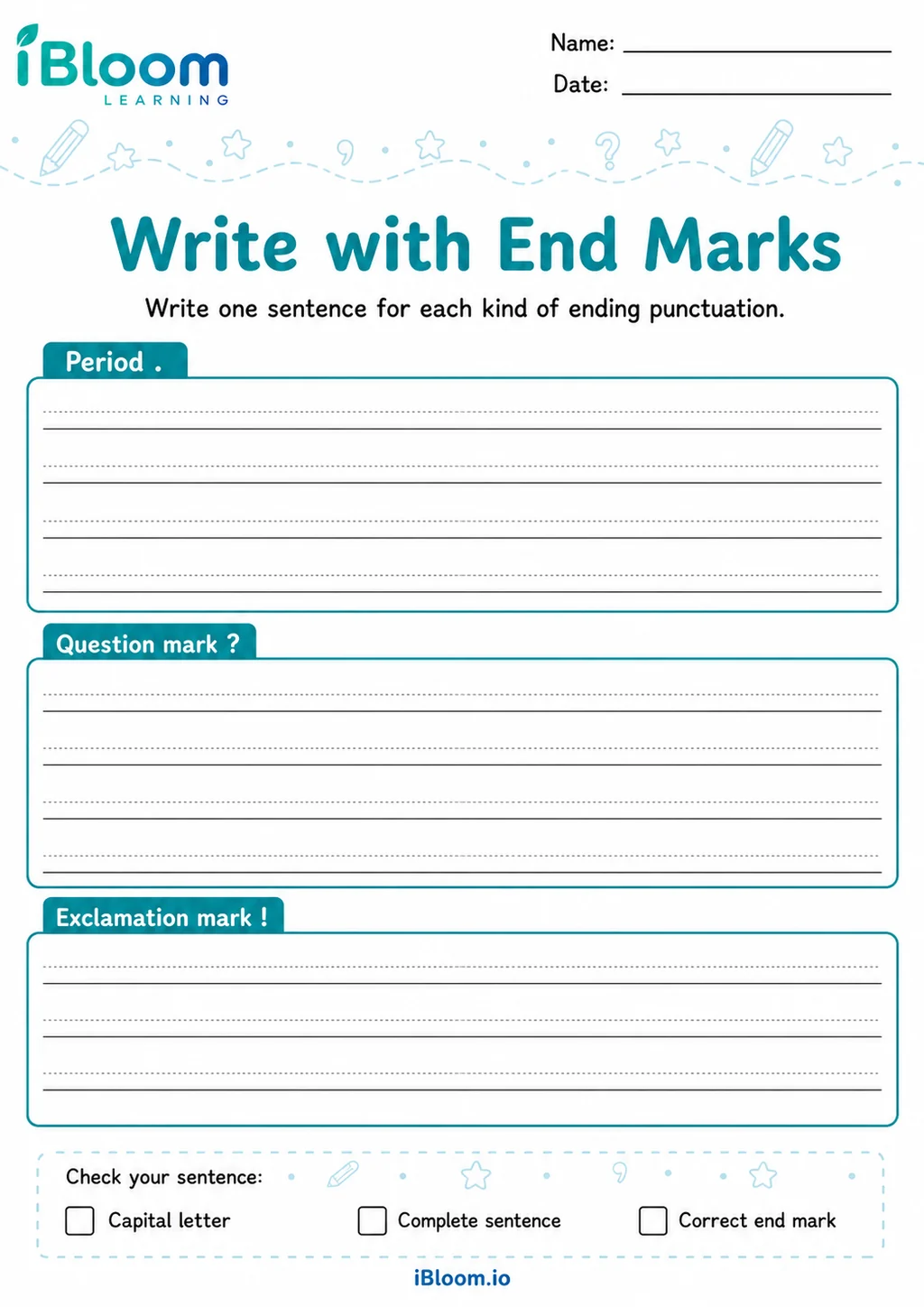
About this worksheet
This Grade 2 editing sheet has 16 sentences with an incorrect ending mark. Children read each sentence for meaning, then rewrite it with a period, question mark, or exclamation point. The separate key gives all corrected sentences. It practices the punctuation conventions in CCSS L.2.2.
Aligned to L.2.2
How can a sentence tell you which mark to use?
Read the whole sentence and decide whether it asks, tells, or expresses a strong feeling. Questions end with question marks, statements with periods, and strong exclamations with exclamation points.
For example, “Can I have a turn!” asks for something, so change its ending mark to a question mark. The exclamation point does not fit its purpose.
How to use this worksheet
- 1Read each sentence aloud and decide whether it asks, tells, or exclaims.
- 2Rewrite it with one correct ending mark.
- 3Check that the new mark matches the sentence meaning.
Common mistakes and quick fixes
The mistake
Choosing an exclamation point just because a sentence starts with “Wow.”
The fix
Read the whole thought. Use the exclamation point when the speaker expresses strong feeling.
The mistake
Leaving a question with a period.
The fix
Check whether the sentence asks something; if it does, end it with a question mark.
The mistake
Changing the sentence words while editing its end mark.
The fix
Keep the original words and correct only the final punctuation mark.
Curriculum alignment
This worksheet practices the skill named below.
Use standard English capitalization, punctuation, and spelling when writing.
On this sheet: Children correct sentence-final periods, question marks, and exclamation points.
Show the official wordingHide the official wording
Demonstrate command of the conventions of standard English capitalization, punctuation, and spelling when writing.
What to practice next
Questions parents and teachers ask
How many sentences does the worksheet include?
It includes 16 sentences across three parts. Each sentence has an ending mark that does not match its meaning. Children rewrite the sentence with the correct period, question mark, or exclamation point, then compare the complete corrected sentence with the separate answer key.
Which punctuation marks are practiced?
The worksheet practices periods, question marks, and exclamation points. The sentence wording supplies the clue: a question asks, a statement tells, and an exclamation expresses strong feeling or surprise. The learner should read the whole sentence before changing its ending mark.
Should children copy the whole sentence?
Yes. The worksheet directions ask children to rewrite each sentence with its corrected ending punctuation. Copying the words also gives them a chance to check capitals and spacing, while the answer key shows the corrected full sentence for comparison.
How can I explain a missed answer?
Ask the learner to read the sentence aloud and say whether it asks, tells, or exclaims. Then connect that purpose to its end mark. For example, “May I borrow your ruler” asks a question, so it needs a question mark rather than a period.
Can I use this as a short editing lesson?
Yes. Model one item by reading it aloud, naming its purpose, and rewriting its ending mark. Then have the learner try the remaining sentences independently or with a partner. Use the answer key afterward to review any sentence where the purpose was unclear.