
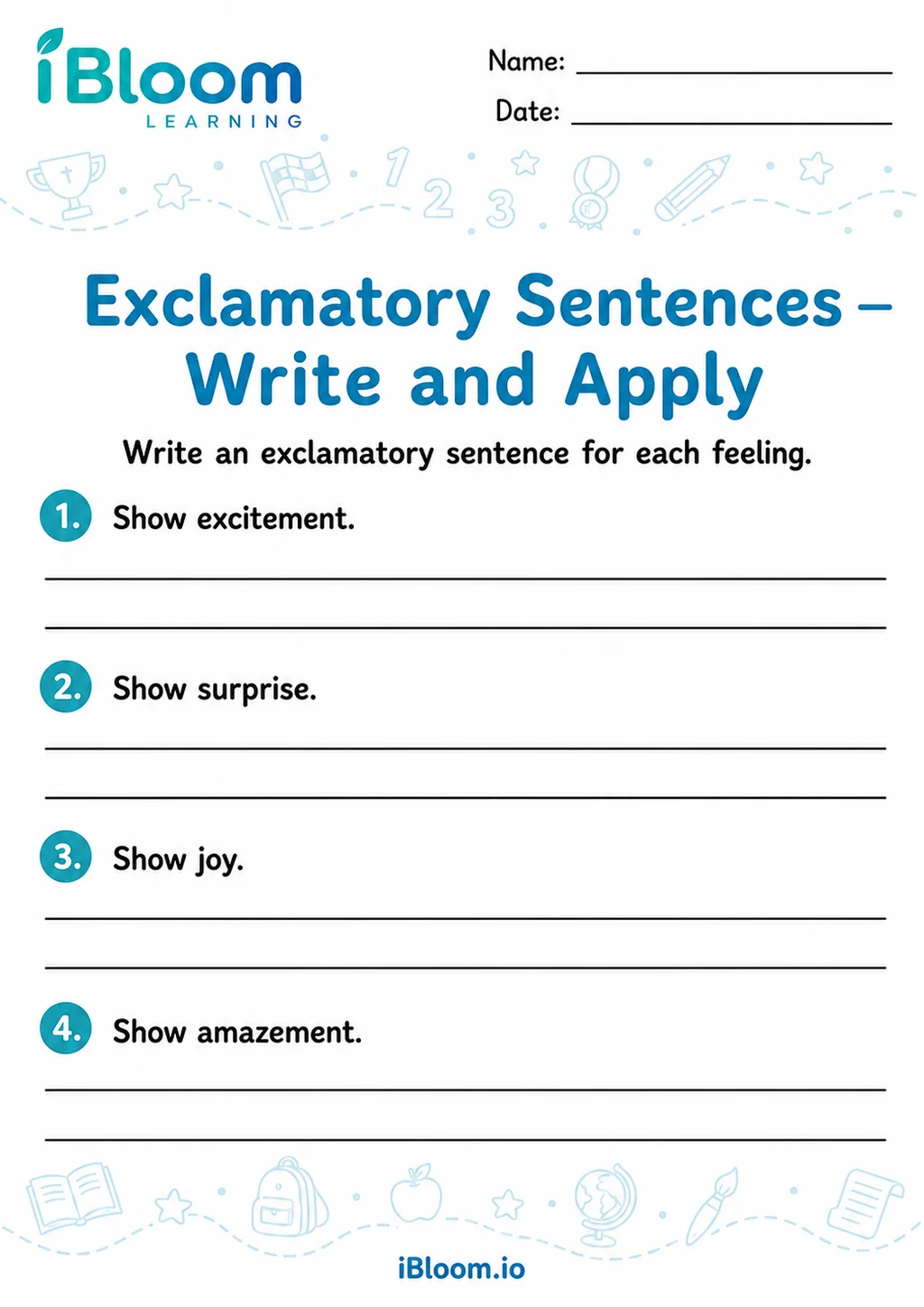
About this worksheet
This free printable Grade 2 worksheet gives children 14 ways to check an exclamatory sentence. Part A asks them to choose a correctly edited sentence. Part B has four sentences to rewrite with a capital letter and an exclamation mark. Part C adds names and the word I, so children check the middle of each sentence too. The practice supports Common Core L.2.2 through capitalization and punctuation in writing. Short sentences leave room to copy the whole corrected version. The separate answer key shows each choice and every complete correction.
Aligned to L.2.2
What makes these sentences exclamatory?
An exclamatory sentence expresses a strong feeling, such as surprise, joy or excitement. The exclamation mark tells the reader to hear that feeling. Read “What a great surprise!” aloud and let your voice match its meaning.
Every sentence on this worksheet is intended as an exclamation. Children focus on editing the supplied words, starting with a capital and using one exclamation mark at the end.
How can a child check both ends of a sentence?
Ask your child to touch the first letter and then the final mark before writing. Question 6 needs two changes: the lowercase i becomes I, and the question mark becomes an exclamation mark. The words between them stay in the same order.
- 1Original: i cannot believe it?
- 2Capitalize I: I cannot believe it?
- 3Replace the ending: I cannot believe it!
Which capitals belong inside an exclamation?
The names Mia, Ben and Sam need capitals wherever they appear. The word I also stays capitalized in the middle of a sentence. Question 12 makes that last check necessary: “What a fast runner I am!”
Part A has four questions, each with three edited versions to compare. Part B gives four start-and-end corrections. Part C gives six complete sentences to rewrite while checking names and I as well. Use the key after the child has checked both ends and the middle.
How to use this worksheet
- 1Read the directions and say one sentence with a surprised voice.
- 2Complete Part A by checking the first letter and the ending of each choice.
- 3Rewrite all four Part B sentences, keeping the original words.
- 4In Part C, underline each name and I before copying the correction.
- 5Compare with the key and explain each changed letter or punctuation mark.
Mistakes to check together
The mistake
Adding ! after the old mark, as in surprise.!
The fix
Replace the period or question mark with a single !.
The mistake
Fixing the start but leaving ben lowercase in question 10.
The fix
Check names throughout the sentence: Ben begins with B.
The mistake
Writing “What a fast runner i am!”
The fix
The word I needs a capital even in the middle of a sentence.
Curriculum alignment
Edit capitals and punctuation in complete exclamatory sentences.
On this sheet: Children select and write correctly capitalized sentences ending with exclamation marks.
Show the official wordingHide the official wording
Demonstrate command of the conventions of standard English capitalization, punctuation, and spelling when writing.
What to practice next
Make more practice
Further reading
Questions parents and teachers ask
Should my child rewrite the whole sentence?
Yes, Parts B and C ask for the whole corrected sentence. Copying the words gives children a chance to check the first capital, any names, the word I and the ending together. Part A uses choices, so children only mark the correctly edited version there.
Why does question 6 have a question mark to fix?
Question 6 is meant to express surprise, so its question mark must become an exclamation mark. The wording “I cannot believe it” expresses a reaction here. Have your child read it with a surprised voice, then check that the capital I is corrected as well.
Does every capital letter go at the start?
No, names and the word I also need capitals inside sentences. In question 10, Ben appears near the end. In question 12, I appears in the middle. Part C asks children to look through the whole sentence after they have checked its first letter.
Can my child add extra exclamation marks?
Use one exclamation mark for each correction on this sheet. It is enough to show the intended strong feeling. If your child writes two or three, ask them to keep one and check the capitalization next. This keeps attention on the complete sentence and its correct ending.
How should I use the answer key?
Use the key after your child has reread each corrected sentence. Check every capital and the final mark, rather than only looking for an exclamation mark. If one detail differs, ask your child to name the change and repair that sentence on the worksheet before moving on.