

About this worksheet
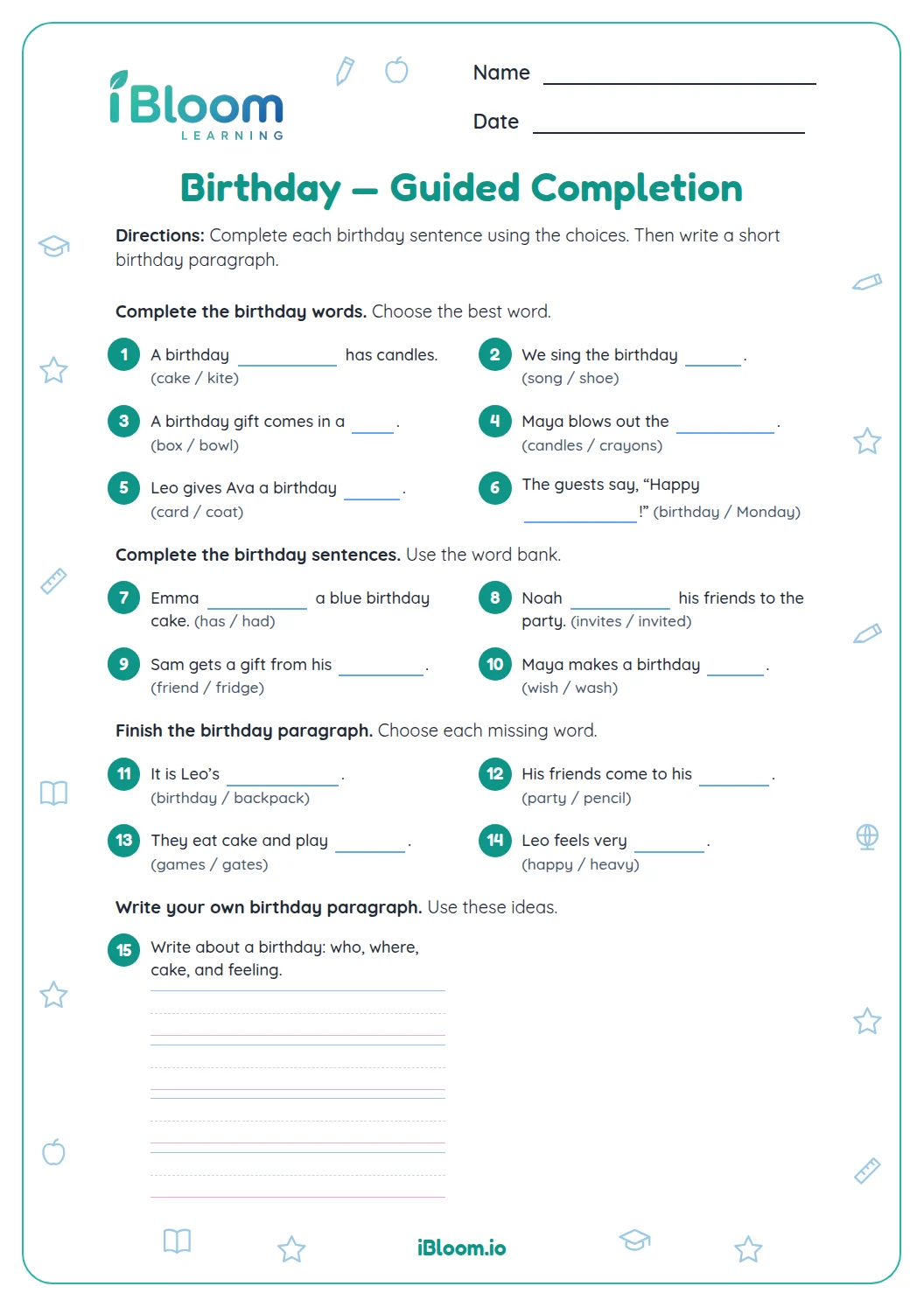
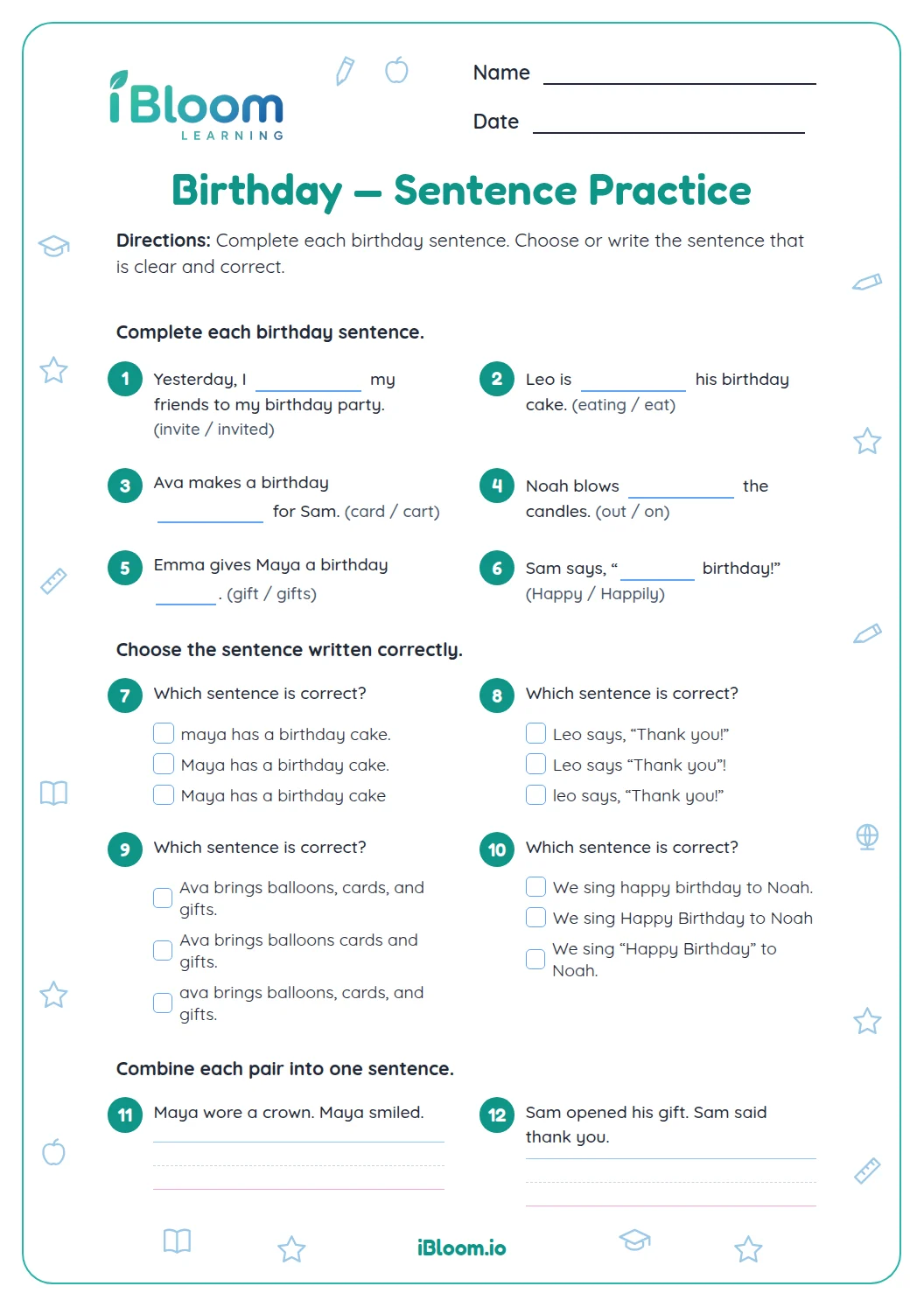
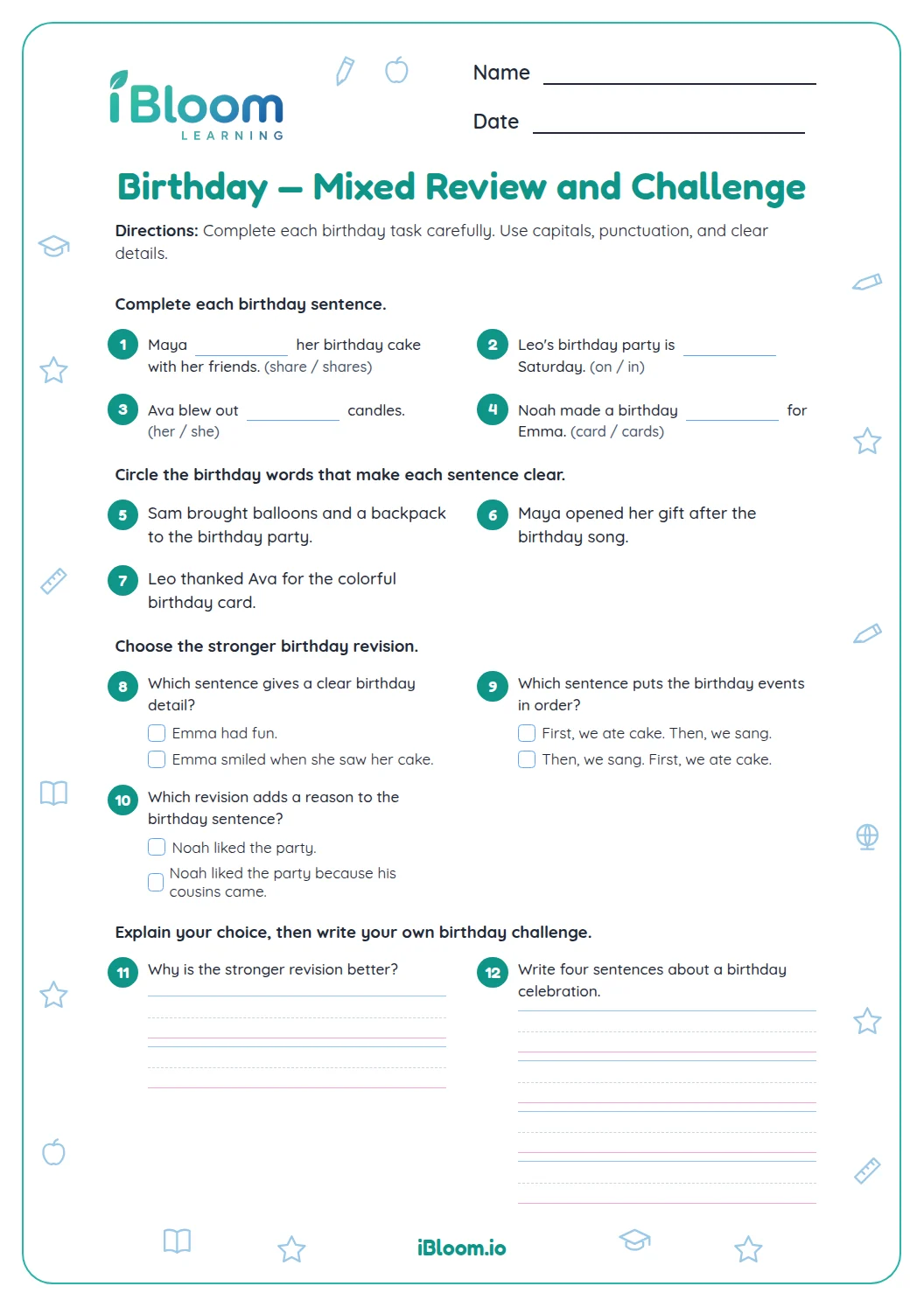
This printable Grade 2 worksheet gives learners focused birthday-themed proofreading practice. The 14 short questions ask them to correct capitalization, spelling, and end punctuation in familiar words and sentences. A separate answer key helps an adult review the edits.
Aligned to L.2.2
Which birthday words need capitals?
Capitalize the first word of a sentence, names of people, and names of days or months. The first part asks learners to correct one word at a time, such as changing “saturday” to “Saturday.”
- 1Original: saturday
- 2Corrected: Saturday
- 3A day name begins with a capital letter.
How can a quick edit improve a sentence?
Read each birthday sentence or word first, then make the specific edit named in the prompt. A question needs a question mark, while a strong exclamation needs an exclamation point. Check spelling when a familiar birthday word looks unusual.
What editing tasks are included?
The 14 items stay with birthday words and sentences. Learners correct capitalization, spelling, and end marks, then use the answer key to check each response.
- Questions 1–7 and 9–14 ask for capitalization or end-mark edits.
- Questions 8 and 12 correct birthday-word spelling.
- Each prompt asks for one short word or punctuation correction.
How to use this worksheet
- 1Read each birthday prompt carefully.
- 2Find the specific word or end mark it asks you to correct.
- 3Check whether a sentence begins with a capital or includes a name or day.
- 4Read a sentence to decide whether it tells, asks, or exclaims.
- 5Write the requested correction and check it with the answer key.
Common mistakes and quick fixes
The mistake
Capitalizing every word
The fix
Capitalize the sentence beginning and names, not ordinary words.
The mistake
Using a period after a question
The fix
Ask whether the sentence is asking something; if so, use a question mark.
The mistake
Forgetting to rewrite the whole sentence
The fix
Copy the full sentence so each correction is easy to check.
Common Core alignment
Learners edit birthday words and sentence endings using standard capitalization, spelling, and punctuation.
Use standard capitalization, punctuation, and spelling when writing.
On this sheet: Learners correct capitalization, spelling, and sentence-ending punctuation.
Show the official wordingHide the official wording
Demonstrate command of the conventions of standard English capitalization, punctuation, and spelling when writing.
What to practice next
Further reading
Questions parents and teachers ask
What should be capitalized in a sentence?
Capitalize the first word of a sentence and specific names, including people, days, and months. Question 1 asks learners to change “saturday” to “Saturday.” The worksheet keeps each correction short so attention can stay on the editing rule.
How do I choose a period or question mark?
Use a period for a statement and a question mark for a question. Read the words to hear whether someone is asking something. “Did you bring a card?” asks a question, while “We sang to Mia.” tells what happened.
What kinds of errors does this sheet ask learners to fix?
The birthday words include capitalization errors, misspellings, and missing end marks. Learners make one short correction at a time, such as changing “ballon” to “balloon” or adding a question mark to a question. Learners check one clearly identified error in each item.
Should learners rewrite the full sentence?
Each prompt asks for one focused correction, such as a capital letter, a spelling fix, or an end mark. Learners write only the requested word or punctuation mark. This keeps attention on the editing choice before they compare the response with the answer key.
How many questions and pages are included?
There are 14 questions across two worksheet pages and a separate answer key. The items focus on birthday-related words and sentence endings, with short corrections for capitalization, spelling, and punctuation. The key gives the matching correction for each item so the work can be checked quickly.
How can an adult help without correcting the sentence for the child?
Ask the learner to point to the first word, any names, and the sentence’s end. Then ask whether it tells, asks, or exclaims. These prompts help the child locate the editing choices before checking the corrected sentence in the key.