
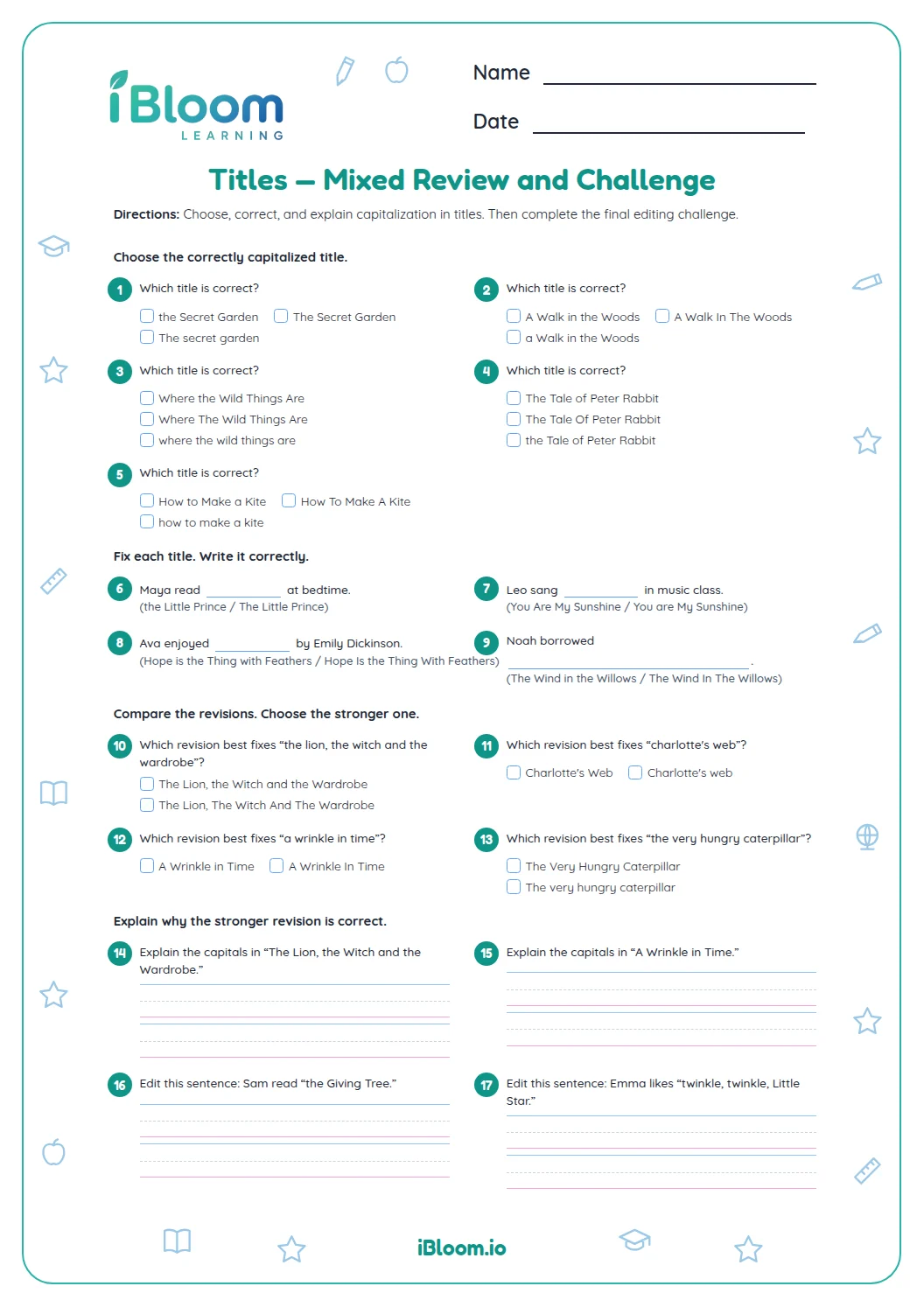
About this worksheet
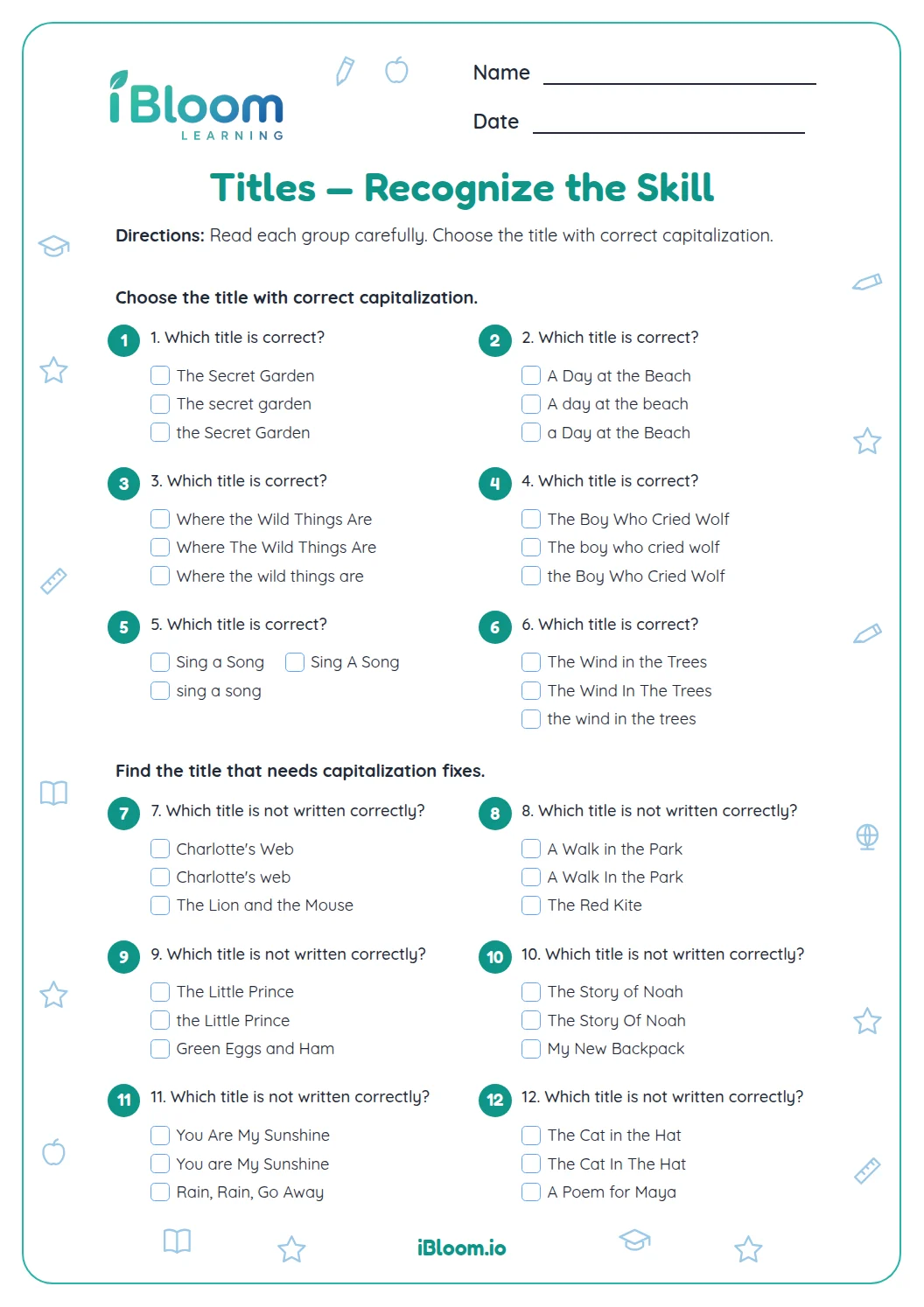
What capitalization skill does this worksheet teach?
Aligned to L.3.2
What skill does this page practice?
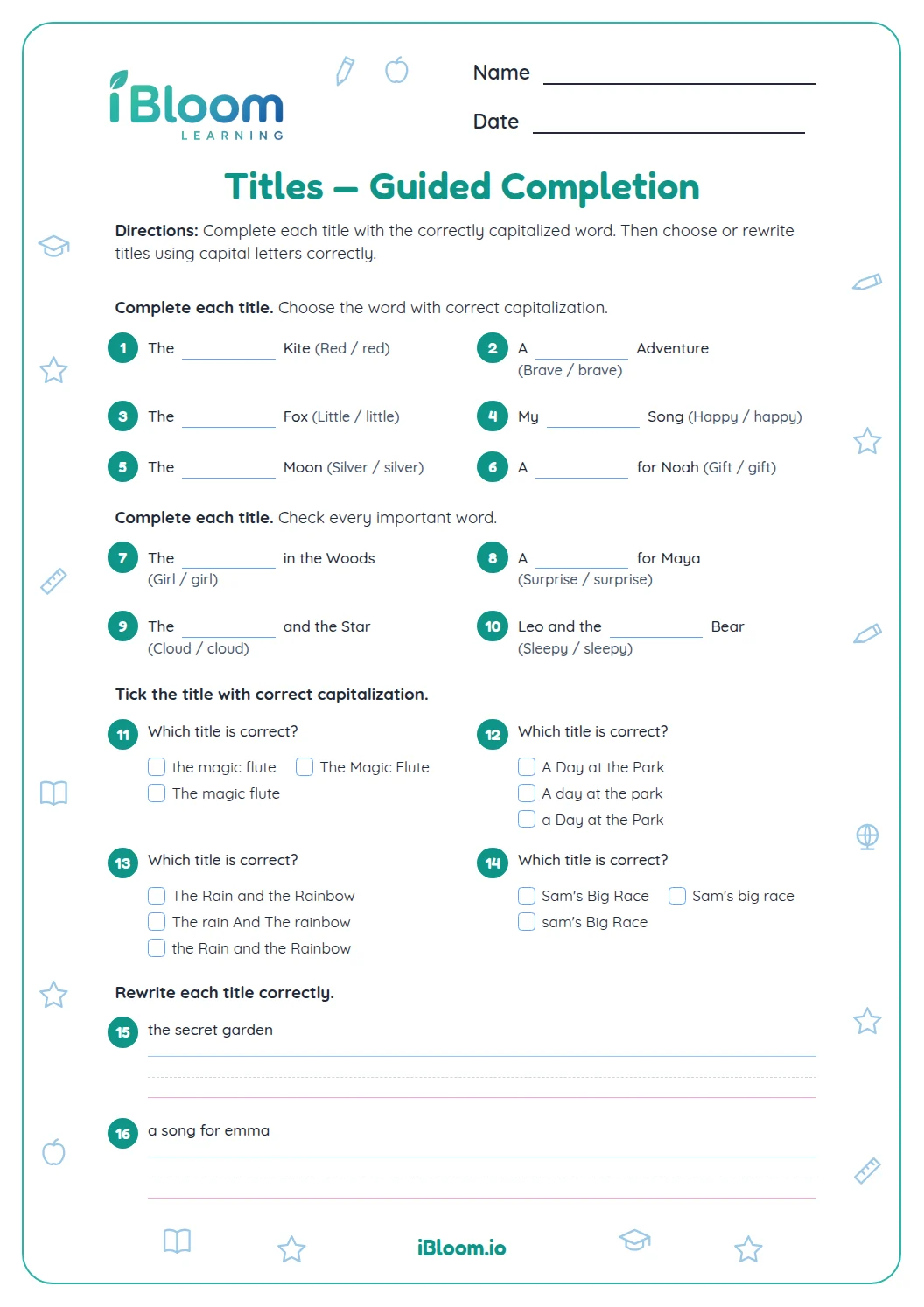
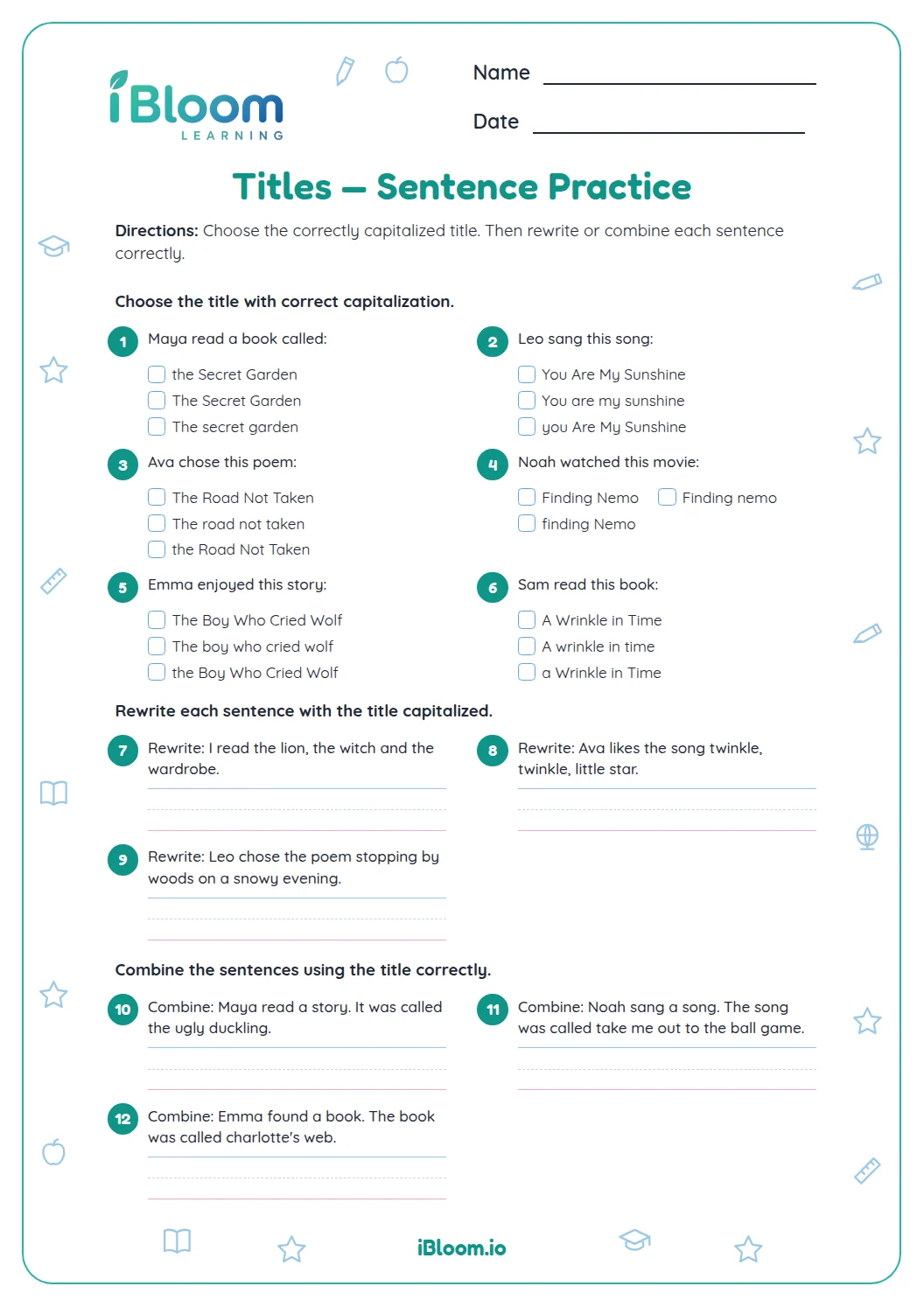
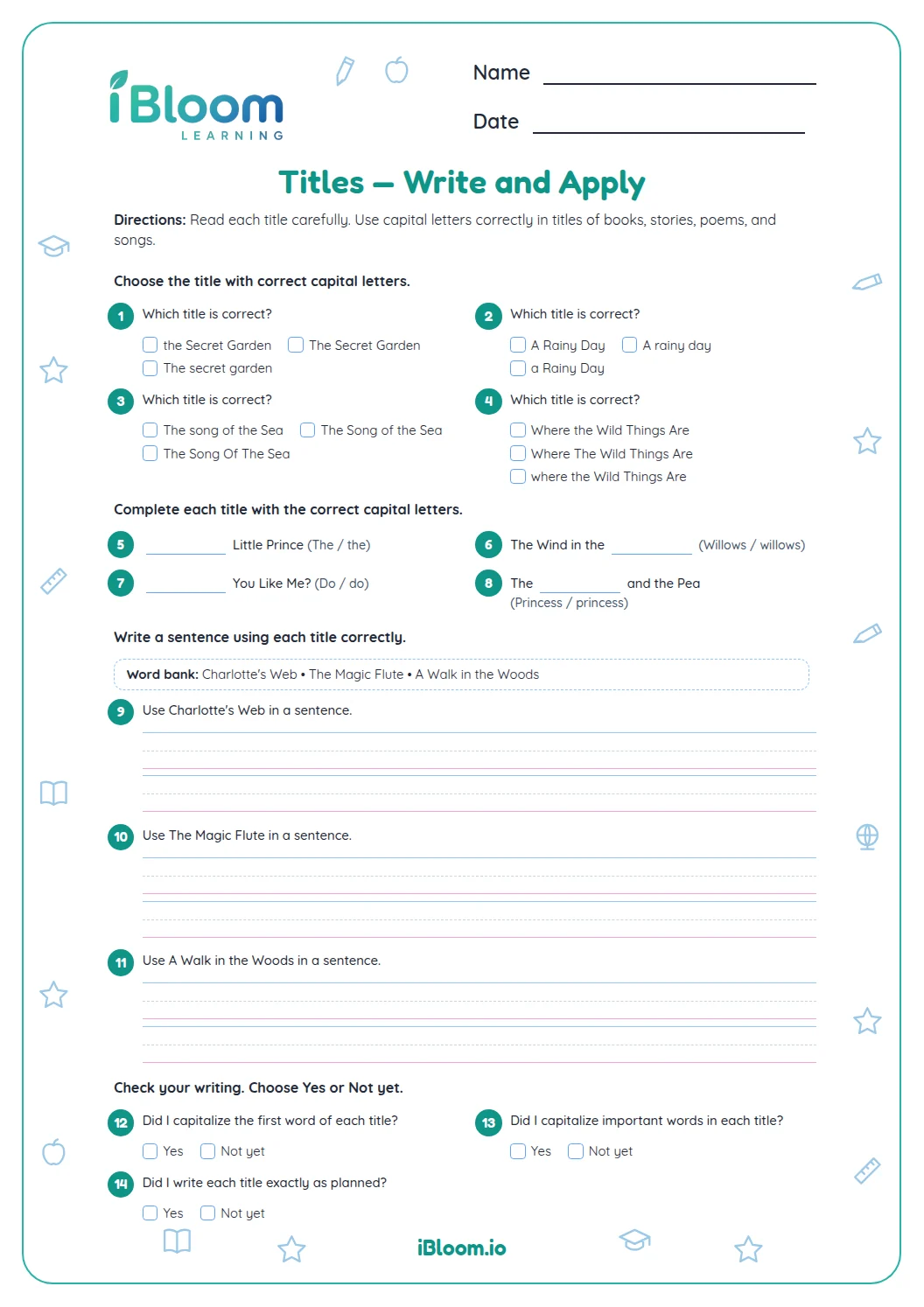
Edit book titles by capitalizing the first and last words and the important words between them. Keep short articles, conjunctions, and prepositions lowercase unless they begin or end a title; capitalize names.
Try the worked example with a pencil, then use the same check on the practice items.
- 1the little red hen
- 2The Little Red Hen
- 3Capitalize the first and last words and important words; keep “the” lowercase only when it is not first.
How is the practice organized?
Rewrite each title in title case. Items include short connecting words and proper names, so children must apply the capitalization rule across varied titles.
How can families check the work?
Use the key after completing a part. Ask the learner to point to the clue, equation, or spelling decision that supports one answer.
How to use this worksheet
- 1Read the entire title first.
- 2Capitalize the first and last words.
- 3Capitalize nouns, verbs, adjectives, adverbs, pronouns, and proper names.
- 4Keep short articles, conjunctions, and prepositions lowercase in the middle.
- 5Reread the title and compare it with the key.
Common mistakes and quick fixes
The mistake
Capitalizing every short word.
The fix
Keep short articles, conjunctions, and prepositions lowercase in the middle.
The mistake
Leaving a proper name lowercase.
The fix
Capitalize names such as Max, Clara Barton, and Lake Erie.
The mistake
Lowercasing the first word because it is usually an article.
The fix
Always capitalize the first word of a title.
Common Core alignment
This worksheet practices the following Common Core skill.
Capitalize appropriate words when writing titles.
On this sheet: The questions directly ask learners to apply this skill.
Show the official wordingHide the official wording
Demonstrate command of the conventions of standard English capitalization, punctuation, and spelling when writing.
What to practice next
Make more practice
Further reading
Questions parents and teachers ask
Which words should be capitalized in a title?
Capitalize the first and last words, important words such as nouns and verbs, and proper names. Keep short articles, conjunctions, and prepositions lowercase when they appear in the middle of a title. For example, “at” stays lowercase in the middle of “A Day at the Beach.”
Are names capitalized in these titles?
Yes. Names such as Max, Clara Barton, and Lake Erie keep their proper capitalization inside a title. A title rule does not make a proper name lowercase. In “A Picnic for Max,” capitalize Max because it is a person’s name.
How many titles does the worksheet include?
There are 16 titles to edit across three worksheet pages. The three-page answer key gives a corrected version for each title. The answer pages show the corrected title forms for every practice item. A separate key page corresponds to each practice page.
Why are some small words lowercase?
Short articles, conjunctions, and prepositions are usually lowercase in the middle of a title. The first and last words are capitalized even when they are short, so check where each word appears. Words such as “and” stay lowercase in the middle, but capitalize if first or last.
How can a child check an edited title?
Read the title from beginning to end and check the first and last words, important words, and names. Then look for short connecting words in the middle that should stay lowercase. This reread catches both lowercase connector words and missing capitals in names.