


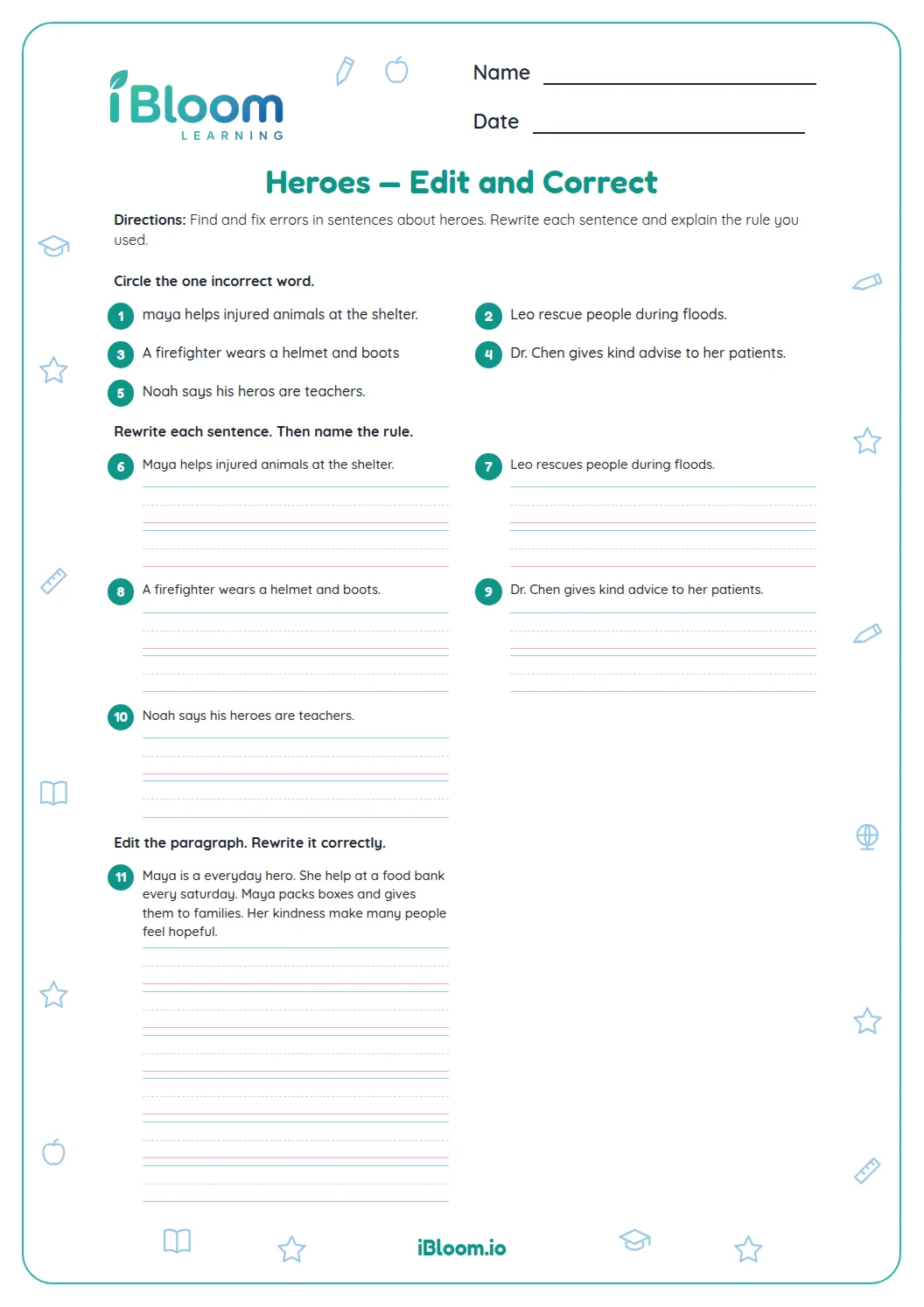

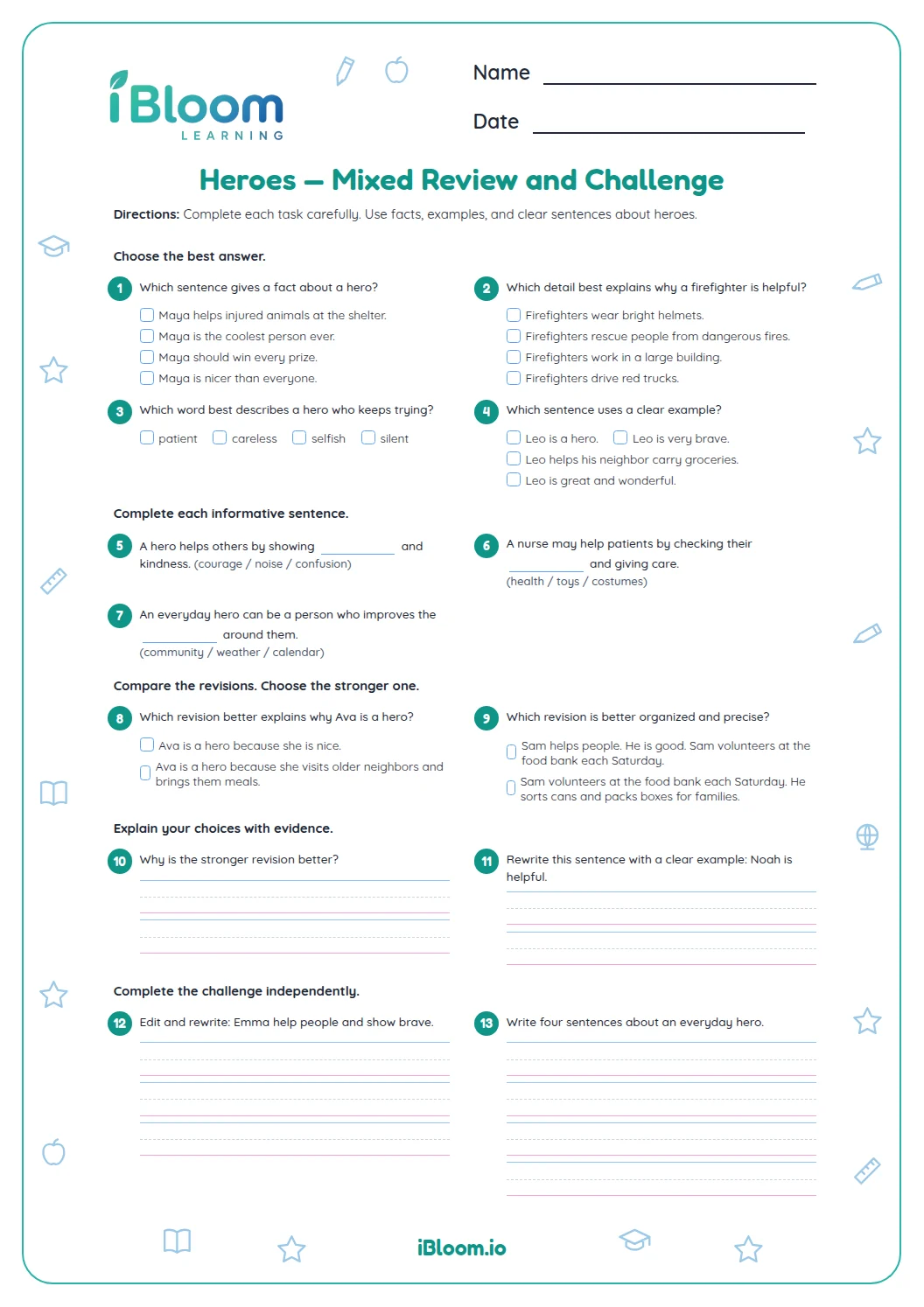
About this worksheet
Students complete short writing tasks about community heroes, from a crossing guard and school nurse to helpful neighbors. The prompts move from naming a useful action to supporting a main idea with a fact, explanation and closing sentence. Model answers are included, but students may write other accurate responses. The work supports CCSS W.3.2 by asking writers to convey information clearly with relevant details.
Aligned to W.3.2
What do students write about?
The prompts use familiar community roles to practice informative writing. Students state how a person helps, add a supporting fact, explain why the work matters and write a closing sentence.
- Part A: complete focused sentences about helpers.
- Part B: add facts and explanations.
- Part C: plan and complete short informative ideas.
How can a writer support an idea?
A fact gives a specific piece of information. An explanation connects that fact to the main point. For example, “A school nurse checks students who feel sick” is a fact; “Students can get care and return to class” explains its value.
How to use this worksheet
- 1Read each prompt and write one complete sentence or a short completion.
- 2Use the sample key to check that your response answers the prompt; your wording can differ.
- 3For fact-and-explanation prompts, underline the fact and the words that explain its importance.
- 4Choose one helper and combine two of your answers into a short paragraph.
Common mistakes and quick fixes
The mistake
Writing only “She helps people” without naming the helper’s action.
The fix
Add a concrete action, such as checking students who feel sick or helping children cross.
The mistake
Listing a fact but not connecting it to the topic.
The fix
Add a sentence beginning “This helps because…” and explain the effect.
Common Core alignment
The prompts practice Grade 3 informative writing through clear ideas and relevant details.
Write informative texts that explain a topic with facts and a concluding statement.
On this sheet: Students complete topic sentences, add facts and explanations, and write a closing sentence about community helpers.
Show the official wordingHide the official wording
Write informative/explanatory texts to examine a topic and convey ideas and information clearly.
What to practice next
Make more practice
Further reading
Questions parents and teachers ask
Can students give answers that differ from the answer key?
Yes. The key gives sample responses because students may name different community helpers or use different wording. A response is successful when it answers the prompt, names a clear action or fact, and explains how that detail supports the main idea.
What does informative writing do?
Informative writing teaches readers about a topic. A writer introduces the subject, groups related information, adds facts or details, connects ideas, and provides a closing statement. These prompts practice those moves with familiar people who help a school or neighborhood.
How can a student make a response more specific?
Replace a general statement such as “she helps people” with a concrete action. For example, a crossing guard helps children cross a busy street. Then add a sentence explaining how that action helps the community. A concrete detail makes the idea easier for readers to picture.
How can families extend this writing practice?
Ask the student to interview a real community helper, with permission, or recall someone who has helped them. They can combine a topic sentence, one fact, an explanation, and a closing sentence into a short informative paragraph. This gives the paragraph a clear beginning, middle, and ending.
What makes a detail useful in informative writing?
A useful detail gives the reader information about the topic. On this sheet, students connect community helpers with actions such as guiding children safely or keeping a park clean. Ask what the action tells us about the helper’s work, then add that fact to the paragraph.