


About this worksheet
The questions use familiar Earth topics—water, trees, recycling, habitats, and clean air—to help Grade 4 writers recognize what each sentence contributes to an informative paragraph. Students choose a strong topic sentence, sort facts from opinions, and select details that actually support the topic. The page replaces the old generic sentence-choice activity with fourteen focused writing decisions.
Aligned to W.4.2.a and W.4.2.b
What makes a sentence useful in informative writing?
A topic sentence tells the paragraph’s main point. The other sentences should explain it with checkable facts, definitions, examples, or details. An opinion may be interesting, but it cannot prove a factual point.
For example, “People can save water at home in several ways” introduces a main idea. A detail about turning off the faucet fits; a sentence about salty oceans does not.
How do I choose a supporting detail?
First name the paragraph topic in a few words. Then ask whether the detail gives information about that topic and whether a reader could check it. Questions 7, 9, and 12 practice this test with clean air, wetlands, and soil.
How can I keep an informative prompt focused?
Name the Earth topic first, then ask for facts that explain it. A prompt about Earth’s rotation stays focused when it asks how rotation causes day and night.
How to use this worksheet
- 1Read the question and identify its Earth topic.
- 2Choose facts that can be checked, not personal judgments.
- 3For a prompt, decide whether it asks for information or an opinion.
- 4Compare each short response with the key’s main idea.
Common mistakes and quick fixes
The mistake
Choosing an opinion because it sounds convincing.
The fix
Ask whether evidence could verify the statement.
The mistake
Adding a true fact that does not fit the topic.
The fix
Name the paragraph topic and check that the detail explains it.
The mistake
Writing a prompt that asks for a preference.
The fix
Use a question that invites facts or an explanation.
Common Core alignment
This page practices the Grade 4 work of organizing informative writing and choosing relevant facts and details.
Introduce a topic and group related information.
On this sheet: Questions 2, 8, and 11 distinguish a main idea or ending from supporting information.
Show the official wordingHide the official wording
Introduce a topic clearly and group related information in paragraphs and sections.
Develop a topic with facts, definitions, details, and examples.
On this sheet: Questions ask students to recognize factual, defining, explanatory, and example details.
Show the official wordingHide the official wording
Develop the topic with facts, definitions, concrete details, quotations, or other information and examples related to the topic.
What to practice next
Make more practice
Further reading
Questions parents and teachers ask
What does this Earth worksheet ask students to do?
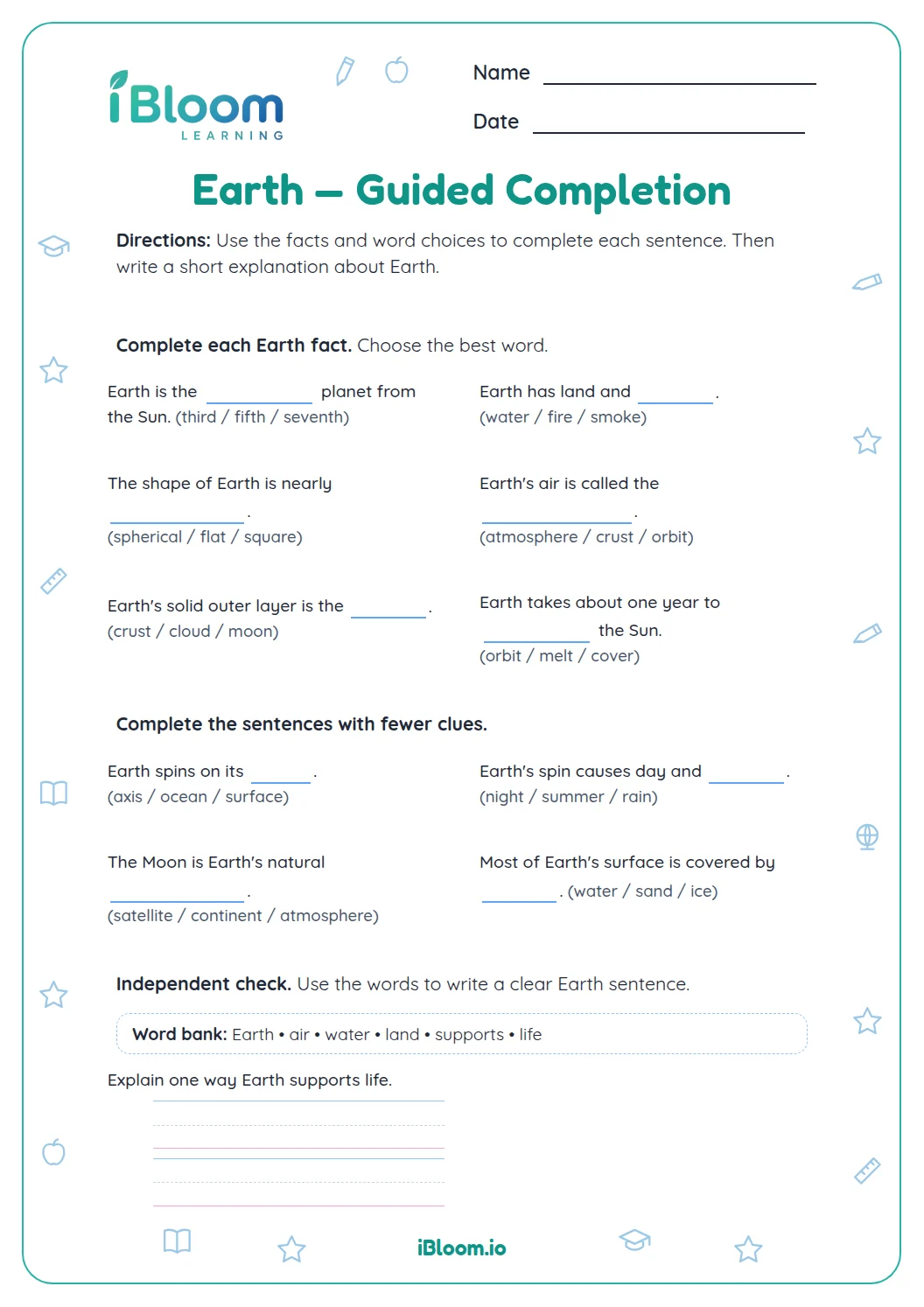
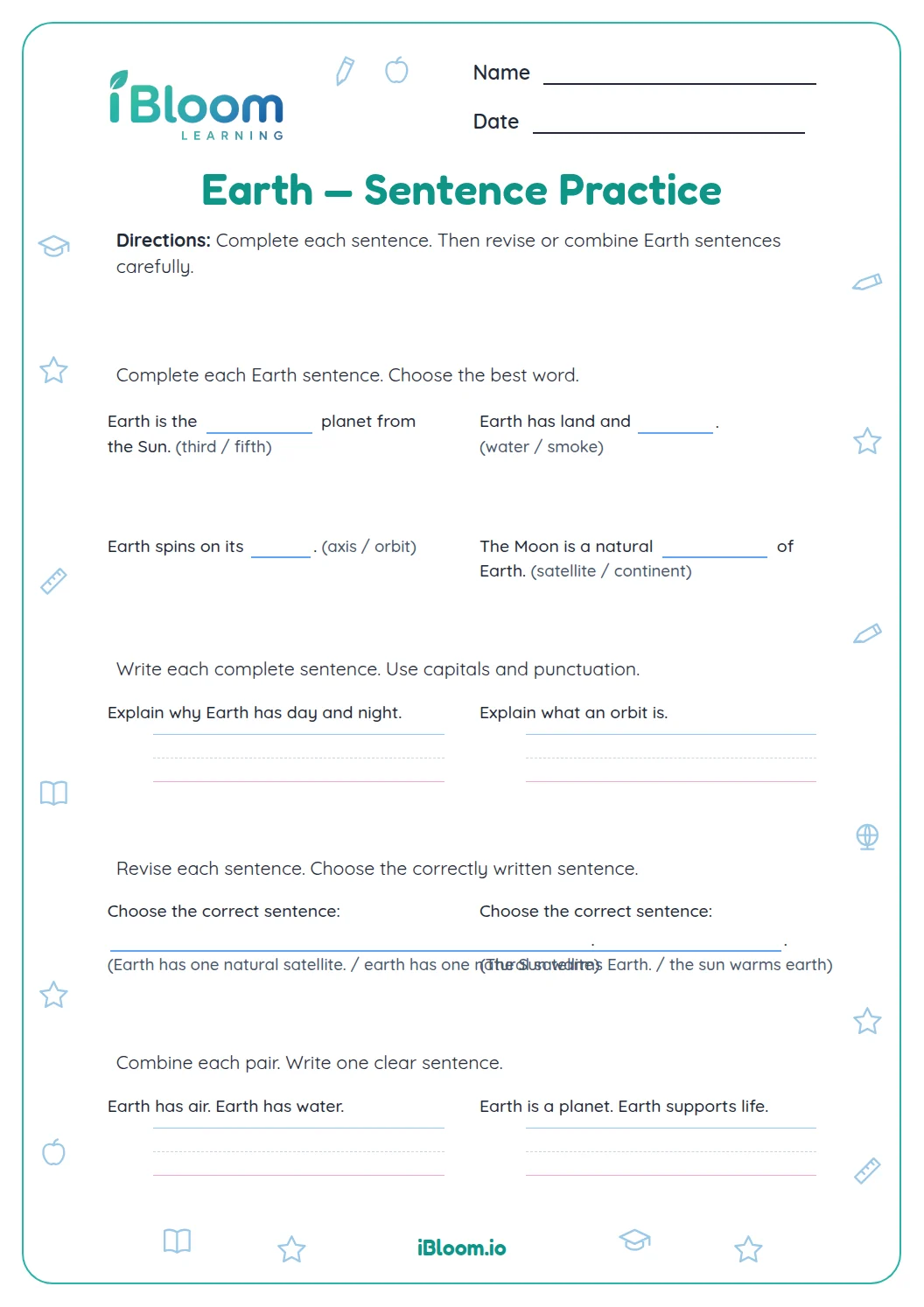
Students identify Earth facts, definitions, explanations, and focused informative prompts. The fourteen questions use topics such as the planet’s movement, atmosphere, and layers. The key includes the intended response for each item; for short responses, accept accurate wording that explains the requested Earth fact.
How can a student tell a fact from an opinion?
A fact can be checked with evidence, while an opinion expresses a personal judgment. “Earth orbits the Sun” can be verified; calling Earth the best planet depends on someone’s view. Have the student name what evidence could confirm each factual choice.
What is an informative prompt?
An informative prompt asks the writer to explain or describe a topic with accurate information. On this page, prompts ask about Earth’s land, water, atmosphere, rotation, and layers. A prompt asking which planet is best invites a preference instead of an explanation.
How should we check the short responses?
Compare the response with the key’s main idea, not just its exact wording. A correct answer should stay on the named Earth topic and include the requested fact or explanation. If it is incomplete, ask the student which detail would make the explanation clearer.
Can we extend the practice after the page?
Choose one Earth topic from the questions and have the student write a focused topic sentence followed by two accurate details. Then check that both details explain the same topic. The activity carries the page’s focus-and-support practice into a short paragraph.