



About this worksheet
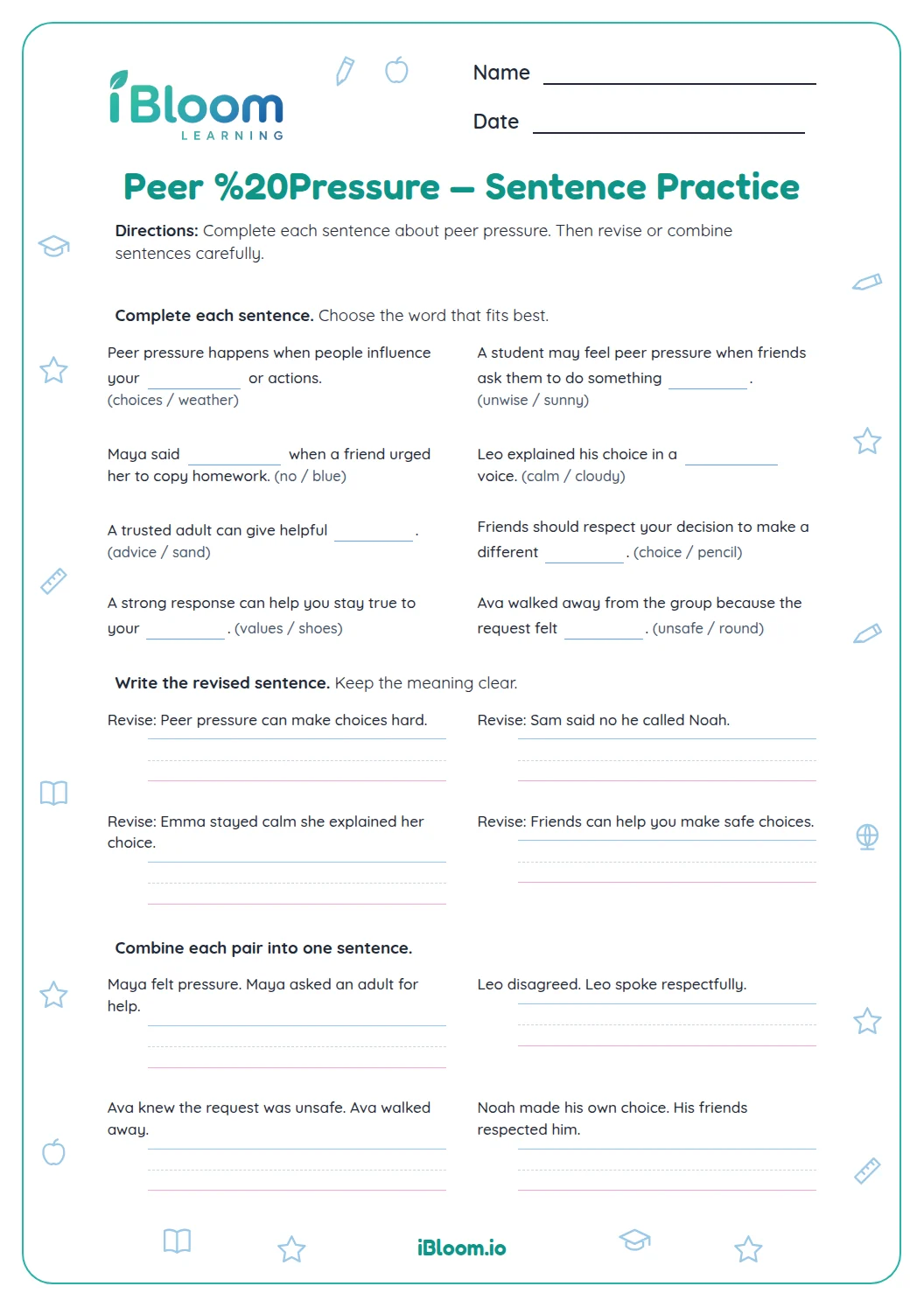
This free Grade 4 writing worksheet develops informative writing about peer pressure. Students identify a focused topic sentence and relevant details, connect ideas, define a key term, revise for precision, and write an informative sentence. The prompts use practical, supportive examples such as pausing, saying no, and asking a trusted adult for help. The writing practice aligns with Common Core W.4.2. The answer key provides a sample response while allowing students to use different accurate wording.
Aligned to W.4.2
What writing skills are practiced?
Part A identifies a clear topic and useful detail. Part B asks for an original informative sentence. Part C checks relevance and clarity.
- 1Topic: helpful responses to peer pressure
- 2Possible topic sentence: People can use several strategies when they feel pressure from friends.
How can a paragraph stay focused?
Begin with a topic sentence, add facts or examples that explain it, connect related ideas with words such as also or for example, and finish with a related conclusion.
How should adults discuss this topic?
Keep the activity focused on writing choices. Children can invent a classroom example instead of describing a personal situation.
How to use this worksheet
- 1Read the writing goal before choosing or drafting.
- 2Underline the topic words and keep each sentence connected to them.
- 3Add a fact, definition, or specific example that informs the reader.
- 4Use a linking phrase to show how ideas relate.
- 5Finish with a sentence that returns to the topic.
Common mistakes and quick fixes
The mistake
Adding a detail that is interesting but unrelated to the topic.
The fix
Before keeping a detail, ask whether it explains the paragraph’s topic.
The mistake
Repeating the topic sentence instead of explaining it with an example.
The fix
Add a fact or example that tells the reader more about the topic.
The mistake
Ending with a new idea that does not connect to the paragraph.
The fix
End with a sentence that sums up the information already given.
Common Core alignment
Write informative text with a clear topic and relevant facts.
On this sheet: The questions ask students to practice write informative text with a clear topic and relevant facts..
Show the official wordingHide the official wording
Write informative/explanatory texts to examine a topic and convey ideas and information clearly.
What to practice next
Make more practice
Further reading
Questions parents and teachers ask
What does the worksheet ask students to write?
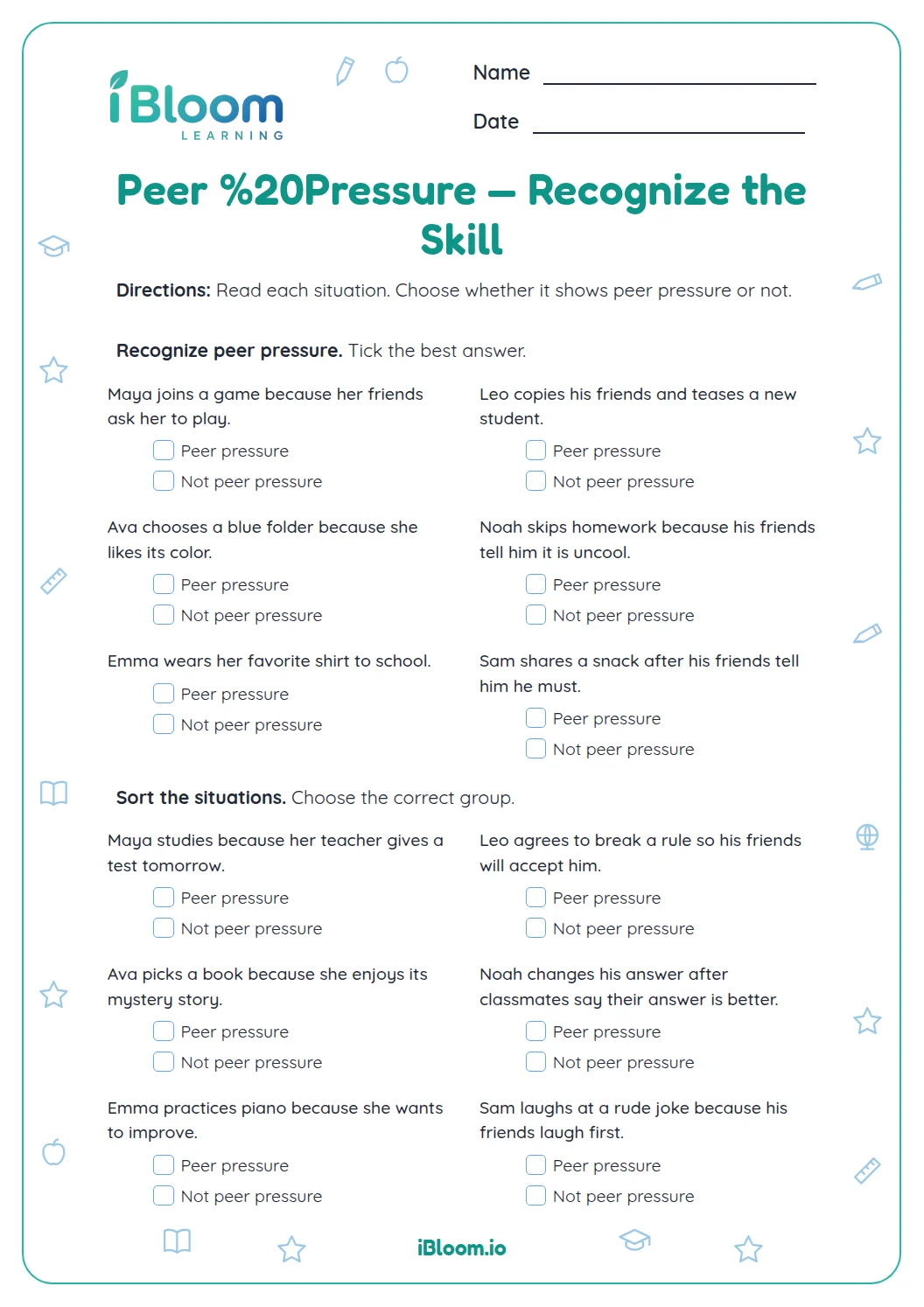
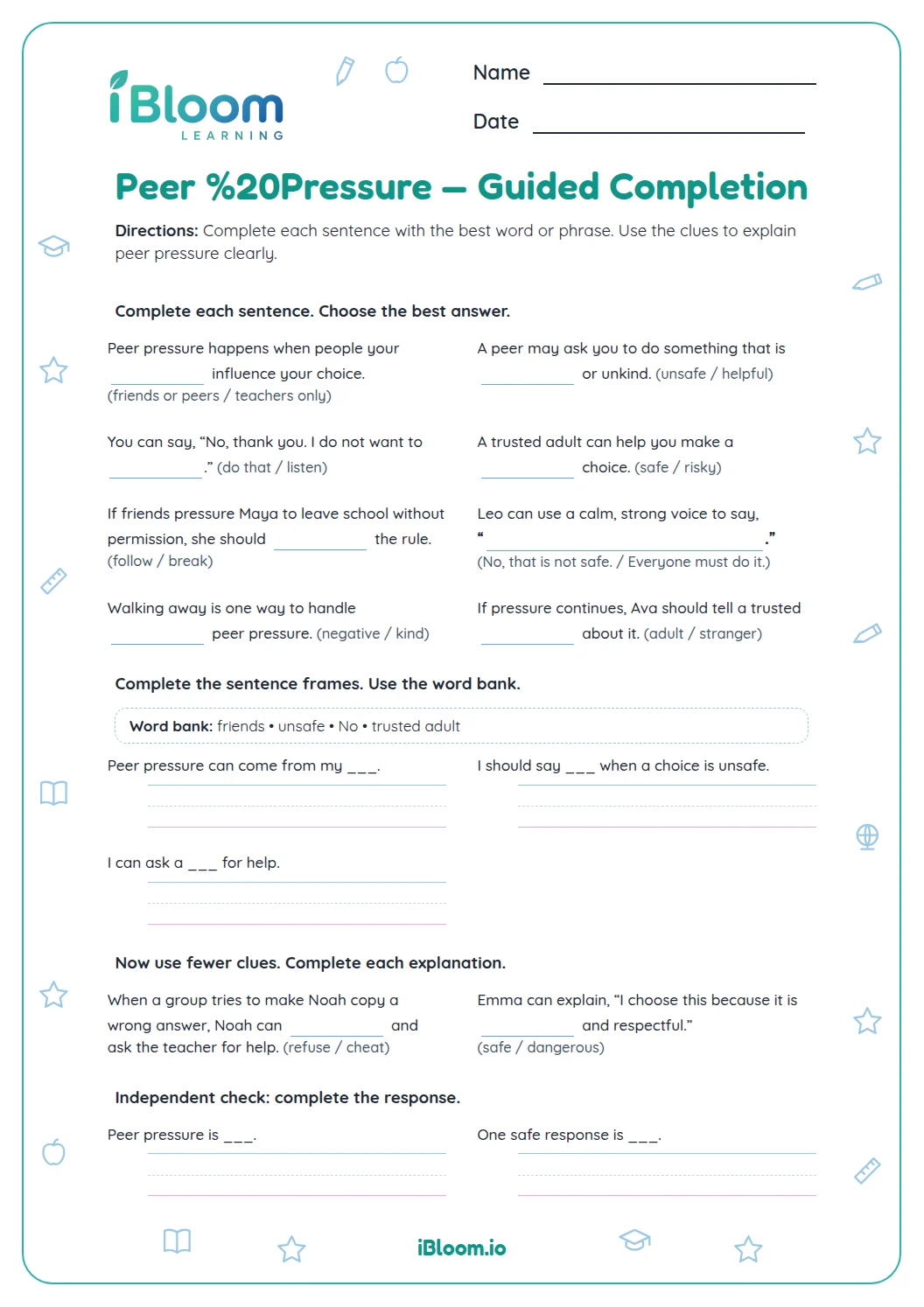
Students write one informative sentence about safe responses to peer pressure. The other items check topic sentences, relevant details, definitions, transitions, and conclusions. The prompts use invented classroom examples, so students can complete the activity without describing personal experiences.
Can students use different answers?
Yes. The open response can be answered in many ways, so the key gives a sample rather than the only acceptable wording. A response should stay on topic and give clear information. Students can use an invented example instead of sharing a personal experience.
What does “peer pressure” mean here?
The worksheet treats peer pressure as influence from people of a similar age to act in a certain way. The prompts invite students to explain safe choices without requiring them to share personal experiences. Students can use invented examples, so the writing practice does not require sharing personal experiences.
How can I support a student who gets stuck?
Invite the student to choose one response strategy from the prompt, then state one concrete example. A starter such as “For example…” can help connect the detail to the main idea. Students can use invented examples, so the writing practice does not require sharing personal experiences.
Does this page include a key?
Yes. The answer key includes choices for the multiple-choice items and a sample sentence for the open response. Use the sample as a model and accept other accurate, relevant writing that follows the prompt. Students may use a made-up example.