


About this worksheet
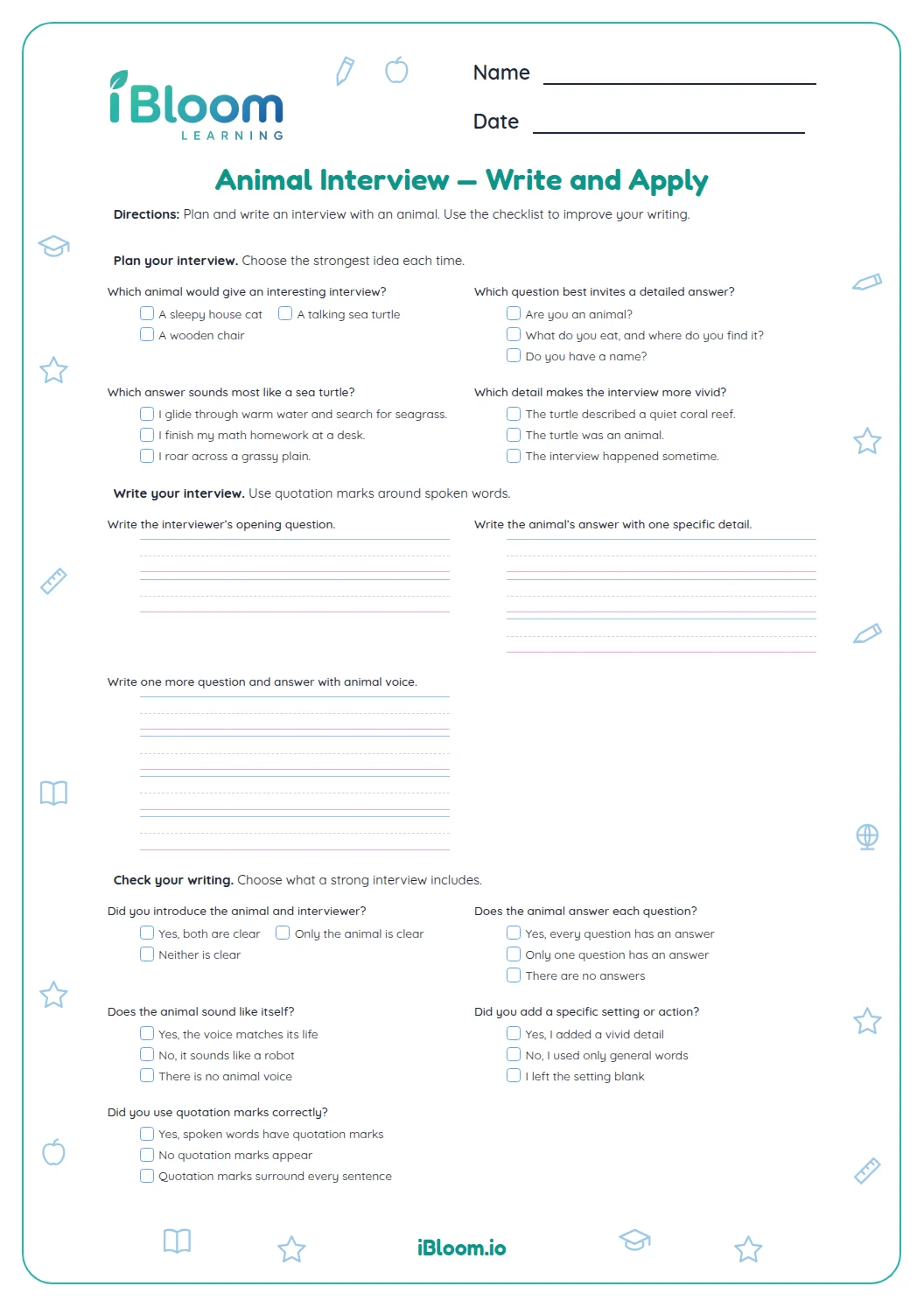
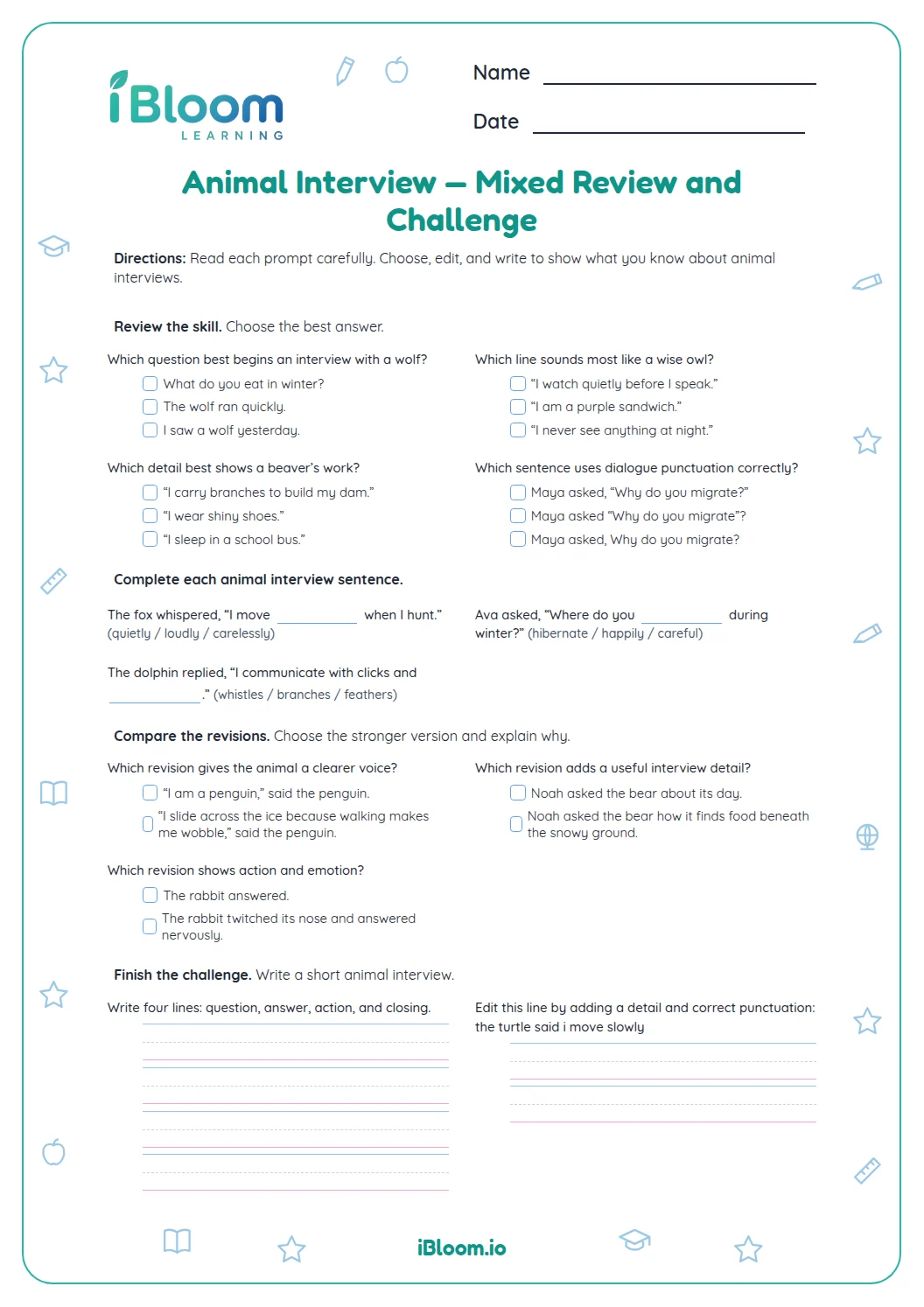
Students create an interview with an animal guest, then develop the scene through questions, first-person answers, setting details, a small challenge and a closing moment. The guided steps keep the writing manageable while leaving room for original ideas. Sample answers show one possible direction; students can invent a different animal and details. The sequence supports CCSS W.4.3 narrative techniques, descriptive details and clear event order.
Aligned to W.4.3
How does the interview become a narrative scene?
The prompts ask students to choose a guest, establish a setting, write dialogue and action, introduce a small challenge, and end the scene. The animal can speak in first person, giving the interview a consistent voice.
- Part A: introduce the animal guest and setting.
- Part B: write dialogue, responses and action.
- Part C: add a final exchange and close the scene.
How can writers balance dialogue and action?
Dialogue lets the interviewer and animal share ideas. Action shows what happens between answers. A quick movement such as stepping into moonlight or ducking behind a tree helps the scene feel like a story instead of a list of questions.
How to use this worksheet
- 1Choose one animal guest and keep its name and point of view consistent.
- 2Write complete answers that move the interview forward.
- 3Include at least one setting detail and one action between lines of dialogue.
- 4Read the whole sequence and add a closing sentence that feels like an ending.
Common mistakes and quick fixes
The mistake
Writing a list of questions with no events in the scene.
The fix
Add a small action or challenge that changes what happens during the interview.
The mistake
Switching between “I” and “it” when the animal answers.
The fix
Keep the animal’s spoken answers in first person, then use the interviewer’s voice outside the quotation.
Common Core alignment
These guided prompts support Grade 4 narrative writing through dialogue, description, event order and closure.
Write narratives with a clear sequence, dialogue, description and closure.
On this sheet: The guided interview prompts build a narrative scene through dialogue, first-person response, action, setting details and closure.
Show the official wordingHide the official wording
Write narratives to develop real or imagined experiences or events using effective technique, descriptive details, and clear event sequences.
What to practice next
Make more practice
Further reading
Questions parents and teachers ask
Can students invent a different animal character?
Yes. Fern the fox is only one sample character. Students can choose another animal, give it a name, and adapt the answers. They should keep the character’s voice and details consistent from the opening through the closing moment. Students can change the guest or setting while keeping the interview structure.
How does the worksheet help turn questions into a story?
The prompts ask for more than an interview list. Students add a setting, first-person answers, an action, a small challenge, a feeling, and a closing moment. Together, those details create an event sequence that readers can follow. This sequence helps the reader follow what happens during the meeting.
What point of view should the animal use?
The animal speaks in first person during its answers, using words such as “I” and “my.” The interviewer can ask questions in their own voice. Keeping those voices distinct helps readers know who is speaking. The interviewer’s questions can stay in a separate, consistent voice.
What makes a strong ending for the scene?
A strong ending gives the interview a sense of closure. The animal might return to its den, the interviewer might say goodbye, or the scene might echo a detail from the opening. It should feel like the event has finished.
How does dialogue help an animal interview scene?
Dialogue shows what the reporter and animal say. Students can pair each spoken line with an action or setting detail to make the interview feel like a scene. A sequence word can then show when the next event happens and help the ending feel complete.