



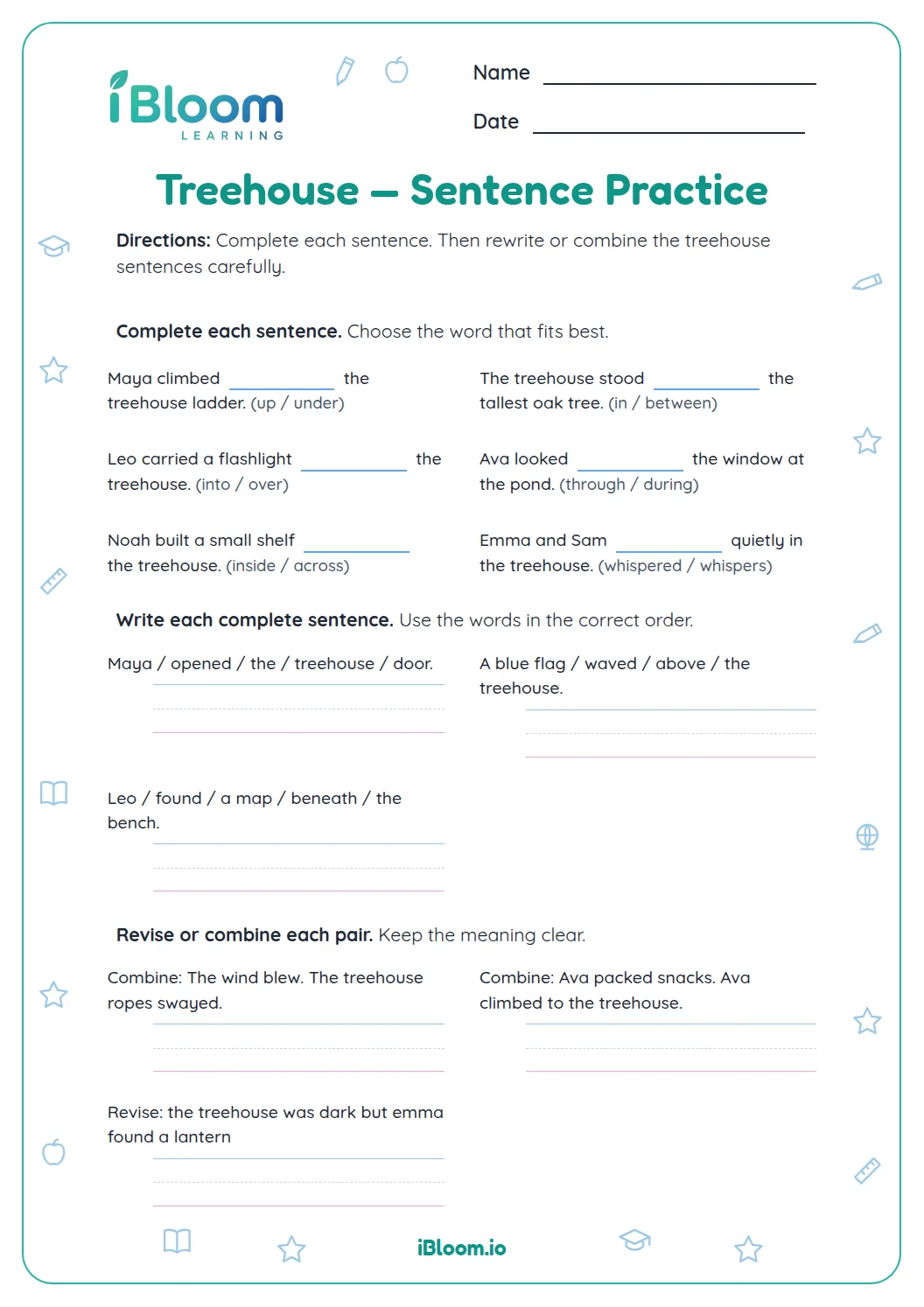
About this worksheet
A narrative needs more than a kind act: readers need to know where the story begins, what changes, how a character responds, and why the ending matters. These fourteen sentence choices follow small acts of help in everyday settings. The page replaces a generic complete-sentence item with focused practice in narrative sequence and craft.
Aligned to W.4.3.a and W.4.3.b
How do sentences make a story easy to follow?
A clear opening places characters in a situation. Actions then unfold in an order readers can follow, often with transitions such as “first,” “then,” and “later.” A strong ending shows what changed or how a character feels.
Questions 1, 3, 6, 7, and 10 practice those jobs. Notice that a sentence can be grammatically complete and still be a weak choice if it interrupts the story.
How can a detail show kindness?
A specific action lets readers infer a character’s choice. “Rosa stood up and offered her seat” shows what she did; “Rosa was nice” only tells the reader what to think. Dialogue and sensory details can make the moment feel real.
How can sentence combining improve a narrative?
Keep both actions in the combined sentence and make their connection easy to follow. A joining word can show that one action followed another or that one action helped complete the next.
How to use this worksheet
- 1Read each choice aloud and listen for a complete thought.
- 2Check capitals and ending punctuation when revising.
- 3When combining, keep both actions and show their connection.
- 4Compare open responses with the key’s model, then revise if needed.
Common mistakes and quick fixes
The mistake
Treating a fragment as a complete sentence.
The fix
Check that the sentence says who acted and what happened.
The mistake
Leaving out one action when combining sentences.
The fix
Keep both actions in the revised sentence.
The mistake
Forgetting capitals or ending punctuation.
The fix
Reread the sentence and check its first and last marks.
Common Core alignment
The worksheet practices narrative craft: clear event sequence, relevant details, dialogue, and an ending.
Orient the reader and establish a situation.
On this sheet: Questions 1, 3, and 10 focus on setting and event order.
Show the official wordingHide the official wording
Orient the reader by establishing a situation and introducing a narrator and/or characters; organize an event sequence that unfolds naturally.
Use dialogue, description, and details to develop events.
On this sheet: Questions practice dialogue punctuation, character response, and scene details.
Show the official wordingHide the official wording
Use dialogue and description to develop experiences and events or show the responses of characters to situations.
What to practice next
Make more practice
Further reading
Questions parents and teachers ask
What does this Good Deeds worksheet practice?
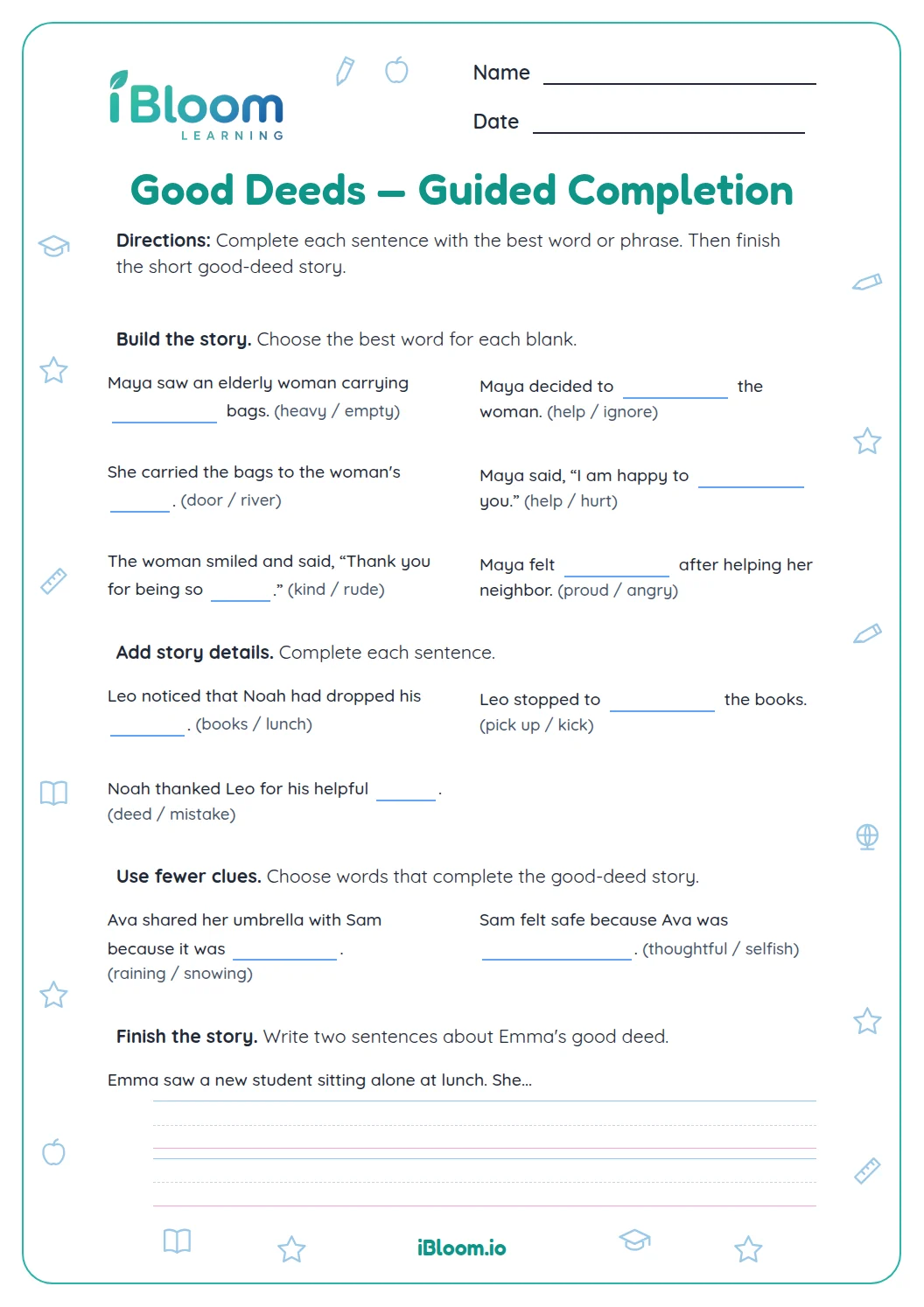
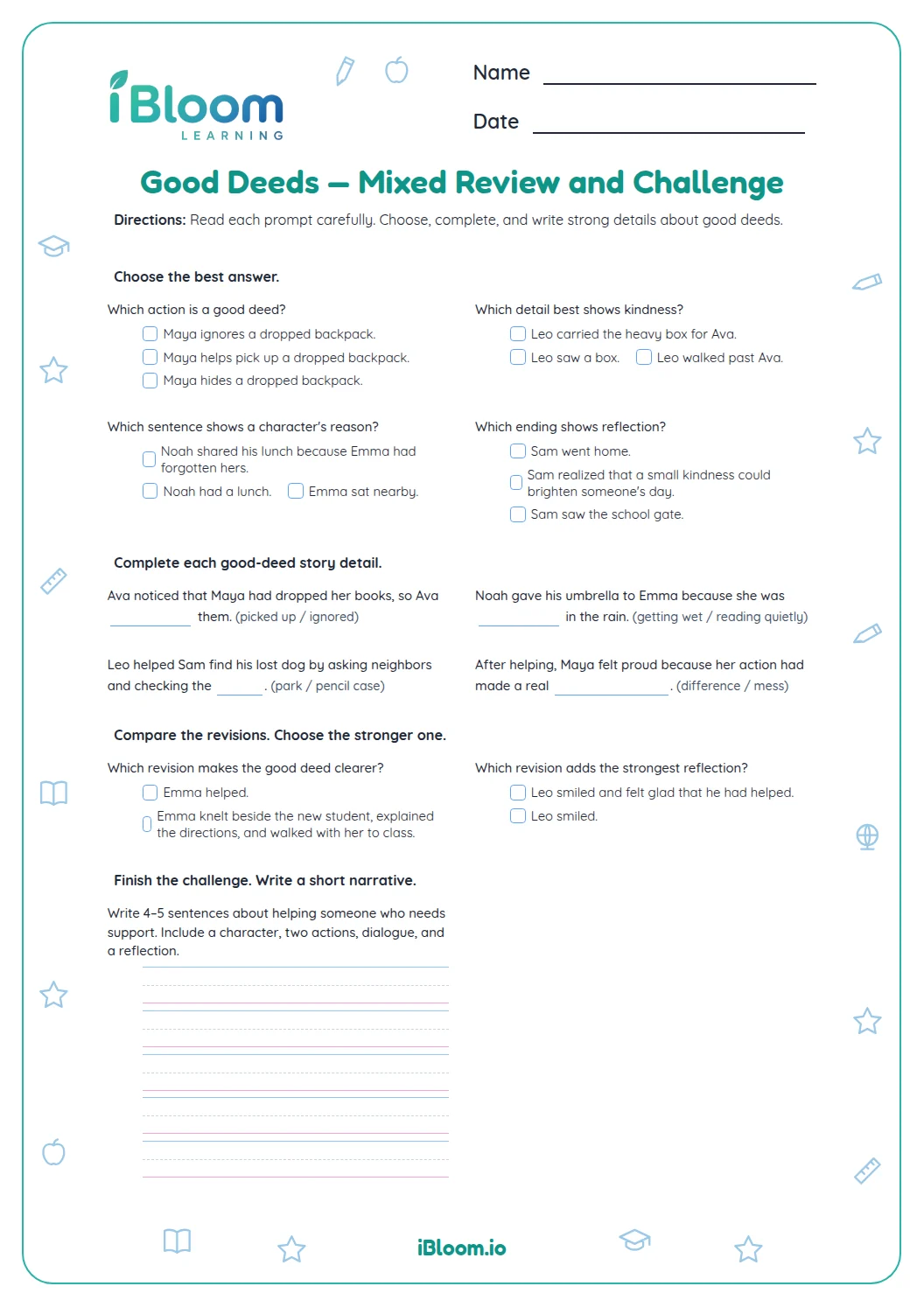
The fourteen questions move from recognizing complete narrative sentences to correcting and combining sentences about helpful actions. The answer key gives models for open responses. Students can use different wording when each sentence is complete, clear, and faithful to the prompt.
What makes a sentence complete?
A complete sentence expresses a full thought, usually with a subject and a verb. “Maya helped her neighbor” is complete; “Helping her neighbor” leaves the reader waiting for who helped. Ask the student to identify who acted and what that person did.
Why combine two sentences in a story?
Combining related actions can make a narrative smoother and show how one event connects to the next. For example, Maya finds a purse and gives it to a teacher. Keep both actions clear, and use a joining word or phrase that fits their relationship.
Are the written answers required to match the key?
No. The key gives one sample for each open response. Accept another sentence when it uses correct capitalization and punctuation, forms a complete thought, and keeps the good deed described in the prompt. The multiple-choice items have one intended answer.
How can I review a missed answer?
Ask the student to read the sentence aloud and listen for a complete thought. For a combined sentence, check that both actions remain and that the wording shows their connection. Use the model answer as a guide, then let the student revise independently.