




About this worksheet
This guided-completion worksheet helps Grade 4 students identify the object in a prepositional phrase. Students first locate the word or words after a preposition, then complete phrases and use them in sentences. The prompts distinguish the preposition from its object and include pronoun objects as well as nouns.
Aligned to L.4.1.e
What is on this worksheet?
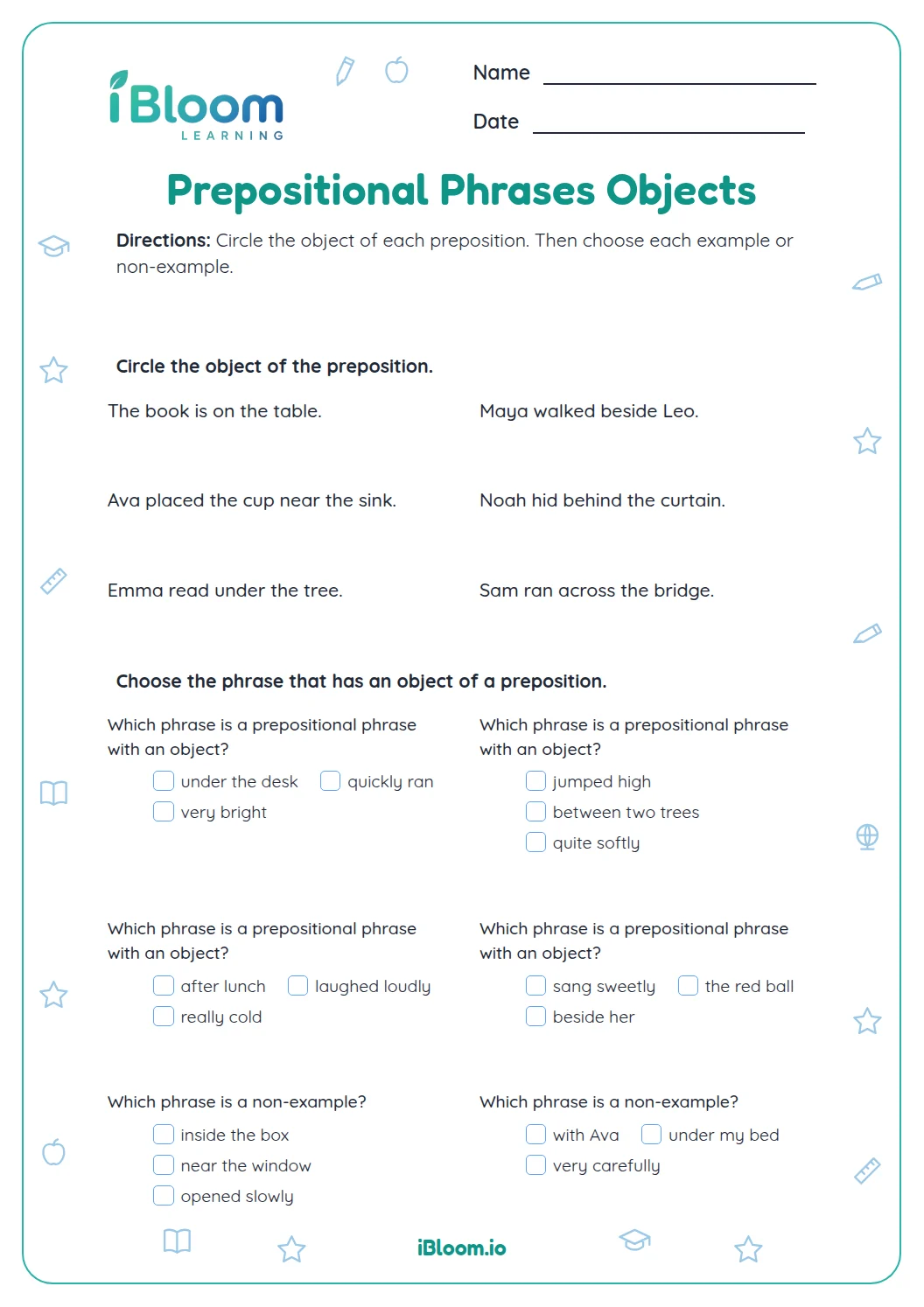
The first section asks students to find the object in a prepositional phrase used in a complete sentence. The next section gives an incomplete phrase and asks students to supply a fitting object.
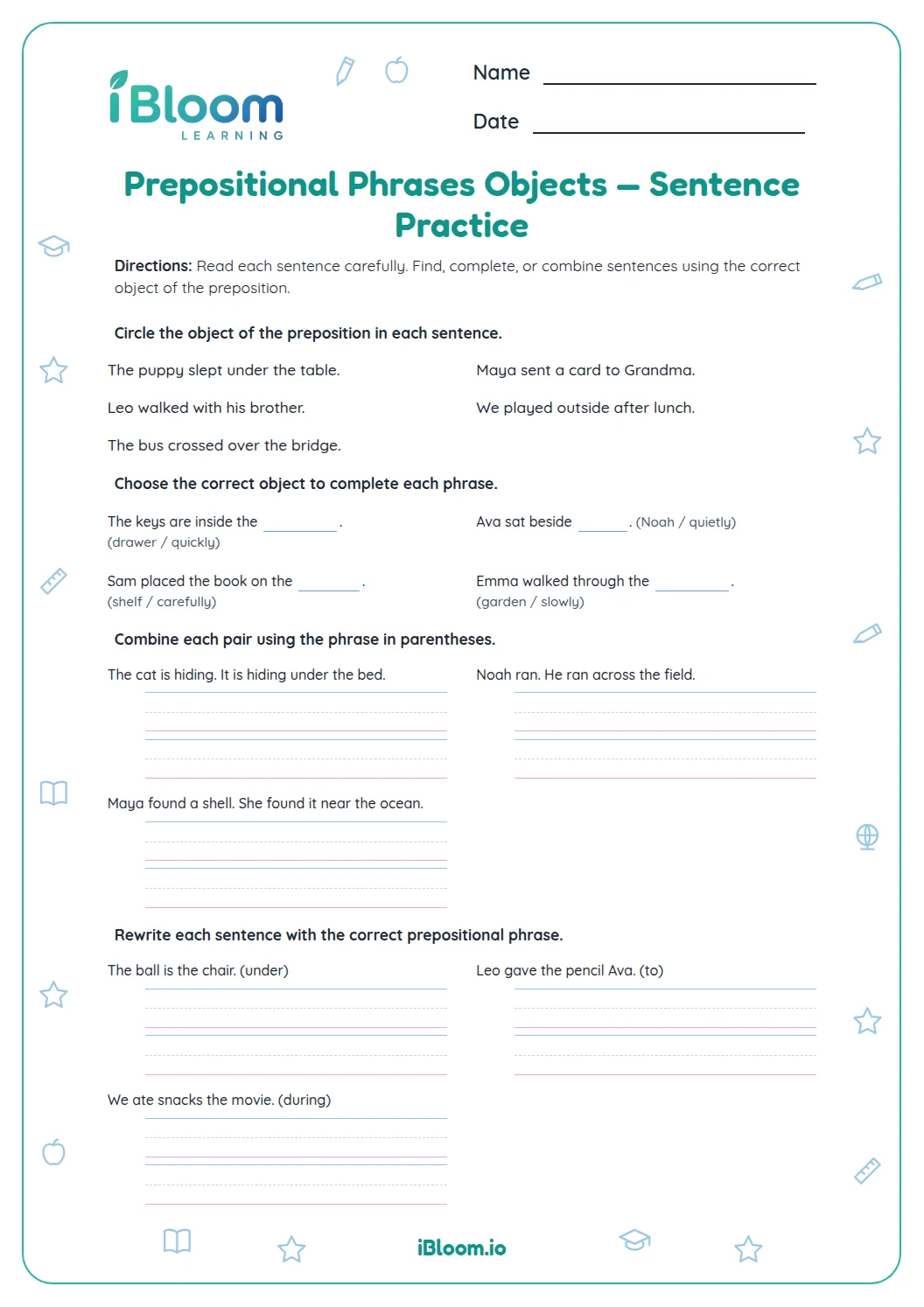
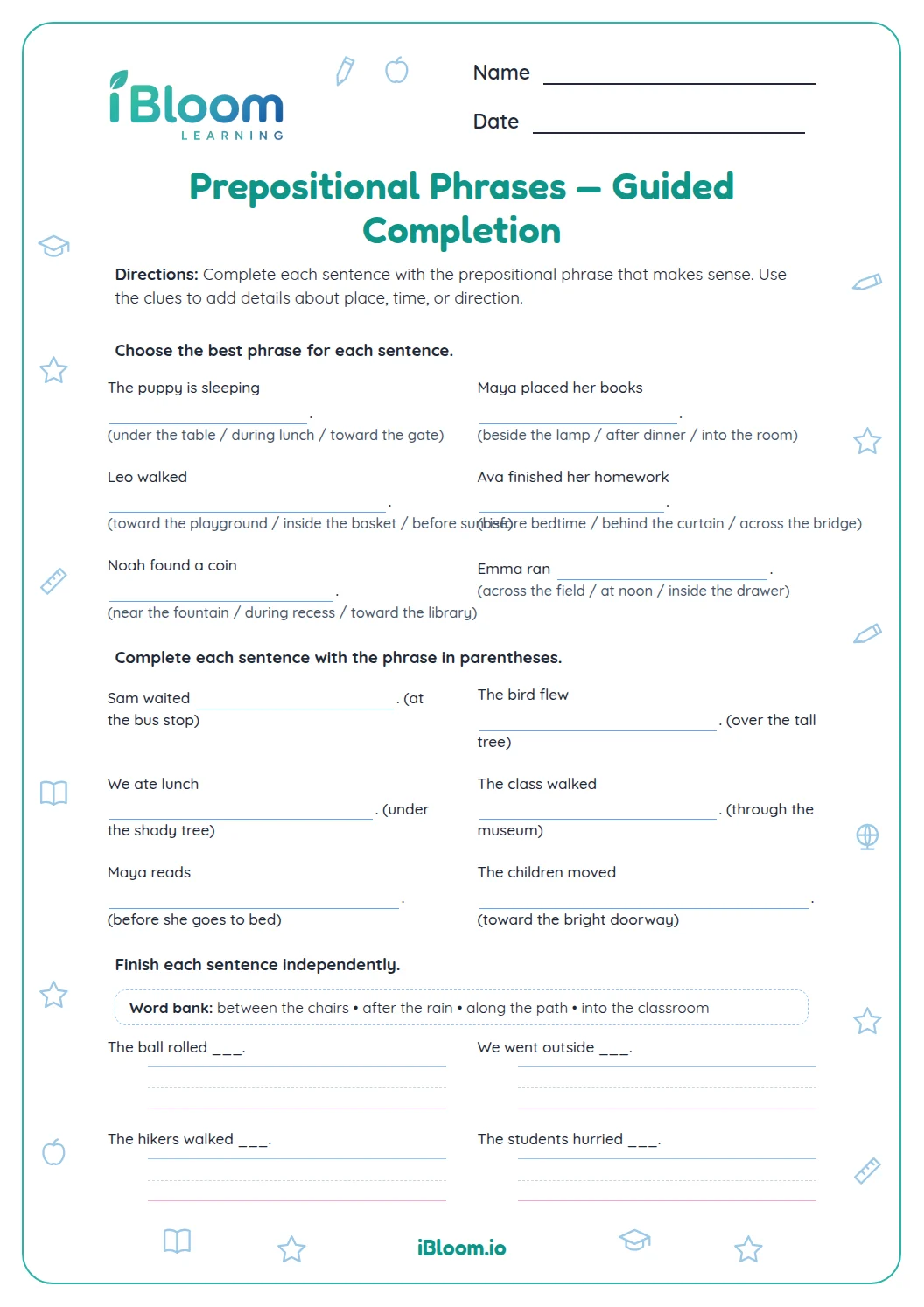
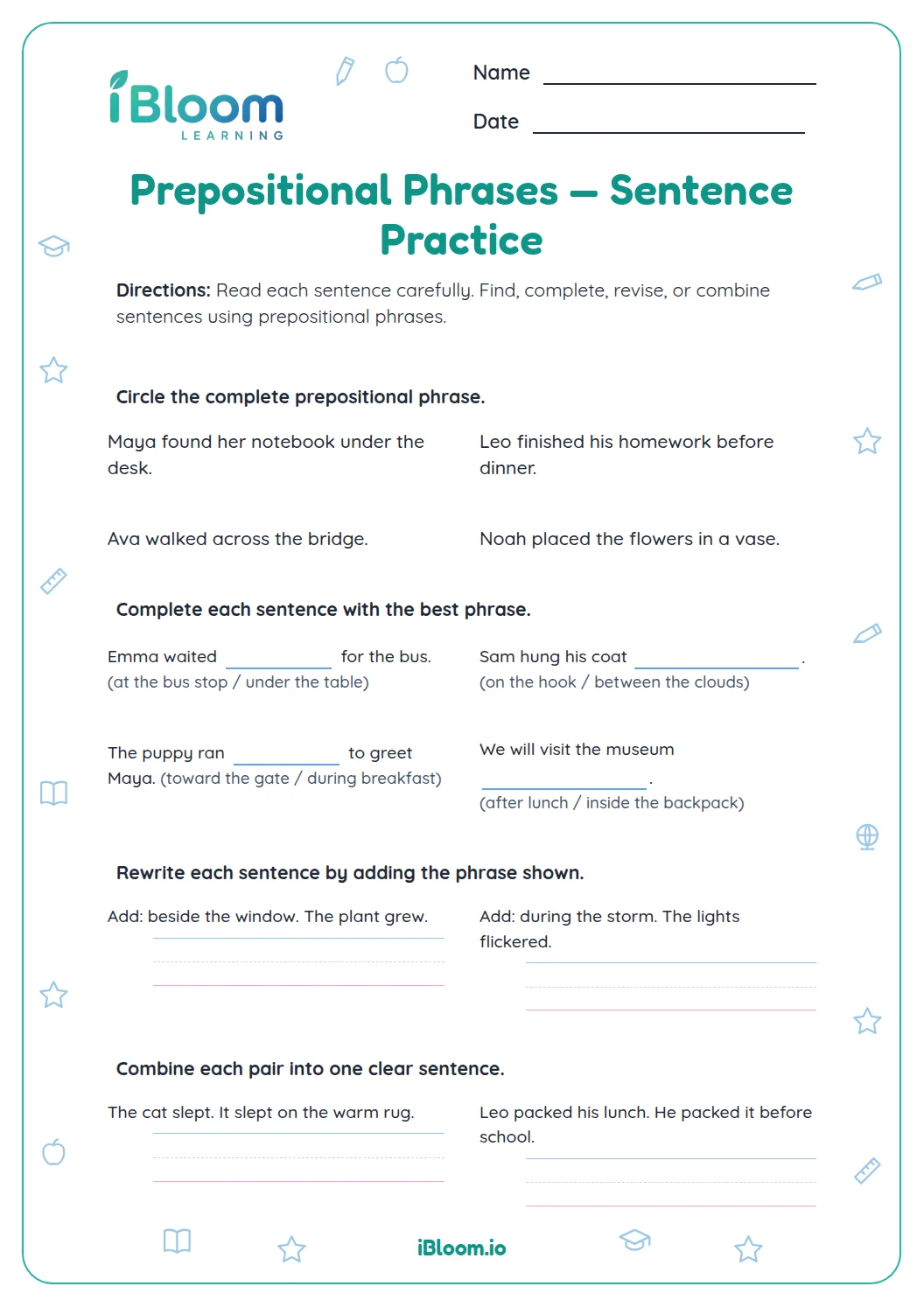
Part B completes phrase frames with an object. Part C uses sentence writing to apply prepositional phrases in context.
- Part A: identify the object after a preposition.
- Part B: complete a prepositional phrase with an object.
- Part C: add a phrase that fits a sentence and tells where.
How do you find the object?
First find the preposition, such as under, beside or through. Then ask “under what?” or “through what?” The word or words that answer the question are the object.
In “The keys rested under the cushion,” under is the preposition and cushion is its object. The full phrase is under the cushion.
Can a pronoun be an object?
Yes. In “Dad parked beside us,” the pronoun us is the object of beside. Objects can be nouns such as tunnel or pronouns such as us.
When identifying an object, include the complete noun phrase when the directions ask for it, such as her backpack. If the directions ask for the object word, provide the noun or pronoun.
How to use this worksheet
- 1Find the preposition in the sentence or phrase.
- 2Ask “what?” or “whom?” after the preposition.
- 3Write the noun or pronoun that answers that question.
- 4For sentence completions, add a full prepositional phrase that fits the meaning.
- 5Check the key; other phrases are correct when they fit the sentence.
Common mistakes and quick fixes
The mistake
Naming the subject instead of the object after the preposition.
The fix
Ask “near what?” or “through what?” to find the object.
The mistake
Giving only the preposition when asked for the object.
The fix
Write the noun or pronoun that follows it, such as fence in “near the fence.”
The mistake
Writing a phrase that does not tell where in the sentence.
The fix
Try the phrase in the sentence and check that it answers “where?”
Common Core alignment
This worksheet supports Grade 4 grammar work with prepositional phrases.
Form and use prepositional phrases.
On this sheet: Students find the objects in phrases, complete phrase frames and write a sentence containing a prepositional phrase.
Show the official wordingHide the official wording
Form and use prepositional phrases.
What to practice next
Make more practice
Questions parents and teachers ask
What is the object in “near the fence”?
Fence is the object of near. Ask “near what?” to find the noun that completes the phrase. Together, near and the fence make a prepositional phrase in the sentence. The phrase answers where the robin perched. Use the stated objects and counts to explain why the answer fits this particular question.
Can the object be more than one word?
Yes. A noun phrase can include describing words, as in “her backpack.” In that item, the full object is her backpack; backpack is the main noun in the phrase. Include the whole noun phrase when the question asks for the complete object.
Can a pronoun follow a preposition?
Yes. In “beside us,” us is a pronoun and the object of beside. Pronouns such as me, us, and them can follow prepositions and complete a prepositional phrase. The pronoun is the object because it follows and completes the meaning of the preposition.
What is the difference between the preposition and its object?
The preposition shows a relationship, such as under. Its object names what follows it, such as cushion. Together, under the cushion forms a phrase that tells where something is. The object completes the relationship named by the preposition. Use the stated objects and counts to explain why the answer fits this particular question.
What can a phrase add to a sentence?
A prepositional phrase can tell where, when, or in what direction something happens. For example, “under the branch” tells where the bird rested. The phrase starts with a preposition and includes its object. The object names the person or thing connected to that relationship.