





About this worksheet
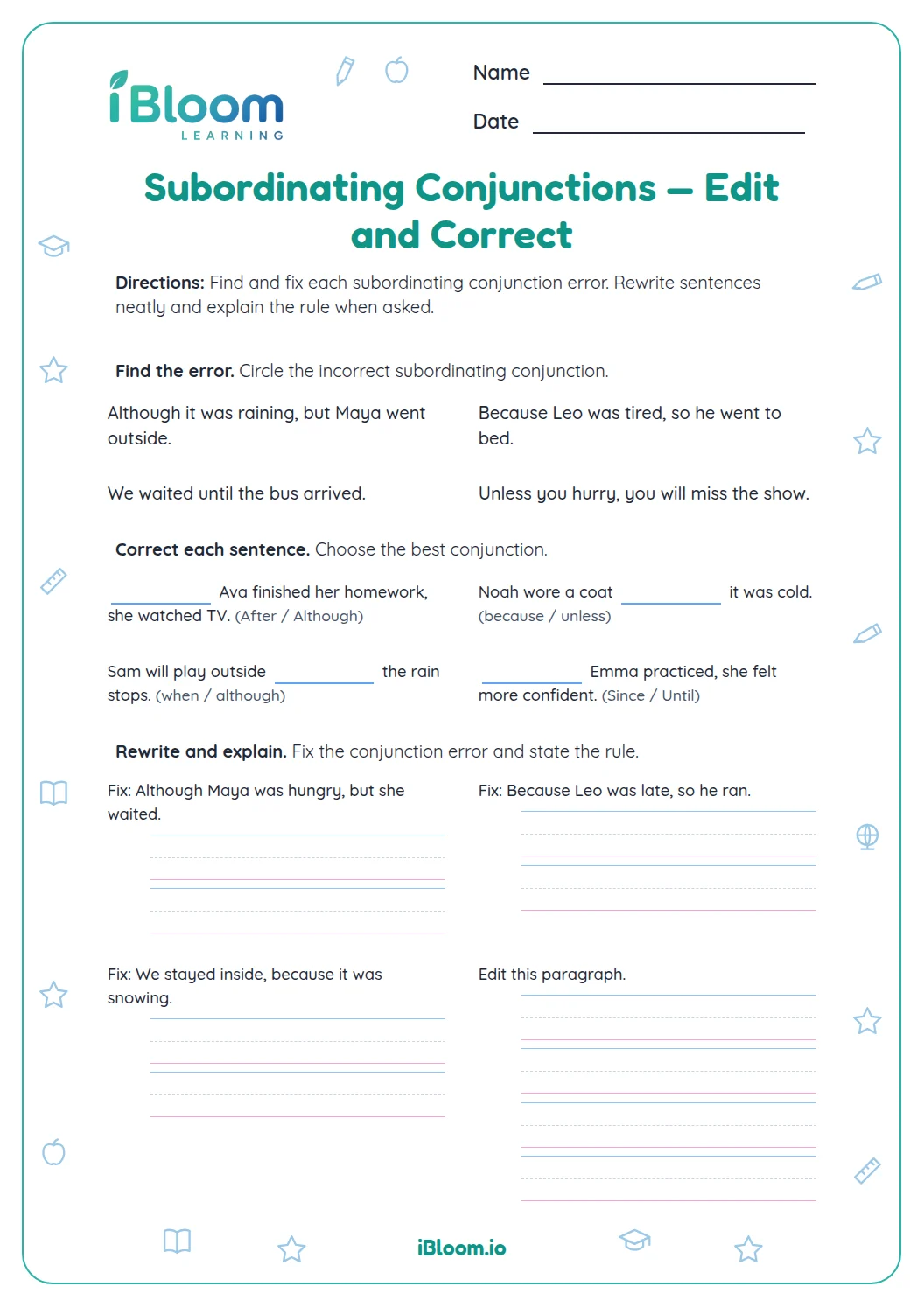
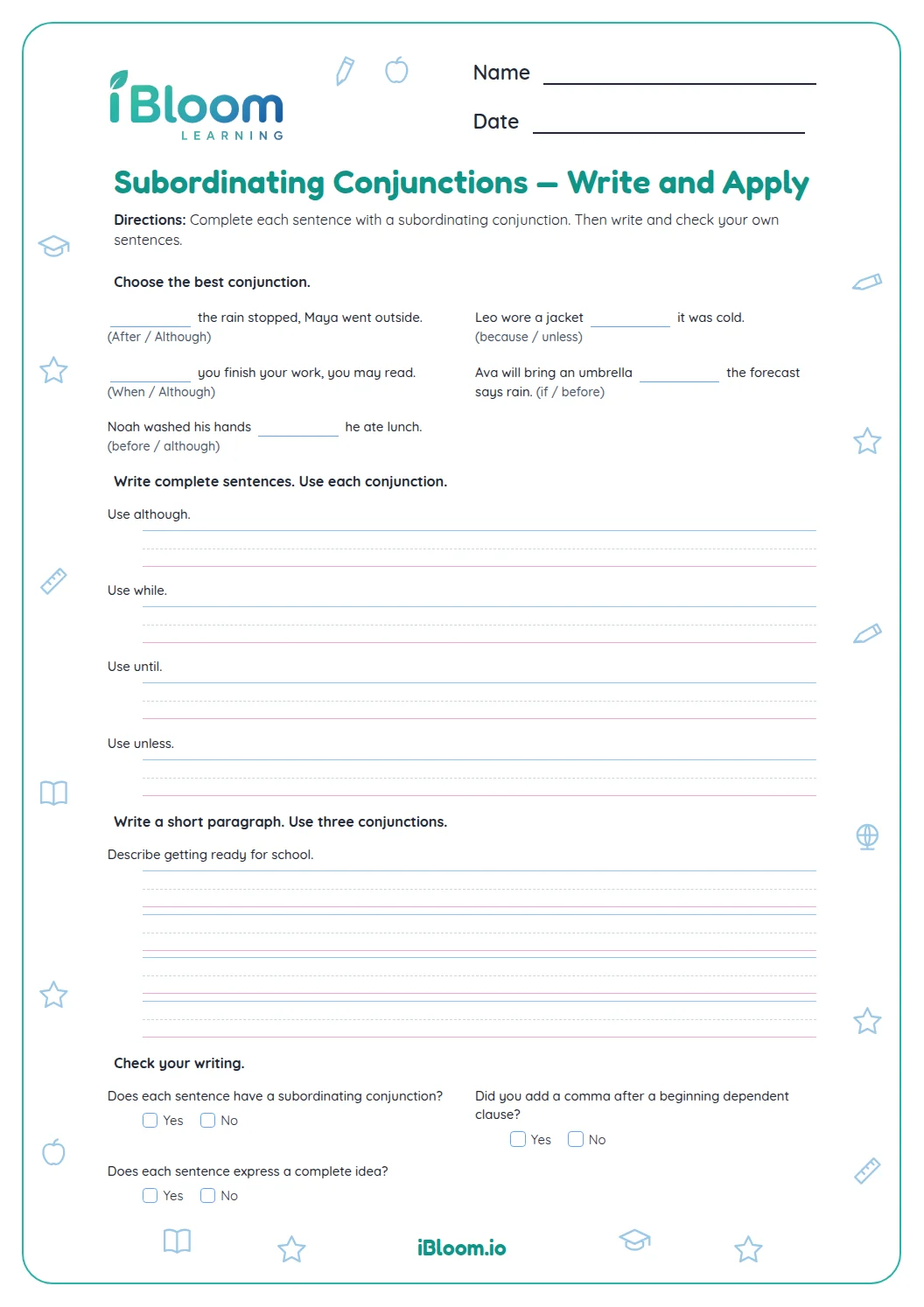
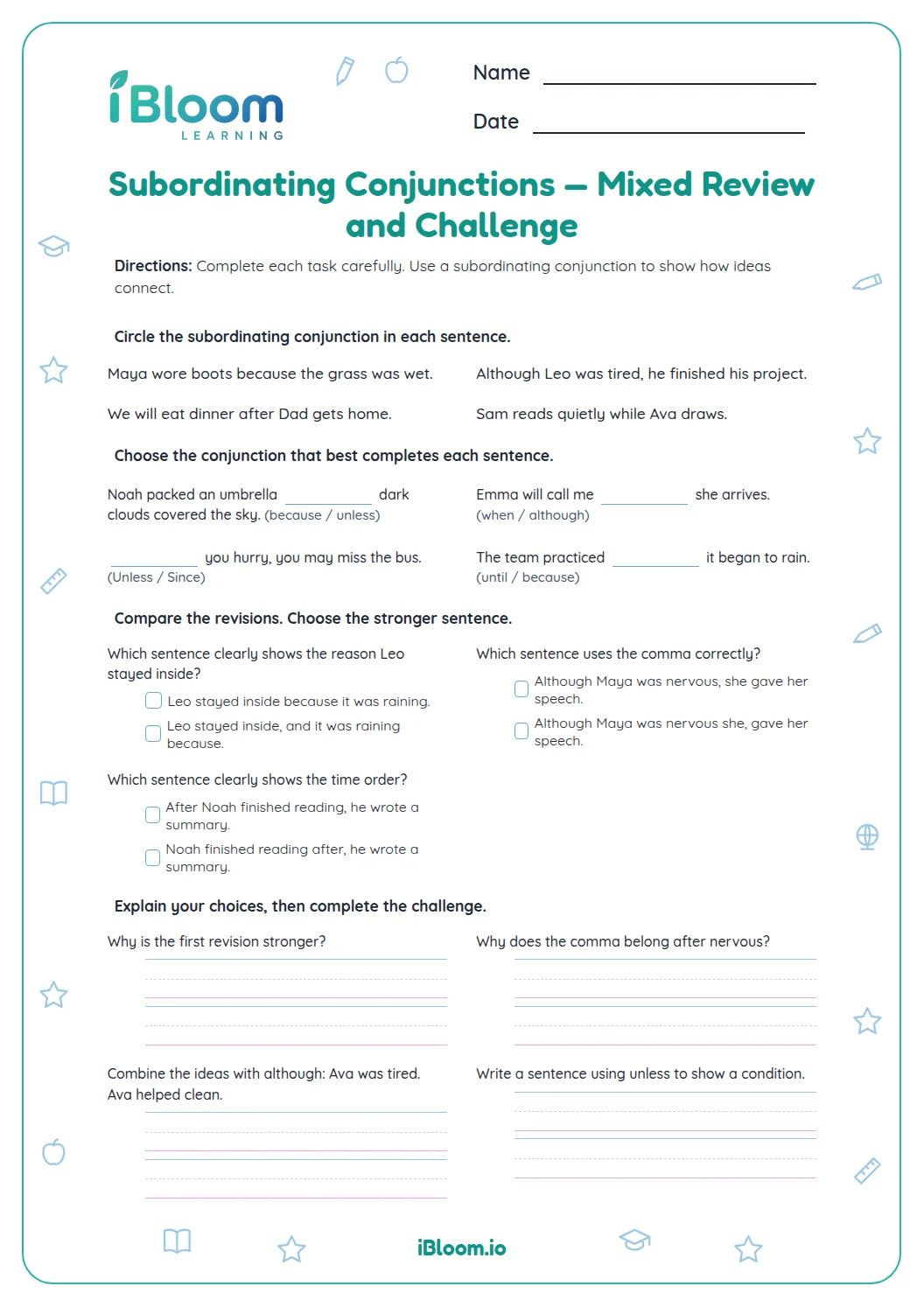
This free Grade 4 printable returns to two clear recognition tasks: find a subordinating conjunction in a sentence, then decide whether another sentence contains one. The 16 items practice the skill with familiar words such as because, while, before, although, and if. An answer key is included.
Aligned to L.4.1
What does a subordinating conjunction do?
It introduces a dependent clause and shows how that clause relates to a main idea. Words such as because, although, while, before, when, and if can signal reason, contrast, time, or condition.
- 1Maya smiled because she won the game.
- 2The subordinating conjunction is because.
- 3It introduces the reason Maya smiled.
How can you recognize one in a sentence?
Read the whole sentence and find the word that introduces one clause and connects it to another. Then check that the word shows a relationship between the ideas.
How does the second part check recognition?
Part A asks for the conjunction in each sentence. Part B asks whether each sentence contains a subordinating conjunction; sentences joined only with and or but are non-examples.
How to use this worksheet
- 1Read the full sentence before choosing a word.
- 2Find the word that connects a dependent clause to a main clause.
- 3In Part B, check whether the sentence has a subordinating conjunction.
- 4Use the key to review the word or feature that supports each answer.
Common mistakes and quick fixes
The mistake
Choosing any word that joins ideas.
The fix
Check whether it introduces a dependent clause; and and but do not.
The mistake
Labeling a sentence from its topic instead of its grammar.
The fix
Find the clause connection and the word that introduces it.
The mistake
Confusing contrast and reason.
The fix
Reread both ideas: although signals contrast, while because gives a reason.
Common Core alignment
Learners identify subordinating conjunctions and recognize how they connect clauses.
Use standard English grammar when reading and discussing complete sentences.
On this sheet: Part A asks learners to identify subordinating conjunctions; Part B checks whether sentences use one to connect clauses.
Show the official wordingHide the official wording
Demonstrate command of the conventions of standard English grammar and usage when writing or speaking.
What to practice next
Make more practice
Further reading
Questions parents and teachers ask
What is a subordinating conjunction?
It introduces a dependent clause and connects it to a main clause. Because, although, when, and if are examples. In “Maya smiled because she won the game,” because introduces the reason Maya smiled. The first eight items ask learners to find this kind of word.
What does Part A ask learners to do?
Choose the subordinating conjunction in each sentence. Read both clauses and find the word that connects them. In “Maya smiled because she won the game,” because introduces the reason. The answer key names the conjunction in every sentence.
How does Part B work?
For each sentence, choose Yes if it contains a subordinating conjunction and No if it does not. “Ava read after she finished her chores” is an example. “Leo packed pencils and crayons” is not because and does not introduce a dependent clause.
Can a sentence begin with a subordinating conjunction?
Yes. In “Although it was cold, Maya played outside,” the dependent clause comes first, and a comma separates it from the main clause. The worksheet includes sentences with this order so learners can recognize the conjunction in different positions.
How can a learner distinguish conjunctions?
A subordinating conjunction introduces a dependent clause, as because does in “because she won.” And and but connect ideas without introducing a dependent clause. Part B asks learners to use that difference when deciding whether each sentence is an example.