




About this worksheet
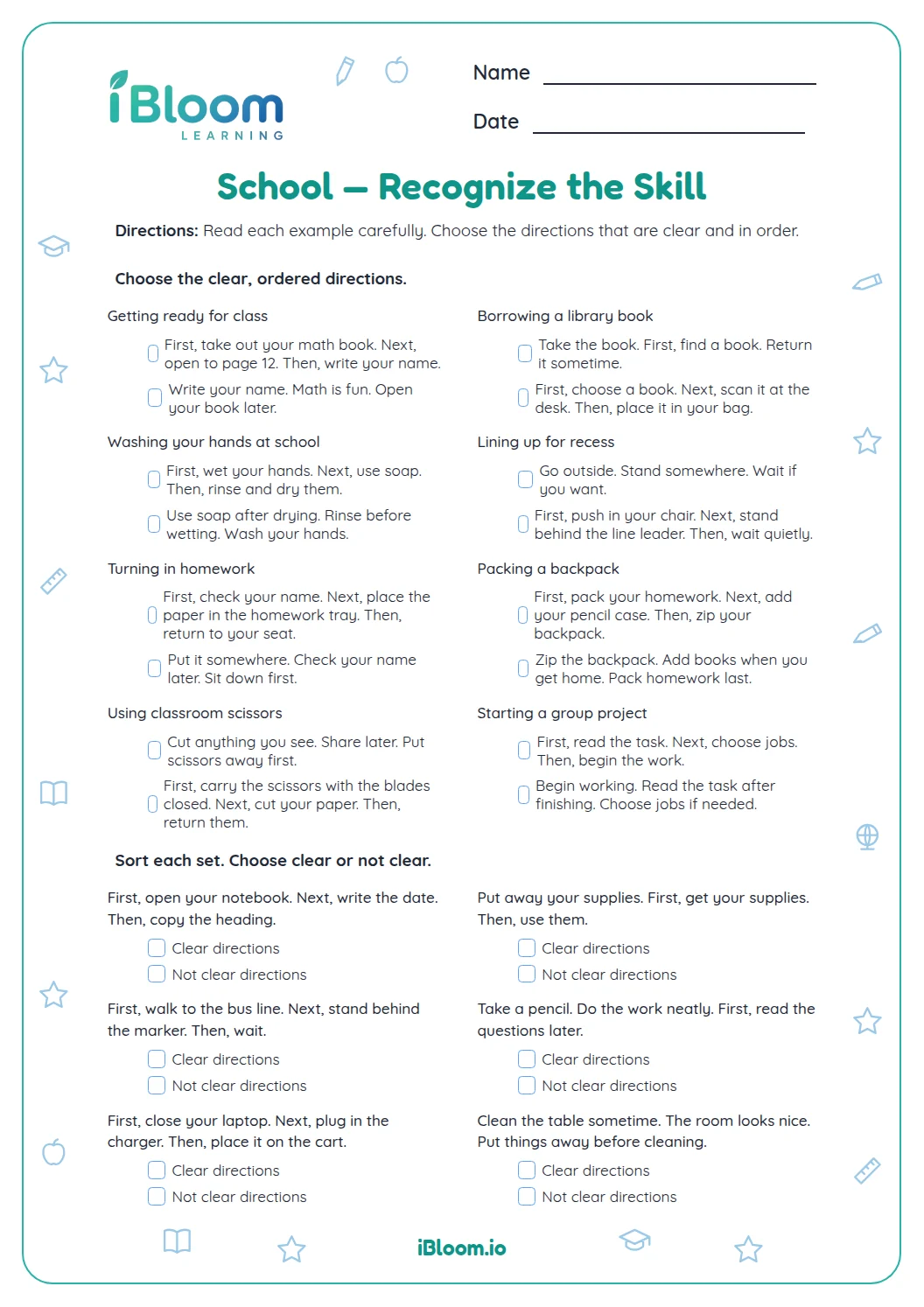
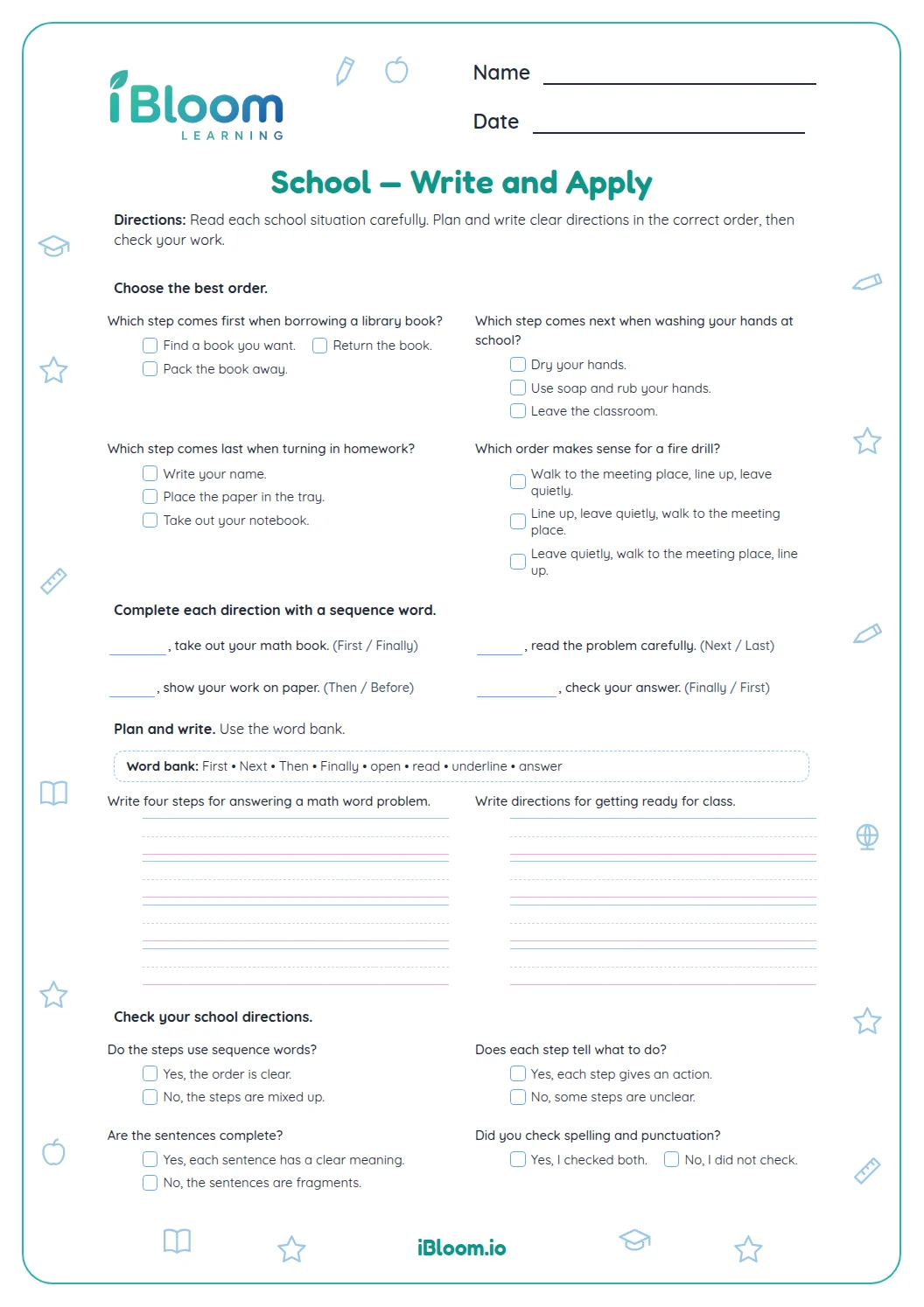
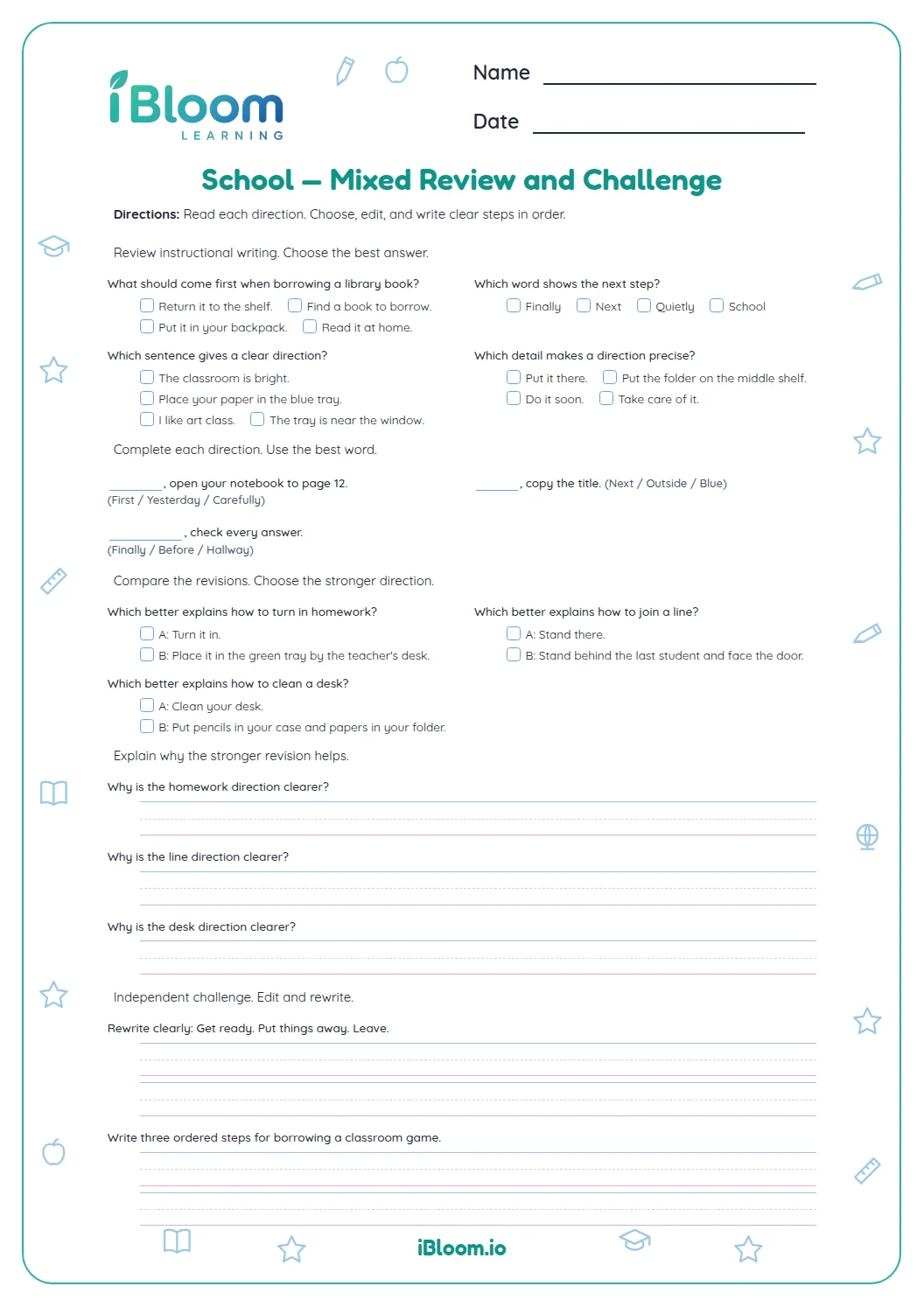
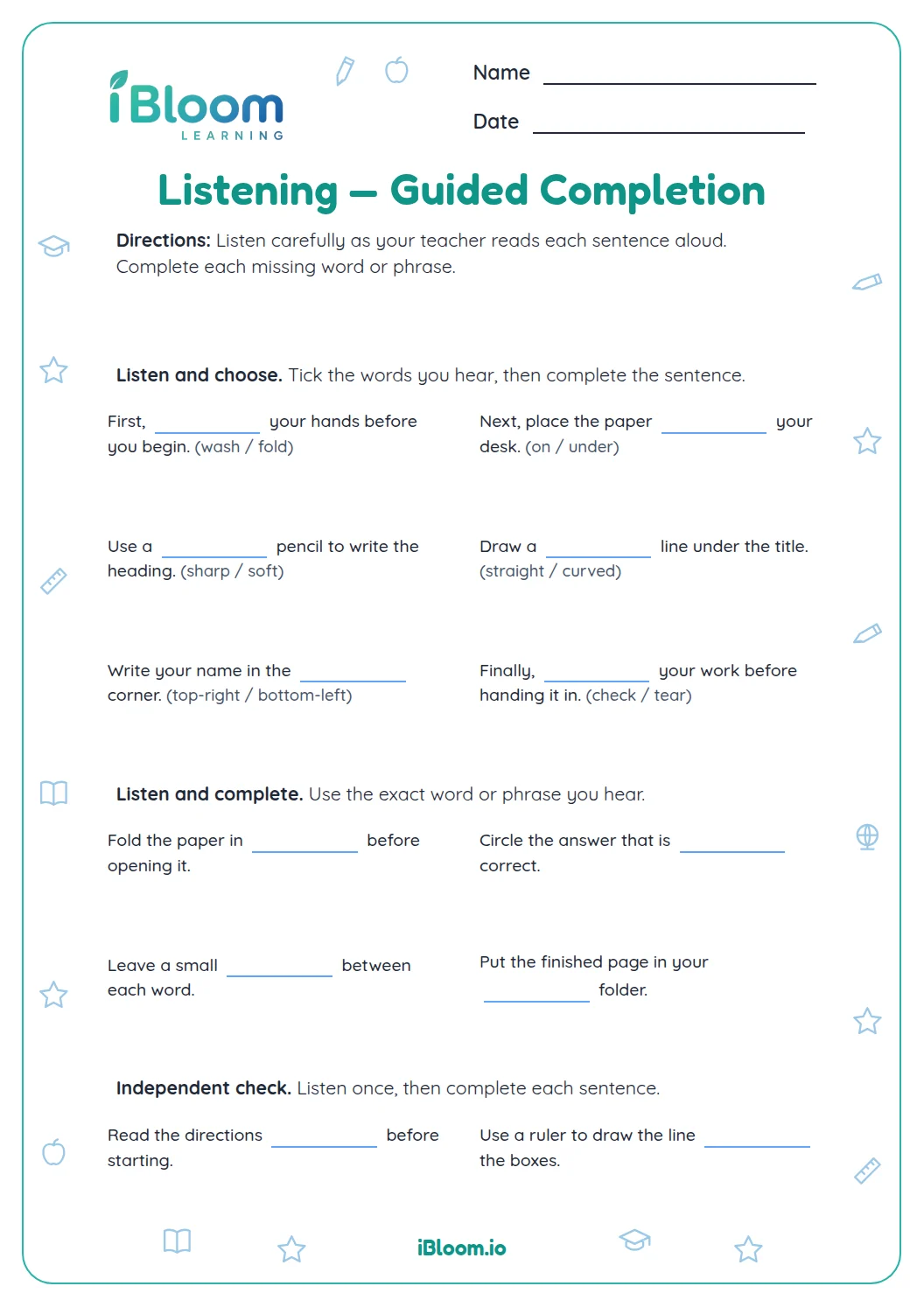
This free printable helps Grade 4 students complete and evaluate school directions. Learners supply sequence and action words, then choose steps that are specific and logically ordered. The familiar routines let students focus on how directions guide a reader. A separate answer key supports review.
How do sequence words guide school directions?
Words such as first, next, and finally tell a reader when to do each step. Question 1 begins a routine with “First,” while question 4 signals its last step with “Finally.”
- 11) ___, take your math book from your desk. → First
- 24) ___, put your math book away. → Finally
What makes a direction clear?
A clear direction names an action and gives enough detail to follow it. “Put the worksheet in the blue folder” tells the learner what to move and where to put it. Question 14 contrasts that with vague directions.
How can you check whether steps are in order?
Imagine following each step exactly as written. Question 13 puts getting paper and writing a name before beginning the assignment, so the materials are ready when the work starts.
How to use this worksheet
- 1Read each direction once to understand the task.
- 2For a blank, choose a word that completes both the sentence and the routine.
- 3For a choice, check that it gives an action rather than an unrelated fact.
- 4Look for sequence words that show what happens first, next, or last.
- 5Read the completed directions in order to check that they make sense.
Common mistakes and quick fixes
The mistake
Choosing an action that comes too late in a routine.
The fix
Ask what a student needs to do before the next step can happen.
The mistake
Using a vague phrase such as “put it away.”
The fix
Name the item and where it belongs.
The mistake
Treating a fact as a direction.
The fix
Check that the sentence tells someone what action to take.
What to practice next
Make more practice
Further reading
Questions parents and teachers ask
What does this school-directions worksheet practice?
Students complete short directions with action words and sequence clues, then choose clear steps for school routines. The 16 questions include eight completions and eight choices. A separate answer key gives a target response for each item. Each response can be checked against the routine described in its sentence.
How should a child answer question 10?
Question 10 asks what to do before measuring water in a science investigation. Reading the directions first helps the student know the steps and any safety guidance. The other choices happen later or do not begin the investigation. The choices reflect a sensible beginning, middle, and end.
What makes “Put the worksheet in the blue folder” clear?
It names the item to move and the place to put it. A reader does not have to guess what “it” means or where “away” is. Specific nouns and action verbs make a direction easier to follow. A reader should be able to follow the action without guessing.
How can a student check the order of steps?
Read the steps as if doing the task. Question 13 starts with getting paper, then writing a name, and then beginning the assignment. If a step depends on something not done yet, the sequence may need to change. This check helps the reader follow the same sequence.
Why use words such as first, next, and finally?
These words show when an action belongs in a sequence. “First” signals a starting step, while “finally” marks the last one. The worksheet asks students to use those cues alongside clear actions and details in classroom routines. That makes the step usable by someone who has not seen the worksheet.