



About this worksheet
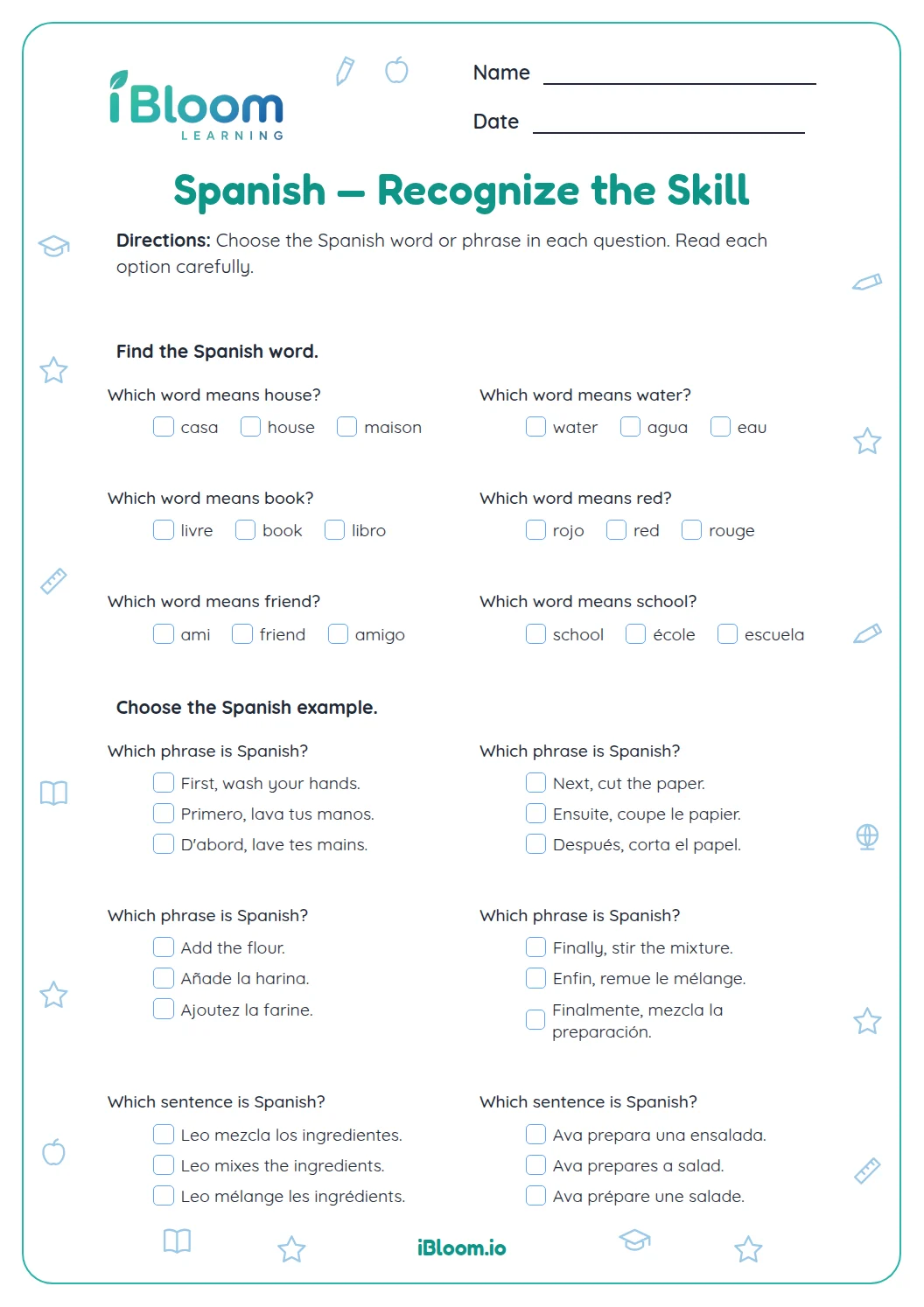
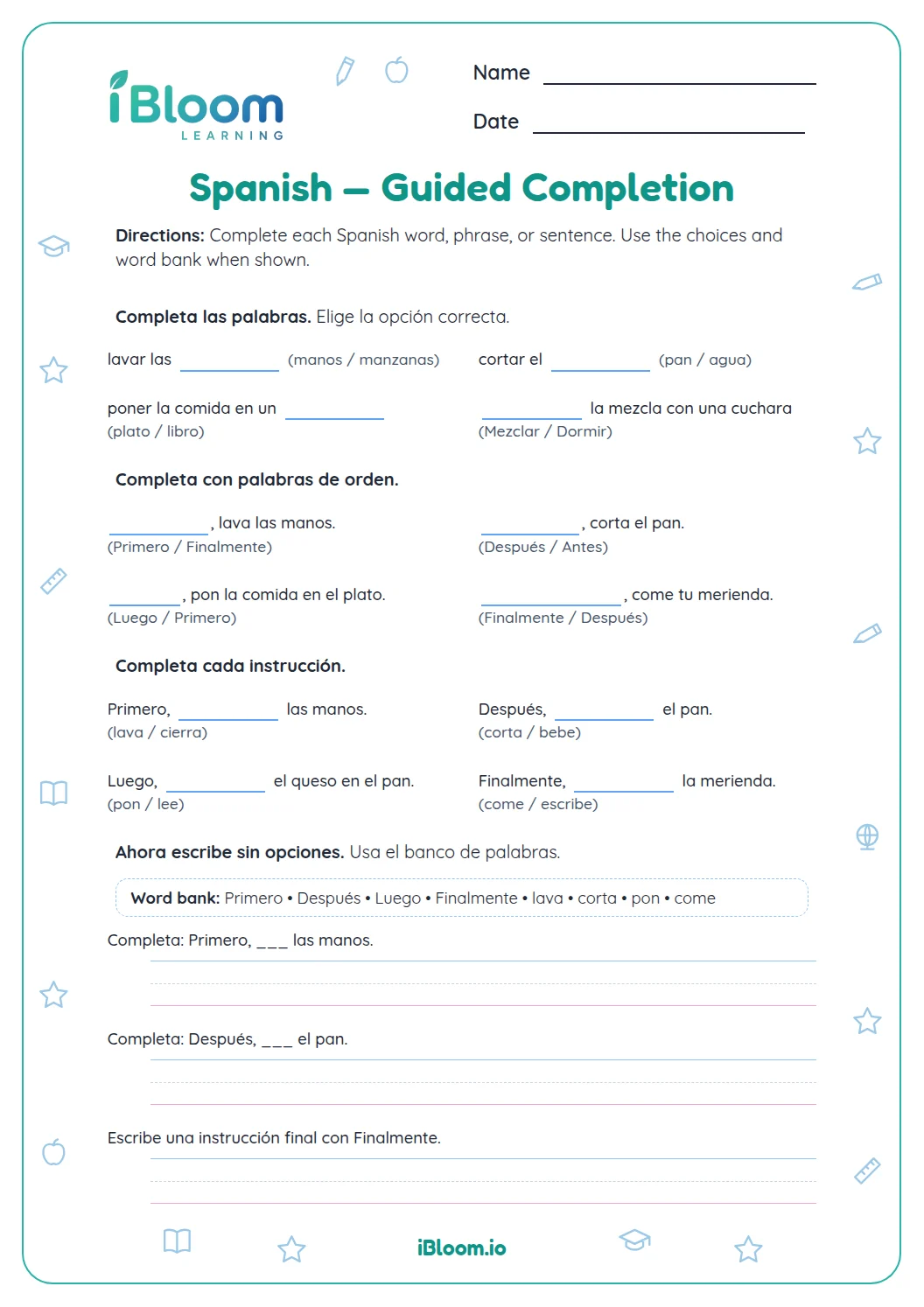
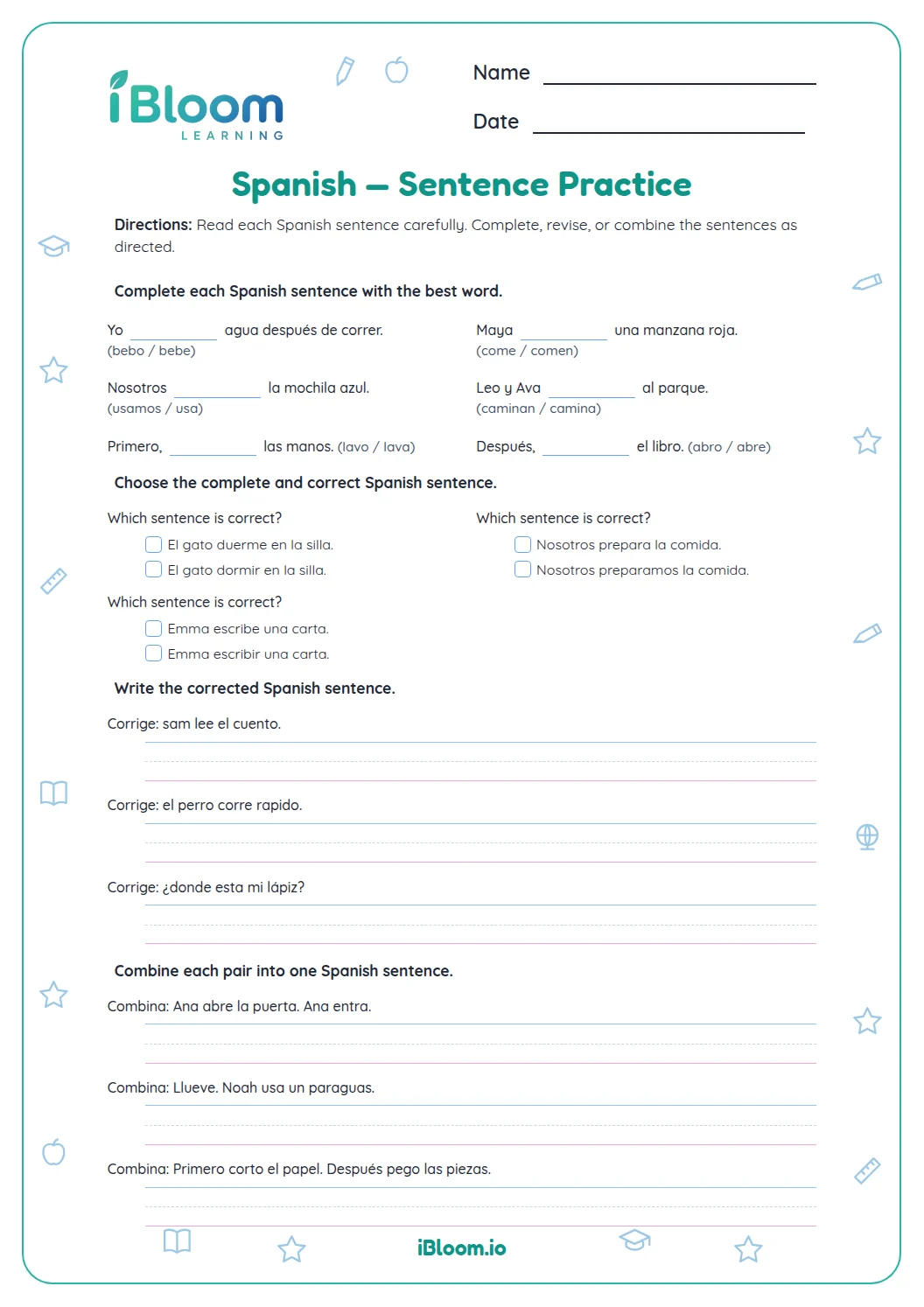
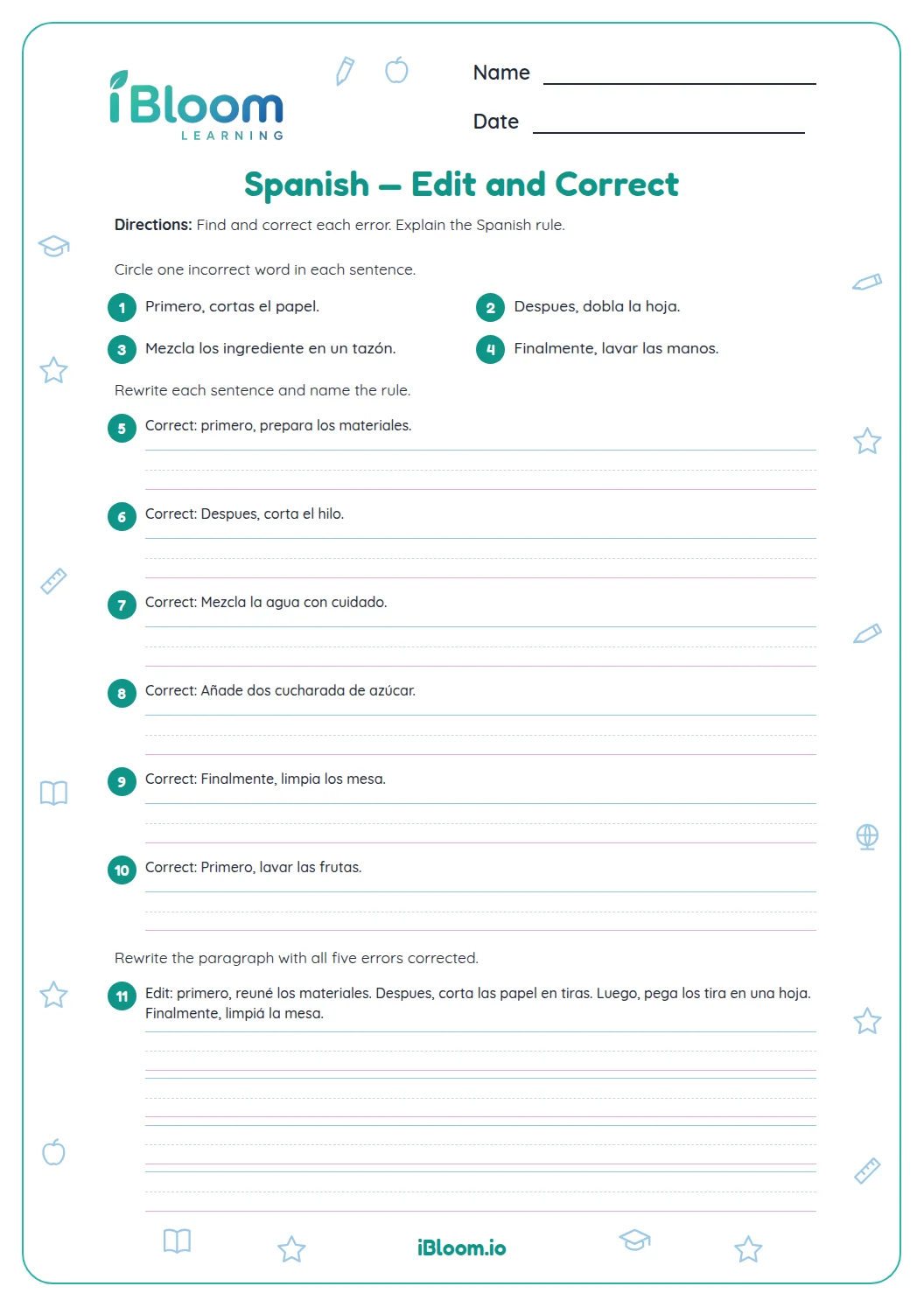
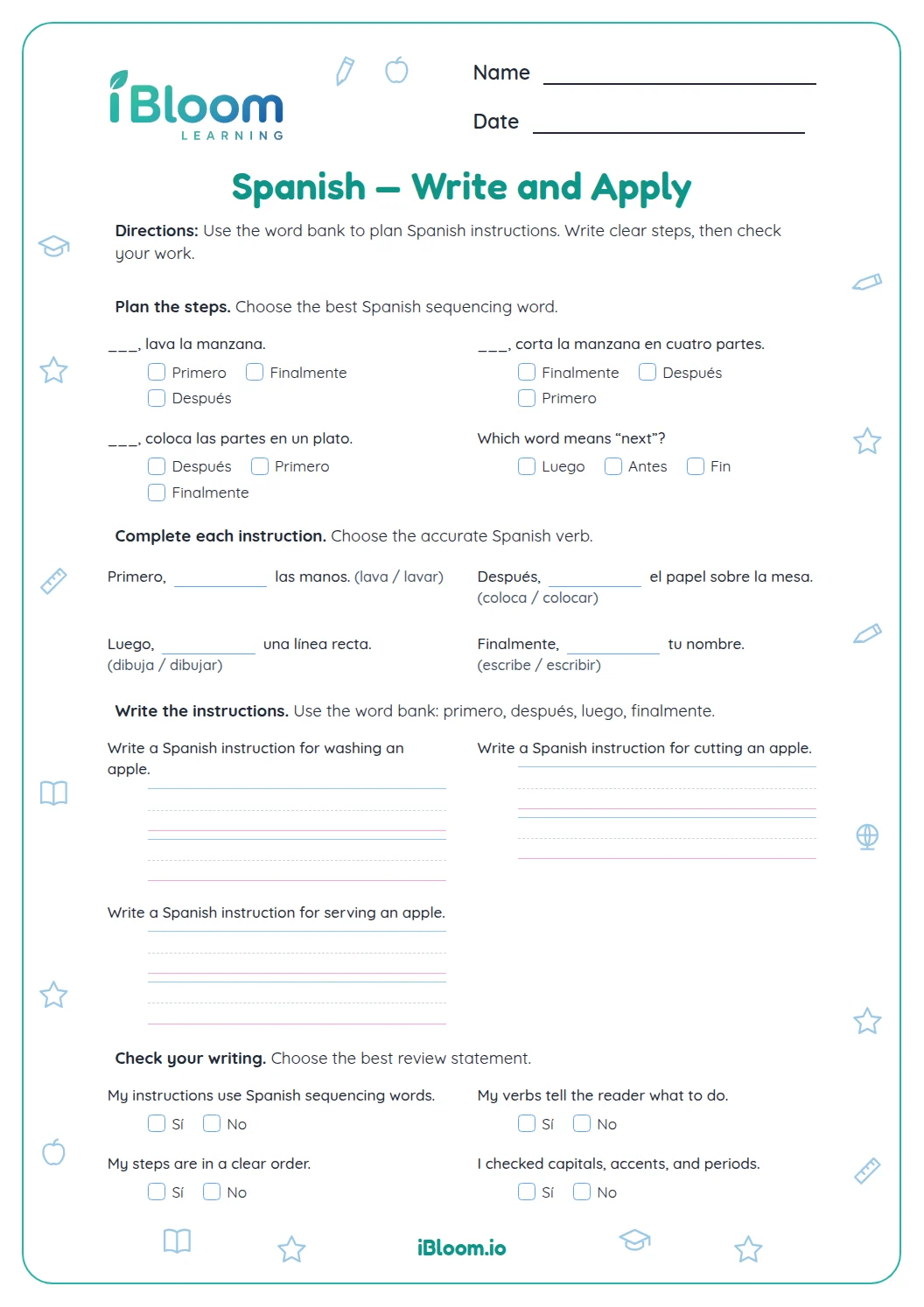
This Grade 4 worksheet practices Spanish words and action verbs used to give clear instructions. Children choose sequence words such as primero and finalmente, select command forms, and write a brief explanation and a short set of ordered directions. The answer key gives correct choices and sample responses for the open writing prompts.
How do Spanish sequence words guide a reader?
Primero signals the first step. Después or luego tells the reader what comes next, and finalmente signals the last step. These words help a reader understand when to do each action.
- 1Primero, lava tus manos. Después, mezcla los ingredientes. Finalmente, sirve la limonada.
Which verbs make an instruction clear?
A direction begins with an action verb such as abre, añade, vierte, coloca, dobla or corta. The verb tells the reader what to do. A short detail can tell how or where to do it.
- 1“Corta tres formas” names an action and gives a useful detail.
How can you check the order of directions?
Imagine following each action in turn. A clear set of directions starts with a useful first step, moves through actions in a sensible order, and ends when the task is complete. The final questions ask learners to explain and write directions in Spanish.
How to use this worksheet
- 1Read each Spanish sentence aloud before choosing.
- 2Look for the action verb or sequence word named in the prompt.
- 3For order questions, say the steps aloud with primero, luego and finalmente.
- 4For the last two prompts, write a reason and a short set of ordered steps in Spanish.
- 5Use the answer key’s sample responses to check the main idea.
Mistakes to watch for
The mistake
Choosing a verb form that does not fit a command.
The fix
Read the sentence as a direction to one reader, then choose the command form such as abre.
The mistake
Using finalmente for the first step.
The fix
Use primero to start and finalmente to signal the last action.
The mistake
Picking a vague direction such as “Haz algo.”
The fix
Choose a specific action that tells the reader exactly what to do.
What to practice next
Make more practice
Questions parents and teachers ask
What does primero mean?
Primero means “first.” It signals the opening action in a set of directions. On this worksheet, children choose primero for “___, lava tus manos” and compare it with finally, which belongs near the end of a process. Students can practice these words aloud together.
What is the difference between después and finalmente?
Después means “after” or “next,” while finalmente means “finally” or “at last.” Después links a step to what follows; finalmente signals that the process is reaching its end. The worksheet asks learners to notice those sequence roles. Students can practice these words aloud together.
What is an action verb in an instruction?
An action verb tells a reader what to do. Spanish examples on this page include abre (open), añade (add), vierte (pour), coloca (place), dobla (fold) and corta (cut). Choosing a clear verb makes a direction easier to follow.
Why should instructions be in a clear order?
A reader needs to know what to do first, what happens next and when the task is finished. Sequence words such as primero, después and finalmente make that order visible. The questions use familiar actions to practice choosing an order that makes sense.
Can a learner answer aloud instead of writing?
Yes. A learner can say the selected word or direction aloud and explain why it fits. Reading the Spanish sentence aloud also gives practice hearing how a command or sequence word works in context. The printed answer key makes it easy to check the choice.
What can my child practice next?
Ask your child to explain a familiar routine in Spanish using primero, después and finalmente. They can choose action verbs for each step, then read the directions aloud to see whether the order is clear. The sibling topics offer other situations for instructional writing.