


About this worksheet
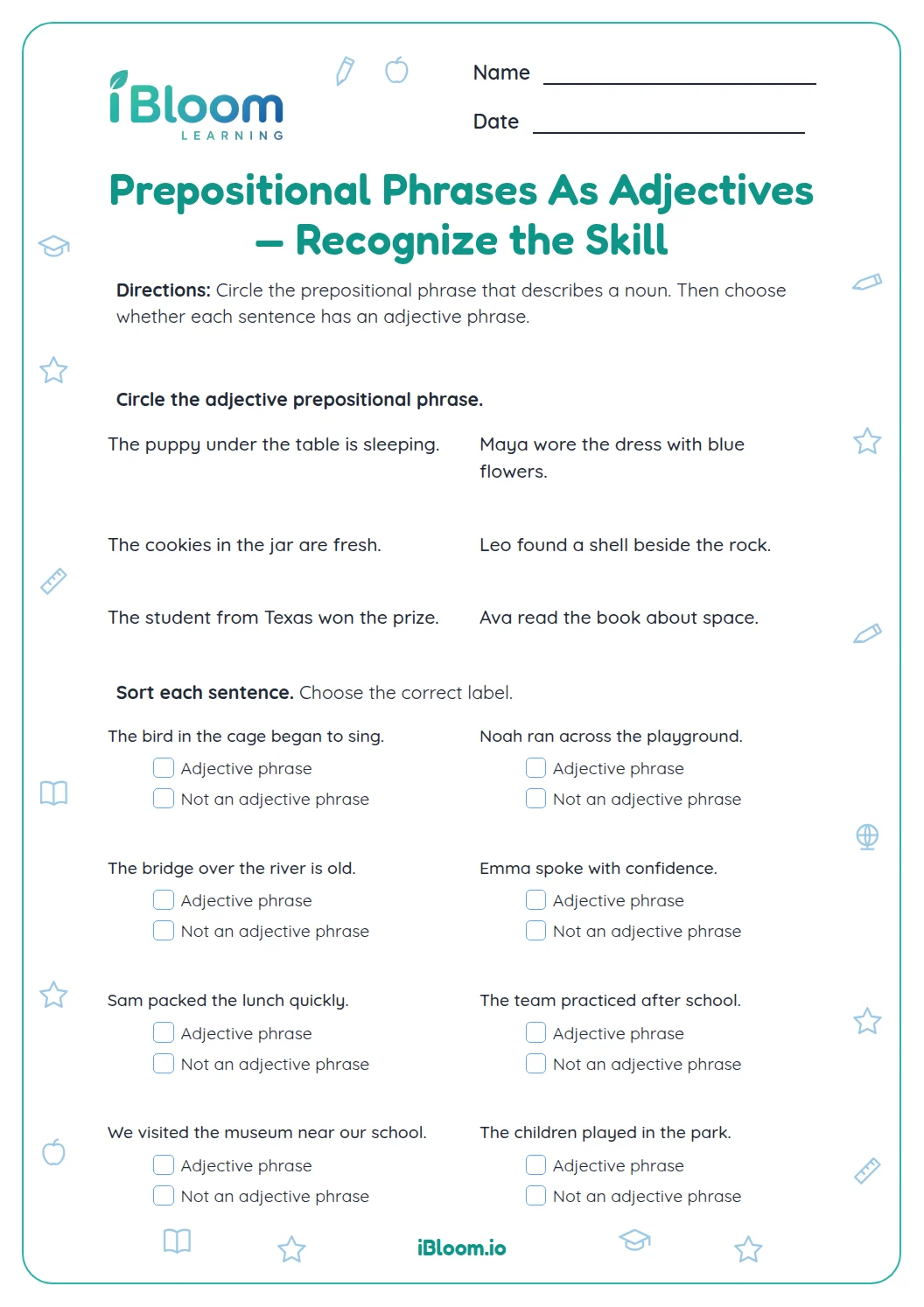
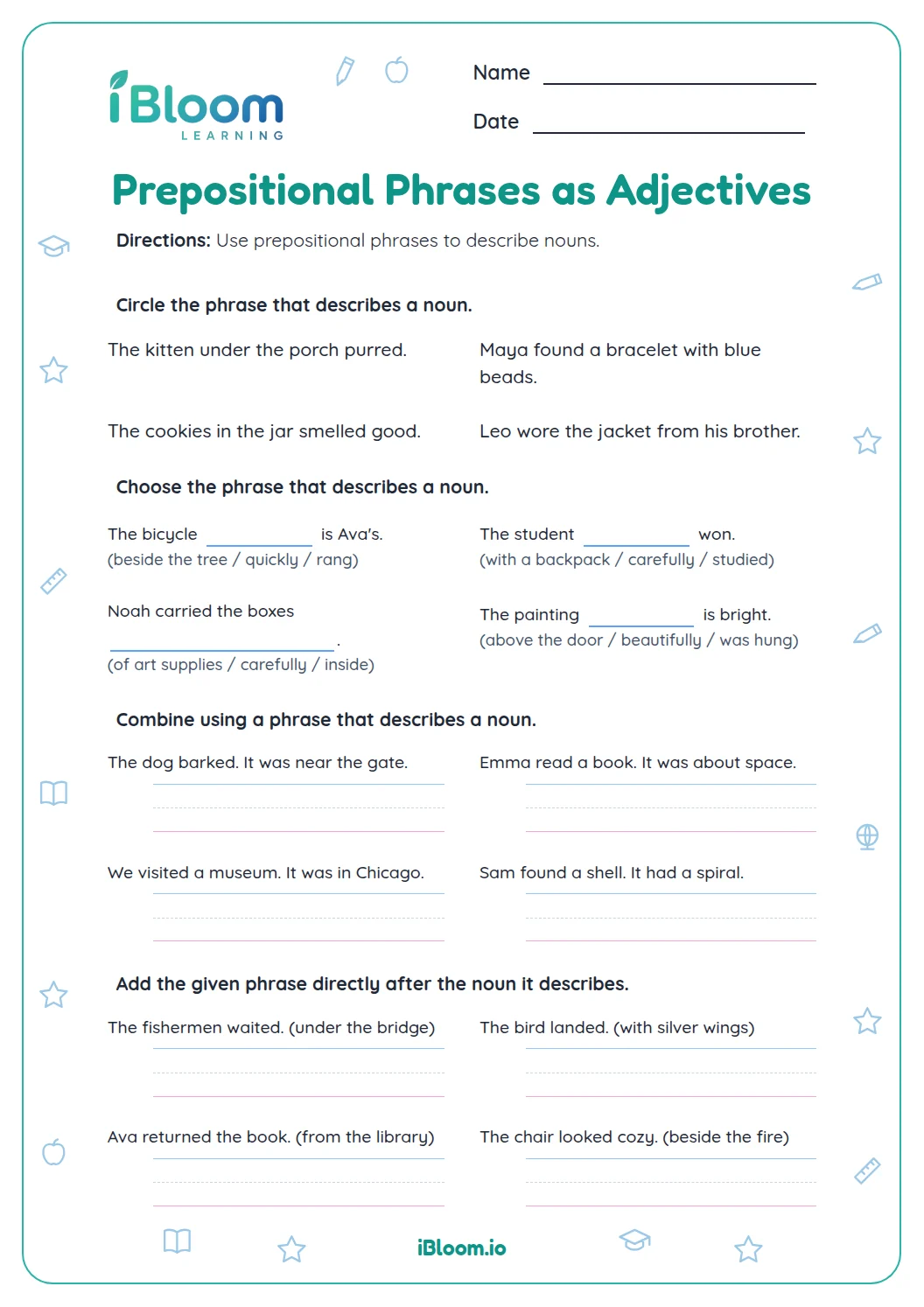
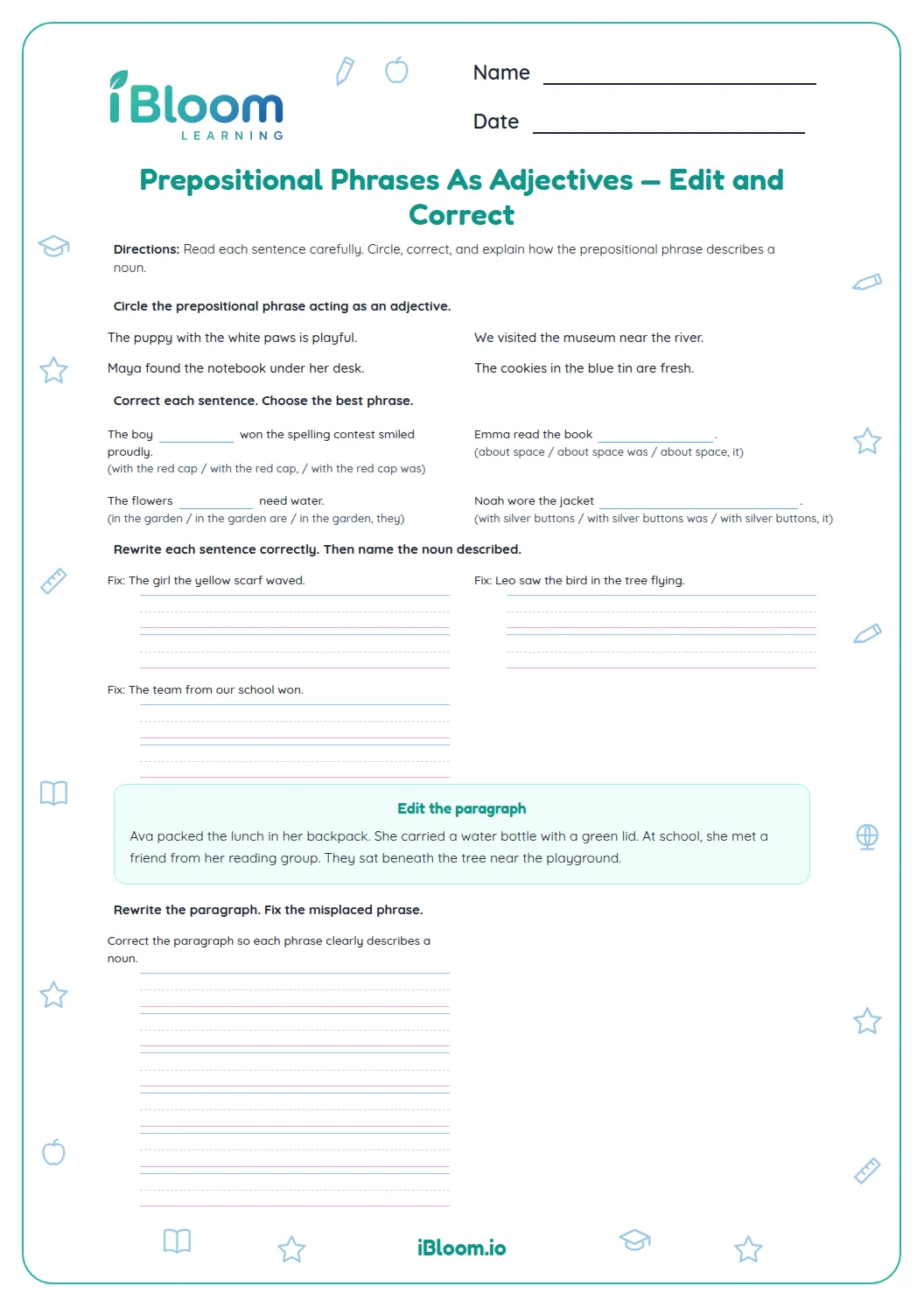
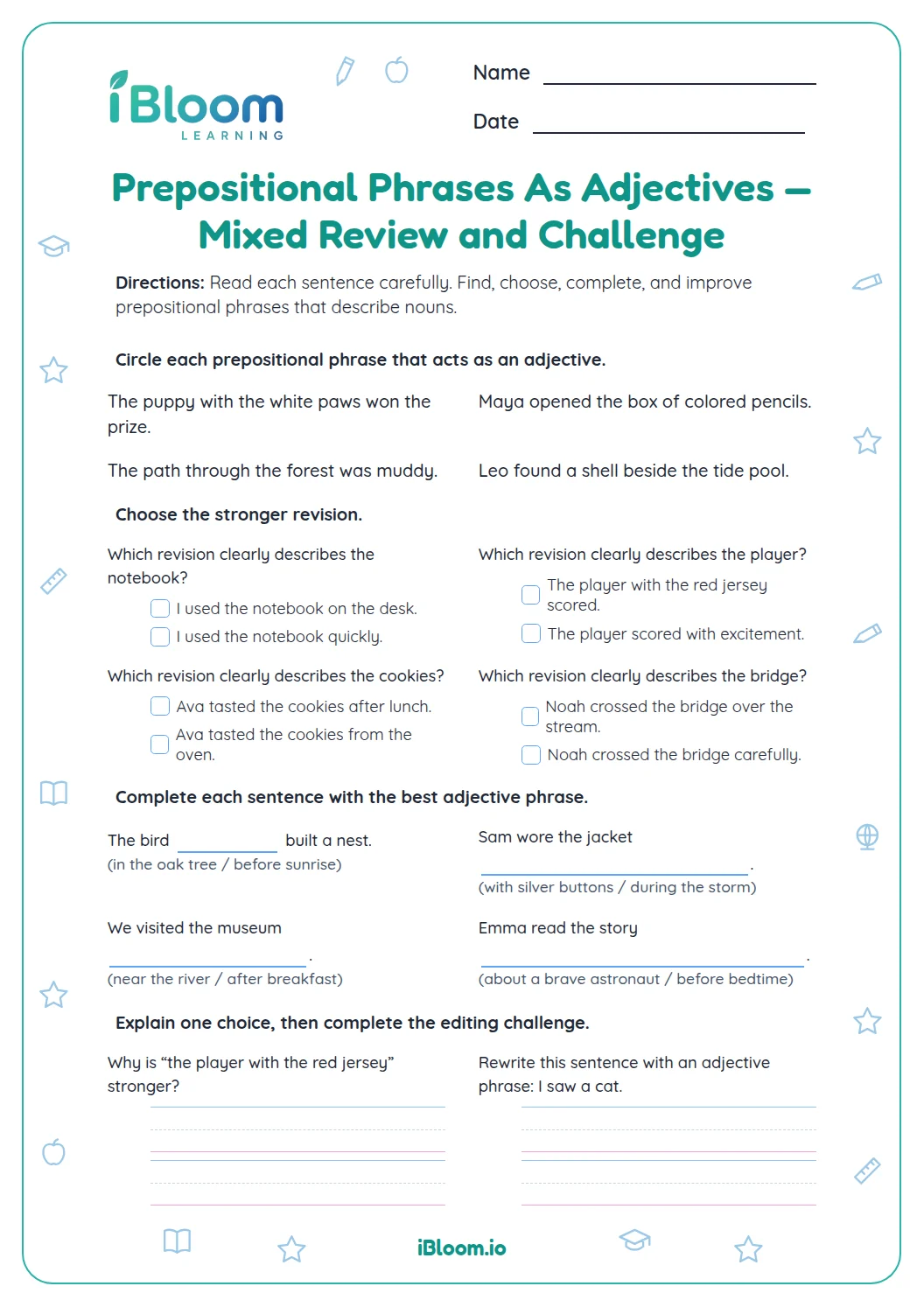
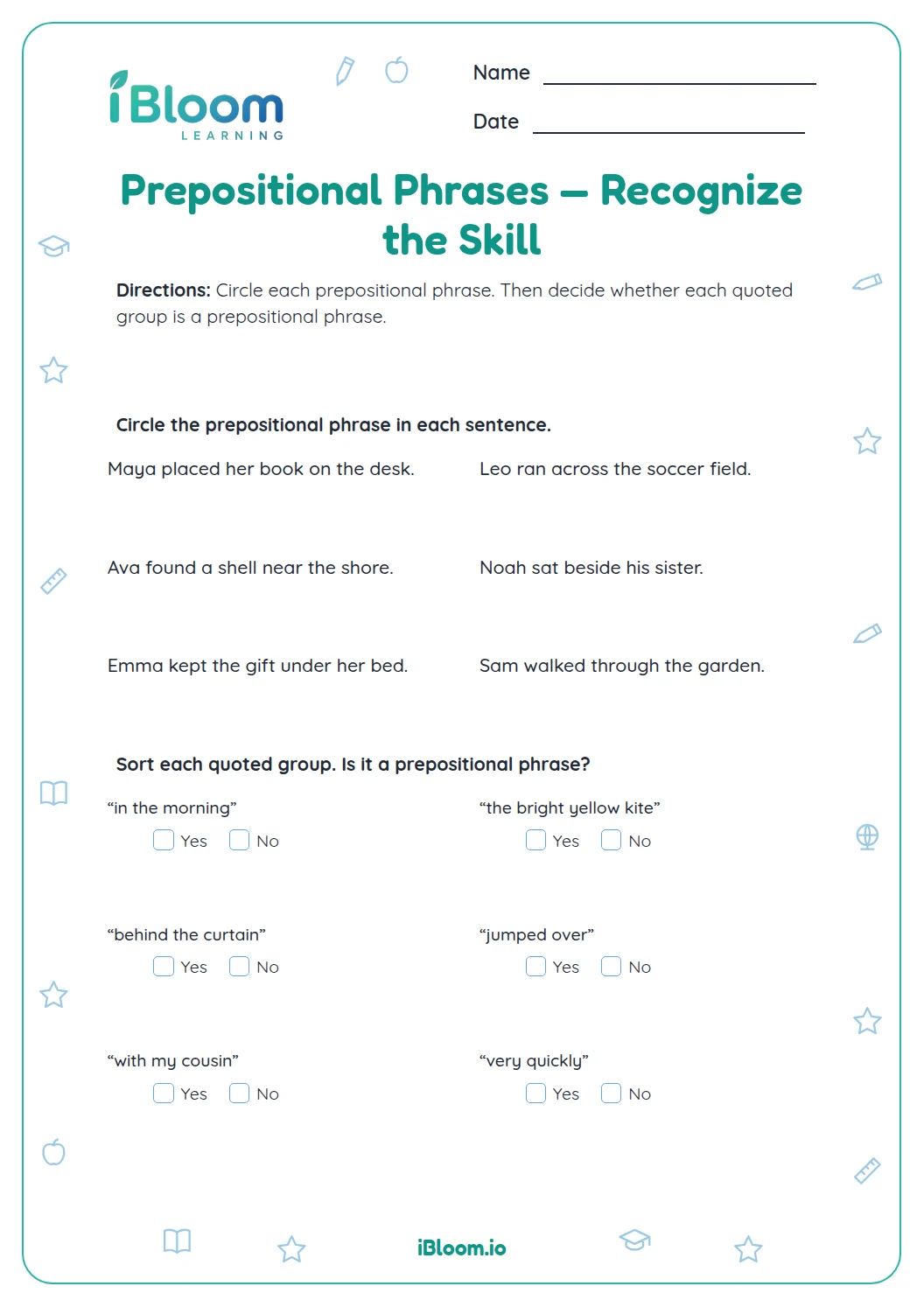
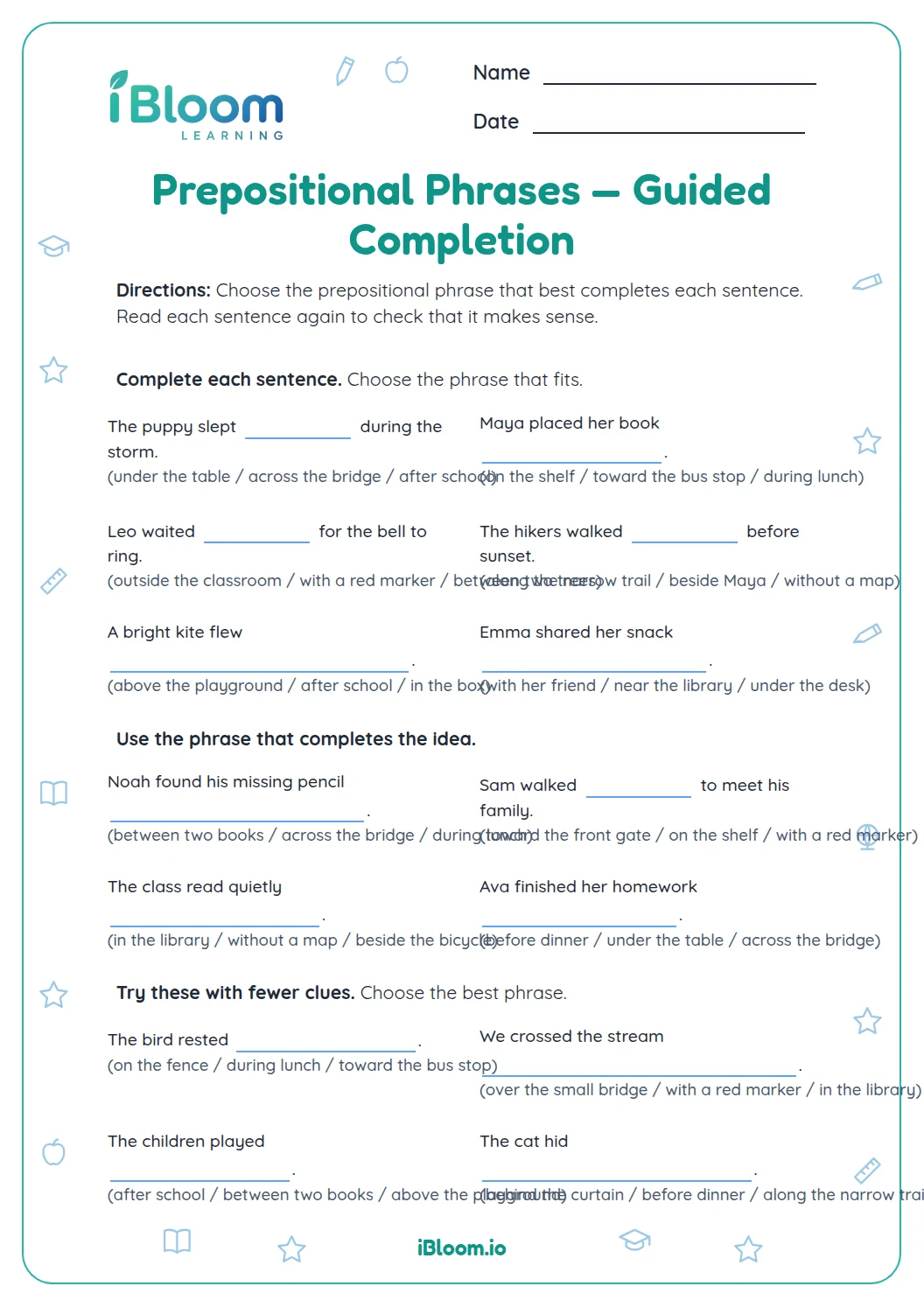
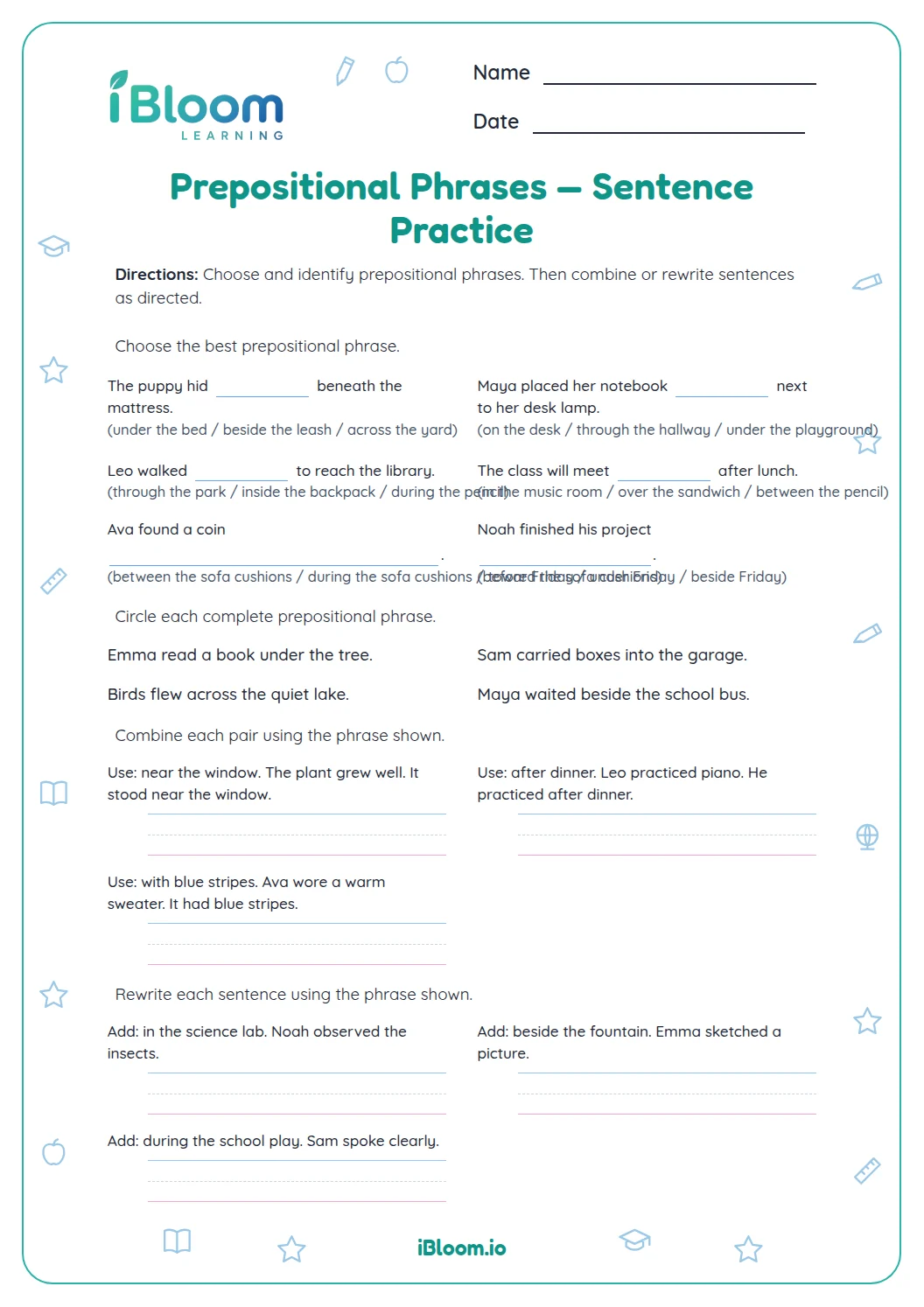
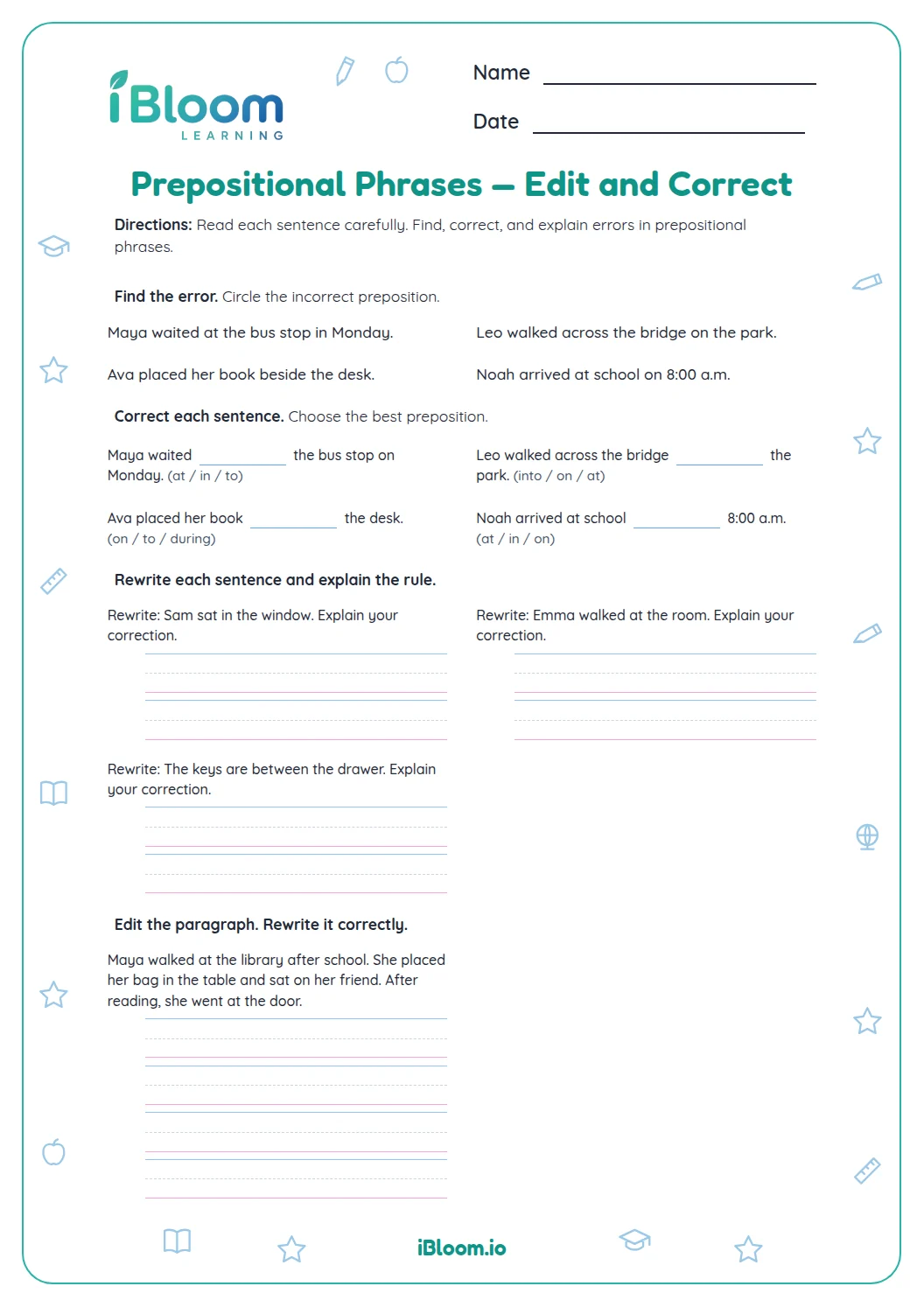
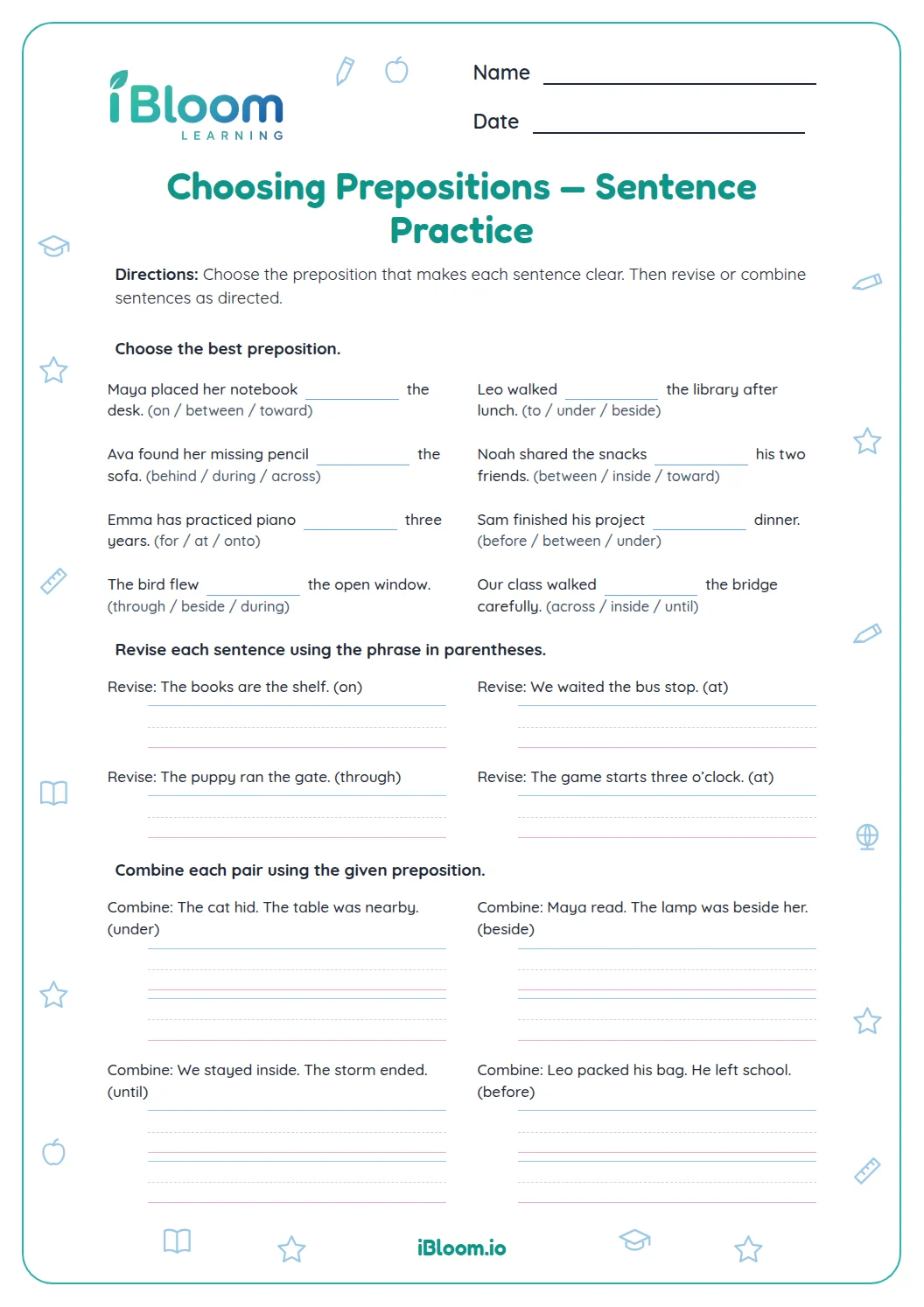
This Grade 5 grammar worksheet helps students recognize how a prepositional phrase can describe a noun. Students first find the phrase in a sentence, then choose a phrase to complete a sentence, and finally write their own examples. Across 15 prompts, phrases such as “by the lake” and “with the red scarf” add clear details about the nouns they follow. The answer key includes sample responses for the open writing prompts.
Aligned to L.5.1.a
Which phrase describes a noun?
Part A asks students to locate a prepositional phrase and connect it to the noun it describes. In question 1, “by the lake” tells which cabin, so it describes “cabin.”
How can a phrase add detail?
Part B offers phrases that can complete a sentence with a noun detail. “The book on the shelf belongs to Jo” uses “on the shelf” to identify the book.
How do students apply the skill?
Part C asks for original sentences. A response to question 11 might be “The bird in the oak tree sang.” The phrase “in the oak tree” adds information about the bird.
How to use this worksheet
- 1Find the preposition, such as by, of, through, or with.
- 2Read the words after it as one phrase.
- 3Ask which noun the phrase gives more information about.
- 4For a writing prompt, name the noun and add a phrase that describes it.
- 5Reread the sentence to check that the phrase sits beside the noun it describes.
Common mistakes and quick fixes
The mistake
Choosing a phrase that tells how an action happened.
The fix
Check whether the phrase describes a noun; “ran quickly” describes an action, not a noun.
The mistake
Calling every prepositional phrase an adjective phrase.
The fix
Ask what the phrase modifies. On this sheet, the target phrase gives details about a noun.
The mistake
Separating the preposition from its object.
The fix
Keep the preposition and its object together, as in “through the woods.”
Students explain and apply the function of prepositions by using prepositional phrases to describe nouns.
Students identify prepositional phrases and apply them to describe nouns in sentences.
On this sheet:
Show the official wordingHide the official wording
Explain the function of conjunctions, prepositions, and interjections in general and their function in particular sentences.
What to practice next
Further reading
Questions parents and teachers ask
What is a prepositional phrase?
A prepositional phrase begins with a preposition and includes its object, such as “by the lake” or “with the red scarf.” Together, those words can add information about a noun in a sentence. The worksheet asks students to find and write such phrases.
How can a prepositional phrase act like an adjective?
A phrase acts like an adjective when it describes a noun by answering which one or what kind. In “the cabin by the lake,” the phrase “by the lake” helps identify which cabin. Students practice this relationship in sentences. The noun is stated in the example.
How many questions are included?
There are 15 prompts in three parts. Students identify phrases, choose phrases that complete noun descriptions, and write original sentences using a phrase to describe a noun. The answer key provides sample responses for the open-ended items. Sample responses appear in the key.
Do the writing questions have only one correct answer?
No. Several phrases can describe a noun correctly, so the key gives sample sentences. Check that the response includes a prepositional phrase and that the phrase gives information about the noun named in the prompt. Check both the noun and phrase.
How can I distinguish an adjective phrase from an adverb phrase?
Look at the word the phrase describes. If it adds detail about a noun, as “with floppy ears” describes a puppy, it has an adjective function. A phrase that tells how an action happened describes the action instead. The target is the described noun.
What is a useful way to check a phrase?
Read the sentence and ask “Which one?” or “What kind?” about the noun. If the phrase answers that question, it provides a description of the noun. Then reread the sentence to make sure the phrase fits. Reread the finished sentence aloud.