

About this worksheet
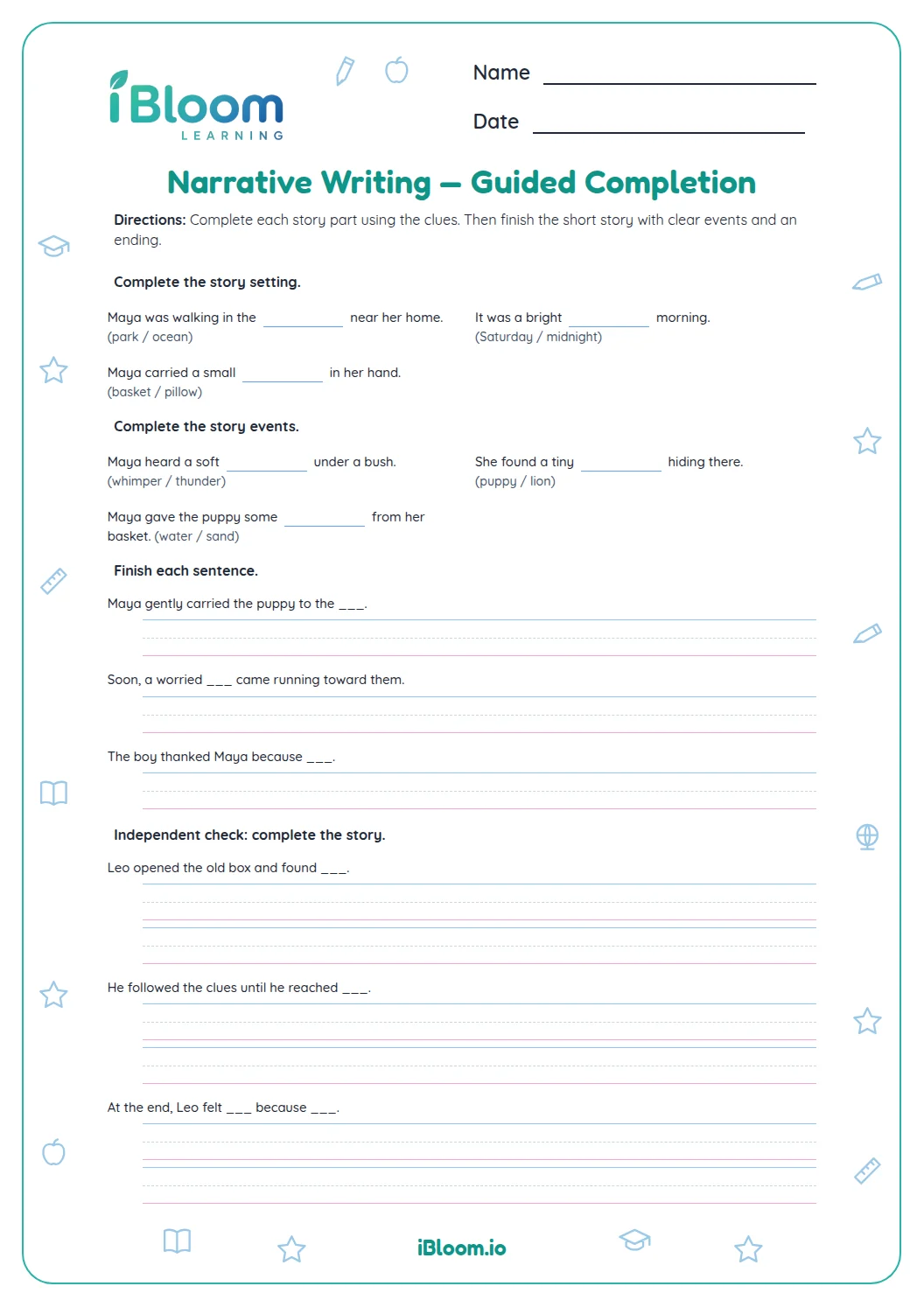
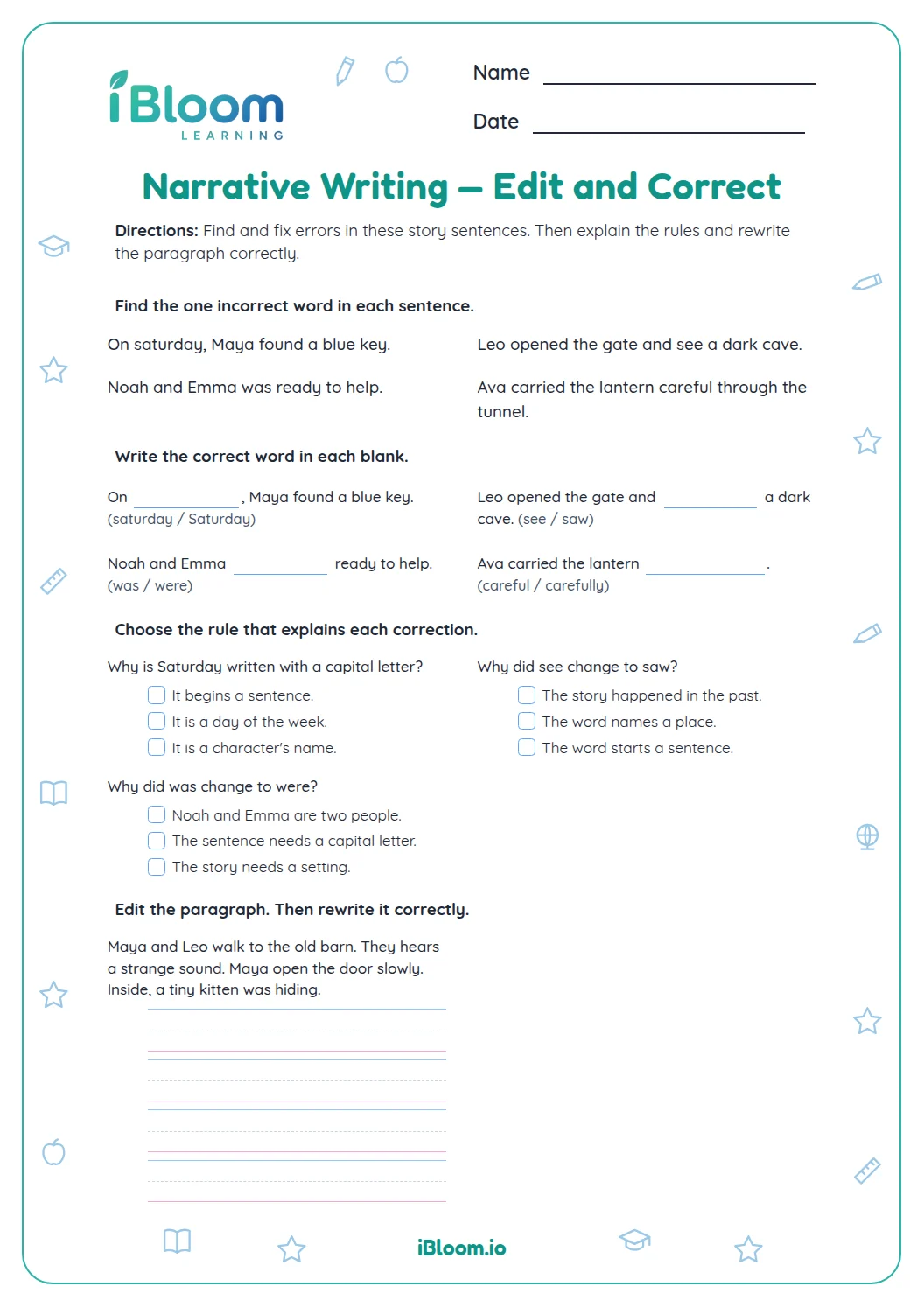
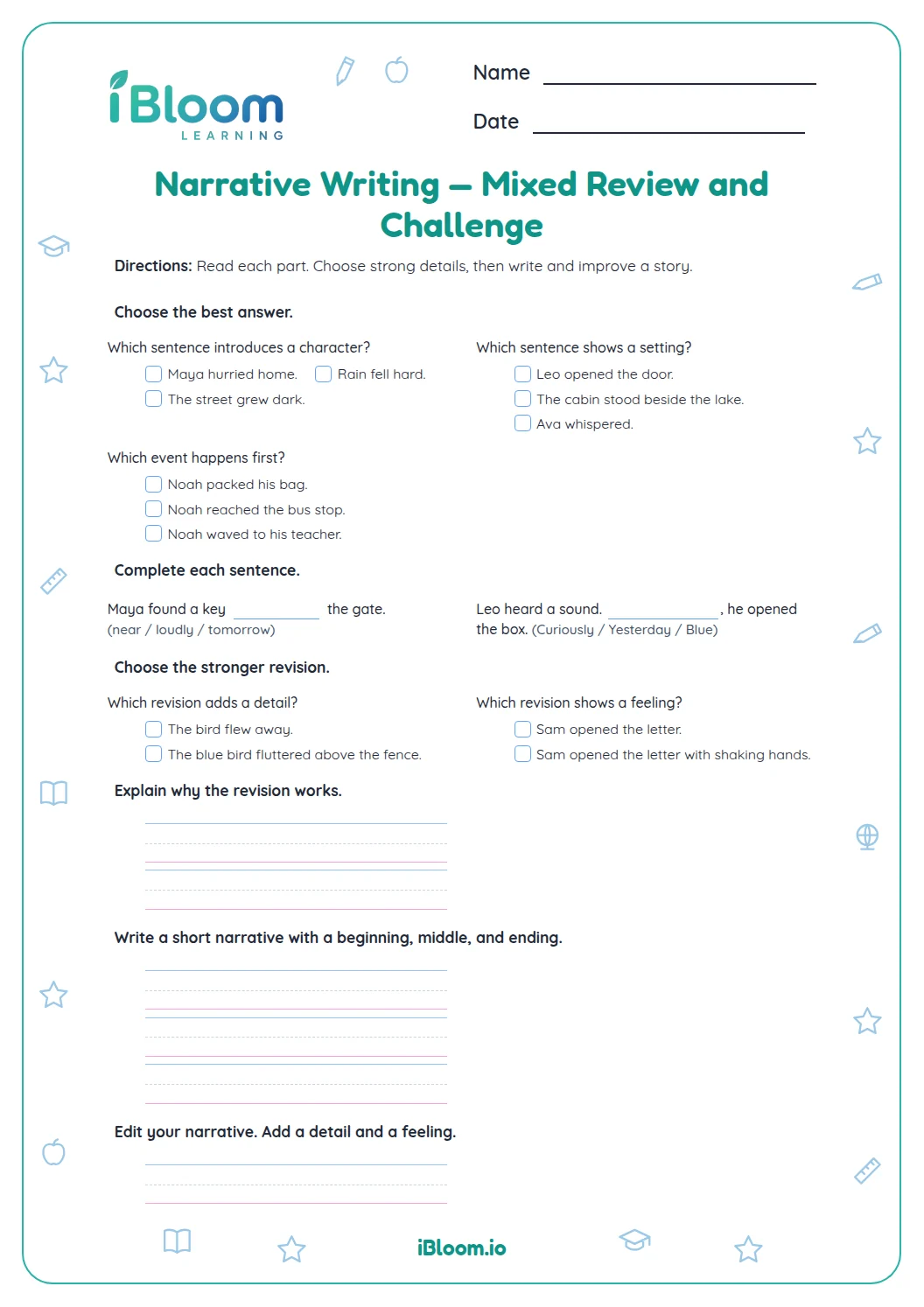
This narrative-writing worksheet is aimed at Grade 3 students and offers 14 prompts about story details, event order, transitions, problems, solutions, and endings. Students first choose effective examples, then connect events and write their own story details and a short narrative. The key includes sample responses for open writing. The work supports CCSS W.3.3 by practicing sequenced events, details, and a clear ending.
Aligned to W.3.3
What details help a reader picture a story?
A clear setting or action gives the reader something specific to imagine. Part A asks students to choose details such as “The wind rattled the cabin window” and “At dawn, silver waves rolled onto the quiet beach.”
How do transitions make event order clear?
Part B asks students to order a short seed story and add transitions between events. Words such as “then” and “afterward” help signal what happens next.
What makes a short narrative feel complete?
Parts C and D ask students to invent a problem and a solution, then write a short story with a setting, an event, and an ending. The key provides sample answers; a different response can work if it includes the requested story elements.
How to use this worksheet
- 1Choose specific details that help readers picture the setting or character.
- 2Put events in the order that makes sense for the story.
- 3Use a transition to show when the next event happens.
- 4Make the solution respond to the problem already introduced.
- 5Reread the story to check that it has a setting, event, and ending.
Common mistakes and quick fixes
The mistake
Listing events without showing their order.
The fix
Use time words such as “then” or “afterward” to connect them.
The mistake
Adding a solution unrelated to the problem.
The fix
Check that the character’s action directly addresses the difficulty.
The mistake
Ending before showing what changed.
The fix
Add a final event or reaction that lets the reader know how the story turns out.
Curriculum alignment
This worksheet practices the skills named in the standard below.
Write narratives with sequenced events and descriptive details.
On this sheet: Students plan and write connected narrative elements with transitions and an ending.
Show the official wordingHide the official wording
Write narratives to develop real or imagined experiences or events using effective technique, descriptive details, and clear event sequences.
What to practice next
Questions parents and teachers ask
What story elements does the worksheet practice?
The prompts cover setting, characters, ordered events, transitions, a problem, a solution, and an ending. The short-story item asks students to include a setting, an event, and an ending. Those elements help a reader understand where events happen and how the story concludes.
Are there right answers to the writing questions?
The answer key provides sample responses for open-ended writing. Other ideas can be correct when they answer the prompt and make sense with the story details a student has chosen. A response should still include the detail or story element named in the question.
How does the worksheet practice event order?
Students put events from a seed story in a sensible sequence and add transitions to connect events. They also select sentences that show an event happening at a particular point in a story. The transition prompts ask students to make the relationship between consecutive events clear.
How many questions are on the page?
There are 14 questions: seven multiple-choice items, five fill-ins for event order or transitions, and two written responses. The final written response asks for a short three-sentence story. The key offers sample answers for both open writing prompts. Students can use the answer key to check that both responses include the requested parts.
What makes a narrative ending clear?
A clear ending shows what happens after the main event or how the character responds. The worksheet asks students to choose an ending that reveals a change and to finish an original short story. Students can compare the final event with the story’s problem to check that the ending fits.