Free printable practice
Decomposing Practice Activities
Printable Grade 1 base ten block worksheets that help children break two-digit numbers into tens and ones with clear visual models.
Free printable worksheet PDFs
Preview every available page, then download the free worksheet PDF for home, homeschool, tutoring, or classroom practice.
Preview the exact activity before downloading it.
Practice that builds confidence
What decomposing means in Grade 1
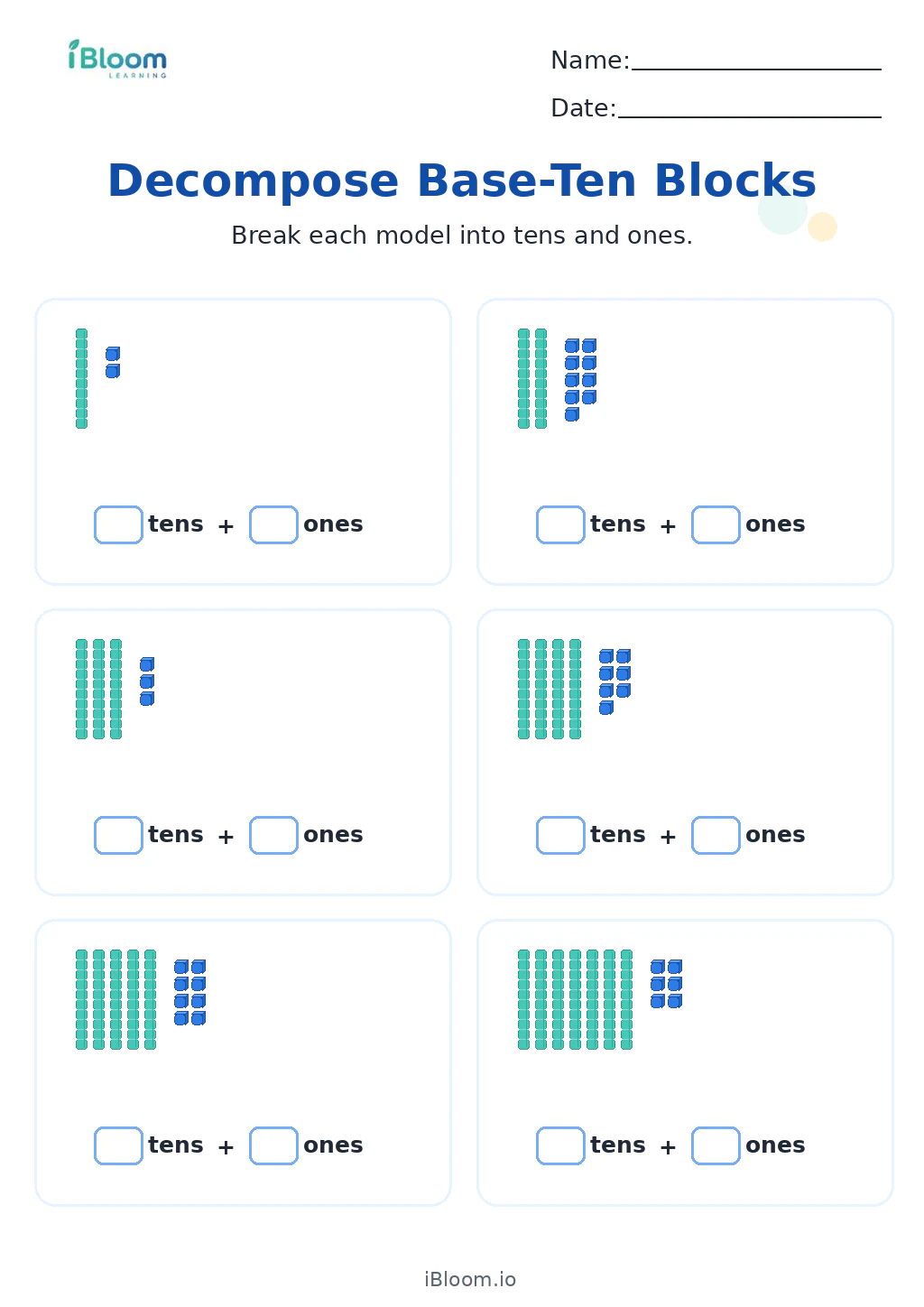
These Grade 1 decomposing worksheets help children see two-digit numbers as groups of tens and extra ones. Using base ten blocks, children practise connecting a number such as 47 with 4 tens and 7 ones.
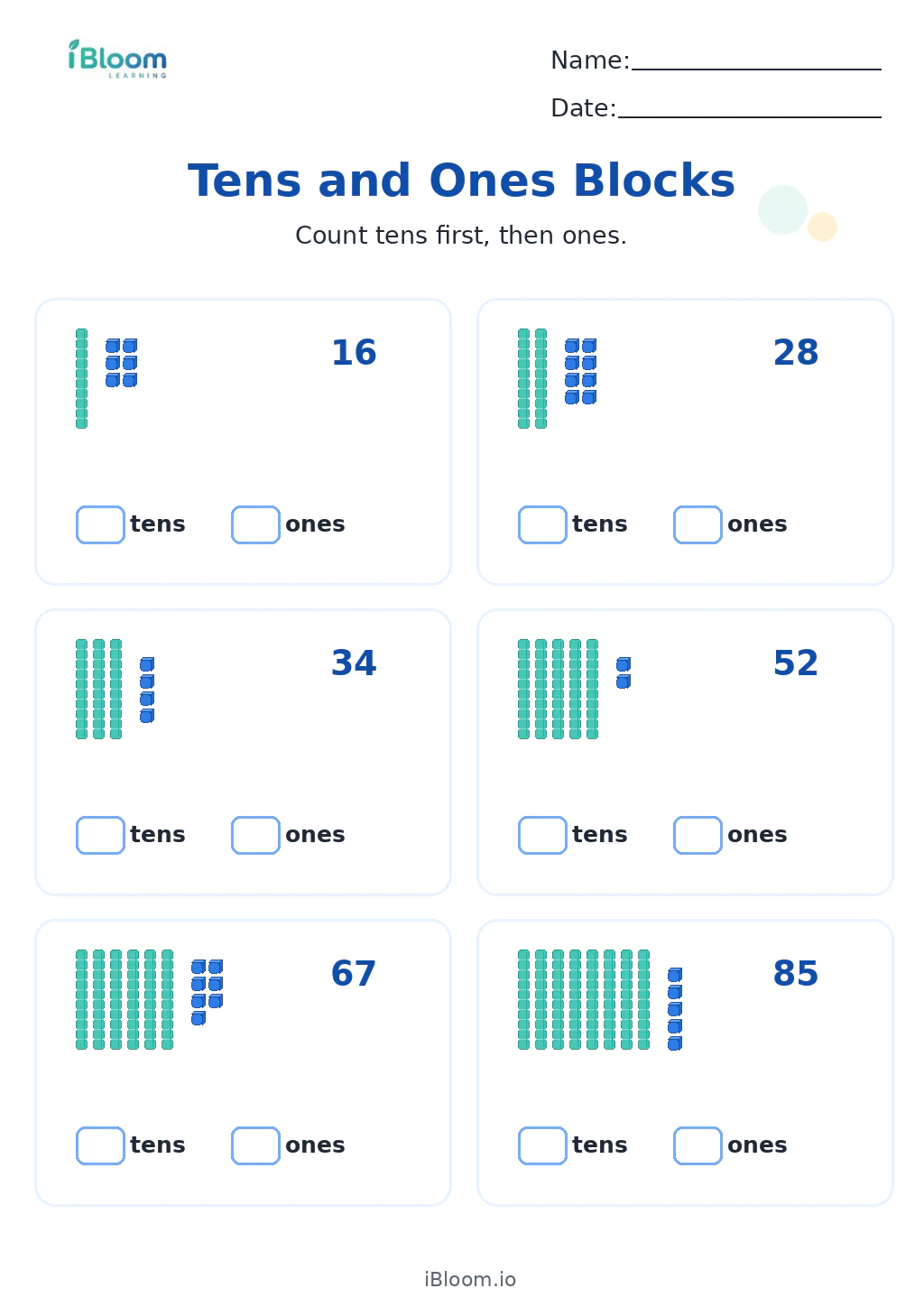
The printable activities include visual models, counting tasks, matching, and number-writing practice. Children build place value understanding by moving between blocks, words, and numerals.
Decomposing is the skill of breaking a number into useful parts. In this collection, the focus is on base ten understanding: a two-digit number is made of tens and ones. Children learn that 30 and 5 make 35, and that 35 can be shown as 3 ten-rods and 5 one-cubes.

How the practice progresses
The worksheets begin with clear base ten block pictures so children can count rods and cubes directly. Then they move toward writing the number, filling in tens and ones, and matching models to numerals. This progression helps children stop counting every cube one by one and start recognizing a ten-rod as one group of ten.
A simple parent routine
At home, choose one worksheet problem and ask, “How many tens? How many ones? What number does that make?” Have your child point to each ten-rod first, then the ones. For extra practice, use small objects grouped into bundles of ten and leftovers, then write the matching number sentence, such as 20 + 6 = 26.

Classroom uses for teachers
Teachers can use these pages for place value centers, morning review, small-group reteaching, or independent practice after a base ten blocks lesson. They also work well for quick checks: if a child writes 52 for 2 tens and 5 ones, the teacher can immediately see that the tens and ones positions need more work.

Common errors to watch for
Some children count each cube in a ten-rod instead of treating it as a group of ten. Others reverse the digits, confuse “tens” with “ones,” or write only the total number without explaining the parts. Encourage them to label both parts: tens first, ones second.
Free printable PDF download
Use this grade 1 decomposing base ten worksheet page to preview the activity, print it, or download it as a PDF for quick practice. It works well for homework, homeschool lessons, tutoring, morning work, revision, and classroom centers.
Answers and answer key support
After the child completes the worksheet independently, parents and teachers can use the answer support or answer key information to check the work, review mistakes, and choose the next practice step.
Why iBloom worksheets help
The pages keep the visual model at the center of the task, so children are not memorizing place value language without meaning. A helpful child-friendly strategy is: “Count the long tens, count the little ones, then put the digits in order.” This gives Grade 1 learners a repeatable way to decompose and read two-digit numbers confidently.
Helpful answers
Frequently asked questions
What does decomposing mean with base ten blocks?
It means breaking a number into tens and ones. For example, 46 is decomposed as 4 tens and 6 ones, often shown with 4 ten-rods and 6 one-cubes.
Are these worksheets suitable for Grade 1 beginners?
Yes. The activities use pictures of base ten blocks so children can count and see the parts before writing the matching two-digit number.
How can I help my child if they reverse the digits?
Ask them to say the parts in order: tens first, ones second. Then have them point to the ten-rods and one-cubes before writing the numeral.
Do children need physical base ten blocks to use these pages?
Physical blocks are helpful but not required. The worksheets include visual block models, and you can also use bundled straws, sticks, or small objects grouped in tens.
How do these worksheets support later addition and subtraction?
When children understand that two-digit numbers are made from tens and ones, they are better prepared to add, subtract, regroup, and compare numbers.
Is this grade 1 decomposing base ten worksheet free?
Yes. You can preview it for free and use the printable worksheet for home or classroom practice.
Can I download this grade 1 decomposing base ten worksheet as a PDF?
Yes. Use the worksheet download option to save a printable PDF, or print the worksheet directly from the page.
Does this grade 1 decomposing base ten worksheet include answers or an answer key?
When the activity has fixed answers, iBloom includes answer support so parents and teachers can check the completed worksheet.